Ettore Sottsass was one of the most influential designers and architects of the twentieth century. His ability to break the traditional mold of design, his innovative use of color and his ironic and provocative approach have made him a key figure on the international scene.
Founder of the Memphis Group and historical collaborator of Olivetti , Sottsass has redefined the way in which we see and experience design, transforming it into an emotional and cultural experience. His works range from the design of furniture and furnishing objects to the creation of iconic buildings, always characterized by a profound reflection on society and the relationship between man and object.

Biography of Ettore Sottsass: from Austria to Italy, a talent without borders
Ettore Sottsass was born on 14 September 1917 in Innsbruck, Austria , into a family from Trentino. His father, Ettore Sottsass Sr., was a rationalist architect who worked mainly in Trentino-Alto Adige and influenced his education.
After moving to Turin, Sottsass graduated in architecture at the Polytechnic of Turin in 1939 . During World War II , he was drafted and spent time in a prison camp in Montenegro, an experience that profoundly shaped his outlook on life and design.
In 1947 he moved to Milan , a city that would become the center of his creative activity. Here he opened his first design studio, dedicating himself to the design of furniture, ceramics and architecture.
Design as an expression of freedom: the style of Sottsass

Sottsass was not interested in creating objects only for their practical function. For him, design was an expressive act, a way to communicate emotions and challenge conventions.
1. The role of color
Contrary to the minimalist and monochromatic tendencies of modern design, Sottsass used bright and bold colours. His palette included strong colours, bright contrasts and unusual combinations, with the aim of creating environments and objects that stimulated the senses .
For him, color had a symbolic and emotional value:
- The red to evoke passion and energy.
- The yellow to communicate joy and creativity.
- The blue and green to convey tranquility and depth.
2. Irony in design
Many of his objects seemed like visual games: exaggerated shapes, out-of-scale proportions and unexpected materials were typical elements of his style. He didn’t want the design to be serious and boring, but to entertain and surprise .
3. The anti-functionalist philosophy
In the 1950s and 1960s, functionalism dominated design, with the motto form follows function. Sottsass rejected this vision and believed that design should follow emotions rather than mere practicality.
The collaboration with Olivetti: the man behind the iconic machines
One of the most important chapters of Sottsass’s career was his work with Olivetti , a cutting-edge Italian company in the IT and typewriter sector.
In 1958 , Sottsass became a design consultant for the company and began designing products that would change the face of industrial design.
1. Elea 9003 (1959) The first Italian computer

The Elea 9003 was the first mainframe computer produced in Italy. Sottsass designed it as an innovative object, with an elegant and intuitive design, overcoming the austerity of the computing machines of the time .
2. Valentine (1969) The pop typewriter

Perhaps his most famous design, the Valentine was a red, lightweight, portable typewriter, aimed at a young, creative audience. Unlike traditional typewriters, heavy and bulky, the Valentine had an attractive and unconventional design, turning it into a style icon.
The Memphis Group: the postmodern design revolution
In 1981 , Sottsass founded the Memphis Group , a collective of designers who revolutionized 1980s design with eccentric and unconventional creations.
Memphis broke with the rules of modernism, proposing furniture and objects with extravagant geometric shapes, bright colors and innovative materials .
Iconic Memphis Works
- Carlton Bookcase (1981) One of the most famous pieces of furniture of the Memphis movement, an asymmetrical and multicolored bookcase , which almost looks like a sculpture. More than just a bookcase, it is a sculptural composition , characterized by dynamic asymmetry , bright colors and a bold use of geometric shapes. The structure, made of plastic laminate , alternates inclined and perpendicular elements that challenge the traditional conception of furniture, transforming it into a functional work of art. With its iconic and provocative design , Carlton perfectly represents the spirit of the Memphis Group : a playful aesthetic, a rejection of the rules of modernism and a celebration of expressive freedom in design.

-
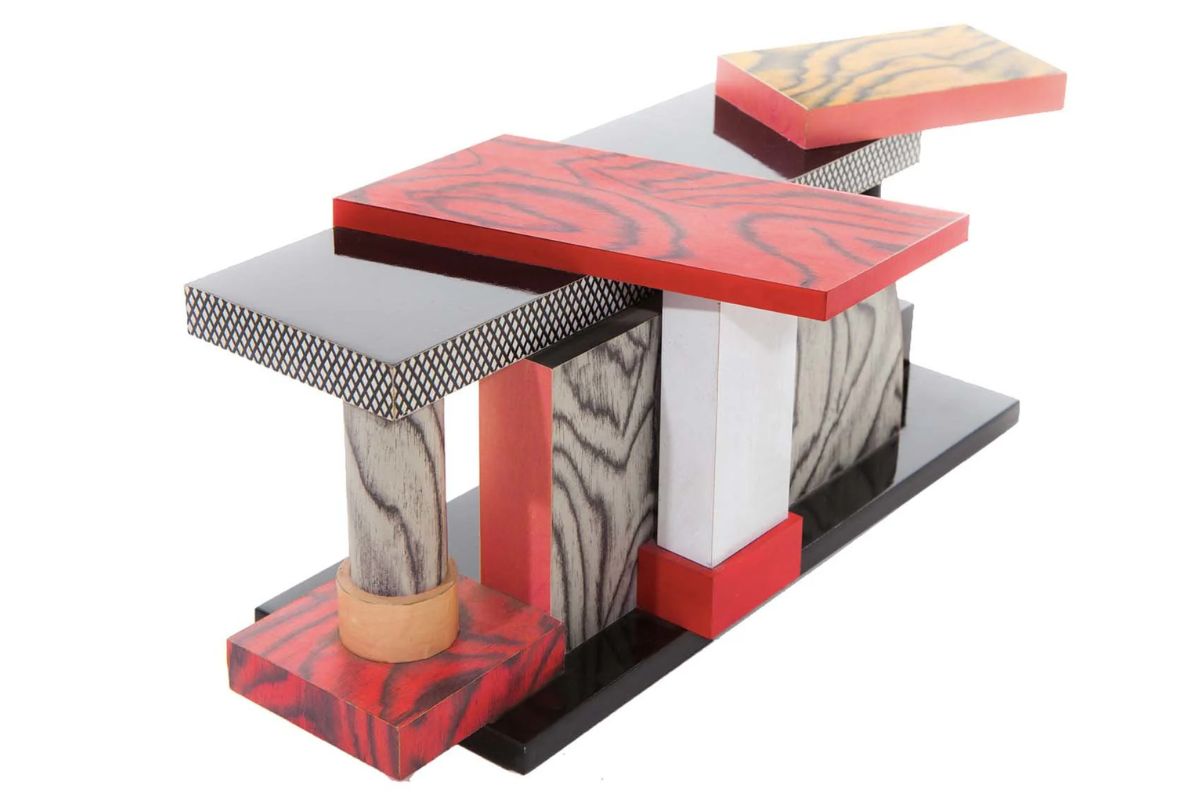
Tartar Table (1985) An icon of postmodern design, designed by Ettore Sottsass for the Memphis Group . The Tartar Table stands out for its bold geometric structure and the use of innovative materials and contrasting colors. Its massive cylindrical legs and surface decorated with abstract patterns evoke a playful and sculptural aesthetic, typical of the Memphis style.
This work perfectly embodies Sottsass’ philosophy: ua design that is not only functional, but which becomes a visual and emotional experience, challenging traditional furniture conventions.
-
Tahiti Lamp (1981) The to Tahiti Lamp is one of the most representative objects of the postmodern movement. It is a sculptural and playful table lamp , composed of geometric shapes assembled in an apparently random way, but with a precise chromatic logic. The structure resembles a stylized exotic bird , with a long inclined neck that supports the light source, while the bright colors and patterned decorations enhance its irreverent and experimental character. Made of lacquered sheet metal and laminated plastic , the Tahiti is not just a functional object, but a true manifesto of Sottsass’s radical design, which challenged aesthetic conventions and transformed every piece of furniture into a statement of style.

Memphis’ success was enormous, and the group collaborated with designers and luxury brands such as Karl Lagerfeld , who furnished his home with Memphis furniture.
The last phase: global architecture and design
From the 1990s onwards, Sottsass dedicated himself mainly to architecture and international projects. He worked in Japan, India and the United States , creating residential buildings, showrooms and art galleries.
In the last years of his life, his studio collaborated with luxury brands such as Alessi and Venini , continuing to explore new forms and materials.
He died on 31 December 2007 , leaving an invaluable legacy in the world of design.
The legacy of Ettore Sottsass: why is his design still so influential today?
Sottsass radically changed the way of conceiving design. Today his approach is more relevant than ever :
? He introduced the concept of emotional design , questioning the dogma of pure functionality.
? He anticipated the importance of personalization and identity in everyday objects.
? It has inspired generations of designers , from the big names in fashion (such as Karl Lagerfeld) to young creatives who see design as a means of expressing themselves.
His works continue to be exhibited in the most prestigious museums in the world , from the MoMA in New York to the Triennale in Milan. His innovative spirit and his vision of design as an instrument of freedom and artistic expression make him a timeless icon.
Ettore Sottsass, the designer who changed the world

Ettore Sottsass was not just a designer: he was a philosopher of design , a visionary who transformed objects into visual, ironic and profoundly human stories .
His work continues to inspire and influence how we interact with glthe objects and spaces that surround us.
His legacy is alive, and his message is clear: design must not only serve, it must excite .
Leave a comment