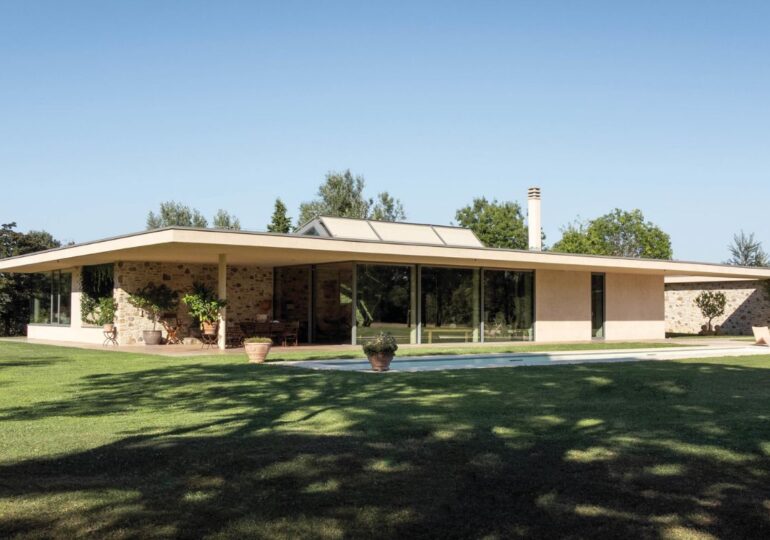
The patio houses are homes organized around an open internal courtyard: a central void, open to the sky, which is not an “accessory garden” but a primary room . It is from that void that the house takes air and light; that’s where the routes are defined; it is there that the distance – always delicate – between what is public and what remains private is measured. The patio is, in typological terms, a climatic and social heart : it distributes, protects, illuminates. It allows you to live “outdoors” without exposing yourself, transforming intimacy into a project.
The patio house was born as an evolutionary response to two constraints that run through the history of living – climate and privacy – and which, in different contexts, generate surprisingly similar solutions. Research on the Mesopotamian house indicates the emergence of the central courtyard plan around the third millennium BC. , with examples in cities such as Ur and other settlements in the area. Even the civilization of the Indus Valley shows houses in which a courtyard open to the sky becomes a light and ventilation device for the rooms arranged around it, as reported by the excavations of Mohenjo-daro .
From then on the theme never stops transforming: in the Greco-Roman world the domus stages the courtyard in the sequence atrium/peristyle , as an infrastructure of representation and daily life, with a spatial clarity that remains a lesson in domestic direction. In other words, the patio house is a millennial typology because it is a robust idea: it does not promise “view”, it builds measurement , rhythm , breath . And it is also for this reason that, when we enter the patio houses of famous architects , we will not talk about nostalgia for the archetype, but about a still current grammar: that of the habitable void .
the patio as a design tool
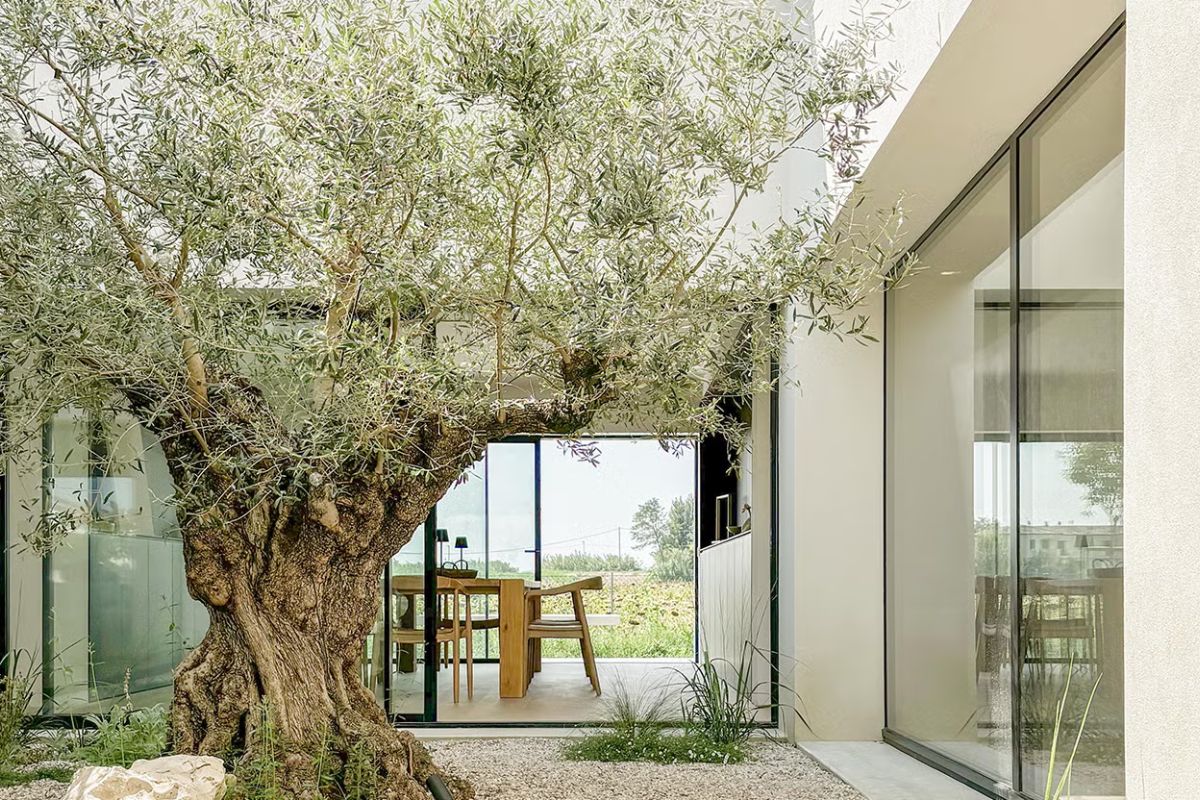
A patio does not “work” by presence, but by proportion . It is a question of geometry and section even before it is of atmosphere: width and height of the wings, relationship with the openings, control of radiation in the seasons, ability to trigger natural ventilation. In summary, the patio is a spatial technology: it produces comfort not with the system, but with the orientation, with the shade, with the distance, with the material.
On the level of experience, the patio introduces a fertile paradox: the more introverted the house, the brighter it can become. Light does not enter “from outside” in an undifferentiated way; is filtered , it becomes time and measure. The internal courtyard, in fact, does not only illuminate: it orders . It makes the house legible as a sequence of thresholds – rooms, porticoes, passages – and allows you to build privacy without closing yourself off, because what opens is not the street, but the sky.
Patio houses, famous architects: 7 iconic works in which the courtyard is a “room” and device
The patio can be a quiet and almost monastic center, or a central domestic garden; it can be dry empty or dense landscape; it can be a rigorous rule or a sensorial story. Here are 7 iconic works whose courtyard is a real room to live in.
Patio houses by famous architects: Azuma House (Row House), Tadao Ando, Osaka (19751976)

Among the c patio houses of famous architects , the Azuma House by Tadao Ando is one of the most cited examples because it transforms the central patio into a true climatic room and in a project device.
On a narrow lot in the urban fabric of Osaka , the system is built by subtraction: three bays in sequence environment / open internal courtyard / environment where the void does not complete the house, the governs . Circulation is part of the thesis: to connect the living and sleeping areas you cross the patio, so the house forces you to measure light, rain, wind and seasons as architectural material. From a performance point of view, the courtyard works as a well of light and an air chamber: it deeply illuminates an otherwise introverted volume, promotes ventilation and makes the section legible. Privacy is also “typological” rather than decorative: the façade facing the street remains controlled, while the opening is moved inside, where the open-air courtyard becomes the true domestic front.
Therefore, it is a patio house not because it “has a courtyard”, but because the courtyard is the element that organizes space, microclimate and intimacy.
Patio houses by famous architects: Casa Gilardi, Luis Barragán, Mexico City (Tacubaya, 19751977)

Casa Gilardi is an exemplary case because it demonstrates that the patio is not just a “distributive” void, but a perceptive field where structure, light and color become technique. The lot (approximately 10 m existing jacaranda , which is not “decorated” but taken as a typological pivot. The patio works as a privacy filter (controlled facade towards the street) and as a light regulator: a corridor-gallery connects the built bodies and constructs a calibrated sequence of compressions and dilations, up to the most radical room, where dining area and water are merged into a single spatial scene (water mirror, floor, vertical wall and skylight are studied as a single system).
Here the “technology” is also chromatic: a declared palette (intense pink, light purple, white), modulated on site according to the incidence of light; and above all the yellow gallery, with colored glass applied to the vertical cuts, which transforms the passage into a chamber of light and leads to the saturated blue of the pool bottom.
Therefore, it is a patio house not because it “has a courtyard”, but because the courtyard orders the layout , governs the threshold between inside and outside and makes comfort (bright, climatic, intimate) a direct consequence of the project.
Patio houses by famous architects: Schindler House (Kings Road House), R. M. Schindler, West Hollywood / Los Angeles (19211922)
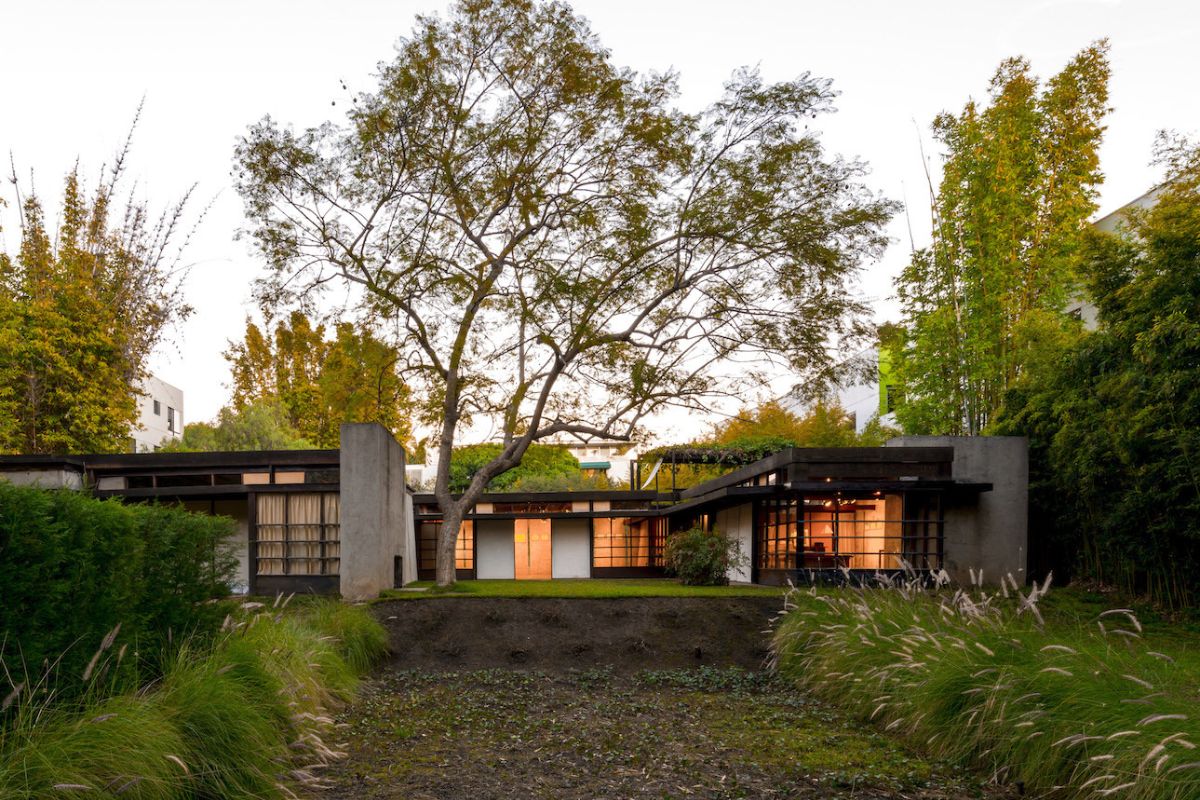
The Schindler House is a milestoneare because it anticipates, with almost programmatic clarity, the modern idea of ?? courtyard house as a system of “external rooms” equivalent to the internal ones. Here the patio is not an episode: it is the module that constructs daily life. The system works by interlocking: two residential units (designed for two couples) are organized into L-shaped volumes which do not seek a representative façade, but generate protected courtyards as direct extensions of the study spaces.
The separation between inside and outside is made deliberately porous: sliding panels, large openings and a sequence of thresholds ensure that the patio becomes a true outdoor room – not a “garden”, but a space of use – where light and ventilation do not arrive as a concession, but rather as a consequence of the design. Technically, the house is also a construction laboratory: walls in slabs/panels, structure and infills designed for a dry and experimental domesticity; but the most current lesson is typological: privacy does not depend on closing oneself, it depends on building an external interior .
The result is a patio house in the full sense: living does not revolve around a “central” living room, but around courtyards that regulate the climate, orientation of the gaze and social life, transforming the patio into a true device of domestic freedom.
Patio houses by famous architects: Muuratsalo Experimental House, Alvar & Elissa Aalto, Muuratsalo (Jyväskylä), 19521954

The Muuratsalo Experimental House is a rare case because it brings the archetype of the courtyard-atrium (admittedly close to the idea of the Roman atrium) into a Nordic context, transforming it into a protected intermediate space : an internal courtyard that opens towards the best exposures and builds a habitable microclimate between inside and outside. But its uniqueness lies above all in the fact that the patio is also a device of material knowledge : the internal walls become a true sample wall , divided into experimental fields where Aalto tests bricks, masonry equipment, finishes and performance over time. In this house the patio does not “serve” only to bring light and air: it serves to make the architecture work as a laboratory, where technique is not backstage, but a daily story.
Patio houses by famous architects: Kingo Houses (courtyard houses), Jørn Utzon, Helsingør (Elsinore), 19561959
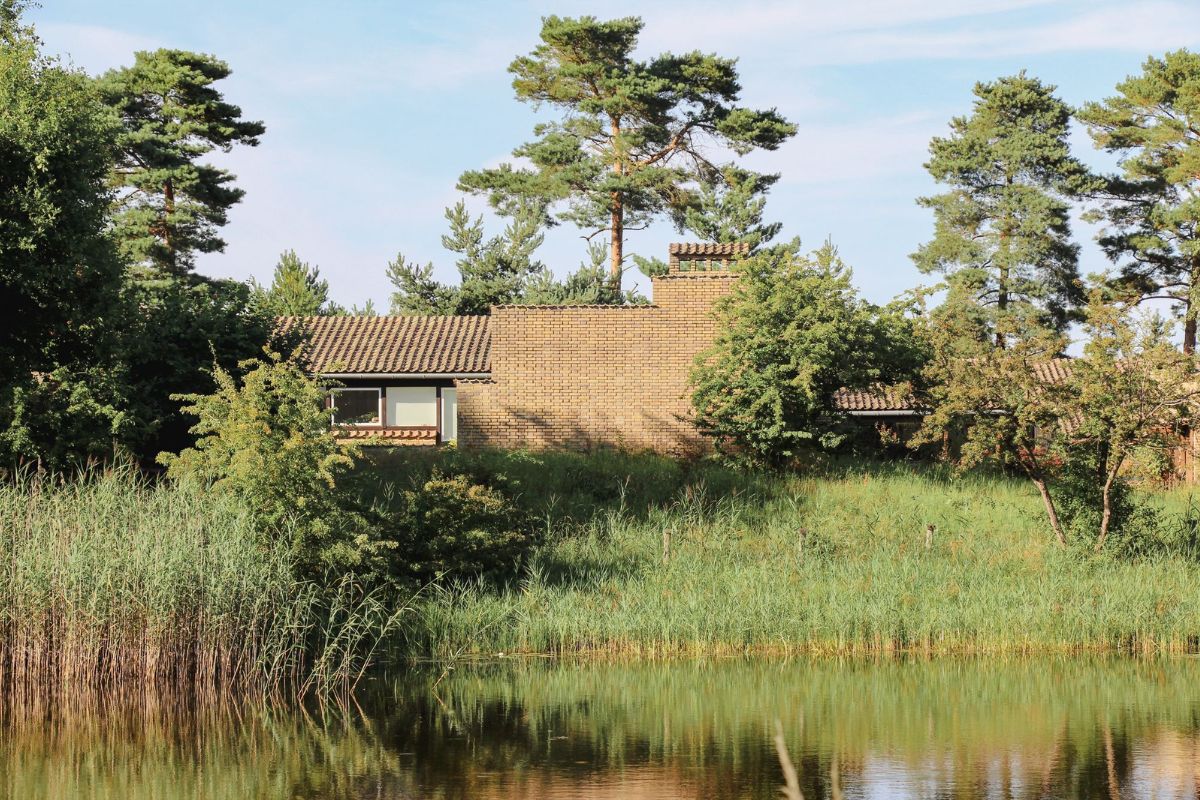
The Kingo Houses (Romerhusene/Kingohusene) are a structural reference for the keyword patio houses famous architects because they demonstrate that the typology is not a “villa” affectation, but a model of habitable density : a settlement of 60 units (often reported as 63) conceived as L-shaped houses which, together with the brick walls , define a private courtyard – the true outdoor room for living. The domestic module works for typological clarity: two wings separate functions and degrees of privacy, while the courtyard compensates for what the square footage does not allow, restoring light, air, protection and controlled external life . The most cultured choice is urban planning: the system follows the terrain with “additive” logic and Utzon describes the system asand flowers on the branch of a cherry tree, each facing the suna poetic that coincides with a concrete rule of orientation, screening and control of the gaze .
Fredensborg Houses (courtyard houses), Jørn Utzon, Fredensborg (19591963)
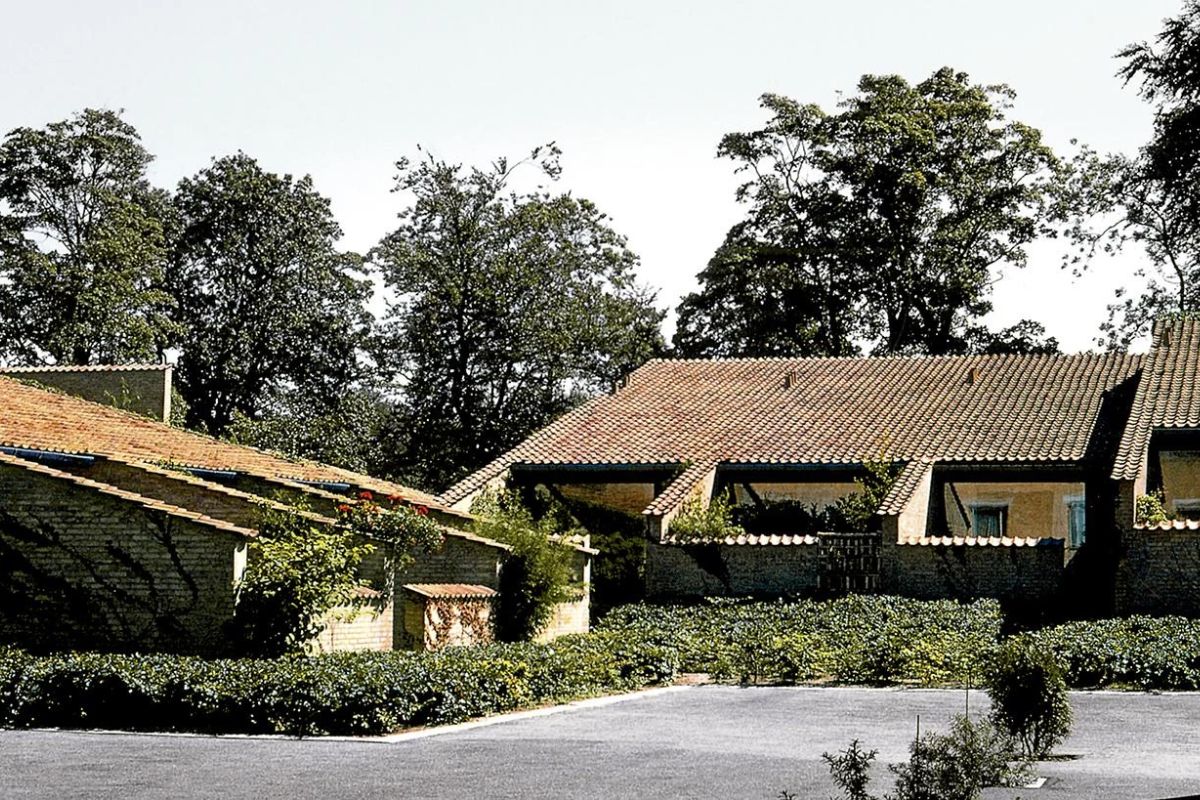
The Fredensborg Houses deserve special mention because they demonstrate that the patio house can be, at the same time, a domestic form and urban intelligence . Utzon works on the theme of the private courtyard as a unit of repeatable quality: each house is set on a simple geometry (low body, brick walls, inclined roofs) which defines a protected internal courtyard not a residual “outside”, but an open-air room where light and air are made compatible with privacy and density. The key point of the project lies in the graduation of the thresholds : from the private courtyard (intimacy, microclimate, daily life) we move on to pedestrian paths and semi-collective spaces, up to the common green spaces , with very fine control of what you see and when you see it. Technically it is a lesson on how the patio works “on multiple scales”: as a screen from the wind , as an enclosure that accumulates heat on mild days, as a filter that allows generous openings towards the inside without exposing the house to the outside. And, above all, as a tool of social composition: the courtyard typology allows closeness between houses without conflicting glances, because the opening is brought back to the centre, inside a designed void.
It is the perfect example of why the patio houses of famous architects are not just icons: they are spatial protocols capable of transforming a settlement into a truly habitable place, not just “well designed”.
Moriyama House, Ryue Nishizawa / SANAA, Tokyo (20022005)

Among the patio houses of famous architects , the Moriyama House is useful because it overturns the traditional image of the courtyard house: instead of a single volume that embraces a central courtyard, Nishizawa breaks down the house into several independent bodies scattered throughout the lot, and transforms the “emptiness” between these volumes in a system of micro-patios , passages, interstices and minute courtyards. The patio here is no longer a single center, but a constellation of domestic exteriors : air and light become distributive matter, and privacy does not derive from a compact enclosure, but from a strategy of distances, orientations and misalignments between the volumes. Technically it is a contemporary lesson on the topic: the internal/external threshold is not a clear boundary, it is a sequence of conditions; the house “breathes” not because it has large openings towards the outside, but because the outside is internalized as a network of small controllable courtyards. The urban density of Tokyo also enters into the project: the fragmentation allows us to avoid direct views and modulate views and shadows, transforming the lot into a private micro-neighborhood. In SEO terms, it is one of the most current answers to the question “famous architects’ patio houses” because it demonstrates that the patio is not necessarily a central geometric figure: it is a principle putting the void in command which can take on new forms without losingre its primary function of light, air and designed intimacy.