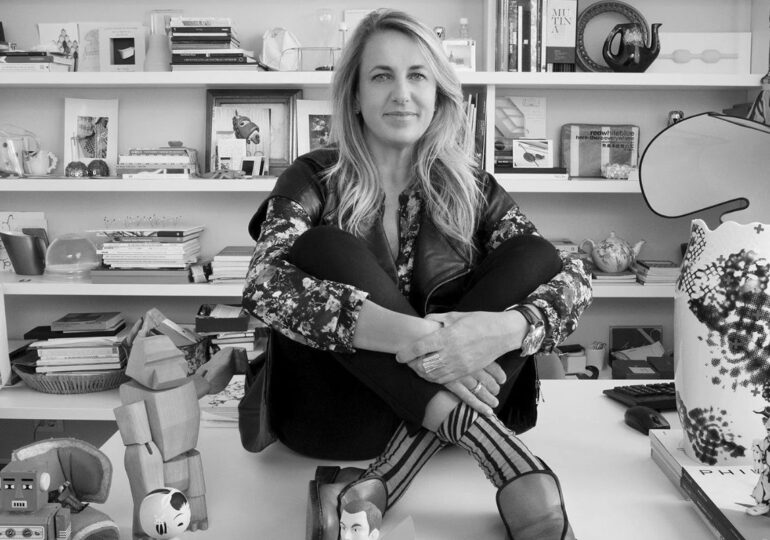
Talking about Patricia Urquiola today means talking about one of the most decisive figures in contemporary design. Not only because she is considered the most influential female designer in the world , but because her vision has changed the very way of understanding design: less self-referential, more sensitive, capable of combining poetry and innovation, craftsmanship and industry .
His name constantly appears in international conversations about the future of interior and product design. From art director of Cassina to designer of hotels and iconic cultural spaces, up to his objects entered in the catalogs of companies such as Moroso, Kartell and B&B Italia, Urquiola today represents a transversal point of reference for architects, interior designers, companies and enthusiasts.
Its influence goes beyond furnishings: Urquiola is a cultural bridge between Europe and the global world, between tradition and contemporaneity, between formal research and social attention. It is a voice that stands out in a sector often dominated by male brands, and which has been able to propose a feminine design without being feminist in manner , delicate but powerful, light but structured.
Today we talk about her because her language has become universal : capable of interpreting the complexity of our time with an aesthetic that is not a passing fad, but a lasting vision , already fully entered into the history of design.
Biography of Patricia Urquiola: from origins to international recognition
Patricia Urquiola was born in Oviedo, Spain, in 1961. She grew up in a cultural context in which creativity is seen not as a luxury, but as a natural language. After his initial studies in Madrid, he chose to move to Milan, where he graduated in Architecture at the Polytechnic under the guidance of Achille Castiglioni , one of the absolute masters of Italian design. This meeting is decisive: from him he learns the centrality of the design process, the value of detail and the importance of looking at objects not only for their function, but as mediators of emotions and relationships .
In the 1990s he collaborated with Vico Magistretti , another design giant, and with Piero Lissoni in the Lissoni Associati studio. It is in this period that he refined his ability to read space and translate it into a coherent story, developing a design sensitivity that combines architectural rigor with an innate poetic lightness.
In 2001 he founded the Studio Urquiola in Milan, with which he designed projects ranging from product design to interior architecture , up to the artistic direction of historic companies. His vision is not limited to the product: each creation is part of a narrative ecosystem , which connects materials, technology, craftsmanship and cultural memory.
Over time, Patricia Urquiola established herself as one of the very few female designers to achieve global recognition, winning international awards and collaborating with the most prestigious brands in the sector. In 2015 she was appointed art director of Cassina , a role that marks a turning point in the history of the brand andconsecrated her as one of the most influential voices in world design.
Patricia Urquiola’s style: between poetry, innovation and memory
Talking about Patricia Urquiola’s style means entering a fluid territory, in which the boundaries between architecture, design and art dissolve. These are never simple objects, but multisensory experiences, born from the encounter between design rigor and creative freedom .
His approach always starts from the observation of people and their daily gestures. Each of Urquiola’s projects seeks to dialogue with those who use it , generating comfort and surprise. This explains why many critics speak of an “empathetic” design: not cold, not detached, but capable of welcoming and including.
Among the most recognizable characteristics of his language we find:
-
The innovative use of materials : Urquiola experiments with ceramics, fabrics, glass, metals and resins, often combining them in unexpected ways. Textures become the protagonists, with surfaces that almost seem to tell a story.
-
The fluidity of forms : soft lines, enveloping curves and organic geometries recur in his projects, almost as if to suggest an idea of continuity between body and space.
-
Cultural hybridization : despite living and working in Milan, he always brings with him a touch of his Spanish origin, intertwined with oriental, Mediterranean and Nordic suggestions.
-
The contamination between craftsmanship and technology : a sofa, an armchair or a tile designed by Urquiola are never the result of a standardized industrial process, but a balance between technical innovation and manual savoir-faire.
-
The search for lightness and play : in his works there is a frequent ironic vein, never banal, which dismantles the rigidity of contemporary design to restore a freer and more joyful dimension.
In this sense, Patricia Urquiola is often defined as a visual narrator : she does not simply design spaces or objects, but scenarios that invite those who experience them to build their own personal story.
Patricia Urquiola’s iconic projects
Each project by Patricia Urquiola is much more than a simple exercise in style: it is a piece of a language that evolves over the years, always remaining recognisable. His works cross different worlds – from furniture to textiles, from surfaces to hotel interiors – but they have in common the ability to combine comfort, irony and cultural memory .
Tufty-Time (2005) B&B Italia
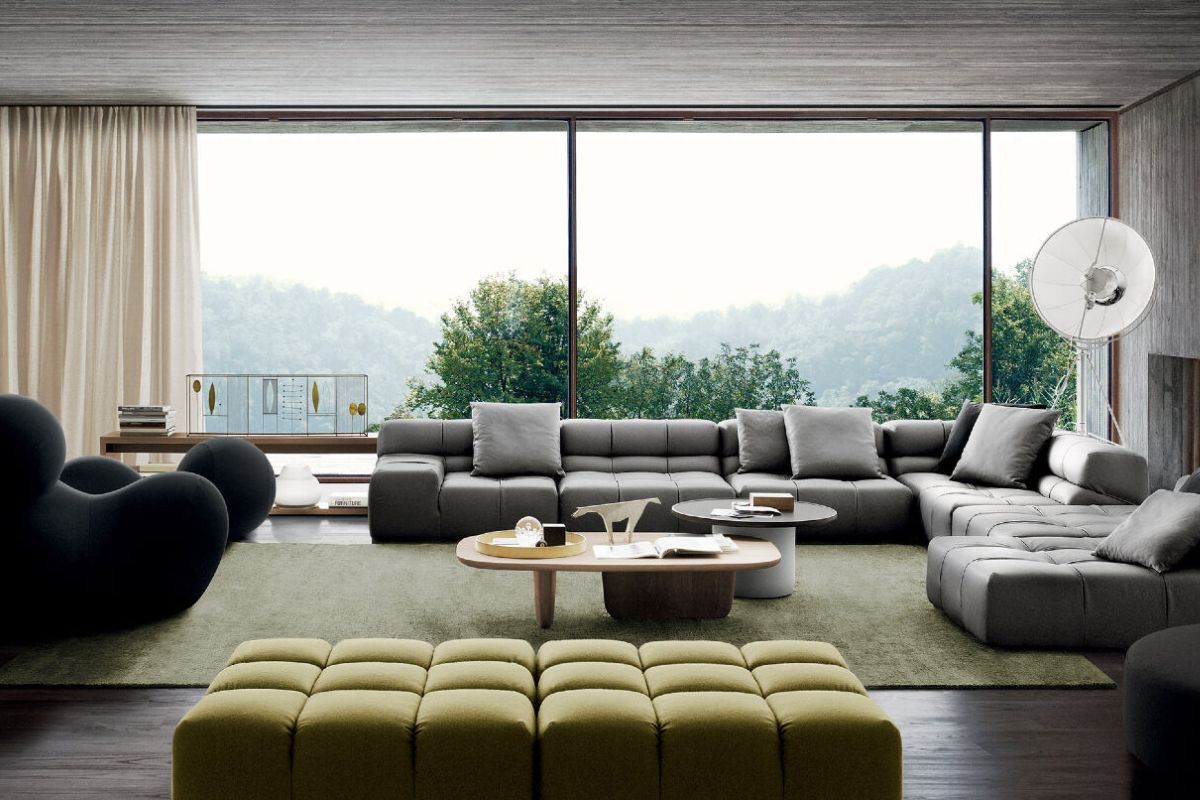
The modular sofa that has changed contemporary living: low seat, modular modules in depth and width, “checked” stitching that references the Chesterfield and deconstructs it. Perfect for islands, chaise longues, corner compositions. Materials: high density foam, fabric/leather coverings, completely removable covers in the textile versions. For images: overall view in island configuration + stitching detail.
Husk (2011) B&B Italia

Armchair(and family) founded on the dialogue between rigid shell and soft capitonné cushions . Shell in recycled plastic material, generous padding, swivel or fixed bases, indoor/outdoor versions and bed Husk Bed . For the images: body + macro of the cushions.
Smock (2005) Moroso

Sculptural armchair with circular openings in the armrests and smocked upholstery that recalls tailoring. Couture aesthetics, enveloping comfort; It works in both residential and hotel sectors. Images: front three-quarters + detail of the curls.
Fjord (2002) Moroso
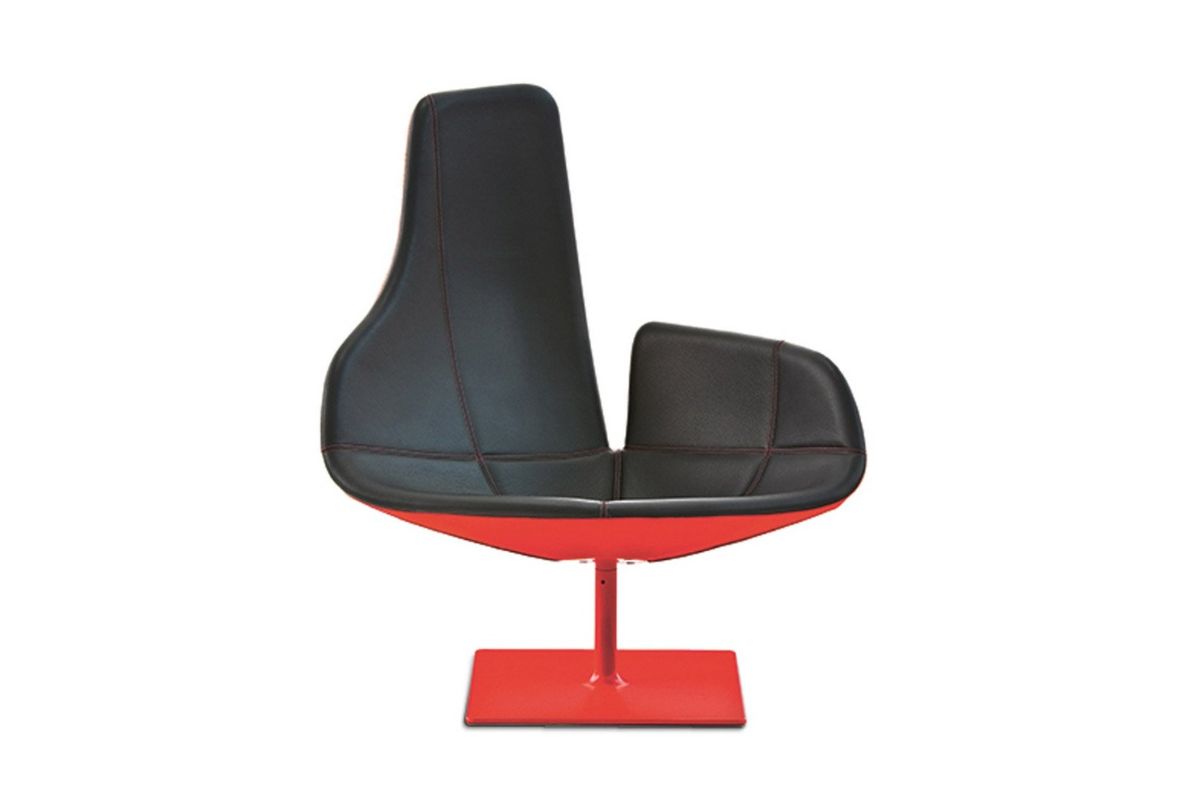
Seat (family) that reinterprets Scandinavian design with controlled asymmetry : “shell” cut, soft curves, sled/swivel bases. Early icon-Urquiola which explains well its balance between poetry and ergonomics. Images: side profile + close-up of the cut.
Antibodi (2006) Moroso
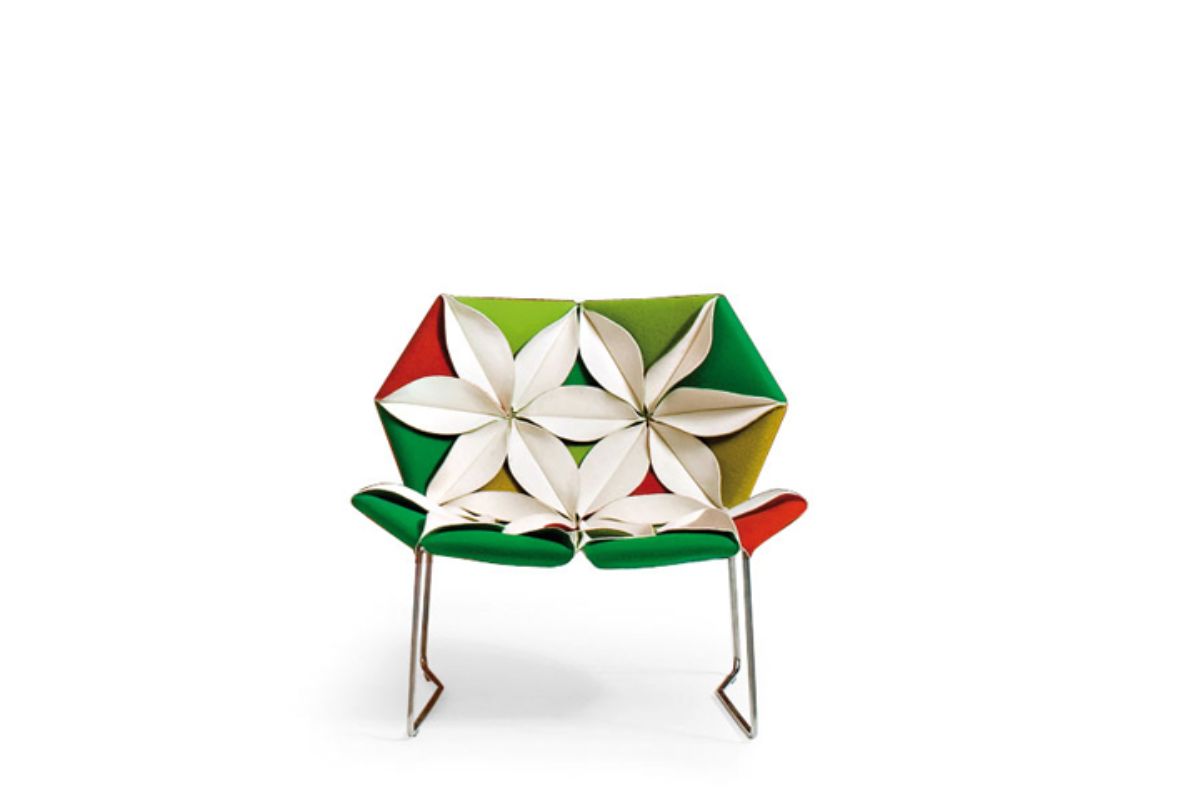
Woven chaise/lounger with modular petals in felt or leather on structural mesh. A hybrid between carpet and flower, between textile and shell. It is a manifesto of his research on skins/textures . Images: zenithal view to read the pattern + macro of the petals.
Tropicalia (2008) Moroso

Outdoor collection in metal tubing woven with polychrome technical threads. Geometric patterns and vibrant colors; iconic in hospitality and residences with important outdoors. Images: armchair + daybed in an outdoor context.
Caboche (2005) Foscarini (with Eliana Gerotto)
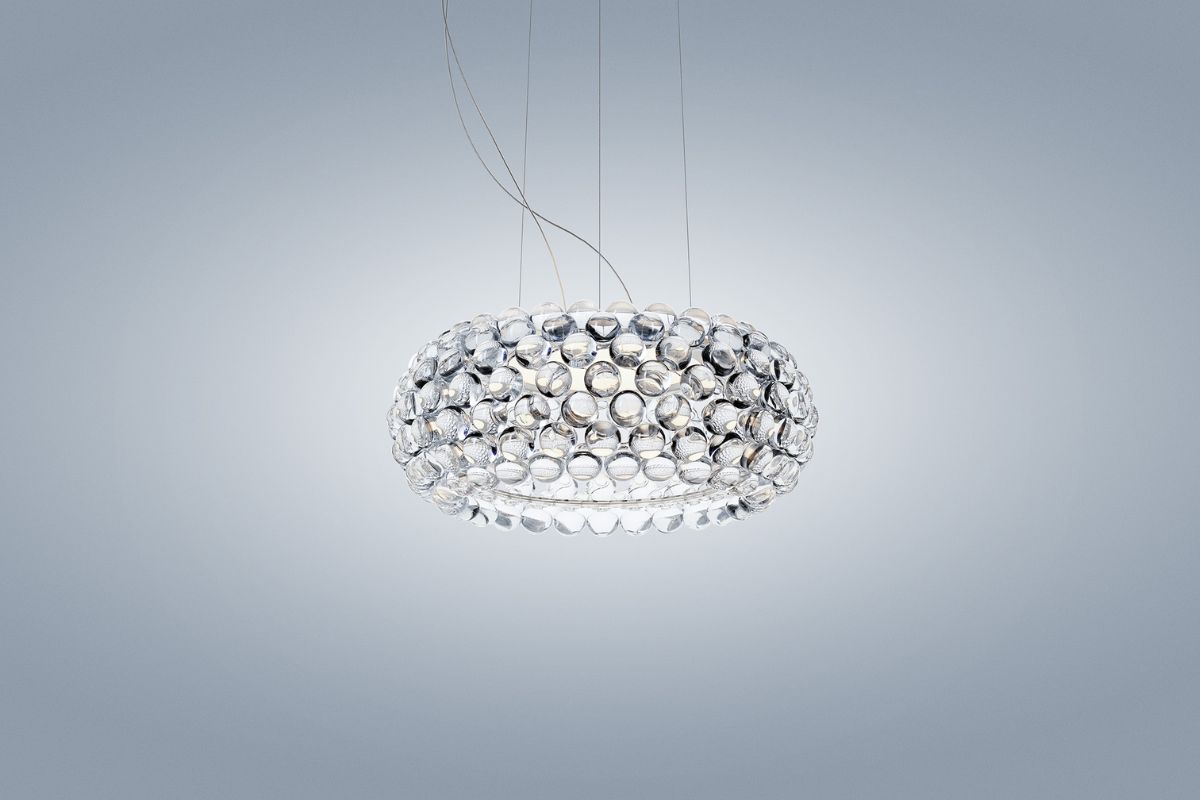
Luminous sphere composed of rings of transparent spheres which multiply the light (jewel effect). Large family (suspension, floor, table). Images: backlight for the play of refractions.
Chasen (2008) Flos

Suspension with adjustable metal slats which change the section of the lighting body (from closed to “whip”), modulating light and shadows. Mechanical poetry. Images: two different opening states.
Mutina Azulej (2012), Déchirer (2008), Cover (2016)

-
Azulej : contemporary cement tiles, mixable patterns, tone-on-tone/contrasted variants.
-
Déchirer : ceramic surfaces in relief with a tear effect and textile textures.
-
Cover : covering system with calibrated graphics, designed for architectural continuity.
Images: 3×1 grid with a close-up for each collection.
Mangas (2009) GAN (Gandia Blasco)

Knitted carpets and poufs in wool, like oversized sweaters: modular modules, warm/dusty palettes. Brings the textile world to the center of the interior. Images: modular composition + mesh macro.
Vieques (2008) Agape
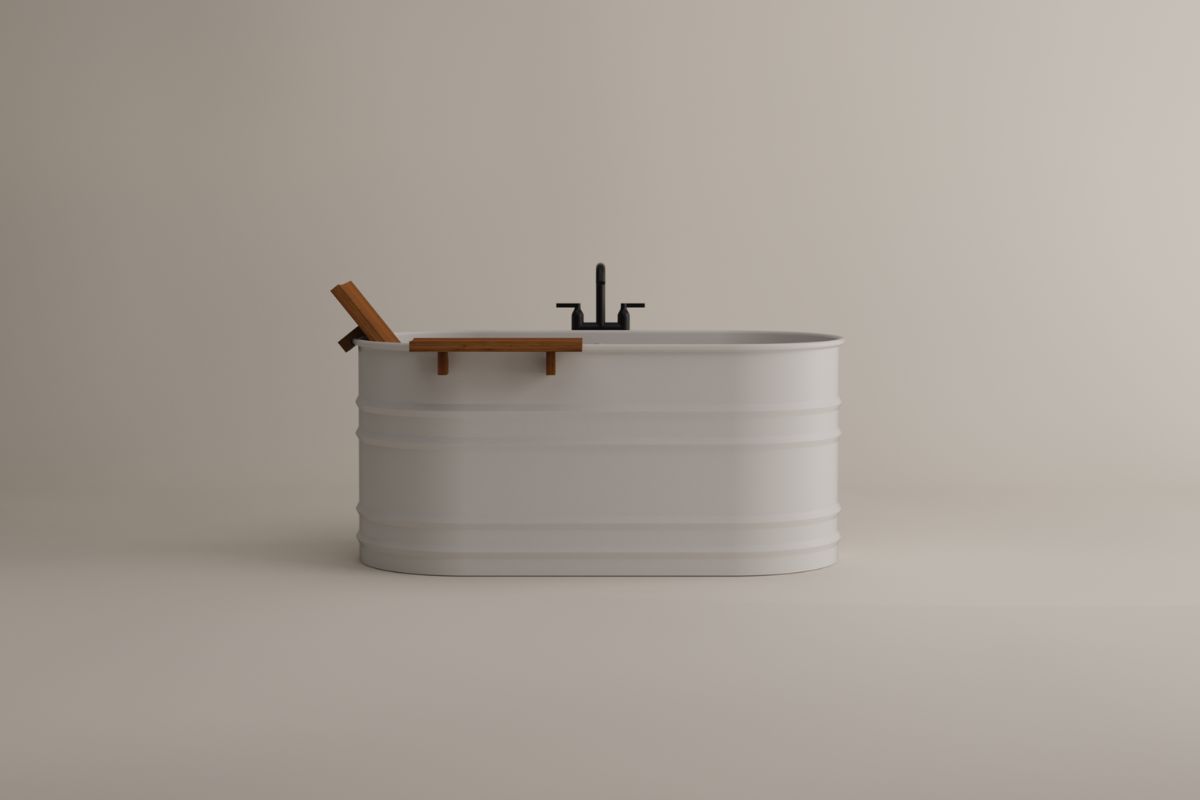
Freestanding bathtub in painted sheet metal with wooden edge and shelf (iroko): cultured reference to bathtubs of yesteryear, made contemporary. Images: set view + edge/wood detail.
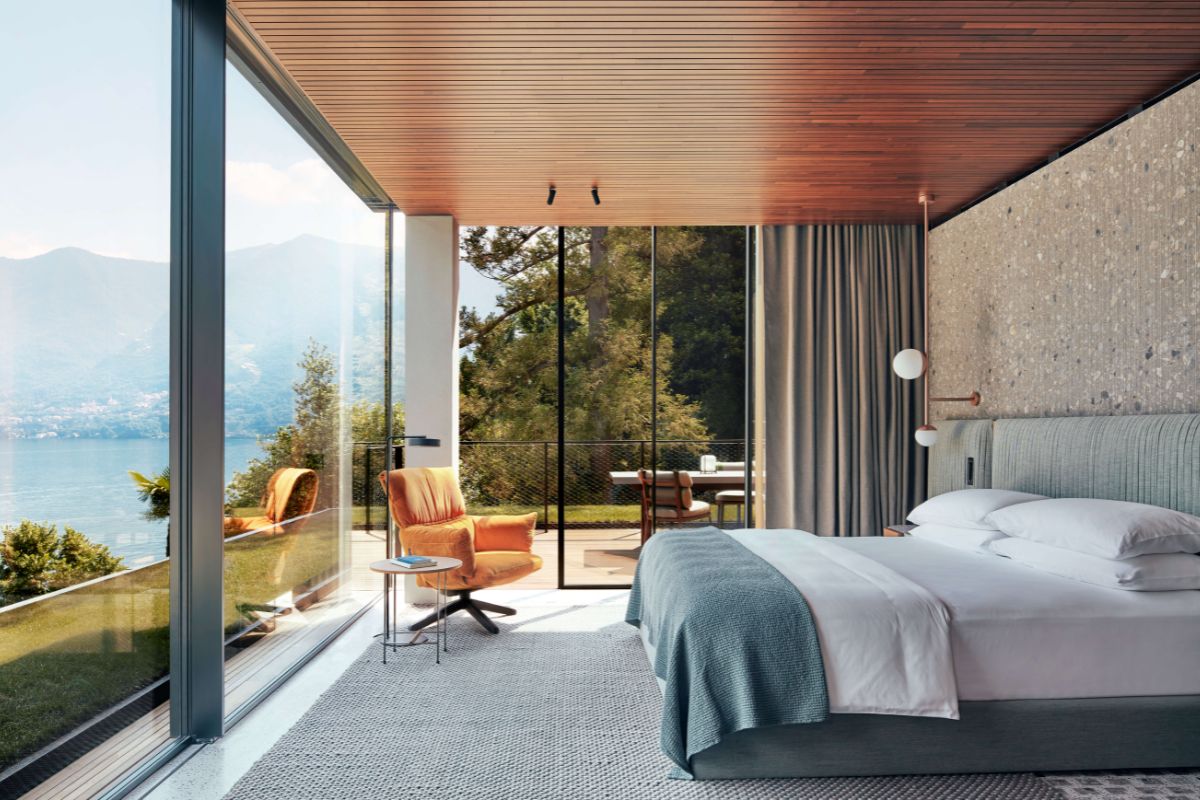
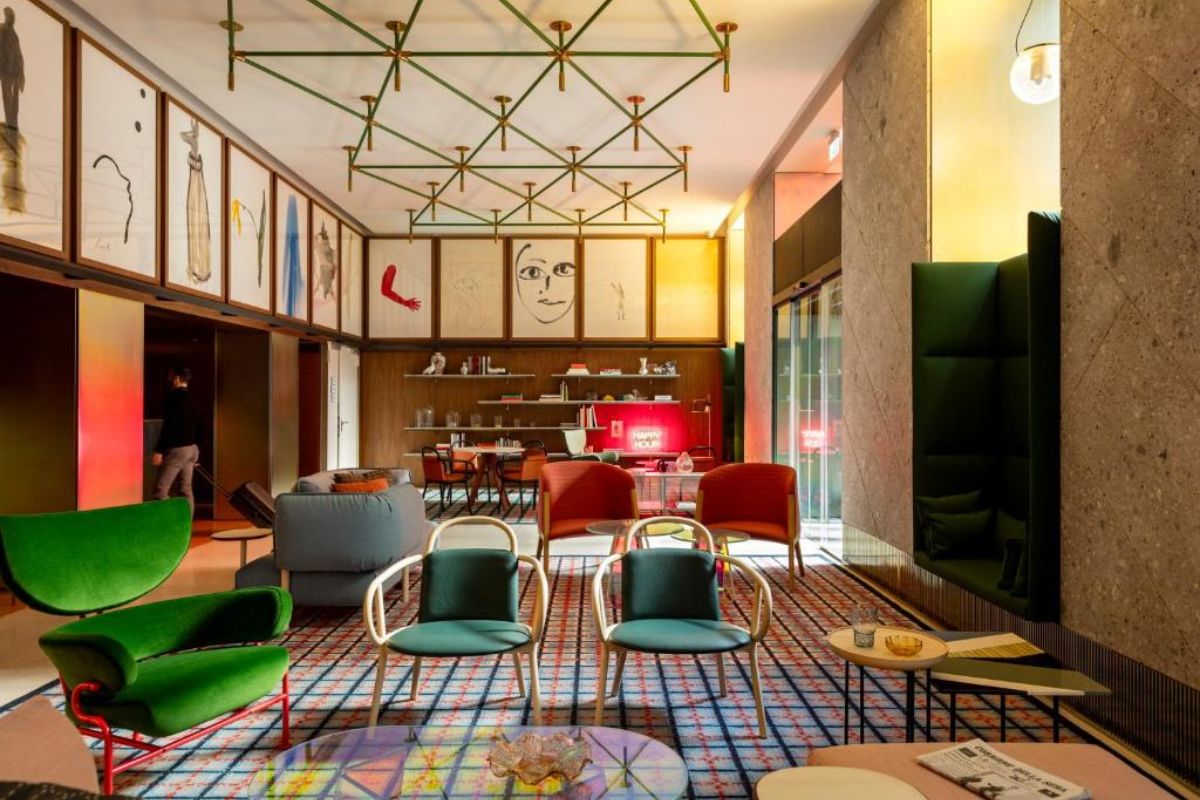
Interiors: Mandarin Oriental Barcelona (2010), Il Sereno Lago di Como (2016), Room Mate Giulia Milano (2016)
Three case studies that explain Urquiola’s direction in spaces:
-
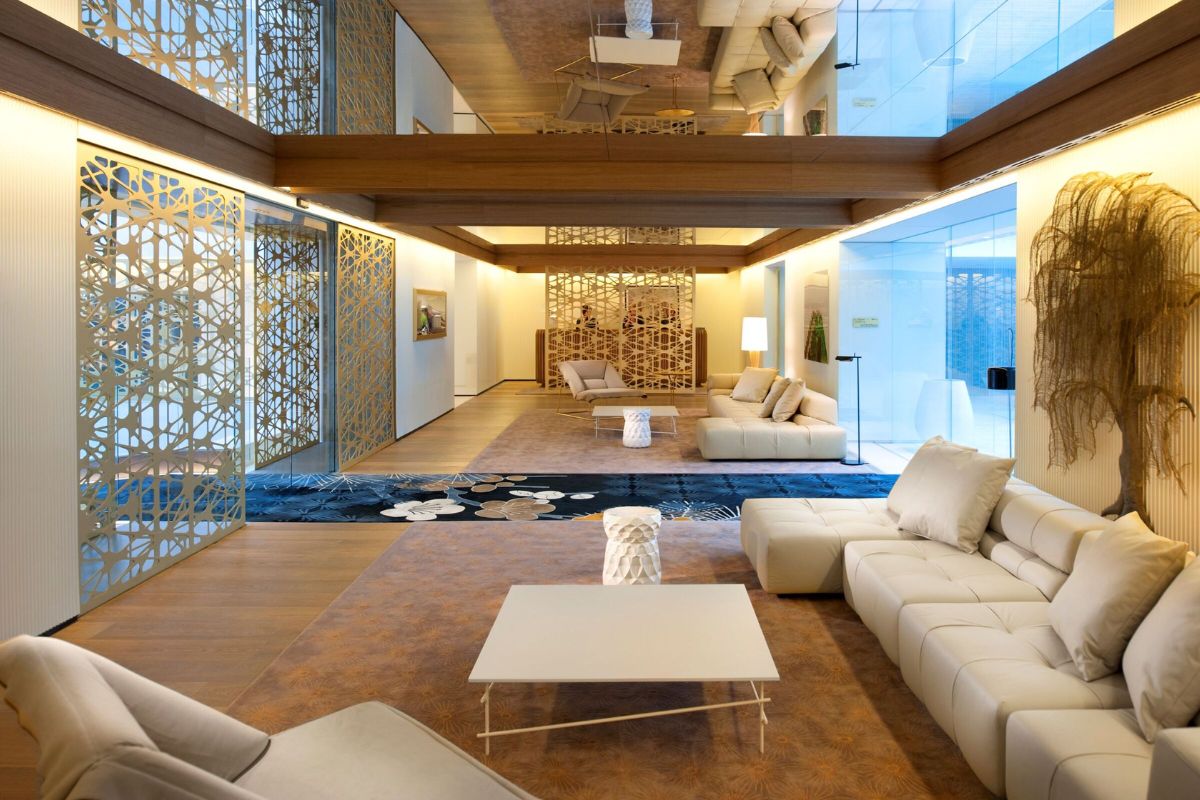
Mandarin Oriental Barcelona : warm materiality, filtering patterns, dialogue with historical architecture.
-
Il Sereno, Lake Como : lake palette, Ceppo di Gré , custom furnishings; rarefied luxury.
-
Room Mate Giulia : pop-cultured Milan, bold colours, Ceppo di Gré protagonist and terracotta pink tiles.
Patricia Urquiola and the sense of design today
Talking about Patricia Urquiola means observing how design can be transformed into a living language, capable of speaking to both companies and people. In his projects there is never a form as an end in itself, but a gesture that invites us to touch, to live, to relate. This is what makes her one of the most authoritative voices of our time: the ability to combine culture, matter and intuition in objects that can fit into everyday life naturally, while maintaining a poetic force.
Today his work does not represent a closed chapter, but a continuously evolving movement: a research that teaches us to consider design as a bridge between innovation and memory, between craftsmanship and industry, between intimacy and community.
In this journey Patricia Urquiola established herself as one of the most influential women of design at an international level: a professional who, with her sensitive and visionary approach, has been able to redefine the way in which we understand spaces and objects.
Patricia Urquiola is not just a world-famous designer: she is a narrator of possible worlds, who through her projects reminds us how design is never just furniture, but a way of looking at and inhabiting the world.
Leave a comment