The house of the future: matter (life cycle, embodied carbon, circularity)
In 2026, talking about matter means talking about a passage of statute: materials are no longer a “choice of finish”, but a determining share of the climate footprint and, increasingly, the object of regulatory measurement. The revision of the EPBD introduced the topic of life-cycle Global Warming Potential : from 2028 (new buildings > 1,000 m²) and from 2030 (all new buildings) the life-cycle GWP will have to be calculated and declared in the energy certification; and EU countries will have to prepare a roadmap towards limit values from 2030.
The point is not theoretical: the Commission highlights that in the EU new construction accounts for approximately 18% of the overall “whole life-cycle” emissions of the building stock despite representing approximately 1% of the total surface area. It is the very definition of “matter” as a lever: what we build today sets a long trajectory, even before consumption in operation.
Then there is the issue of resources: the built environment absorbs an enormous share of extraction and transformation. A WorldGBC briefing points out that buildings impact approximately half of the materials mined globally. And the supply chain continues to depend on materials with high emission intensity: cements and steels – central to construction – are indicated by UNEP/GlobalABC as responsible for a very significant share of global emissions (around 18% ).
Finally, the material produces “end of life” right from the start: in the EU construction and demolition waste is worth approximately 40% of the total, and the Environment Commission describes it as over a third of the waste generated. Eurostat statistics, for 2022, also place the construction sector as the main contributor to waste production (approximately 38.4% ).
Translated into a project, the “matter” pillar is based on three technical decisions – not very photogenic, but very decisive:
-
measure (LCA/EPD as basis, not as attachment): put the life cycle in numbers and compare alternatives on homogeneous metrics, in line with European frameworks such as Level(s) ;
-
reduce (mass, waste, replacements): details that minimize waste, accessible components, scheduled maintenance, stratigraphy that does not force demolition to update;
-
design for disassembly : reversible joints, dry systems where possible, “separable” components for real and not just statistical recovery.
Here also lies the most common misunderstanding: thinking that “material” coincides with a single choice (for example “all wood”). The European management also mentions the issue of carbon storage in biogenic materials, but places it within a framework of calculation and responsibility: not slogans, accounting .
The house of the future: quality (air, light, acoustics, microclimate)
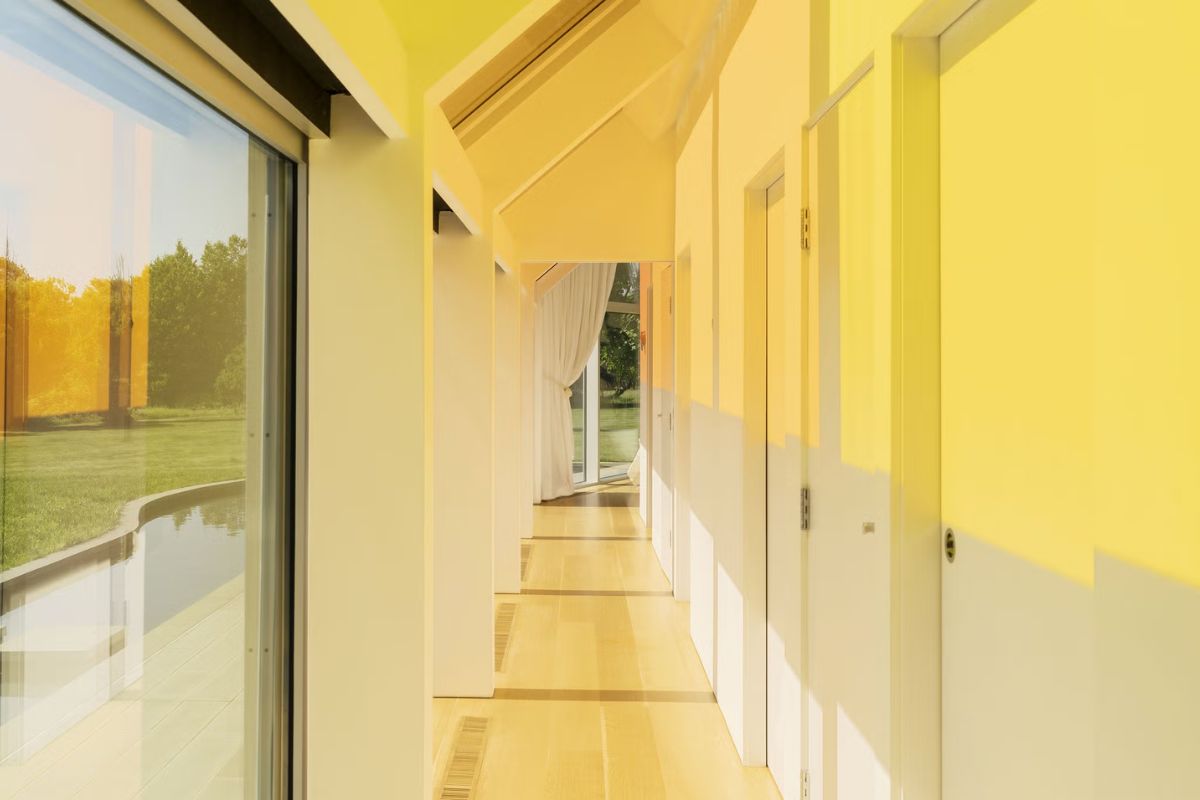
In the lexicon of homes of the future , quality means designing an interior that is not limited to being beautiful, but that functions physiologically and does so in a repeatable, measurable, verifiable way. This is where living changes pace in 2026: because comfort returns to being a technical matter, and the house stops being a scenography to become an environment that protects and supports daily life .
The first quality is air . For years we treated it as a detail, today it is an indicator of health and project. The EEA recalls that indoor poverty can cause or aggravate respiratory diseases, and explicitly cites the role of humidity and mold as risk factors. The WHO, in Housing and Health Guidelines , directly links the difficulty of correctly heating rooms (or, on the contrary, high indoor temperatures) to cardiovascular and respiratory outcomes, placing the home within the sphere of prevention.
Operationally, the house of the future treats air as a system: source control , ventilation , filtration . The European Build Up platform summarizes it clearly and indicates two pragmatic proxies for management: CO? (as an indicator of richange) and PM2.5 (as an indicator of pollutant control). This doesn’t mean reducing everything to a sensor: it means designing envelopes and systems in a coherent way, avoiding the most common mistake of recent years sealed houses without a serious ventilation strategy.
The second quality is the microclimate : temperature and humidity not as a “sensation”, but as thermo-hygrometric stability . The research and guidelines converge on a simple idea: the extreme (too dry, too humid, too hot, too cold) is a risk; stability is a value. A scientific review on indoor air quality guidelines highlights, among other things, the importance of managing relative humidity and ventilation as prerequisites for well-being and performance. Here the house of the future becomes “quiet”: not because it gives up, but because it reduces oscillations, currents, cold spots, localized overheating.
The third quality is light . Not just “more natural light”, but the right light : orientation, shading, reflections, levels and color temperature consistent with functions and times. It is a quality that intertwines project and habit: if the contemporary home hosts work, care, rest and sociality in the same perimeter, light must support different rhythms without invading. For this reason, lighting quality is increasingly spoken of as a component of Indoor Environmental Quality together with air, thermal comfort and acoustics, even in European technical guidance documents for the sector.
The fourth quality is sound. Home acoustics have long been treated as a luxury, but in the homes of the future they will become a requirement: protection from external noise, control of reverberations, sound privacy, spaces that do not amplify fatigue. It is a theme that directly affects the liveability of open spaces and the hybridization of functions (work-home, study-home): acoustics, today, are a form of intimacy.
Finally, quality in 2026 also means a very concrete thing: technical governance . The European Commission, in the implementation materials linked to the EPBD, goes into detail about how technical systems (including ventilation and automation) must be sized and optimized to work well in representative conditions and not just “on paper”.
The house of the future: community (smaller households, shared services, new thresholds between private and municipality)
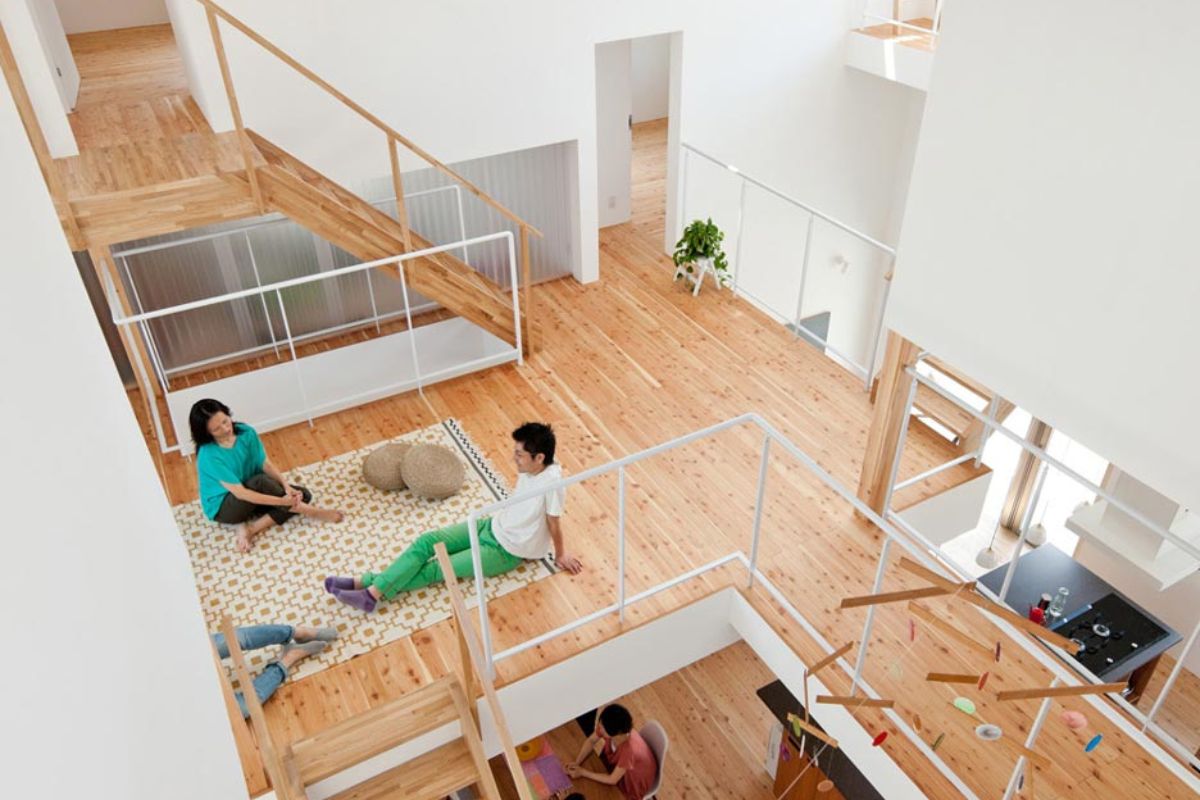
In 2026 the “community” is not a sociological quirk: it is a direct consequence of the numbers. There are 202 million families in Europe, and over 75 million are made up of single adults without children ; between 2015 and 2024 this type grows +16.9% , much more than the total number of families. Downstream, the size of housing changes: in the EU the average is 2.3 people per household (2024). Translated: more “small” (or at least more divided) houses, more non-linear lives, more demand for spaces that can no longer afford unused rooms.
This is why the house of the future moves, in part, outside the housing unit . Not towards a community utopia, but towards a pragmatic model: the home as private cell high quality + a system of shared services that return what the single apartment can no longer contain without waste. Well-designed communal laundries, micro-warehouses, silent work spaces (not the “desk in the room”), guest rooms to avoid dormant square metres, social kitchens when it makes sense, delivery and logistics areas, common outdoor areas that are not a “decorative garden” but an infrastructure for use. Community, here, is a way to increase quality without increasing surface area .
Then there is a second driver: longevity. The share of the population over 80 in the EU is projected to grow strongly (from 6.1% in 2024 to 15.3% by 2100 ). This pushes living towards forms of proximity: spaces and services that reduce isolation, facilitate care and autonomy, make daily life simpler without medicalising the home. Here too, “collectivity” does not mean renouncing intimacy: it means building an ecosystem in which the home is not a fortress, but a connected and accessible place.
The market, meanwhile, is already prototyping a lexicon: co-living/operational living as a combination of private units and common facilities, professionally managed, in which sociability is a service and not an obligation. It is a useful signal because it clarifies a rule: the community only works if it is designed within the thresholds a precise gradient between public, semi-public and private, with acoustics, rules and spatial quality to match.
Therefore, more shared life does not automatically equate to more well-being. Many people have a growing need for control and privacy. The house of the future, therefore, does not just “open”: it draws better boundaries . And in the detail of the article we will see how this pillar translates into typologies, layouts and micro-architectures capable of holding community and intimacy together, without rhetoric.