A refuge for designers, ph
Sleeping well is no longer enough. Those who travel today – especially those who love architecture, design and landscape – are looking for a refuge that speaks a different language. May it be beautiful, yes, but also respectful. Intimate. True.
In an era in which hospitality risks turning into an artificial experience, disconnected from places and values, there is a new generation of Italian hotels that resist with style. They are hotels that do not show off, but tell. Which do not impose themselves on the territory, but take root there with kindness.
In this article we take you to 10 Italian destinations where design meets sustainability. Where rooms become silent settings for authentic experiences. And where every choice a fabric, a tile, a light has a story to tell.
They are not mainstream hotels. Some are hidden in the mountains, others hidden in cities of art. But they all have one thing in common: they chose slow beauty. The one that doesn’t pollute, doesn’t steal space from nature, but listens to it.
How we chose them: authentic, unostentatious design
In this selection you will not find hotels that simply “appear” sustainable. Each facility was selected according to at least three of these criteria:
presence of a recognizable authorial concept or interior design
use of natural, local, recycled or low impact materials
concrete attention to energy and social sustainability
recovery of existing buildings or enhancement of the landscape
local community involvement and ethical supply chains
The result? Places where aesthetics is not an end in itself, but an integral part of a broader cultural and environmental process.
1. Forestis Dolomites Bressanone, Alto Adige
Alpine minimalism in the clouds
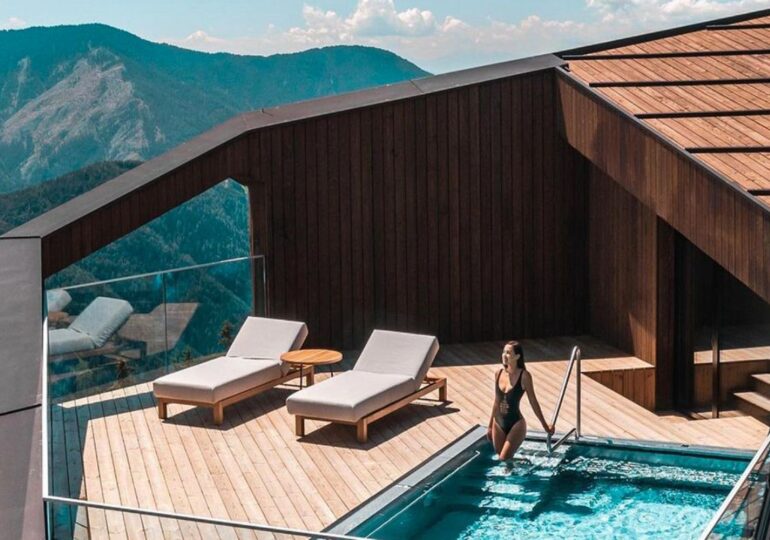
In the heart of the Dolomites, at 1800 meters above sea level, stands a shining example of silent architecture. Forestis is not a hotel: it is a refuge suspended in time. Its vertical larch wood towers seem to be born directly from the forest, and everything – from the materials to the furnishings – respects the wabi-sabi philosophy: essential, natural, imperfect.
The recovery project was born from a sanatorium from the Habsburg era, reinterpreted by Armin and Teresa Hinteregger together with the Asaggio studio. The panoramic suites are real windows onto nature, and the interior design – made of local woods, boiled wool fabrics and dolomite stone – dialogues with the surrounding quiet.
Why is it here
The design is designed to calm the senses: no excess, just form and function
Sustainability is integrated into the passive construction system and materials llocal
The experience is all-encompassing: yoga in the forest, plant-based nutrition and silence as therapy
2. La Dimora delle Balze Noto, Sicily
Between heritage and contemporary visions, the South that enchants
Sicily is full of farms, but few have the evocative and contemporary charm of Dimora delle Balze. We are between Noto and Modica, on a plateau that smells of wild flowers and warm wind. Here a nineteenth-century estate has been transformed into an emotional hotel, where every room is different and every detail is designed to last.
The project, curated by designer and entrepreneur Elena Lops, does not limit itself to restoration: it reinvents with care. The raw concrete meets the original cement tiles, the natural plaster embraces the walls sculpted by time. In the rooms, contemporary works of art coexist with wrought iron headboards and lava stone tubs.
Why is it here
The recovery was done in full respect of the original structure, with local materials and artisanal techniques
The design is eclectic but harmonious, in balance between history and present
The experience includes art, culture and organic cuisine at zero km in an aromatic garden
3. Villa Lena Palaia, Tuscany
Widespread creativity in the Tuscan countryside
Villa Lena is not a simple hotel. It’s a creative ecosystem. Located among the pristine hills of Valdera, this former nineteenth-century villa once a decadent noble residence is today one of the most interesting regenerative hospitality projects in Europe. A place where contemporary art, sustainable agriculture and interior design dialogue without forcing.
The credit goes to Lena Evstafieva (former art curator in London), together with the director Jérôme Hadey and the musician Lionel Bensemoun, who transformed the estate into an artistic residency center with accommodation for guests sensitive to unconventional beauty.
The interiors are a spontaneous fusion of vintage objects, essential design and bohemian touches. No rooms that are all the same: each building has its own personality. You stay in ancient restored barns, converted former stables, suites surrounded by vineyards and olive groves.
Why is it here
The project is based on territorial regeneration, with sustainable restoration and agricultural self-sufficiency
Each season welcomes artists in residence: design evolves, contaminates itself, breathes
The cuisine is agricultural and seasonal, with organic products from the estate and creative vegetarian dishes
We left room for imperfection says Lena and for nature to transform everything.
4. Word Moscatelli Calzolaro, Umbria
A medieval monastery is reborn between raw linen and pink marble
Vocabolo Moscatelli is a surprise. We are in Umbria, in a hamlet almost invisible to the radars of mass tourism, but what happens here is pure poetic design. A structure dating back to 1364 an ancient Benedictine convent ??has been transformed into one of the most refined and respectful boutique hotels of contemporary Italian interiors.
The project bears the signature of the couple Dieter and Valentina Graf, who gave new life to the building with the support of the Milanese studio Studio Klass. The result is an astonishing balance: the mystical charm of the ancient blends with clean geometries, natural fabrics, material surfaces and a color palette inspired by the earth.
Each suite is curated as a microcosm. Custom-designed furnishings, Italian linen sheets, soft and silent lighting, pink Verona marble bathrooms. Outside, a monastic garden with stone swimming pool and climbing vines.
Why is it here
The architectural intervention is sartorial, respectful of the original forms and inspired by monastic tranquility
- The materials all come from Umbria or from sustainable Italian suppliers
The experience is lived slowly: you can meditate, do yoga, read in the library, or cook with the chef
A refuge for designers, ph Leave a comment
10 sustainable hotels in Italy with designer interiors to discover today