We sleep on it a third of our lives, but we rarely wonder who invented it. Yet the bed , an apparently simple and everyday object, is one of the oldest and most complex symbols of human culture: a place of rest, but also of birth, dream, love, illness, death. Its history spans the millennia …
We sleep on it a third of our lives, but we rarely wonder who invented it.
Yet the bed , an apparently simple and everyday object, is one of the oldest and most complex symbols of human culture: a place of rest, but also of birth, dream, love, illness, death.
Its history spans the millennia as a tale of evolution of comfort, taste and society .
Who invented the bed? From stones to Egypt, the origins
The first beds were nothing more than a rise from the ground: piles of leaves or animal skins arranged on smooth stones.
A primordial but revolutionary gesture: separating from the earth meant protecting oneself from the cold, from insects, and – symbolically – getting closer to the sky.
Already 10,000 years ago, in South Africa, some archaeological excavations revealed beds built with reed leaves and insect-repellent ashes : the first examples of natural design.
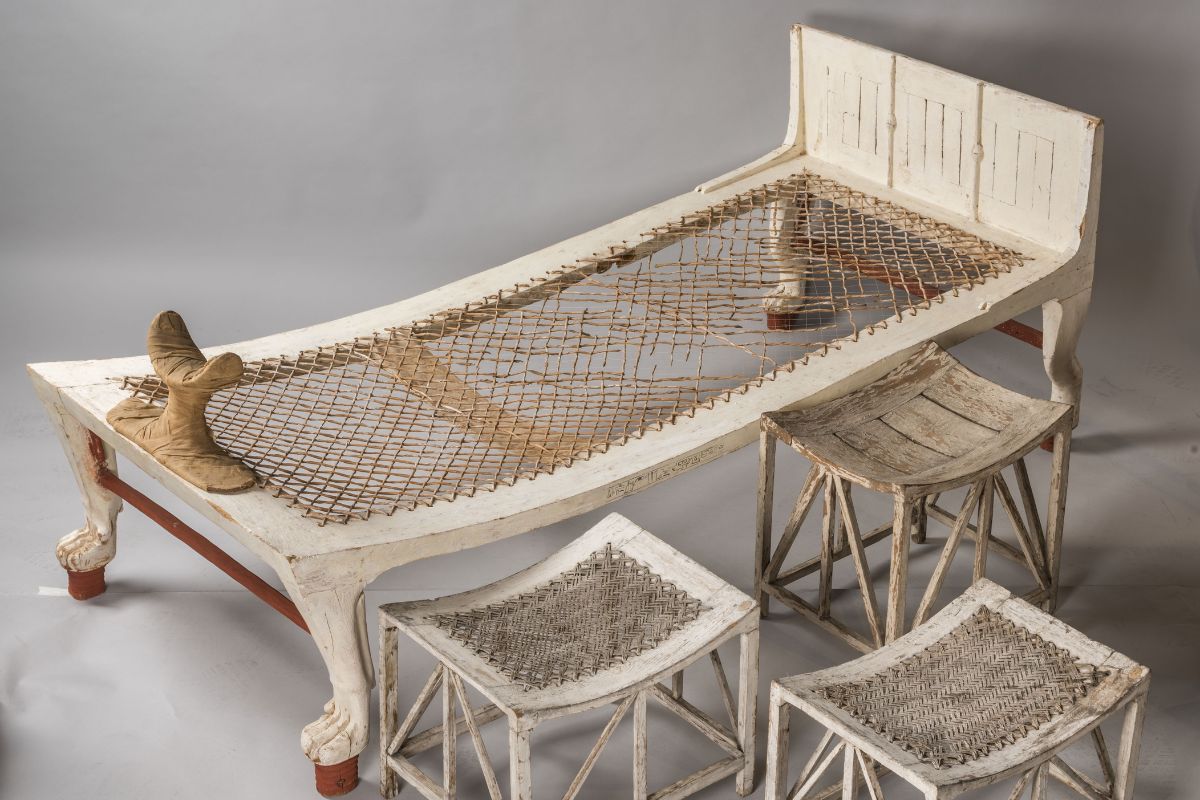
In ancient Egypt the bed became status: a raised wooden platform, with zoomorphic legs, decorated in gold and ivory .
It was a horizontal throne, a sign of power and divinity. Pharaoh Tutankhamun slept on a golden bed curved upwards – a symbol of ascension to heaven even during sleep.
Greece and Rome: the bed as a social scene
For the Greeks and Romans, sleeping was only one of the functions of the bed.
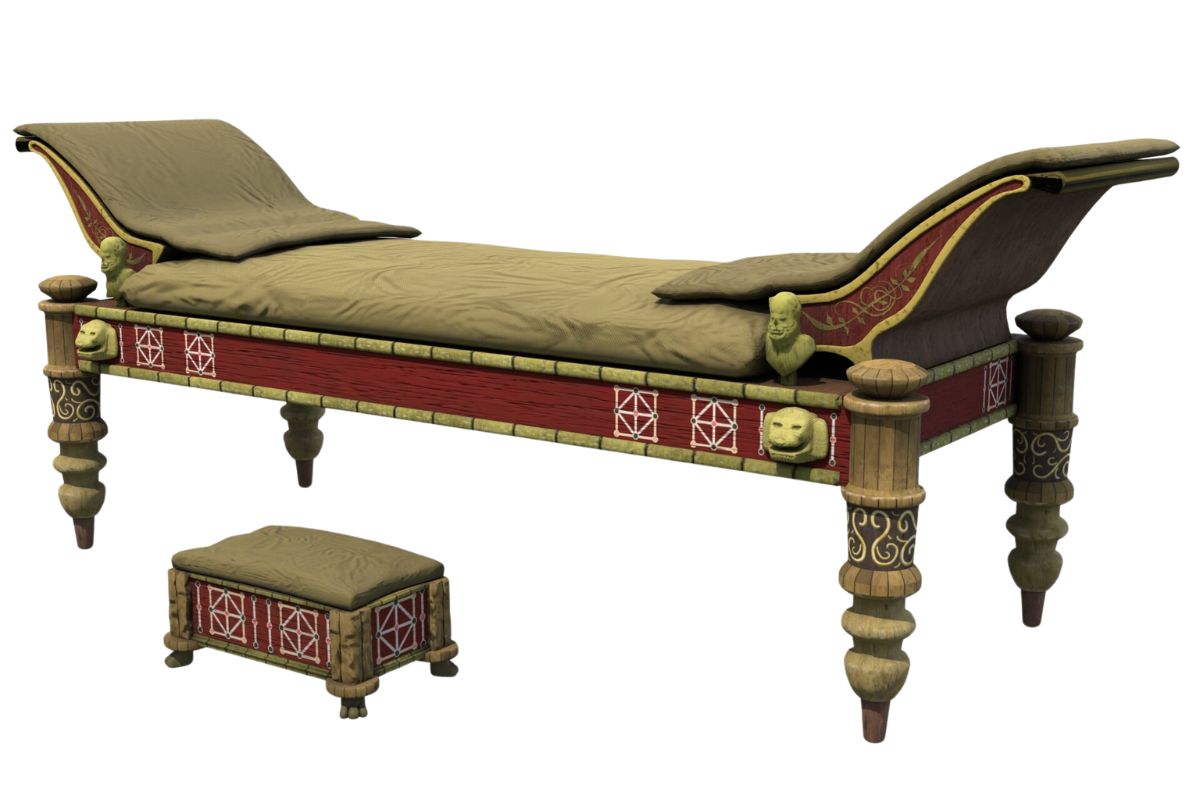
In the Roman triclinium , for example, people ate while lying down: the bed was a convivial piece of furniture.
The structures, often in bronze or carved wood, were enriched with wool and feather mattresses , and embroidered blankets, a symbol of civilization and well-being.
It is in this period that the distinction between daytime and nighttime bed was born, between private rest and public representation.
The bed also becomes an aesthetic object, an integral part of domestic architecture.
Middle Ages: the bed as a fortress and family symbol
In the Middle Ages, the bed once again became a refuge.
The rooms are cold, the floors are stone, and the bed becomes an island closed by curtains and heavy drapes .
Privacy, an almost unknown concept, was born right there, behind those fabrics that guarded sleep and secrets.
The bed becomes the fulcrum of the room , often removable and transportable.
It is the place where one receives, gives birth and dies. In many French and Italian castles, the lord’s bed is placed on a pedestal, adorned with a canopy and family coat of arms: an architecture in the room .
Renaissance and Baroque: the bed as a work of art
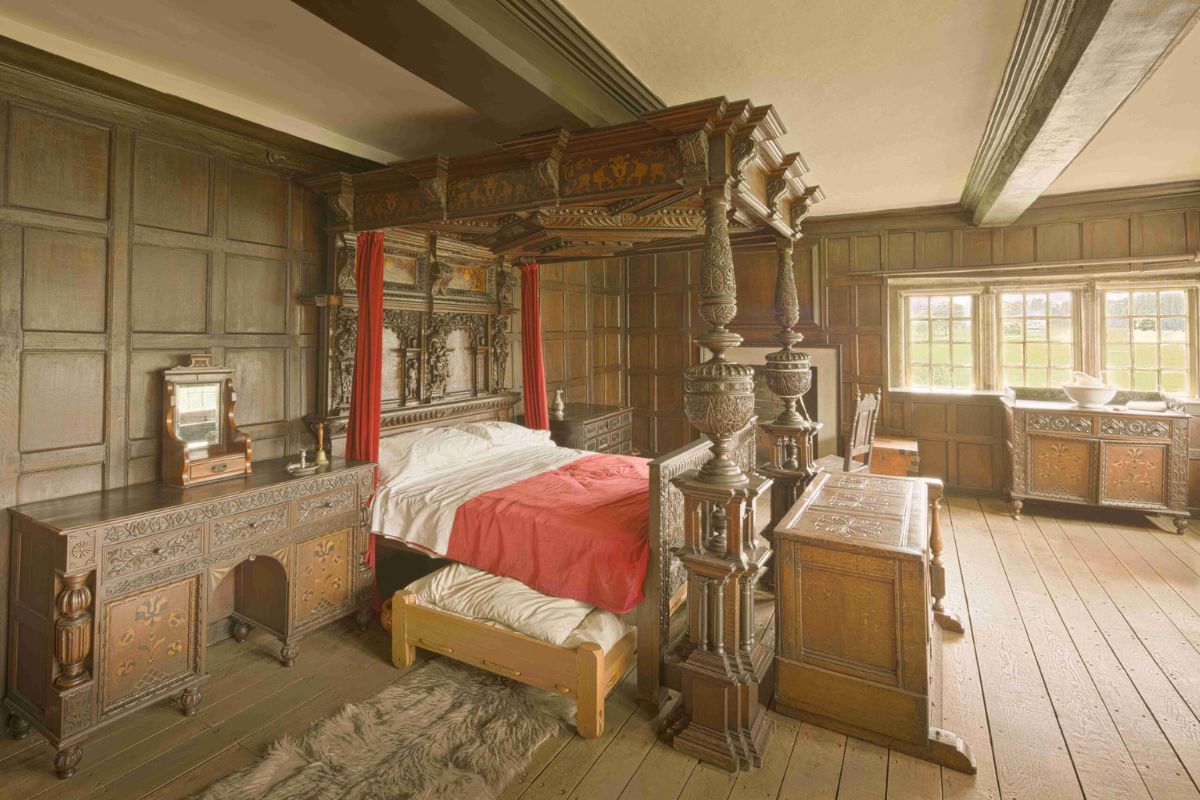
In the Renaissance, with the return of humanism, the bed transformed into an object of art and architecture .
The shapes become lighter, the decorations become more refined, the carved wood tells mythological stories.
In Florence, Venice, Paris, the canopy bed dominates the scene like a small private cathedral.
In the Baroque theatricality explodes: velvets, gilding, inlays, tdraped ends.
The bed is a spectacle for the eye and a manifesto of wealth.
Versailles becomes its emblem, with the famous “lit de parade” of Louis XIV, where the Sun King receives ministers and ambassadors still in their pajamas.
Sleeping, now, is a political act.
Nineteenth century and the industrial revolution: the modern bed was born
With the Industrial Revolution the bed changed its nature.
Wrought iron structures replace wood, hygienic and lighter, in response to epidemics that required healthier spaces.
Design becomes democratic: the first mass-produced beds are born , and the bedroom becomes a bourgeois, private, functional environment.
It is in this period that the modern double bed also appears, symbol of family union and the new idea of domestic intimacy.
The shape remains simple, but there is a new attention to comfort, spring mattresses, slats and fabrics.
Twentieth century: from Bauhaus to Italian design

The twentieth century is the century of the project.
With the Bauhaus, the bed loses all ornamentation: it becomes structure, function, ergonomics.
Shapes are simplified, materials hybridize steel, wood, leather, technical fabrics .
There is only one objective: designing comfort .
In the 60s and 70s, Italian design transformed the bed into a cult object .
The models designed by Flou , Cassina , Poliform , B&B Italia , which combine architecture and everyday life, are born.
The Nathalie bed designed by Vico Magistretti for Flou in 1978 is a revolution: removable, customizable, elegant.
Since then, the bed is no longer just a piece of furniture, but a system .
Storage beds, integrated sommiers and modular projects are born that redefine the concept of sleeping space.
The bed in contemporary design: between comfort and identity

Today the bed is a laboratory of materials and psychology.
We no longer just talk about sleep, but about sensory experience and well-being .
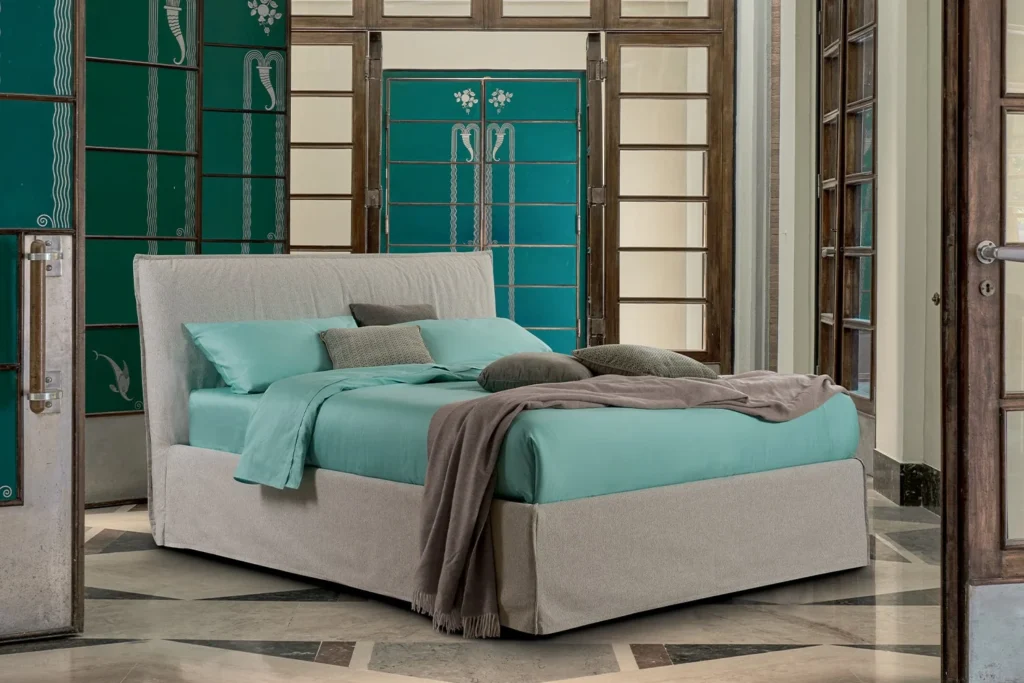
The headboard becomes a sculptural element, the covering tactile, the integrated lighting.
Brands such as Twils, Bontempi, Desiree, Lago, Zanotta and BertO explore a language where technology and craftsmanship coexist: suspended, floating beds, soft like an embrace but built with sartorial rigor .
The bed today represents the threshold between the body and the mind , the place where the rationality of the day turns off and the imagination turns on.
And perhaps it is precisely here that the original meaning of his invention is found: to separate man from the earth, to make him dream a little higher.
From bed to dream
Who invented the bed, then?
Not a name, not an era: but humanity itself , the moment it felt the need to elevate its body and give shape to rest.
Every civilization, every era, every designer has added a piece to this long history of sleeping.
Today, choosing a bed is not just a question of taste or comfort, but a cultural act , a way to tell even in sleep who we are and how we want to inhabit the world.