The concept of climate garden refers to a set of design strategies aimed at making green spaces both private and public more resilient to climate change . The adoption of adequate solutions is essential to guarantee sustainability, well-being and protection of biodiversity. As the British landscape designer Nigel Dunnett states, "gardens must be …
The concept of climate garden refers to a set of design strategies aimed at making green spaces both private and public more resilient to climate change . The adoption of adequate solutions is essential to guarantee sustainability, well-being and protection of biodiversity.
As the British landscape designer Nigel Dunnett states, “gardens must be designed not only to be beautiful, but also to function as resilient ecosystems” (Dunnett, 2008).
What is a climate garden and why is it important

Current trends in landscape design aim to integrate methodologies that favor plant resistance to new climatic conditions, reduce resource consumption and improve environmental quality.
Gardening enthusiasts can also adopt these principles to transform their green spaces into sustainable ecosystems . Piet Oudolf, known for his naturalistic approach, argues that “biodiversity and resilience go hand in hand: the more diversity we create, the stronger our garden will be” (Oudolf & Kingsbury, 2013).
Plants resilient to climate change: which ones to choose
One of the key aspects in designing a climate garden is the selection of plant species . James Watson’s project in southern France highlights the importance of diversification to counteract rising temperatures.
Replacing less resistant species with a wide range of trees , shrubs and seasonal flowering plants allows you to promote biodiversity and improve the resilience of the garden.
Landscape designer Dan Pearson also promotes this vision: “plants must be chosen based on their ability to adapt and their compatibility with the local ecosystem” (Pearson, 2005).
The introduction of drought-resistant plants is crucial to reduce the need for irrigation and ensure survival even in extreme conditions.
Sustainable water management: Rain Gardens and drainage materials
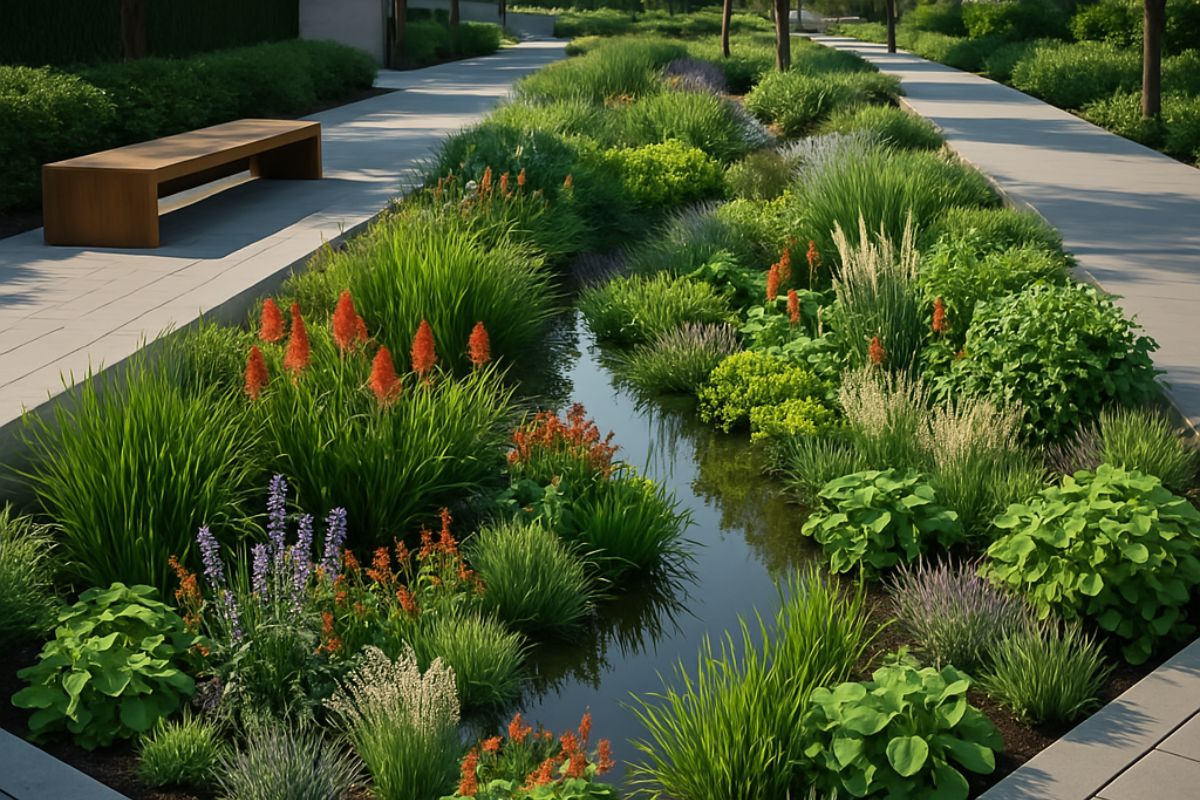
water management is a central issue, especially in a period of extreme weather events. Thomas Massey’s project in Richmond addressed the poor absorbency of the soil with innovative solutions such as Rain Gardens , areas designed to gradually collect and filter rainwater.
The use of permeable materials such as gravel and draining paving improves water infiltration, reduces the risk of flooding and promotes recharge of aquifers .
Michel Desvigne also highlights the importance of integrated solutions: “a resilient landscape is capable of adapting to water changes without losing its identity” (Desvigne, 2019).
Natural architecture: dry stone walls and green infrastructure
Nigel Dunnett, with his projects in England, introduces the use of drywalls cementless structures that allow roots to develop healthily and help regulate soil moisture. These solutions also benefit local fauna.
Green infrastructure such as hedges, buffer strips and wetlands are increasingly popular for mitigating the effect of heat waves and retaining moisture.
Gilles Clément underlines: “a well-designed garden is not a static whole, but a living organism in continuous evolution” (Clément, 2011).
How to design a sustainable and adaptable garden

The climate garden requires an approach based on the observation of natural dynamics . Instead of forcing the growth of unsuitable species, it is preferable to enhance native vegetation and favor a dynamic balance between different species.
Sustainable techniques such as:
-
the use of natural materials for support structures,
-
rainwater collection systems ,
-
plant covers ,
-
strategic tree planting to reduce urban heat,
represent effective strategies to ensure longevity, functionality and climate comfort.
Designing today for the gardens of the future
In a world marked by climate change , green design must be conscious, ecological and far-sighted. The adoption of innovative techniques, the selection of resilient species , and the promotion of biodiversity are the tools to guarantee the well-being and resistance of green spaces.
In the next insights we will analyze other strategies for designing climate gardens that are increasingly adaptable, functional and beautiful. Collaboration between landscape architects, urban planners and botanists will be fundamental to transform gardens into true environmental resources for the cities of the future .
Bibliography
-
Clément, G. (2011). The garden in motion . Quodlibet.
-
Desvigne, M. (2019). Intermediate Natures . Birkhäuser.
-
Dunnett, N., & Hitchmough, J. (2008). The Dynamic Landscape . Taylor & Francis.
-
Oudolf, P., & Kingsbury, N. (2013). Planting: A New Perspective . Timber Press.
-
Pearson, D. (2005). Sustainable Urban Design . Routledge.
Sitography