The bathroom is today the environment in which the most investments are made in renovations. This is highlighted on 2025 U.S. Houzz Bathroom Trends Study , which highlights three dynamics destined to also guide 2026: 78% of owners who renovate their home intervene on the main bathroom; 62% decide to expand the surface area, often reducing other rooms; 43% choose highly durable materials, favoring technical quartz, mineral surfaces, large format stoneware and microcement over purely aesthetic solutions.
The picture broadens by observing the world market: as sector analyzes indicate, the bathroom renovation sector is constantly growing and shows a growing interest in modular systems , efficient systems and low maintenance surfaces , three elements that respond to real needs of daily life.
Even on the aesthetic front, 2026 starts from a clear signal. The Pantone Color Institute has chosen Cloud Dancer as Color of the Year : a smooth, essential white, deliberately free of aggressive undertones. A choice that interrupts the sequence of saturated colors of recent years and which indicates a return to stable palettes, more planning than decorative: neutral chromatic bases that last over time and allow the materials to become protagonists.
It’s a direction that mirrors what interior designers are seeing in projects in Europe and the United States. Customer demands converge towards: environments that are easy to maintain and less vulnerable to wear and tear; solutions that improve the quality of daily experience , beyond the scenic effect; high-performance materials that are resistant to humidity, limescale and stains; systems that can be updated over time , without invasive demolition; larger showers and continuous surfaces, supported by discrete and integrated technologies. But let’s go into detail and discover the 2026 bathroom design trends.
Bathroom materials, surfaces and structures 2026
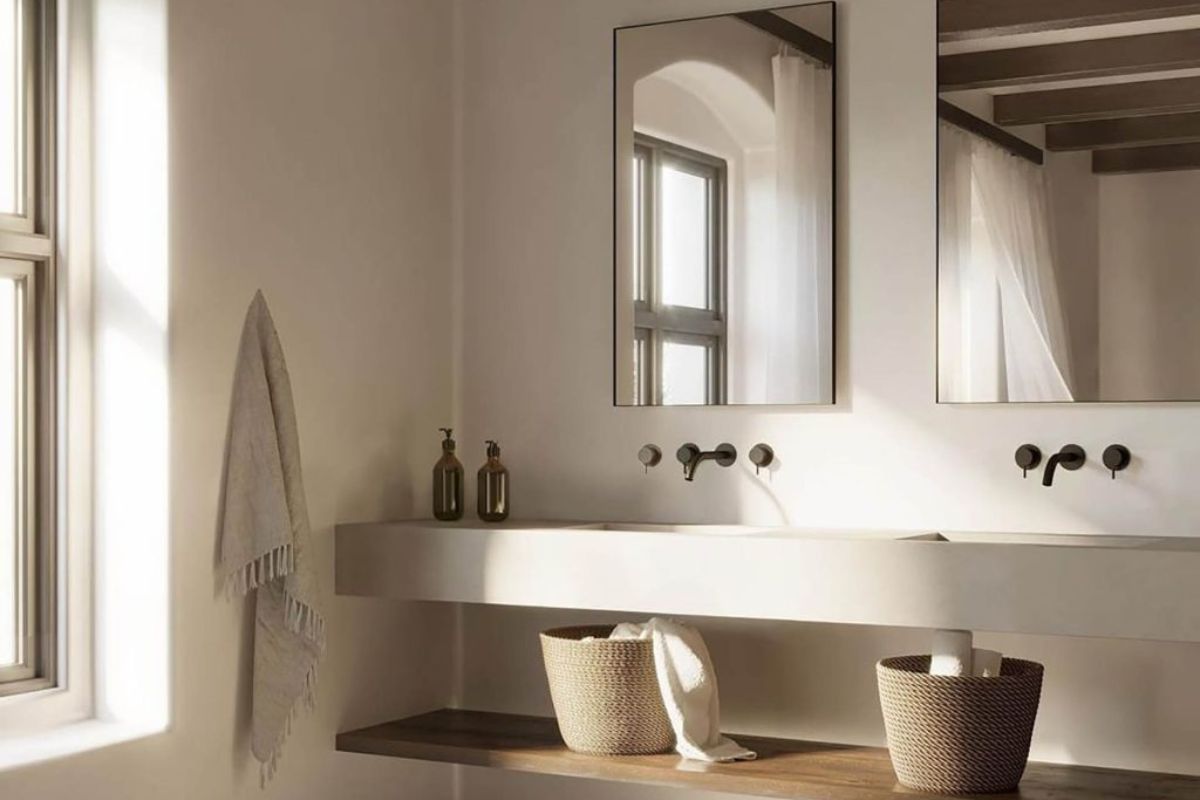
If there is one aspect that defines the 2026 bathroom, it is the maturity of the material choices. There is no longer the chase for the immediate visual effect: designers evaluate performance, longevity, maintenance cycles and the ability of materials to integrate into future projects. It is an aesthetic that arises from function, not the other way around.
1. Continuous surfaces and technical materials: the end of useless interruptions
The growth in the use of microcement , resins and mineral surfaces is one of the most evident trends. The reasons are clear:
-
visual continuity and absence of leaks;
-
high resistance in humid environments;
-
ease of cleaning;
-
adaptability to existing surfaces (less invasive interventions).
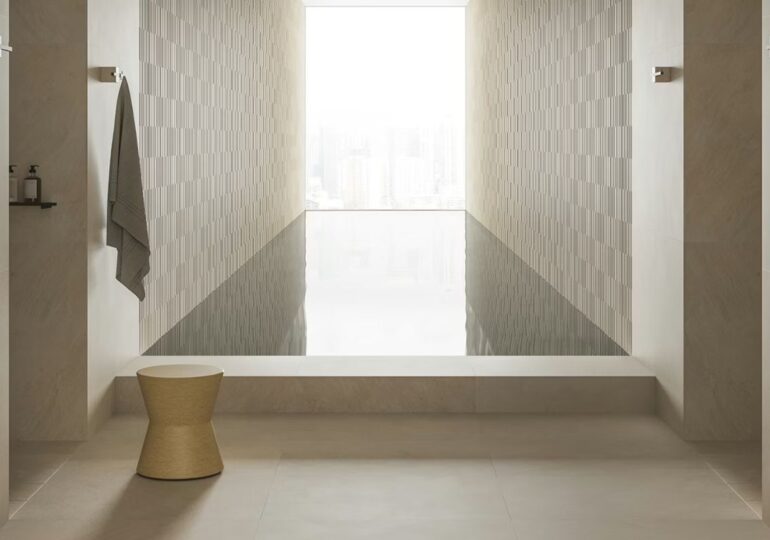
Interior design studies confirm that in 2026 continuous surfaces are chosen both for small urban bathrooms, where they amplify the perception of space, and in larger environments, where they become a languagearchitectural.
Large format stoneware, now available in minimum thicknesses, follows the same direction: increasingly larger slabs, stone or concrete inspirations and almost imperceptible joints.
2. Technical and natural stones: performance before appearance
The average customer is more informed and less willing to tolerate delicate materials. This is pushing towards:
-
technical quartz with soft-touch finishes;
-
sintered stones extremely resistant;
-
natural surfaces treated with water-repellent nanotechnologies;
-
matte and microstructured finishes that mask wear.
Natural stones do not disappear, but are put back into selective use: sculptural tubs, washbasin tops, illuminated niches. Important materials, but inserted with design discipline.
3. Wood and warm textures: not decoration, but acoustic and tactile compensation
It is not simply the return of wood. 2026 sees the controlled use of:
-
heat-treated woods;
-
essences resistant to humidity;
-
technical paneling with wood finish.
The function is not just aesthetic: these elements compensate for the too rigid acoustics of completely mineral baths and introduce a tactile component that reduces the “clinical” effect.
Designers talk about “warm balance”: inserting a few natural elements into a highly technical system.
4. Technical metals: taps and details that become structure
Metal is no longer an accessory, but part of the bathroom architecture. Trends 2026:
-
finishes titanium , brushed nickel , matt champagne ;
-
wall-mounted taps with built-in body and simplified maintenance;
-
handles, shower profiles and accessories in the same finish to ensure visual continuity.
The use of matte black, which has shown durability limitations, is reduced in favor of more stable and technical materials.
5. The role of color: Cloud Dancer as a basis, materials as language
With Pantone 2026 electing Cloud Dancer (a sophisticated, not cold white), color in the bathroom takes on a new role: it is not the protagonist, but infrastructure .
The 2026 palette is built like this:
-
base in opaque whites , neutral or slightly warm;
-
protagonist materials (stone, mineral, cement, wood);
-
chromatic micro-hints on textiles or accessories, not on permanent elements.
Pantone’s white anticipates a season of clean, tidy environments, calibrated on materials and not on colours.
6. Modularity and upgradeable systems: the bathroom designed as a system
One of the most important changes concerns the structure of the bathroom itself:
no longer a set of isolated elements, but a modular system designed to be updated.
Trend 2026:
-
suspended furniture with interchangeable modules;
-
washbasin tops upgradeable without removing the entire structure;
-
niches and shelves integrated into the wall;
-
shower systems with replaceable trays and invisible maintenance panels.
The goal is a bathroom that can evolve without demolition: one of the most recurring requests from customers in the last two years.
Lighting, systems and silent technology in the bathroom 2026

If 2026 favors continuity and performance in materials, an even more significant change takes place in systems and lighting: technology does not disappear, but retreats , integrates, camouflages itself. The goal is not to show innovation, but to make the bathroom more efficient and less vulnerable .
1. Multilevel lighting: not atmosphere, but technical precision
Bathroom lighting in 2026 is structured on three levels, not for aesthetics but for functionality:
Architectural light
Recessed LED profiles, continuous lighting lines, luminous grooves. They do not create gratuitous scenographic effects: they serve to distribute light evenly, avoiding harsh shadows on surfaces that require constant visual maintenance.
Service light
Frontal or bilateral lighting integrated into the mirrors, calibrated to high CRI.
Interior designers have been repeating it for years: light from above distorts, light from the front restores fidelity and visual comfort. In 2026 this rule becomes standard.
Dynamic light (adjustable)
It is not a gadget: it serves to compensate for the absence of natural light , especially in internal bathrooms.
The adjustable color temperature does not follow “wellness” fashions, but ergonomic and circadian criteria.
2. Technical showers: continuous surfaces, advanced drains, minimal maintenance
The shower is the area with the greatest hidden innovation:
-
mineral plates with non-slip microtextures not visible to the naked eye;
-
rapid inspection linear drains;
-
wall panels that can be replaced individually in case of damage;
-
glass with long-lasting anti-limescale treatments;
-
water saving shower heads but with constant flow rate.
The real trend is not aesthetic: it is reducing the number of future operations .
3. Invisible systems: flexible maintenance and upgrades
One of the most discussed changes among interior designers is the increase in demand for:
-
built-in bodies for taps and showers,
-
inspectable modules truly accessible,
-
enhanced ventilation systems , essential for continuous surfaces,
-
multiple electrical arrangements, even in niches and cabinets,
-
systems that allow upgrades without demolition .
Companies are responding with solutions that can be open, clean, updated. For the customer it means only one thing: longer service life .
4. Silent technology: always present, never the protagonist
The 2026 bathroom integrates technology only when it is useful. No smart excesses; much more intelligence, much less protagonism. The most adopted solutions are:
-
mirrors with integrated anti-fogging (not visible, without buttons);
-
smart systems to optimize water consumption ;
-
discrete sensors for night-time passage lighting;
-
toilet with integrated intelligent flushing functions, but without invasive high-tech aesthetics.
The trend is clear: the innovation is there, but it cannot be seen . It remains hidden, controlled, planned.
5. Ventilation and acoustic comfort: the new technical topic
A bathroom with continuous surfaces and technical materials requires:
-
more efficient ventilation;
-
acoustic systems that reduce noise and rumble;
-
insulation solutions integrated into the plasterboard or coverings.
This is not a detail: it has become one of the most discussed quality criteria in professional consultancy.
Furniture, compositions and bathroom furnishing solutions 2026

In 2026, bathroom furnishings no longer follow the language of contemporary living, nor that of spas. It moves in a totally different direction: intelligent modularity , upgradability , suspended structures and technical work plans . It is a functional aesthetic that arises from real needs, not from styling.
1. Suspended furniture and light structures: the bathroom must not touch the ground
Suspension becomes the standard. Not for a minimal effect, but because:
-
facilitates cleaning;
-
reduces contact with humidity;
-
allows air passages which extend the life of the surfaces;
-
visually lightens even small bathrooms.
The new structures are slim but reinforced , with attachment systems capable of supporting significant weights without sagging over time.
2. Advanced vanities: technical surfaces and flexible
The 2026 vanities don’t aim to amaze: they aim to last and function . Key Trends:
-
full extension drawers with thin metal sides;
-
integrated sink tops in technical materials (mineral, quartz, solid surface);
-
anti-fingerprint finishes;
-
organized interiors to prevent the chaos typical of the bathroom.
The new idea of luxury is order that is maintained without effort.
3. Modular compositions: the bathroom designed as a system
Bathroom 2026 follows a precise principle: everything that cannot be updated is a future problem . In design choices this translates into:
-
modules interchangeable over time;
-
floors that can be replaced without touching the structure;
-
columns equipped with adjustable shelves;
-
integrated niches, not supported;
-
standardized components to facilitate future integrations.
Modularity is not an aesthetic concept, but a form of design insurance .
4. Mirrors and technical containers: no more decoration
2026 mirrors are technical devices:
-
integrated anti-fog;
-
high CRI light;
-
minimal frames;
-
backlit containers;
-
invisible electrical arrangement.
The design is reduced to the essence because the instrument must work, even before surprising.
Palettes, combinations and color structures of the 2026 bathroom trends

With Cloud Dancer as the Pantone color of the year, 2026 definitively abandons the “charged” bathroom and rediscovers the logic of the neutral chromatic base . Not a sterile white, but a balanced white, warm enough, which enhances materials and textures.
1. The role of white: infrastructure, not aesthetics
White 2026 does not serve to “shed light”, but to:
-
give visual continuity;
-
bring out the materiality;
-
avoid effects that are dated over time;
-
keep the bathroom tidy to the eye.
It is a stable colour, not subject to fashions, useful as a design foundation.
2. Material palette: the true color is the surface
The colors most used by designers are those of the materials :
-
mineral grays (microcement, resins, technical stones);
-
natural sand beige and greige;
-
tobacco browns in the t versionsheat-treated wood;
-
oxidized tones of metals.
It is a palette that “does not age” because it is not linked to a color but to the skin of the material itself .
3. Disciplined contrasts: maximum one, never decorative
Bathroom 2026 is not neutral by habit, but by visual control . The contrast is used like this:
-
only one;
-
never turned on;
-
always material (a dark stone, a texture, not a flat color).
It is an environment designed to last 1520 years without looking dated.
4. How to actually use Cloud Dancer in the bathroom
Pantone 2026 white works in:
-
walls with high light reflection;
-
vanities with matt or microporous finish;
-
shower profiles;
-
mineral shower trays;
-
illuminated niches.
It should not be used as a “white paint”: it is a furnishing white , calibrated.
What clients are really asking for in 2026 (according to architects and interior designers)

Architectural firms are unanimous: clients no longer ask for “the cover bathroom”. They ask for an easy life , order , efficiency . Here’s what comes up most often in 20252026 project briefings.
1. I want a bathroom that doesn’t get ruined
The most frequent request. The customer wants:
-
non-staining surfaces;
-
materials that are not afraid of water;
-
finishes that do not change after a few months;
-
taps that do not lose pressure or shine.
Durability has become more important than aesthetics.
2. It must be easy to clean
Designers confirm a net increase in requests aimed at:
-
continuous surfaces;
-
absence of leaks;
-
single and integrated plans;
-
showers without complex profiles.
Maintenance weighs more than design.
3. Big shower, everything else comes later
The shower has become the central element, even in small bathrooms.
Requests:
-
floor-level plates;
-
large shower heads;
-
quality glass;
-
integrated niches; Leave a comment