Design and architecture are worlds in which female talent has been able to express itself in an extraordinary way, leaving indelible traces and redefining the very boundaries of creativity. From the pioneers of modernism to contemporary minds leading a stylistic and conceptual revolution, female designers have transformed not only the spaces we live in, but also the perception of the role of women in often male-dominated sectors. This article is a tribute to famous female designers , a journey that leads us to explore the lives and works of figures such as Eileen Gray, Florence Knoll, Patricia Urquiola and many others, to understand how their vision has changed the world of design forever.
Famous women designers: innovation and intuition
Eileen Gray: the art of challenging aesthetic and functional canons
Eileen Gray, born in Ireland in 1878, was one of the most influential and visionary figures of modernism. Not only a designer, but also an architect, Gray has built an independent path that is often in contrast with the dominant currents of her time. His penchant for minimalism and his sense of structure gave rise to works that revolutionized the concept of furniture and housing architecture.
Villa E-1027: a manifesto of modernism
One of Gray’s best-known works is the villa E-1027 on the French Riviera, a project that summarizes his idea of functional and fluid space. Built to live in harmony with the landscape, E-1027 embodies the concept of continuity between inside and outside. Each architectural element is designed to give a sense of openness, while details such as the furnishings and the famous E-1027 Adjustable Table reflect his mastery in combining aesthetics and functionality.
Innovations in materials and style
Gray experimented with materials unusual for his time, such as tubular metal and lacquer, which he used to create shiny surfaces and objects with strong visual impact. His famous Bibendum armchair, with rounded shapes and sinuous lines, is a symbol of modernity and a style statement that has withstood the passing of decades. Gray’s work not only broke aesthetic standards, but also pioneered a new understanding of the role of design in everyday life.
Florence Knoll: functionality and refinementcorporate interior design
Florence Knoll has left an indelible mark on the design of corporate spaces, transforming them from simple workplaces to spaces of collaboration and well-being. Founder of Knoll Associates , Florence developed a design methodology that moved away from heavy decoration, aiming for a clean and rational aesthetic. Trained by Ludwig Mies van der Rohe, she learned the importance of essential lines and functionality above all else.
The “Knoll Planning Unit” and the office revolution
Florence introduced the concept of Knoll Planning Unit , a systematic approach to the design of workspaces. He created layouts that promoted communication and efficiency, introducing modular furniture that easily adapted to companies’ needs. This vision, while bold for its time, helped shape the modern office as we know it today.
Iconic furnishings: simplicity that surpasses time
Many of the pieces designed by Florence Knoll have become symbols of modernism, such as the Knoll Sofa Collection , characterized by straight and minimalist lines, and the Barcelona Chair , designed in collaboration with Mies van der Rohe. Knoll has always underlined the importance of coherence between aesthetics and functionality, creating furniture that not only completes the space, but enriches it with timeless elegance.
Contemporary famous female designers: between innovation, sustainability and cultural identity
Zaha Hadid: futuristic female architecture
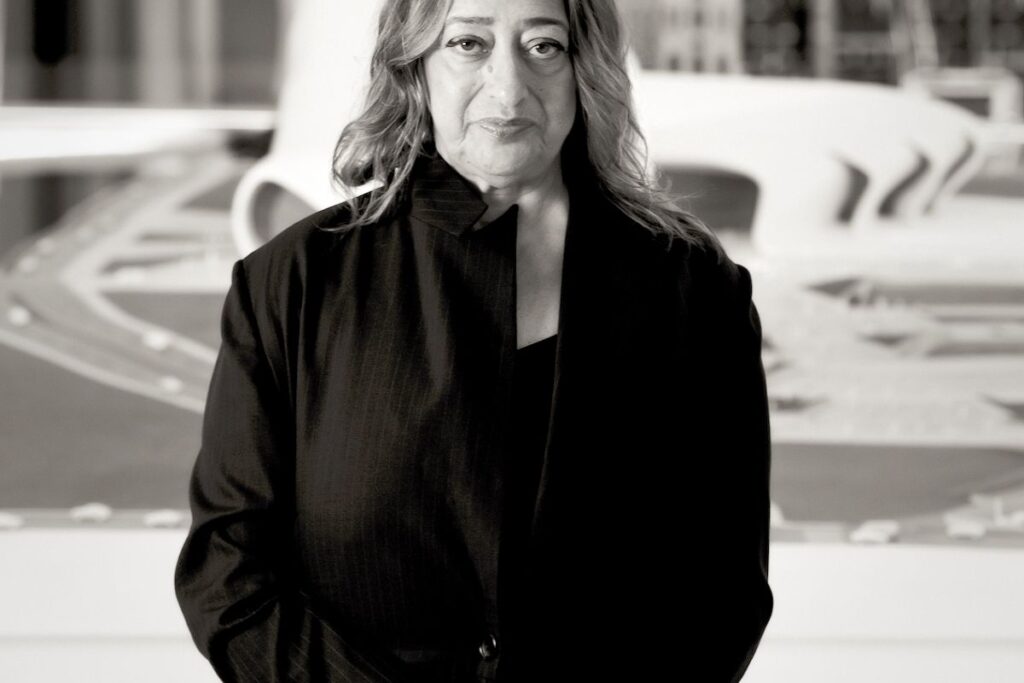
Born in Iraq and naturalized British, Zaha Hadid has been able to transform the face of contemporary architecture. With her bold and visionary style, Hadid has created projects that seem to defy the laws of physics, using fluid geometries and organic shapes that recall the movement of water or the curvature of hills.
The MAXXI in Rome and other iconic works
Among Hadid’s most famous works is the MAXXI – National Museum of XXI Century Arts in Rome, a structure where concrete comes to life through dynamic curves and continuously transforming spaces. Other works, such as Heydar AliyevCenter in Azerbaijan, testify to his ability to blend beauty and structural complexity, creating buildings that seem suspended between present and future.
Feminism and Hadid’s influence on architectural culture
Zaha Hadid was one of the few women to receive the prestigious Pritzker Prize, demonstrating how female talent can break barriers and set new standards. Her career has been a struggle for acceptance in a male-dominated industry, and her success has inspired an entire generation of young female architects and designers.
Patricia Urquiola: a synthesis of culture, art and functionality

Spanish designer and architect, Patricia Urquiola is famous for her ability to combine different styles, creating objects and furnishings that mix European influences and references to Asian culture. Trained by Achille Castiglioni, Urquiola learned the importance of designing intuitively and sustainably, placing comfort and sustainability at the center of her work.
International collaborations and ecological design
Urquiola has collaborated with world-famous brands such as Moroso, B&B Italia and Kartell, developing collections ranging from iconic armchairs such as the Husk Chair for B&B Italia to furnishing accessories with fluid and organic shapes. The designer is a pioneer of sustainable design, using recycled materials and innovative techniques to create ecological and environmentally friendly objects.
The role of color and shapes
Urquiola’s creations are characterized by bright colors, tactile fabrics and geometric shapes inspired by nature. Her attention to detail and quality craftsmanship has given her a reputation for excellence and a strong impact in the industry, making her one of the most authoritative voices in contemporary design.
Icons of Italian design: elegance and innovation Made in Italy
Paola Navone: design as a cultural journey
Paola Navone is an Italian designer who has managed to combine international cultural influences in a unique and recognizable style. Her eclectic aesthetic, which ranges between East and West, makes her one of the most innovative and interesting voices on the Italian design sceneno and international.
Collections and collaborations
Navone has worked with prestigious brands such as Baxter and Cappellini, creating collections that combine raw materials, such as wood and metal, with fine fabrics. His work reflects a love of travel and discovery, and each piece tells a story that goes beyond simple furnishings.
Navone’s impact on modern design
Navone’s design is characterized by an aesthetic sensitivity that goes beyond fashion, creating environments that mix modernity and tradition in a harmonious way. It has received numerous awards, including the Elle Decor International Design Award, confirming its relevance and its ability to transform every space into a visual and sensorial experience.