How to hide the washing machine and dryer when there is no space for a real laundry room? It is a concrete, daily question that concerns many contemporary homes. In fact, not everyone has the possibility of dedicating a specific room or corner to the laundry room: small sizes, complex layouts and different priorities often require solutions that are more intelligent than structural.
In these cases, the project does not involve the creation of an ad hoc room, but rather a series of targeted choices and small measures capable of bringing function and aesthetics together. This is where the so-called “tricks” of the project come into play: tailor-made additions, camouflaged volumes, furnishings that absorb the technical function without declaring it.
Interior designers have been working on this balance for years. Before even thinking about where to place the washing machine and dryer, they evaluate the dimensions, performance and silence of the appliances – often starting from the choice of the best washing machine brands – and then build a solution around it that is consistent with the space and style of the house.
From these real needs arise the 7 ideas that architects and interior designers use most often to hide the washing machine and dryer with elegance, even when space is limited and the laundry room simply isn’t there.
Idea 1: Hide them inside a wardrobe (even when it seems impossible)

When there is no space for a real laundry room, the wardrobe becomes the most intelligent and transversal solution . It is one of the tricks most used by designers because it allows them to absorb the technical function without introducing new “declared” volumes.
Washing machine and dryer are inserted in a full-height column , closed by doors which, from the outside, appear like a normal wardrobe or as a continuous part of the wall.
A real example used in projects
Here we are not talking about theoretical solutions, but about systems actually used in residential projects :
-
Rimadesio Cover
Design wardrobe system with coplanar doors, widely used to hide technical volumes in living environments, corridors or sleeping areas. It was not born as a “laundry cupboard”, but this is precisely why it is appreciated by designers: it makes the function disappear , leaving only the architectural volume. -
Lema Wardrobe by the Centimeter
Tailor-made solution that allows you to design the laundry column internally (appliances, shelves, technical compartments) while maintaining a language consistent with the rest of the house on the outside.
Designer makeup
In these cases the project always starts from:
-
Actual measurements of household appliances
-
Study of ventilation and openings
-
Choice of stable and silent models which is why we often start from the best washing machine brands before even designing thewardrobe
Only afterwards are doors, materials and finishes defined.
Why it works so well: Because the wardrobe is an accepted element in any environment. If well designed, no one will perceive that there is a laundry room behind those doors.
Idea 2: Hide them behind an architectural niche with sliding panels

When the wardrobe isn’t there – or you don’t want to introduce a “furnished” volume – the designers work on the architecture of the space . This is where the technical niche comes into play, a specially designed recess that houses the washing machine and dryer and which, once closed, disappears into the wall .
It is not a decorative solution, but a design trick : the function remains, the view does not.
How it really works
The niche is obtained:
-
in a bathroom
-
in a corridor
-
along a blind wall
-
near the kitchen or sleeping area
The closure occurs via sliding or full-height panels , often treated like wall surfaces: same colour, same finish, same visual reading.
Real systems used by designers
Here we are not talking about “catalog laundries”, but about actually existing paneling systems , adapted for technical use:
-
Rimadesio Velaria / Sail
Sliding panels and retractable systems used to create continuous walls. Perfect for hiding a technical niche without interrupting the architectural rhythm. -
Porro Glide
Minimal sliding door system, widely used in contemporary residential projects to close recesses and technical spaces. -
Lualdi Koan / L7
Flush-to-the-wall doors and panels that allow the laundry to be treated as a true “invisible door”.
Important: these are not products created as laundry , but that is precisely the point. Designers choose them to make the function disappear , not to declare it.
Designer makeup
Those who use this solution pay attention to three fundamental aspects:
-
Perfect alignments : the panel must read like a wall, not like a piece of furniture
-
Fluid opening : better sliding when space is limited
-
Reliable and silent household appliances : once again, the choice of the best washing machine brands affects the success of the project, especially in passage areas or near the sleeping area
When it’s the right choice
-
If you want zero visual impact
-
If the house has a minimal or architectural language
-
If you prefer to work by subtraction, not by addition of furnishings
Mistake to avoid: Think of the niche as a simple “hole in the wall”. Without a study of depth, ventilation and access, the result risks being uncomfortable or not very durable.
Idea 3: Integrate them into the bathroom making them seem part of the furniture
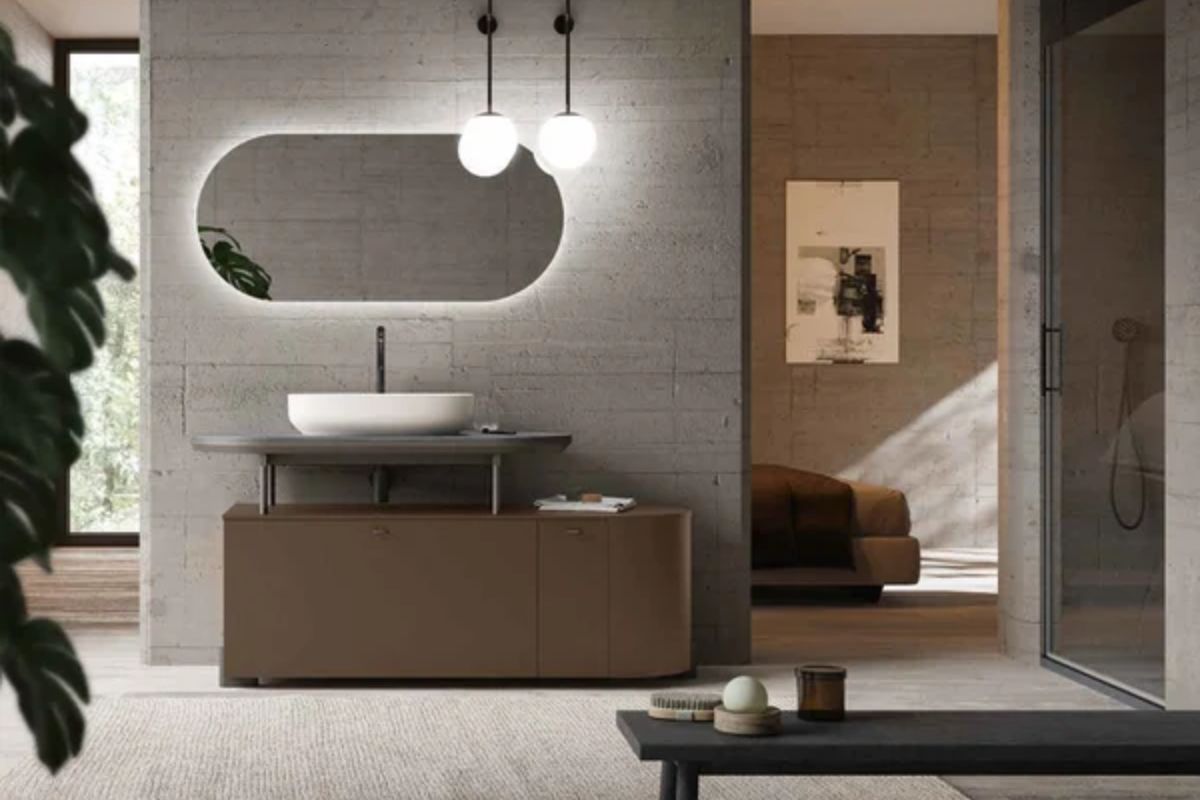
When there is no space elsewhere, the bathroom becomes the most logical place to accommodate the washing machine and dryer. The point, however, is not to make them seem like “tolerated guests”, but elements perfectly integrated into the project .
Designers do this by working on columns and modular systems which absorb the technical function and return it in the form of furniture consistent with the language of the bathroom.
How it really works
Washer and dryer are inserted:
-
in full-height columns
-
behind doors coordinated with washbasin units and wall units
-
often with an upper module for storage or laundry
The result is an orderly, continuous bathroom, where the eye reads volumes , not appliances.
Really existing models and systems
Here there are collections created precisely for this use , not forced adaptations:
-
Arbi Arredobagno Laundry Collection
One of the most complete lines on the market: laundry columns, bases and wall units designed to house washing machines and dryers with dedicated doors, coordinated finishes and correct proportions. -
Cerasa CartaBianca / Segno
Modular bathroom systems widely used in contemporary residential projects. The technical columns allow you to integrate appliances while maintaining a clean and architectural aesthetic. -
Scavolini Laundry Space
A transversal bathroom-laundry program designed specifically for those who do not have a dedicated room but want a tidy and designed solution.
Designer makeup
Integrating the laundry room into the bathroom only works if:
-
The finishes are the same as the rest of the furniture (no visual “detachments”)
-
The doors completely hide the appliances
-
Stable and silent models are chosen, which is why in the most careful projects we often start from the selection of the best washing machine brands , especially when the bathroom is close to the sleeping area
When it’s the right choice
-
If the bagno is of service or sufficiently large
-
If you want a practical but tidy solution
-
If you prefer to have everything concentrated in a single technical environment
Mistake to avoid: Inserting an “exposed” washing machine and dryer without a coherent design: the bathroom immediately loses balance and perceptive value.
Idea 4: Hide them in the kitchen (without making them look out of place)

When space is limited, the kitchen often becomes the only truly designed space in the house. And it is precisely for this reason that many designers choose to also absorb the laundry function here , as long as they do it methodically and without aesthetic compromises.
Washing machine and dryer are not “added”, but integrated into the kitchen system , behind the same doors, with the same finishes and the same compositional grammar.
How it really works
The most successful solutions include:
-
full-height columns dedicated
-
doors identical to those of the kitchen
-
positioning in less operational areas (end of composition, side columns)
In this way the appliance disappears and the kitchen remains readable as a coherent whole.
Really existing models and systems
The advantage here is that many kitchen brands have already provided modules compatible with washing machines and dryers:
-
Ernestomeda Icon / Soul
Advanced kitchen systems that allow the integration of technical columns. In urban projects, washing machines and dryers are often inserted in continuity with pantry and ovens. -
Scavolini Diesel Open Workshop / Formalia
Very flexible kitchen programs, also used to integrate the laundry room behind coordinated doors, especially in open spaces. -
Lube Imagine / Clover
More accessible but designally correct solutions, often chosen when the kitchen is the only space available.
Designer makeup
In the kitchen this solution only works if:
-
The appliances are silent (essential in open spaces)
-
Proper ventilation of the rooms
is provided
-
The columns do not interrupt the visual rhythm of the composition
Here too, not surprisingly, the choice often starts from the best washing machine brands , especially for vibrations and reliability over time.
When it’s the right choice
-
In urban apartments or studio flats
-
When there is no service bathroom
-
If the kitchen is already designed as a multifunctional space
Mistake to avoid: Inserting the washing machine and dryer near the cooking or washing areas without a precise plan: the kitchen loses balance and functionality.
Idea 5: Hide them with light panels, technical curtains or reversible systems
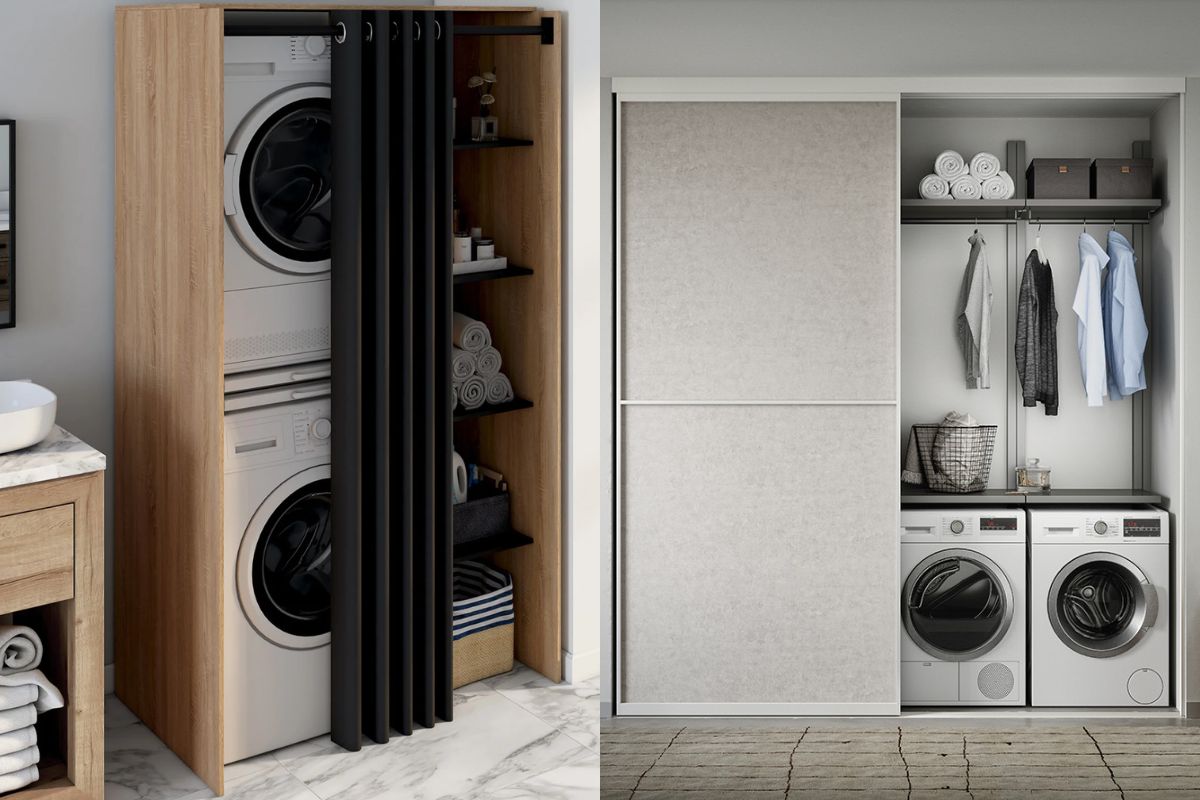
Not all houses allow structural interventions. For rent, in second homes or in temporary projects, designers resort to light and reversible solutions that allow the washing machine and dryer to be hidden without building work and without definitive constraints.
Here the project does not work on volume, but on visual perception : separating, screening, softening.
How it really works
The most effective solutions include:
-
technical or textile curtains on ceiling tracks
-
lightweight sliding panels (laminate, MDF, fabric)
-
easily removable systems
The objective is not to make the function “disappear” completely, but to reduce its visual impact , making it coherent with the space.
Really existing systems and models
Also in this case products created for other uses are used, reinterpreted in a laundry key:
-
IKEA VIDGA
Track system for ceiling or wall curtains, widely used by designers to create light curtains in front of technical niches or laundry corners. -
Silent Gliss 3840 / 5100 Series
Professional tracks, often chosen in carefully designed projects for customized technical curtains, even in bathroom environments. -
Doimo Cityline Sliding panels
Light paneling systems used to close technical spaces without building wardrobes.
Designer makeup
This solution works if:
-
The fabric or panel communicates with the rest of the environment
-
The opening is smooth and silent
-
Behind there is however order and coherence (no visible cables or pipes)
Here too, choosing reliable and compact appliances – often starting from the best washing machine brands – helps to maintain a clean and long-lasting result.
When it’s the right choice
-
In houses for rent
-
In small or irregular environments
-
When a solution is needed not definitive but elegant
Error to avoid: Use improvised or overly decorative curtains: the “emergency coverage” effect is immediate and lowers the perceived value of the space.
Idea 6: Camouflage them in the wall with flush-to-the-wall panels or coordinated surfaces
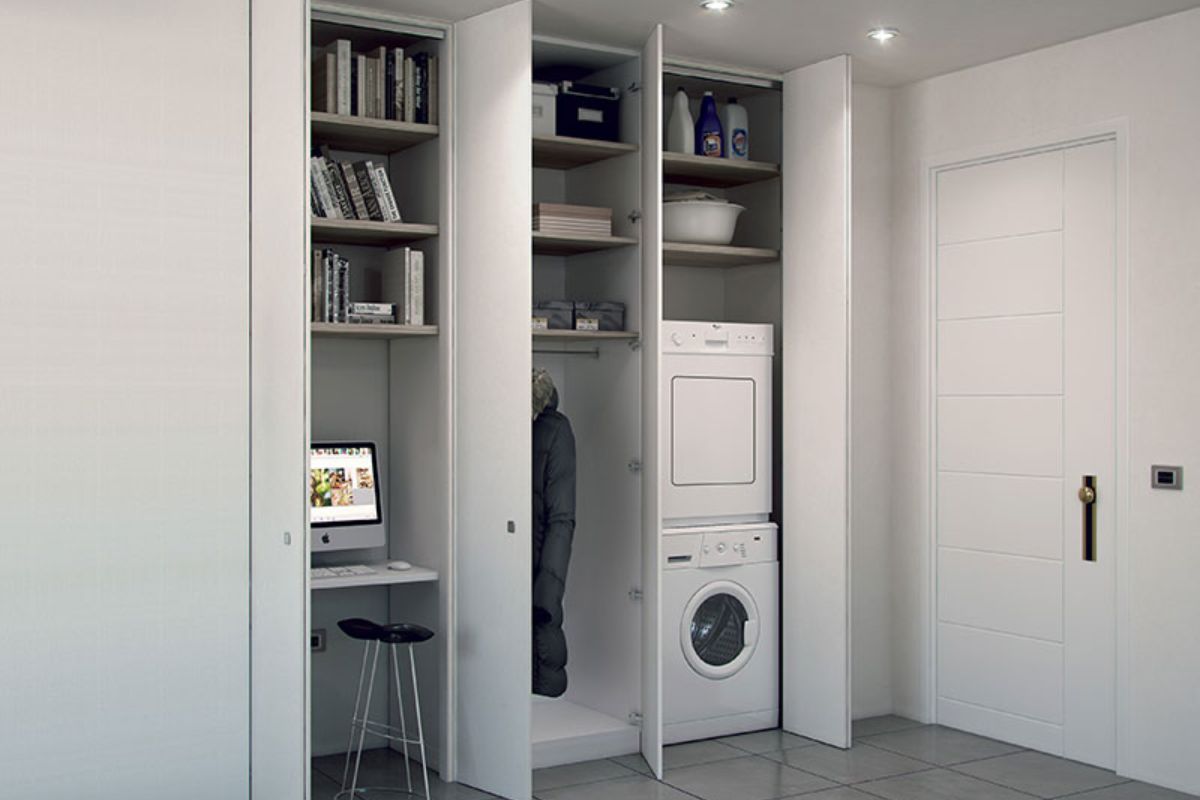
This is one of the most sophisticated solutions from a design point of view . Washing machine and dryer are not simply hidden, but absorbed by the wall , becoming an integral part of the interior architecture.
The principle is clear: the wall must continue , without declaring what is behind it.
How it really works
The laundry room is:
-
obtained within the wall thickness or in a recess
-
closed with panels or doors flush with the wall
-
treated with the same finish as the wall (plaster, boiserie, matt lacquer)
When the panel is closed, the eye perceives neither a piece of furniture nor a technical compartment.
Really existing systems and models
This is where brands specialized in architectural systems come into play, often used in medium-high level projects:
-
Lualdi L7 / Koan
Flush-to-the-wall doors and panels among the most used in contemporary residential projects. Perfect for hiding technical spaces such as the laundry room while maintaining total continuity with the wall. -
Rimadesio Velaria
System of architectural sliding panels that allows you to create real movable walls. Often used to close hidden laundries in corridors or passage areas. -
Eclisse Syntesis Line
Leave a comment
Flush-to-the-wall c