Massimiliano Fuksas is one of the most recognized and discussed Italian architects in the world . Born in Rome in 1944, he was the protagonist of a season of architecture capable of transcending national borders, bringing the Italian project to a global, monumental and strongly identifying scale.
Throughout his career, Fuksas has signed works that have redefined the relationship between architecture, city and public space: iconic, often polarizing buildings, in which formal research coexists with a radical vision of the project as a cultural act even before a functional one.
Today, as his name returns to the center of public debate, let’s retrace together the professional history of Massimiliano Fuksas: from his beginnings to the construction of an international studio, from symbolic projects to the design method that has left its mark – for better or for worse – on the imagination of contemporary Italian architecture.
Who is Massimiliano Fuksas: training and early years
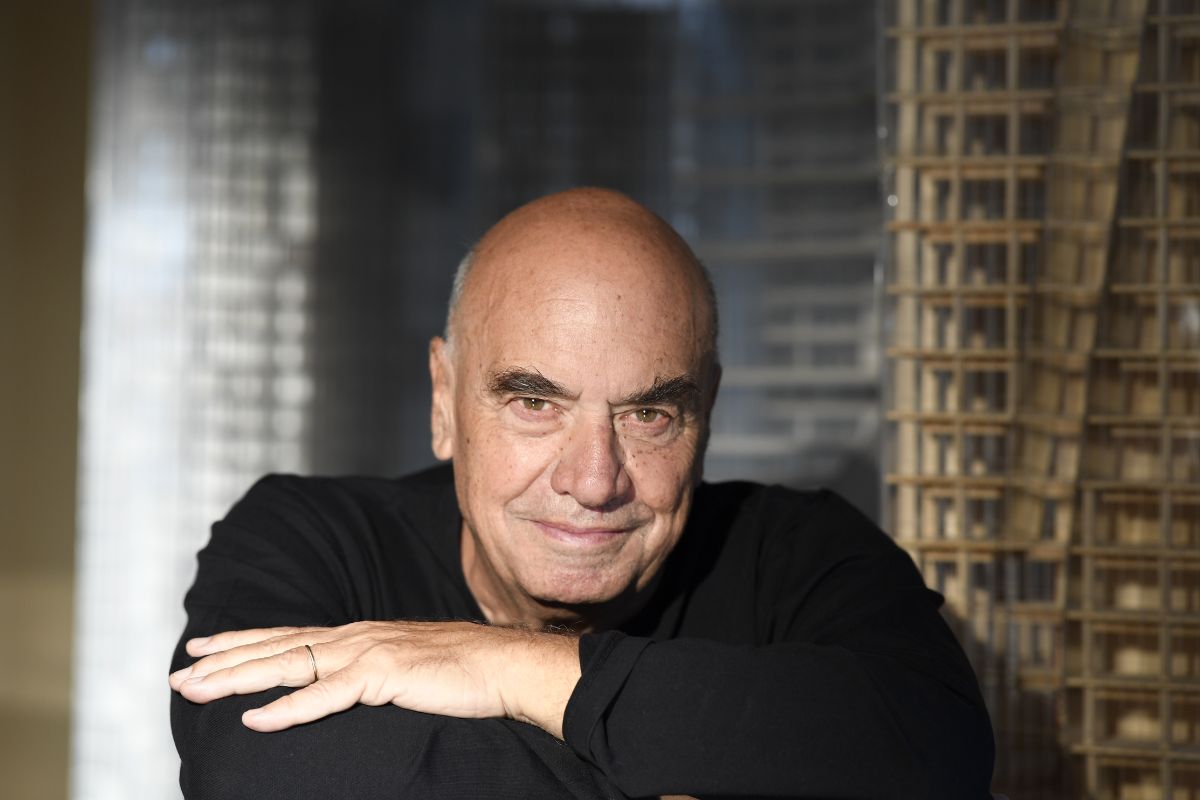
Massimiliano Fuksas was born in Rome on 9 January 1944. His education took place in a complex and stratified cultural context, where Italian architecture is trying to redefine its role between modernity, memory and experimentation. After graduating in Architecture at Sapienza University, Fuksas came into contact with intellectual and artistic environments that would profoundly influence his way of understanding the project: not as a simple functional response, but as a cultural and political gesture.
From the beginning, his work has been characterized by a non-aligned approach, far from a reassuring tradition. Architecture becomes for him an instrument of disruption, capable of generating tension, debate, sometimes conflict. It is an approach that will accompany him throughout his career.
The Fuksas Studio and the international affirmation
In the 1990s, Studio Fuksas became an international reality, with offices in Rome, Paris and later Shenzhen. It is the period in which Fuksas definitively surpasses the national perimeter and becomes one of the most present Italian names in major competitions and global public commissions.
His architecture becomes more and more recognisable: large volumes, continuous surfaces, symbolic use of the building skin, attention to the urban dimension rather than to the individual building. The project does not seek mimetic integration, but a declared relationship – often in contrast – with the context.
The iconic projects that have marked his language
Among the most representative works of Massimiliano Fuksas there are buildings that have become true landmarks, capable of summarizing his architectural vision.
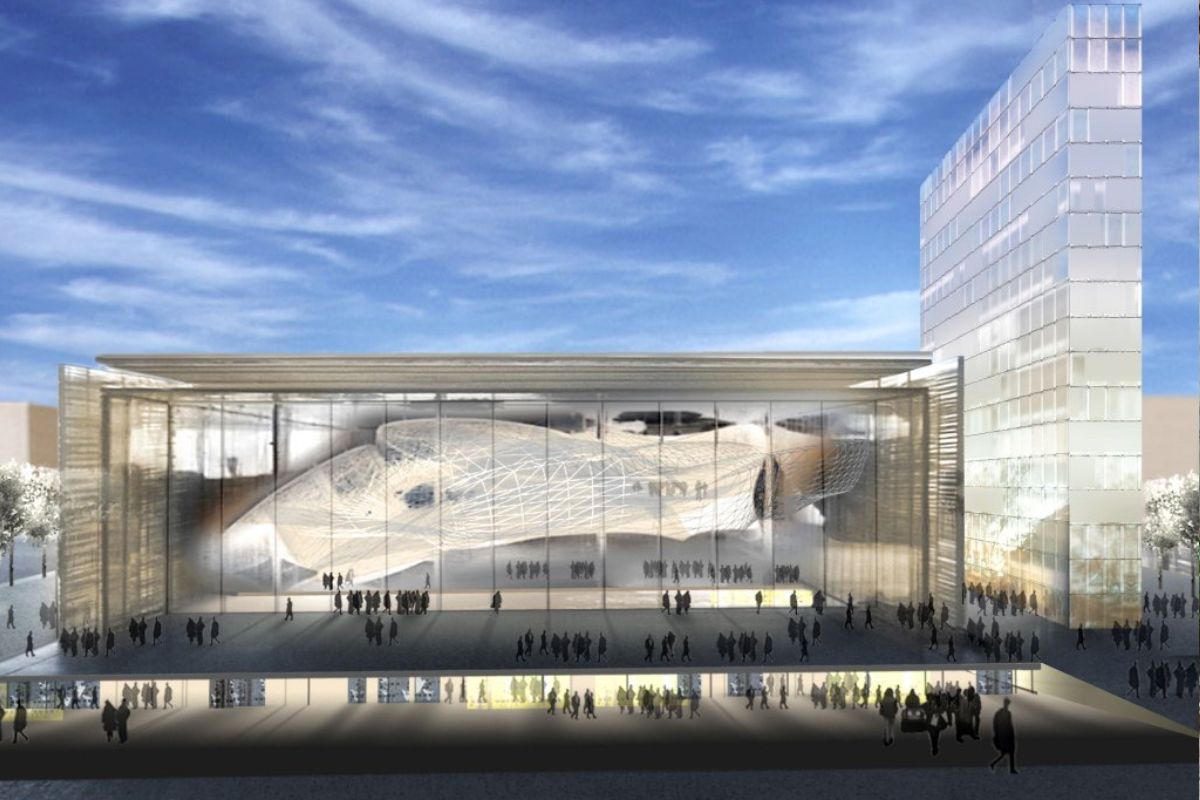
The EUR Cloud in Rome is probably the most discussed project: an architecture-manifesto, conceived as a public and symbolic space even before being a conference centre. A work that has sparked debates on times, costs and role of iconic architecture in the contemporary city.
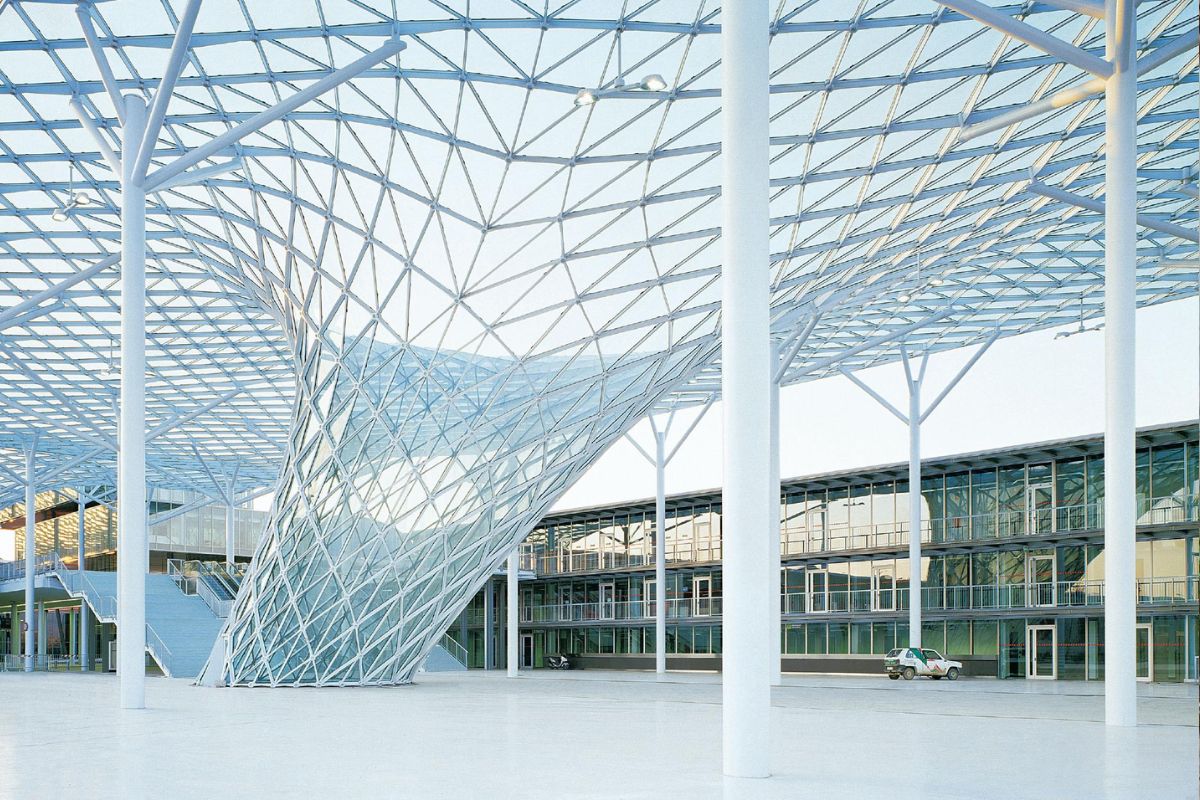
The Fiera di Milano Rho instead represents the infrastructural side of his work: a project on an urban scale, where technical complexity is intertwined with an idea of continuous space and recognizesbile.
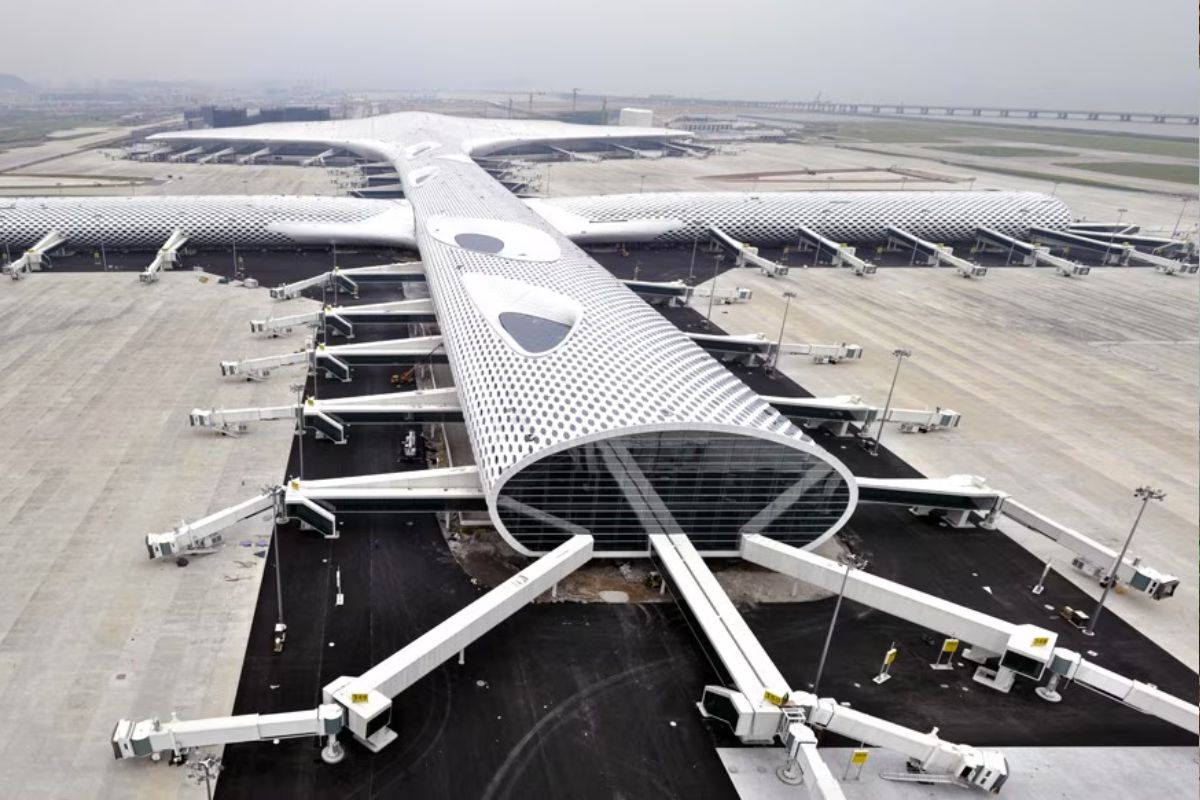
At an international level, Shenzhen Bao’an Airport marks one of the highest points of its global career: a building that combines monumentality, technological research and strong formal identity, becoming one of the symbols of contemporary airport architecture.
The Fuksas method: architecture as a cultural gesture
Talking about Fuksas means talking about a method that rejects neutrality. The project was never born as an exercise in style as an end in itself, but as a critical response to the present. Form, light, scale and matter are narrative tools, used to generate emotion and questions.
Its architecture does not seek immediate consensus. On the contrary, it often puts him in crisis. It is an architecture that divides, that forces us to take a position, and for this reason it remains over time. In a landscape increasingly dominated by standardization, Fuksas’ work vindicates the right of architecture to be an authorial expression.
Criticism, public debate and polarization
Over the years, Massimiliano Fuksas has been at the center of numerous controversies. High costs, long completion times, projects perceived as distant from everyday use: criticism has not been lacking and is an integral part of his path.
However, reducing his work to these simplifications means ignoring the role he had in bringing Italian architecture to an international level, in an era in which few studios were able to compete on that scale. The polarization around its name is, after all, the sign of an architecture that leaves no one indifferent.
Fuksas’s contribution to contemporary architecture
Today Fuksas’s work is reread with greater critical distance. Beyond the individual works, there remains the contribution of an architect who pushed the project out of the comfort zone, asking uncomfortable questions about the role of architecture, power and public space.
In a historical moment in which the debate is once again heating up around his figure, talking about Massimiliano Fuksas means questioning the meaning of iconic architecture, the relationship between the author and the city, and the boundary – always fragile – between vision and responsibility.
Who is Massimiliano Fuksas?
Massimiliano Fuksas is an Italian architect born in Rome in 1944, among the best known internationally. He is known for a highly recognisable, monumental and often iconic architecture, which has marked the architectural debate from the 1990s to today.
What is Massimiliano Fuksas’s most famous work?
Among his most famous works is the Cloud of the EUR in Rome , a conference center and public space that has become a symbol of his architectural poetics. Internationally, Shenzhen Bao’an Airport is considered one of his most representative projects in terms of scale and complexity.
Why is Massimiliano Fuksas often at the center of controversy?
Fuksas is a polarizing figure because his architecture does not seek immediate consensus. Costs, construction times and strong formal impact of some works have fueled the public debate, rendmaking him one of the most discussed Italian architects of recent decades.
What is Massimiliano Fuksas’ architectural style?
It cannot be traced back to a single style in the traditional sense. His language is based on sculptural volumes, iconic shells, large continuous structures and a symbolic use of space. For Fuksas, architecture is a cultural and political act, not just a functional one.
Has Massimiliano Fuksas also worked abroad?
Yes. His firm has operated globally, with projects in Europe, Asia and the Middle East. Among the most important works outside Italy are airports, cultural centers, event spaces and large public infrastructures.
What is the role of Studio Fuksas today?
Studio Fuksas is an international reality with offices in various cities around the world. Over the years it has faced a phase of transformation, but continues to represent one of the most relevant cases of Italian studio capable of operating on a global scale.
What legacy has Massimiliano Fuksas left to contemporary architecture?
Fuksas’ legacy does not just concern individual buildings, but the way in which he brought Italian architecture back to the center of international debate. It contributed to reaffirming the role of the architect as an author, capable of generating visions and discussions, even at the cost of dividing.