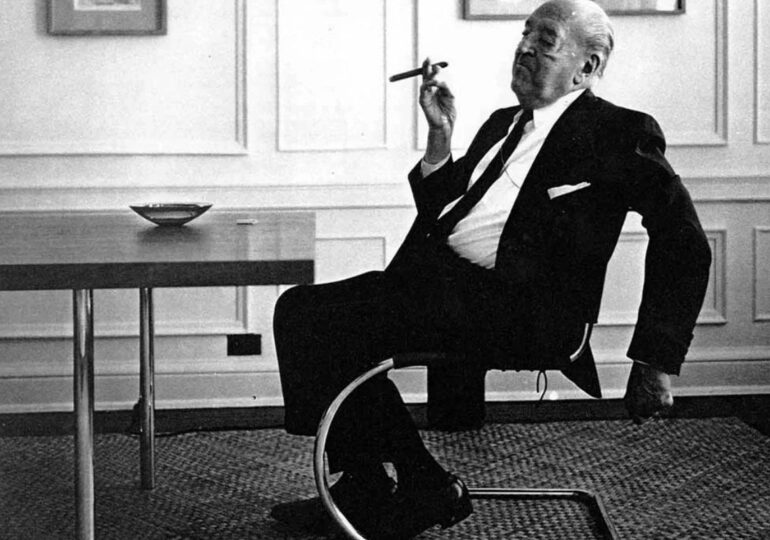
When Ludwig Mies van der Rohe pronounced the famous “ Less is more “, he was not only summarizing a poetic aesthetic, but sanctioned a new way of thinking about architecture. His rigor, his faith in structure, his love for bare material – steel, glass, stone – transformed the project into a form of truth. Mies did not design spaces to excite, but to reveal the essence of things.
Today, his thinking continues to influence architects, designers and digital planners. From the proportions of the Barcelona pavilion to the precision of the Seagram Building, the Miesian lesson is still relevant today: form does not arise from arbitrariness, but from a profound, rational and almost spiritual necessity.
Today we talk to you about his human and professional journey, his most emblematic works, and above all the philosophical roots of an idea of ??design which, more than a century later, remains surprisingly contemporary.
Who was Mies van der Rohe?
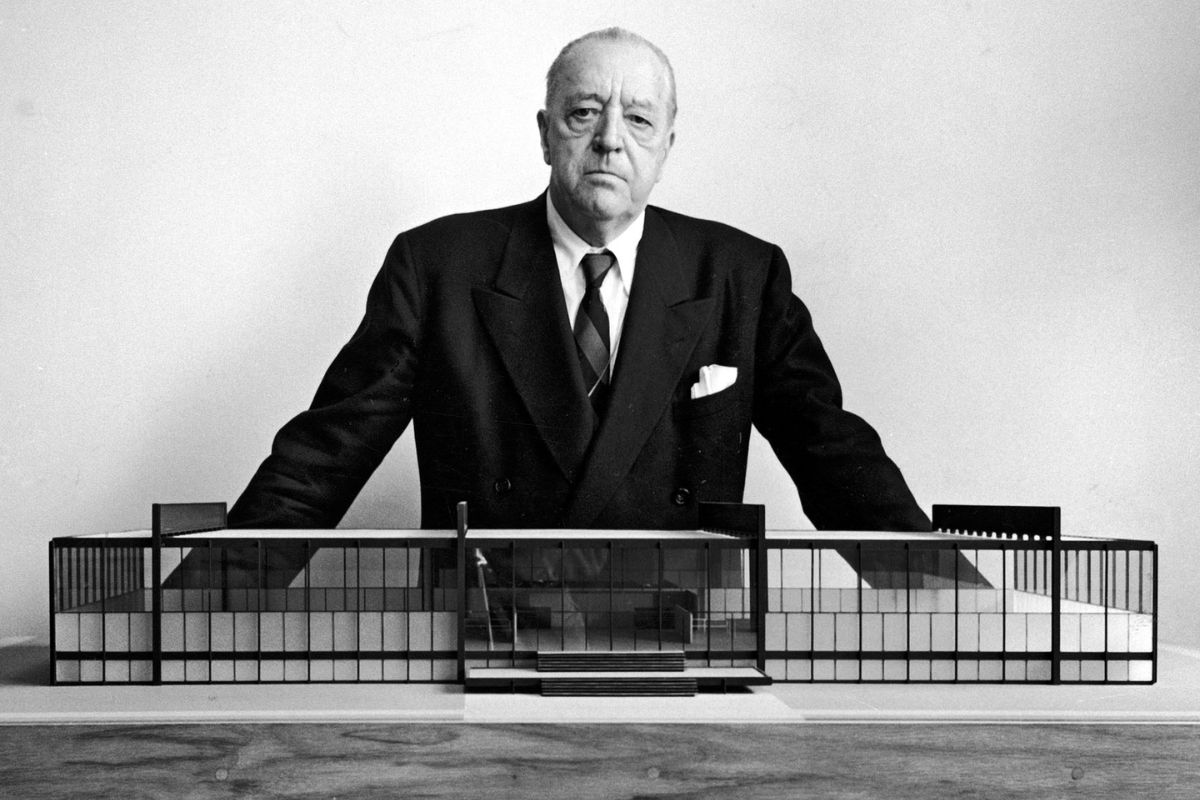
Silence as form: the beginning of a universal language
Ludwig Mies van der Rohe was born in Aix-la-Chapelle in 1886, in a Germany undergoing industrial transformation. Son of a stonemason, he soon learned to respect the material and value of craftsmanship. But his ambition is different: to give shape to essentiality, to transform architecture into a thought.
Mies began working in Peter Behrens’ studio, where he met Walter Gropius and Le Corbusier a triad destined to redefine modernity. From Behrens he inherited the idea of ??an “honest form”, free of frills. However, what will become revolutionary in him is the concept of space as a construction of order and proportion, an architecture that “breathes”.
His is a language that does not impose itself, but reveals itself. And precisely in the silence of form, in the transparency of glass and in the harmony of metal structures, his metaphysical modernism is born: not a style, but a discipline of the spirit.
From the Barcelona Pavilion to the Seagram Building: the idea of perfection
The Barcelona Pavilion (1929) was not only an icon of the Universal Exhibition, but a manifesto of Miesian thought. The onyx, marble and glass slabs alternate in a play of free and reflected planes, while the famous Barcelona chair becomes a symbolic object of pure and architectural design.
There Mies declares that architecture is rhythm, measure and space, not decoration. Each element – from the base to the roof – participates in an invisible but perceptible, almost musical order.
In the Seagram Building in New York (1958), designed with Philip Johnson, he brings his vision to fruition. The tower is rational, but poetic: the steel structure is not hidden, but exalted; the bronze and smoked glass give a monumental gravity to the vertical lightness. It is the meeting point between technique and spirituality, between industrial order and human aspiration.
Less is more: a thought beyond architecture
Less is more is not a slogan: it is a philosophy. In a world that tends towards the superfluous, Mies proposes reduction as a form of freedom. Eliminating does not mean impoverishing, but revealing.
For him, beauty does not lie in complexity, but in precision. And this idea does not only concern architecture, but also design, visual communication, even artificial intelligence: today, in designing interfaces, digital spaces and products, the Miesian lesson is more alive than ever.
In Mies’ structural minimalism lies the root of design thinking : the logical, empathetic and orderly process that leads to the purest, most essential solution. It is the same logic that guides contemporary designers in the search for a functional and conscious aesthetic.
Heritage in contemporary design
From Tadao Ando to John Pawson, from SANAA to Norman Foster, many architects have reinterpreted the Miesian lesson. The idea of ??”continuous space” and “architectural skin” lives in transparent architecture, in suspended museums and in volumes that dissolve the boundary between inside and outside.
In interior design, his thinking translates into modular furnishings, bare surfaces and invisible details: quality becomes proportion, not ornament.
Its spirit also survives in digital: grid-based layouts, the use of transparency and respect for the visual hierarchy in design software arise from that original idea of balance. Mies did not imagine computers, but he would have loved their logic: pure, ordered, rational.
Mies and the school of rigor: from the Bauhaus to the Illinois Institute of Technology
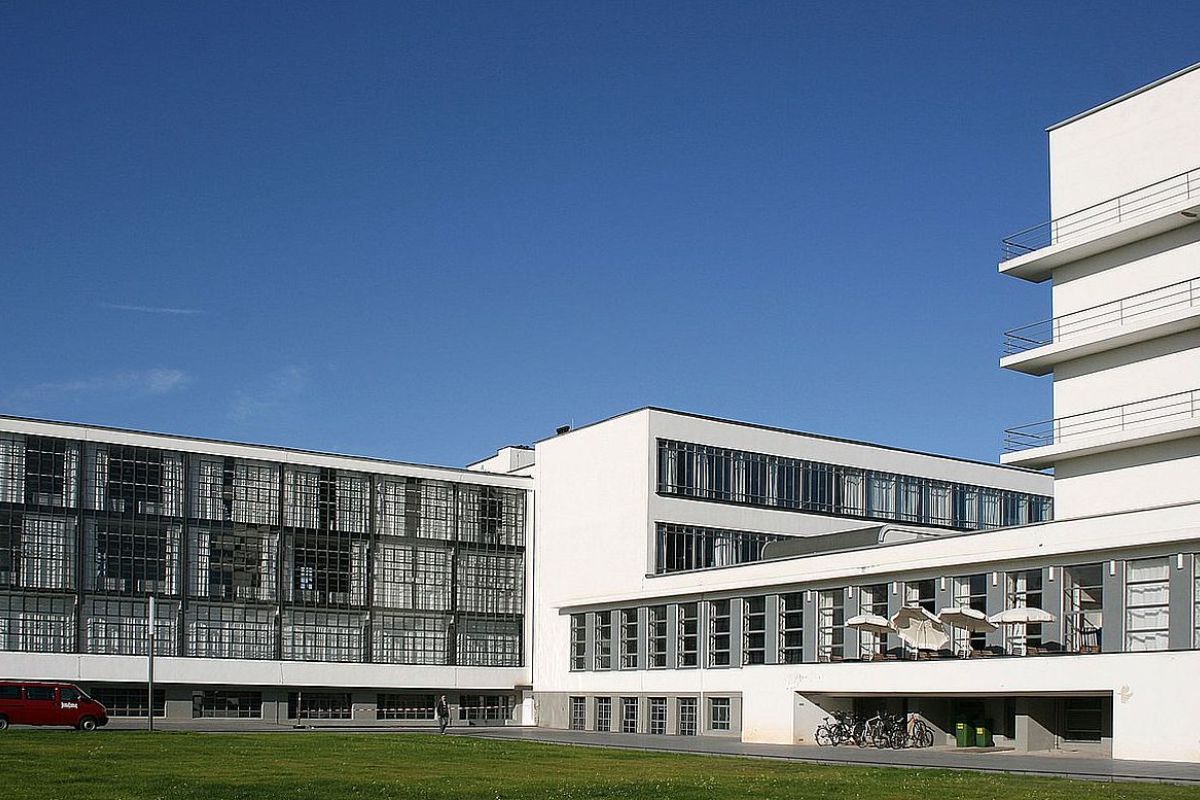
When in 1930 Mies van der Rohe was called to direct the Bauhaus in Dessau , Europe was on the brink of political and cultural collapse. The school founded by Gropius, an avant-garde laboratory for the fusion of art, craftsmanship and industry, was now under the crosshairs of the Nazi regime. Mies accepts the challenge in a moment of collective disillusionment, guided by a profound conviction: only discipline can save the freedom of the project.
In the short period of his direction (19301933), the Bauhaus took on a more architectural, more structured appearance. Mies eliminates expressionist tendencies and focuses his research on the relationship between form and construction , between space and technique . It is here that his rigor becomes method: the project does not arise from intuition, but from a logic of proportions and a precise constructive syntax.
After the forced closure of the Bauhaus, Mies emigrated to the United States. In Chicago he found fertile ground for his ideas and founded the new school of architecture at the Illinois Institute of Technology (IIT) . Here his teaching transforms into an almost scientific system: drawing becomes a moral exercise, a practice of clarity. Building is giving shape to order he repeated to his students and that principle was translated into every detail: from the structural node to the junction between glass and steel.
The IIT trains an entire generation of architects who will change the face of American cities. But above all, Mies builds an educational model still relevant today: teaching design as critical thinking and not as style.
In his classrooms, technical drawing coexists with philosophy, mathematics and art. Geometric precision becomes a universal language. It is in this balance between mind and hand thatmodern architecture as we understand it today was born.
Architecture as ante litteram artificial intelligence
Looking at his works with the eyes of the present, Mies appears as a designer of artificial intelligence ante litteram. We can say, in fact, that his thinking anticipates computational logic: a system of simple rules that generates infinite possibilities. Like algorithms, its language is also reduced to the essential, but extremely versatile.
The Barcelona Pavilion , the Farnsworth House or the Crown Hall of the IIT are generative spaces: primary, pure structures that can adapt to infinite uses and interpretations. Each Mies project is a logical network rather than a finished form, built on modular coordinates, golden proportions, spatial relations.
This vision makes it surprisingly contemporary.
In parametric design, in BIM models and even in today’s digital interfaces, we find that same tension towards poetic rationality . Mies’ idea was not to build an object, but to create a system of thought , an architectural algorithm capable of generating beauty through order.
His mind was a machine of abstraction and measurement, capable of transforming matter into logic and logic into emotion. And perhaps this is why, in the world of AI and augmented design, his name constantly returns: Mies did not only design buildings, but models of intelligence .
What are Mies van der Rohe’s most famous works?
Barcelona Pavilion (1929): the birth of architecture as a sensorial experience
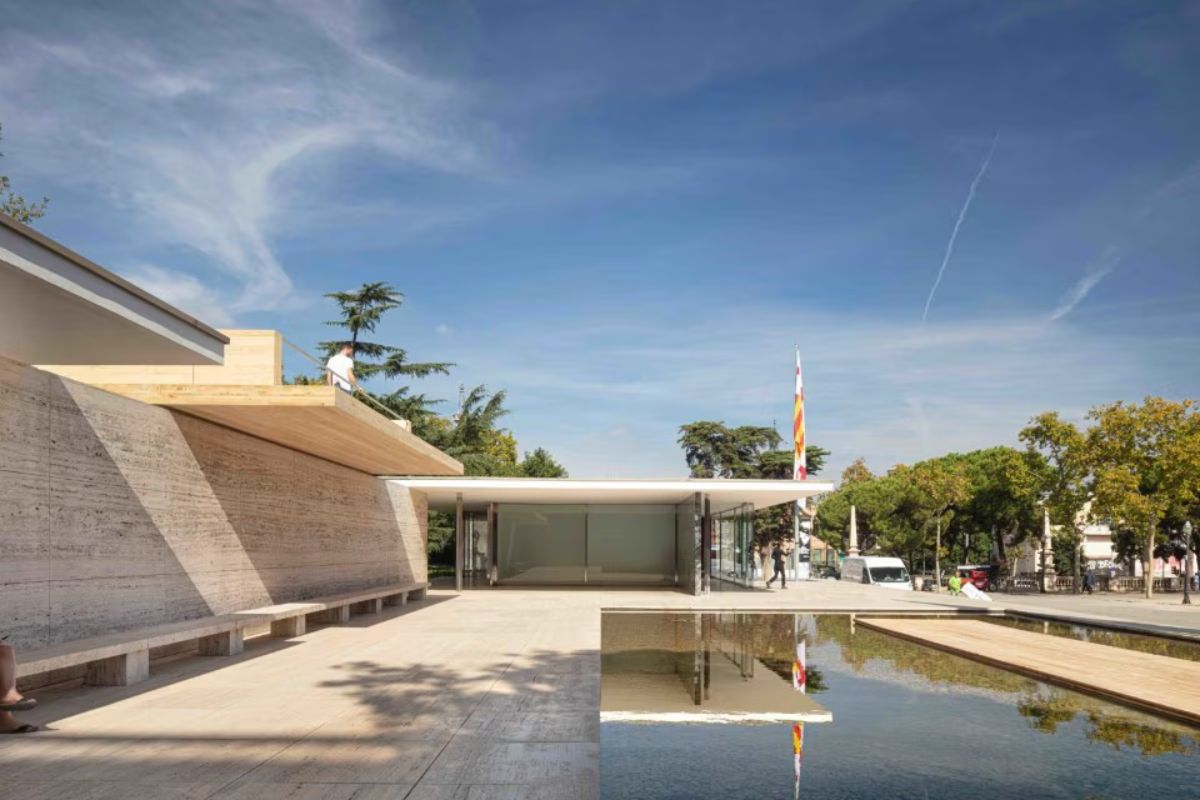
If there is a turning point in modern architecture, it is the Barcelona Pavilion , designed by Mies van der Rohe for the 1929 International Exhibition.
It was not destined to last it was dismantled shortly after the event yet it has become immortal. A seemingly simple construction: a base, a flat roof, eight cruciform pillars, and a sequence of walls that flow freely in space.
But the magic lies in the materials.
Mies uses onyx marble, Roman travertine, green glass and chromed steel as if they were notes of a musical composition. The space never closes: it expands, is reflected, and extends into the water planes. The famous Barcelona chair , designed for the occasion, becomes the natural extension of this concept: an architectural object, not a decorative one.
The Barcelona Pavilion embodies the principle of architectural minimalism and fluid space , two concepts central to digital design and augmented reality today. It is an architecture that invites contemplation, which speaks of balance and lightness, and which is still studied today as a paradigm of modern architecture design .

But the magic lies in the materials.
Mies uses onyx marble, Roman travertine, green glass and chromed steel as if they were notes of a musical composition. Space never closes: it expands, it is reflectedand, it extends into the water plains.
In this context the famous Barcelona Chair (1929) was born, designed together with Lilly Reich to welcome the sovereigns of Spain during the exhibition. A sculptural seat, with a polished steel structure and quilted leather cushions, which perfectly summarizes the Miesian philosophy: rigor, elegance and structural lightness .
Not a complement, but a miniature architecture.
Every joint, every curve of the chair reflects the relationship between function and proportion, becoming one of the absolute symbols of modern design .
Farnsworth House (1951): transparency as a metaphor for truth
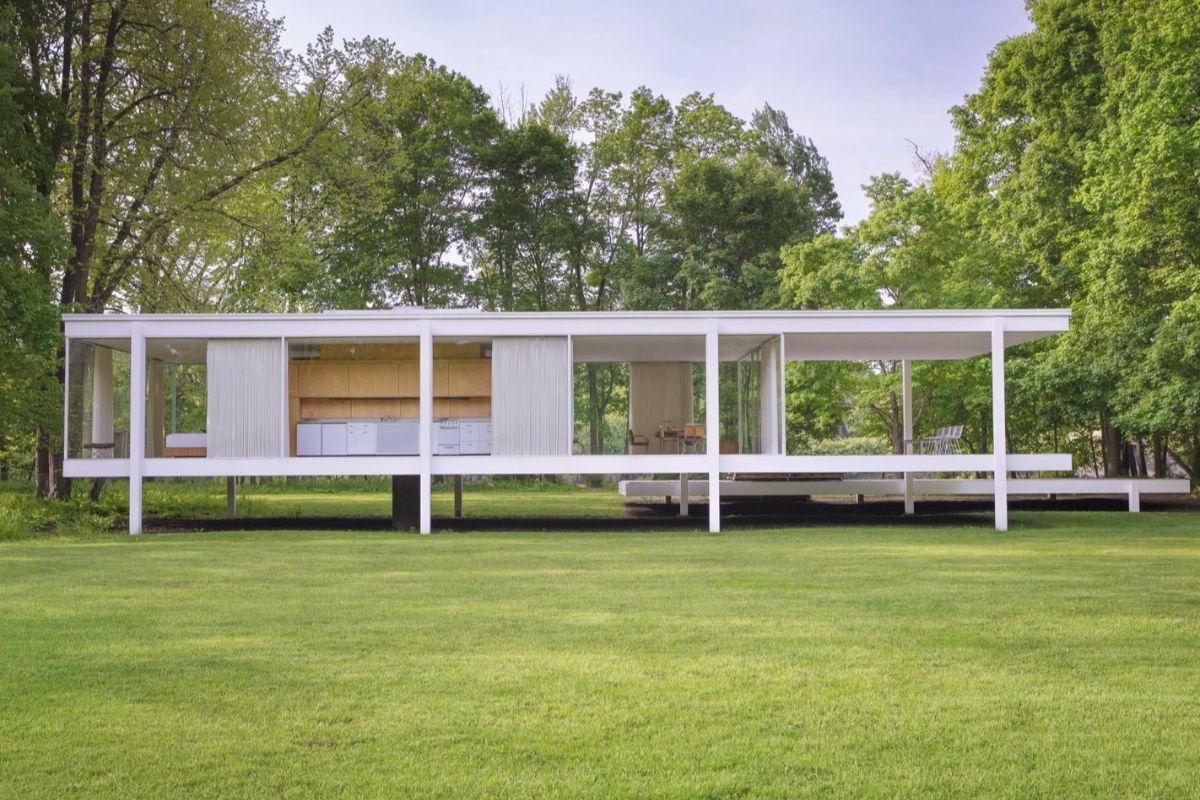
Thirty years after the Barcelona Pavilion, Mies built the Farnsworth House in Plano, Illinois perhaps his most radical work.
A house suspended between earth and sky, entirely in steel and glass, immersed in nature like a poetic object. Here, the distinction between inside and outside disappears: the inhabitant lives inside the landscape, part of a perfectly balanced spatial ecosystem.
The project, commissioned by Dr Edith Farnsworth, is often remembered for its conflict with the client but what matters is the result: a masterpiece of lyrical rationalism , where transparency becomes language.
The house is composed of two parallel horizontal floors supported by slender white beams, a pure and uncompromising volume.
In the context of contemporary design, the Farnsworth House is an archetype of sustainable and relational architecture : it does not impose, but dialogues with the environment.
Its perfect proportions anticipate the logic of glass house design and immersive architecture, today reinterpreted by studios such as SANAA or Sou Fujimoto.
It is a lesson in purity and moderation, a warning against excess and formal arrogance.
Crown Hall (1956): the cathedral of clarity
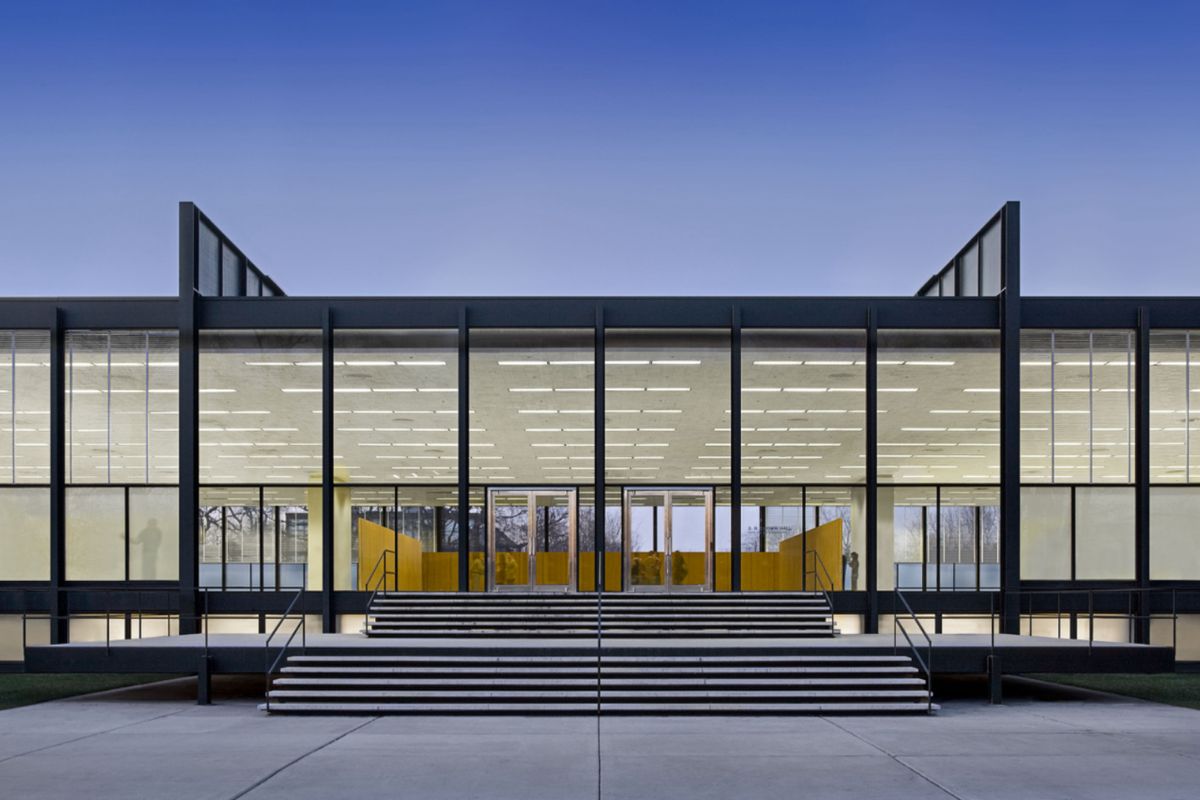
Designed to house the School of Architecture of the Illinois Institute of Technology , the Crown Hall is considered the summa of Mies’ thought.
A glass and steel building, suspended on I-shaped steel beams, without internal columns, with a free space of over 2,000 square meters.
Here the concept of universal space materializes: an open, flexible space, capable of accommodating changing functions without losing its identity.
The interior is an ethical statement even before an aesthetic one: nothing superfluous, no decorative gesture. Everything is reduced to the essential, but nothing is poor. Light, the absolute protagonist, defines the structure and transforms matter into thought.
From a contemporary and SEO perspective, the Crown Hall represents the perfect combination of modular architecture, industrial design and design intelligence . It is a manifesto of efficiency and transparency, a metaphor of Mies’ mind itself: lucid, orderly, luminous.
Not surprisingly, many scholars define the Crown Hall the cathedral of modernism.
A legacy cobuilt over time
From the Barcelona Pavilion to the Farnsworth House to the Crown Hall, Mies van der Rohe constructed a universal grammar of design: a language made of silences, proportions and light.
Its architecture does not speak of power, but of precision.
It does not exhibit, but suggests.
Today, in the digital world and artificial intelligence, his lesson is more relevant than ever: designing means simplifying the experience , reducing to the essence to leave room for meaning.
And so, every line of Mies continues to speak to us, like an eternal code engraved in glass and steel.
God is in the details: the hidden meaning behind Mies van der Rohe’s perfection
The phrase God is in the details God is in the details is one of the most cited in the history of modern architecture. But what did Mies van der Rohe really mean with this expression?
It was not a religious declaration, but rather an ethical and planning vision : the belief that the formal and spiritual perfection of a work lies in the absolute care of every element, even the most invisible.
For Mies, detail is not an ornament, but a manifestation of constructive truth .
In a world in which architecture tended to be increasingly symbolic and spectacular, he reaffirmed the centrality of rigor. The detail is what reveals the coherence between idea and construction, between design and reality. If the project is a thought, the detail is its heartbeat.
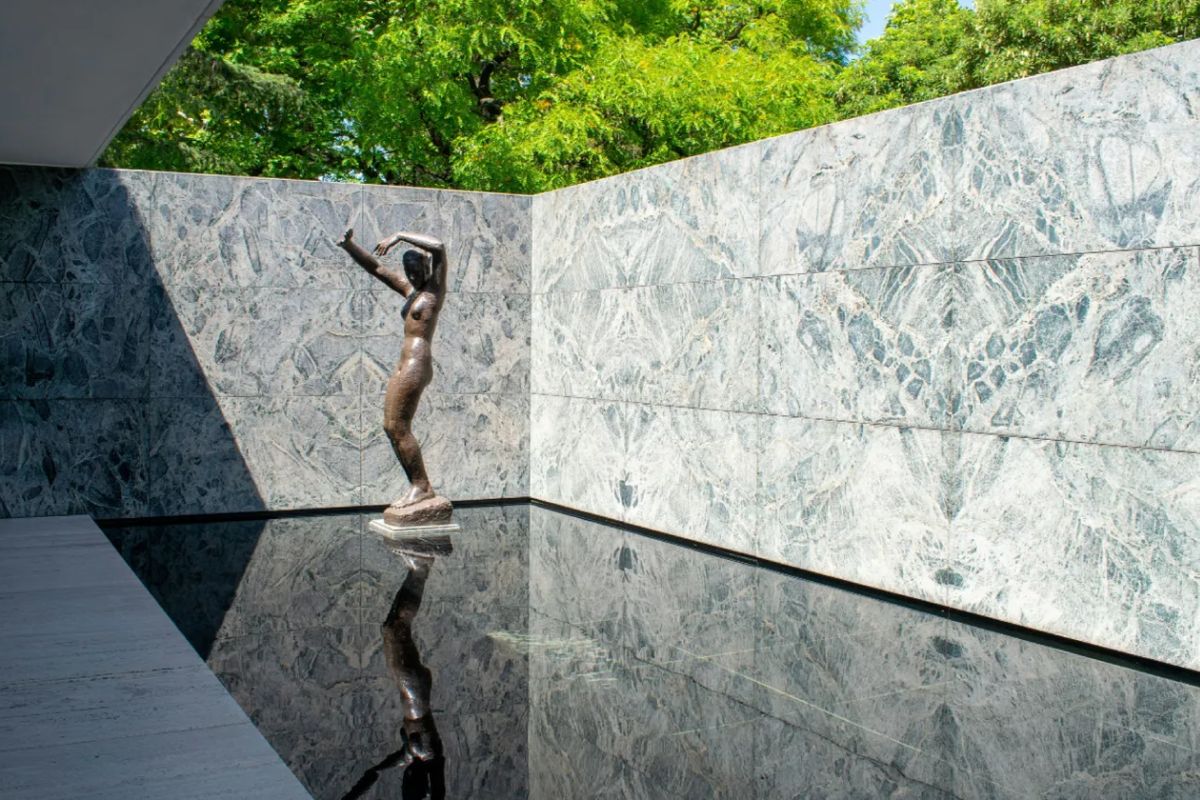
In the Barcelona Pavilion , the joints between the marble panels are invisible, calibrated millimetrically so as not to break the continuity of the space.
In Farnsworth House , the steel beams and aluminum profiles are perfectly aligned, so much so that every reflection of light seems part of the project.
In Crown Hall , the structural nodes of the suspended beams become almost sacred: it is there that the divine logic of the construction manifests itself, the grace hidden behind the mathematics.
God is in the details means, for Mies, that absolute beauty arises from precision .
There is nothing casual in a perfect work: every millimeter has a reason, every proportion a reason. It is a thought that goes beyond architecture and touches design, graphics, even artificial intelligence.
Even in complex generative systems, in fact, quality depends on the definition of the micro-elements: in the code, as in the project, harmony is generated by the control of the minimum.
For this reason Mies is not just an architect, but a philosopher of measurement .
He believed that the truth of the world was inscribed in detail, and that the designer’s responsibility was to recognize it and not betray it.
Where others sought amazement, Mies sought coherence.
Where others built monuments, he built silence, precision and light .
Today, this phrase repeated in architecture schools, design studios and machine learning algorithms continues to be a very timely warning:
IThe future of design, like that of intelligence, will always be in the details.