Why talk about female design today? It’s not just a gender issue. It’s a question of voice.
In the great story of twentieth century design – and even contemporary design – female voices have always been there. But often put in the background, overlooked, confused with those of male colleagues. Yet, there are objects born from profoundly different perspectives , capable of reading the home, the body, everyday life with a design sensitivity that breaks with function and intertwines with life.
They are not “female pieces”. They are pieces of universal design , which however start from experiences, questions, intuitions born from women. Designers, architects, project thinkers.
Feminine design: iconic objects created by women in design
Here is a journey through some of the iconic female design objects more or less known which tell of the intelligence, strength, vision of those who designed with their head, with their hands and with their heart.
1. Marianne Brandt Bauhaus teapot, 1924 – Female design: icons of women in design

In the metal laboratory of the Bauhaus, reserved almost exclusively for men, Marianne Brandt bursts with talent and rigor. His teapot silver and ebony, made of circles and clean lines is a manifesto of function, but with a delicacy that distinguishes it from many contemporary objects.
She wasn’t just a designer. She was also one of the first women to break the mold of a school that spoke of modernity, but still practiced exclusion . His teapot is at MoMA today: elegant, symbolic, still very current.
2. Eileen Gray Bibendum Armchair, 1926

The Bibendum Chair is ironic, sensual, powerful. Designed by Eileen Gray in the 1920s, it is inspired by the famous “Michelin Man” – an advertising symbol that has become a form of hospitality.
Two large padded rings, a large seat cushion, a modernist structure. But also a subtle message: the strength of design that welcomes without subjugating . Gray designed homes for independent women, and the Bibendum was the perfect armchair for reading, reflecting, feeling good.
3. Charlotte Perriand Chaise longue Tokyo, 1940-1954

Many know her for having worked with Le Corbusier, but Charlotte Perriand had a vision of her own. After a long stay in Japan, he developed a series of seats influenced by oriental aesthetics: among these, the Tokyo chaise longue , made with bamboo slats and a folding structure.
Minimalist and material, it blends the efficiency of Western design with the silent spirituality of Japanese craftsmanship . A bridge between cultures. A session that invites calm.
4. Nanna Ditzel Hanging Egg Chair, 1959

The Hanging Egg Chair is a chair suspended like a cocoon, a floating refuge for the body and mind. Created by Nanna Ditzel , a pioneer of Danish design, it is still today among the best-selling and reinterpreted objects of the Scandinavian style.
Ditzel simply didn’t want tofurnish, but create emotional environments , where design became part of the experience. A warm, free, accessible aesthetic. A woman who taught.
5. Gae Aulenti Pipistrello Lamp, 1965 – Female design: icons of women in design

A cultured, multifaceted, energetic architect, Gae Aulenti has designed major projects (Musée d’Orsay in Paris, Palazzo Grassi in Venice), but also objects that have remained close to her heart.
The Pipistrello is a telescopic lamp, with a steel base and methacrylate cap: evocative, sculptural, iconic. It’s not a salon piece. It is a declaration of identity , born in years when women in design were rare and often silenced. But Aulenti spoke loudly. With the voice of form.
6. Patricia Urquiola Husk Chair, 2011

Comfort and thought, softness and precision. The Husk, designed by Patricia Urquiola for B&B Italia, combines a rigid shell (in recycled plastic) with modular and welcoming cushions. Each element can be removed, moved, rearranged.
Urquiola does not design comfortable objects. Design living experiences: not to amaze, but to stay . Husk is an invitation to slow down, sit down, listen to your body. A design that speaks the language of today. And he doesn’t scream.
7. Zaha Hadid Liquid Glacial Table, 2012

Zaha Hadid has made the impossible a practice. With the Liquid Glacial Table , he made water solid: the top seems to ripple under the gaze, the legs are crystalline vortices, as if they had been sculpted by time.
It’s not just a table. It’s a landscape. It is a visual metaphor of its fluid architecture. Hadid did not like limits: neither technical, nor aesthetic, nor cultural. And this object is pure plastic poetry.
8. Matali Crasset Concentré de Vie, 2009

The result of research into contemporary living, Concentré de Vie is a habitable piece of furniture: bed, desk, wardrobe, bookcase in a single object. Designed for small spaces, it is designed for students, migrants, urban nomads.
Matali Crasset works between design and sociology. His colorful and modular style tells that the project can be political, and that creativity is a form of social care .
9. Hella Jongerius Polder Sofa, 2005

Dissonant colours, asymmetric shapes, hand-sewn buttons in relief: the Polder Sofa , designed by Hella Jongerius for Vitra, is a perfect patchwork of imperfections.
It is a sofa that does not try to standardize , but to tell: different territories, different cultures, different materials that coexist. Jongerius is convinced that design must have a “soul”. And the Polder has a lot of it.
10. Nika Zupanc Lolita Lamp, 2008 – Female design: icons of women in design
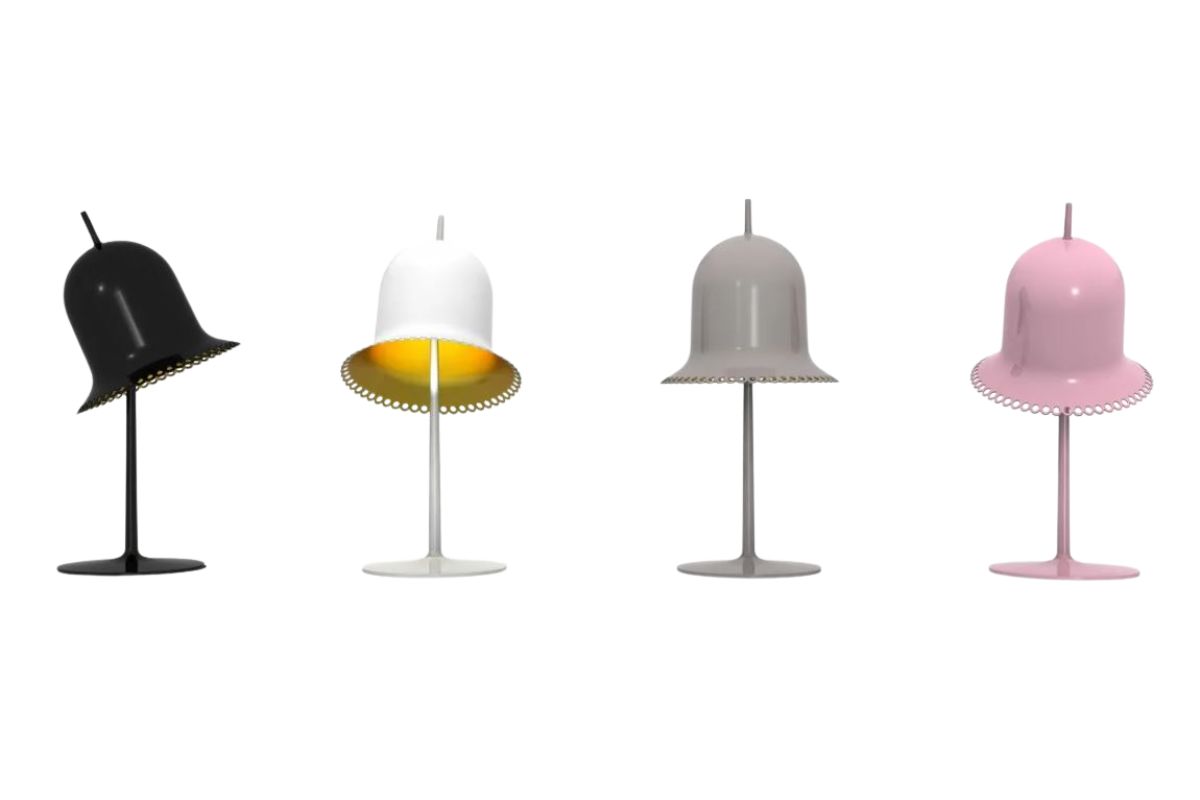
The Lolita Lamp is a small colpo scene. Pink lampshade, retro details, a shape that recalls a subtle irony. But it’s not a quirk. It is an elegant provocation against the stereotype of the woman-object.
Nika Zupanc creates a design that plays with femininity to liberate it. Lolita is a heavy name, and she turns it into light. Literally.
Is there a common lesson of female design?
All these objects do not scream feminism. But they bring in a different way of thinking about design : more inclusive, less self-referential, more attentive to daily gestures, relationships, freedom.
They are not feminine objects. They are design acts full of meaning . Which tell us that there is a parallel history of design, often silent, never marginal.
And which today more than ever deserves to be known, told and celebrated.
Leave a comment