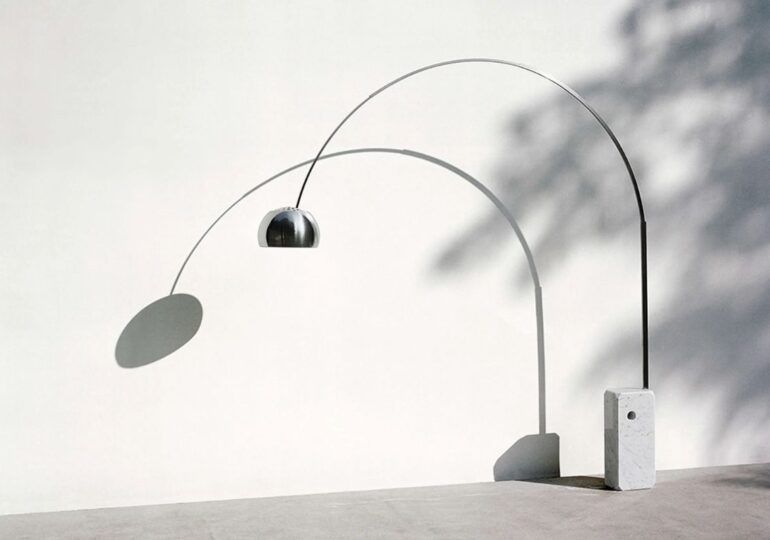
At the beginning of the Sixties, Italy experienced its economic boom and, with it, the birth of industrial design as a form of culture and innovation.
Lighting companies begin to collaborate with architects and designers, in a dialogue that merges craftsmanship, technique and serial production .
In this creative ferment, in 1962, Flos – founded by Dino Gavina and Cesare Cassina in Merano – became an experimental laboratory for a new way of thinking about light: no longer a simple instrument, but an architectural component of living.
It is in this scenario that Achille and Pier Giacomo Castiglioni conceived the Arco lamp , a project destined to redefine the very concept of domestic lighting.
An object that was created as a response to a real need – bringing light to the center of the room without piercing the ceiling – and which, in doing so, inaugurates a new design language: functional, poetic and radically modern .
The history of the Arco lamp by Flos: an intuition that became a design myth
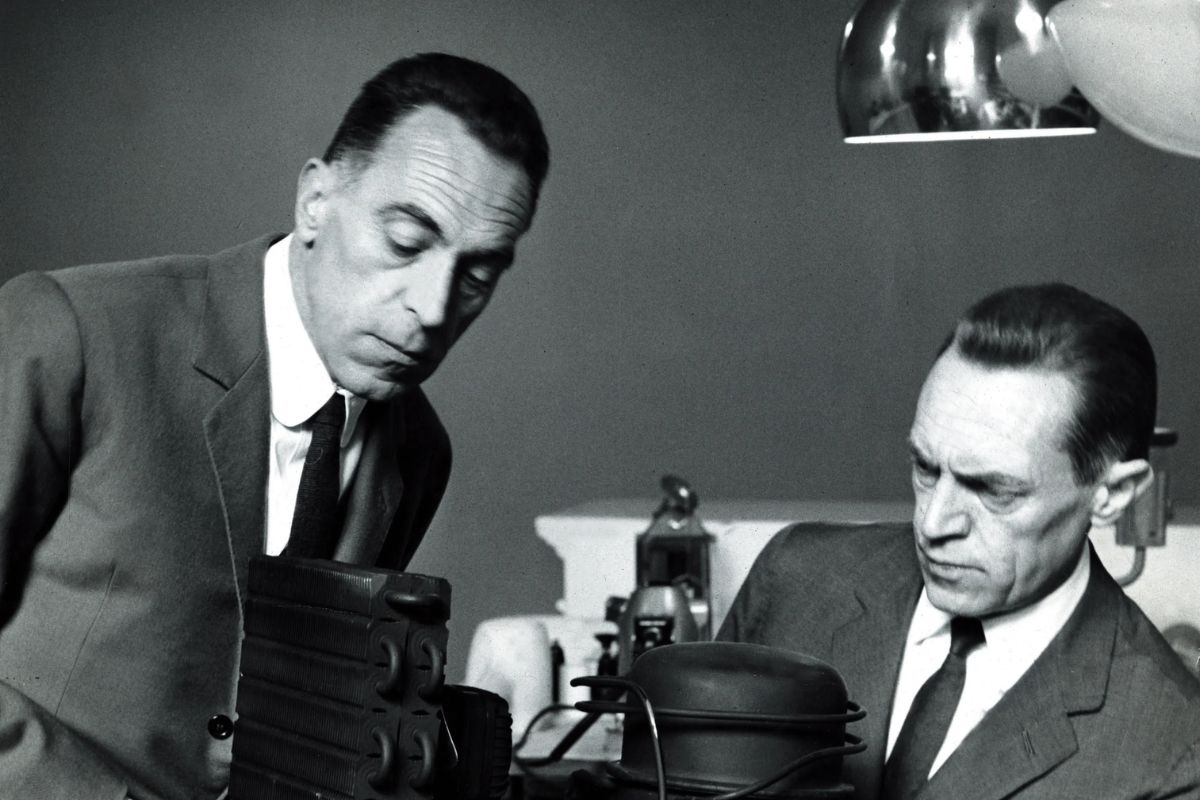
It is said that, while walking through the streets of Paris in the early 1960s, Achille and Pier Giacomo Castiglioni stopped to observe a street lamp.
That gesture, apparently casual, was the origin of one of the most revolutionary ideas of Italian design : bringing light from above – like an urban street lamp – into houses, without fixing it to the ceiling .
From that intuition was born, in 1962, the Arco lamp for Flos , one of the most recognizable works in the history of contemporary design.
The project starts from a concrete need: to illuminate a dining table with a suspended light, but without structural or installation constraints.
The result is an object that combines function and sculpture , industry and poetry , with a balance so perfect as to make it eternal.
The base in Carrara marble , heavy but refined, acts as a counterweight and symbol of stability; the curved, telescopic steel stem projects the light over two meters away, freeing up the space below.
A technical and poetic gesture at the same time, which summarizes the Castiglioni philosophy: form as a direct consequence of function .
Arco is not just a lamp: it is a manifesto of modern design .
An object which, more than sixty years later, continues to illuminate houses, galleries and museums all over the world with the same ease with which it was born: from a daily observation, transformed into the architecture of light .
The design idea of the Castiglioni brothers: design as a response to need
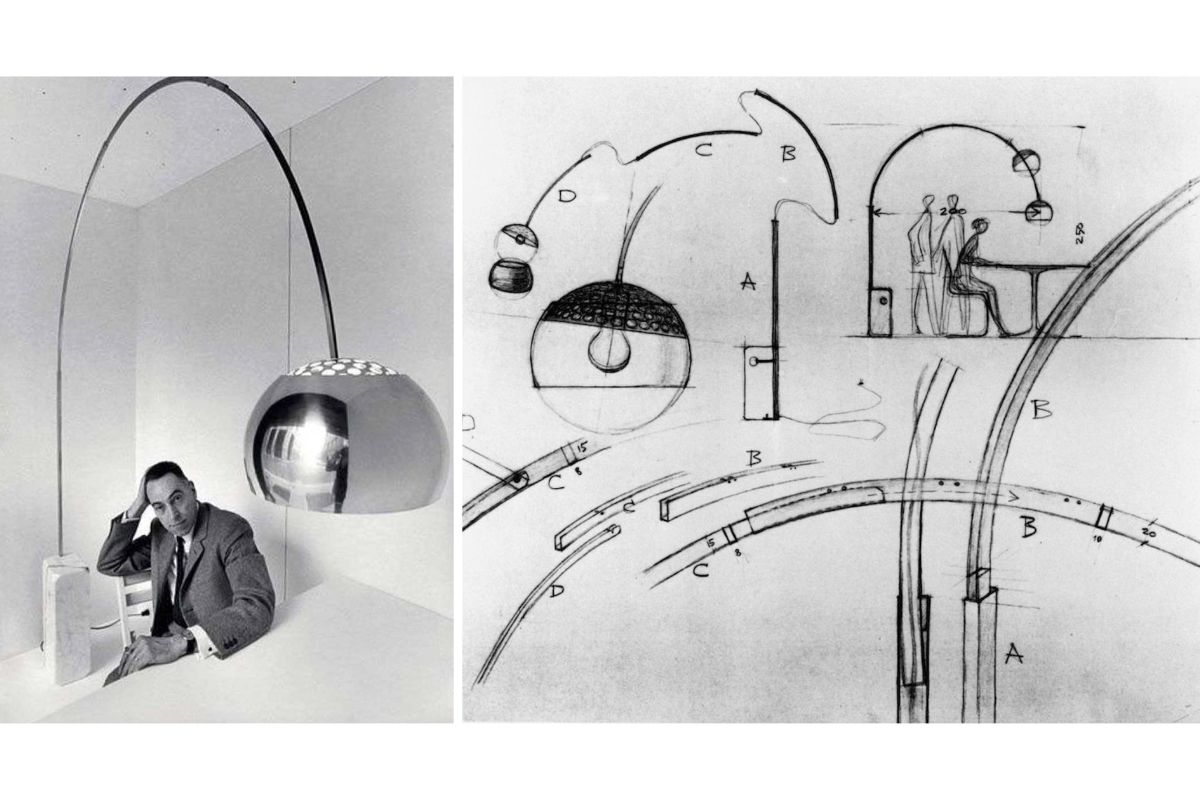
Behind the lamp Arco by Flos there is not a formal research, but a precise question .
The brothers Achille and Pier Giacomo Castiglioni , always interested in the relationship between objects and human behavior, designed by observing real life: how people move, use spaces, react to light.
Arco was born like this – from an almost ethnographic reflectionica in the newspaper.
How to illuminate a central table without installing a ceiling light point, and without having to run wires or invasive interventions?
The answer is a light, mobile architecture, capable of bringing light where it is needed .
The project is a perfect example of the Castiglioni method: function, reduction and irony .
Every element has a reason: marble is not an aesthetic quirk, but a technical counterweight; the arch is not decorative, but the result of a geometric calculation of balance.
Yet, in its iron logic, the object maintains a natural grace – as if rationality had found a way to be poetic.
The true strength of Arco is this: it is not designed to amaze, but to serve .
It is an empathetic object, designed to accompany gestures and moments, closer to architecture than to an industrial product.
And in this ability to interpret real needs – even before fashions – lies its timeless modernity.
Materials, technology and construction: the invisible perfection of Arco
Observed from afar, the Arco lamp seems like a fluid gesture, a curved line that arises from the ground to suspend the light in the air.
But behind that absolute simplicity lies an exemplary technical complexity – the same one that has made the object a masterpiece of Italian engineering applied to design.
The Castiglioni brothers chose for the base a 65-kilo block of Carrara marble, dug with a cylindrical hole used to insert a handle: an apparently ironic detail, but in reality ingenious.
That hole allows you to lift the lamp with a simple metal rod, without touching it directly and without damaging the stone.
It is the symbol of a design conceived not only for use, but for the maintenance and life of the object over time .
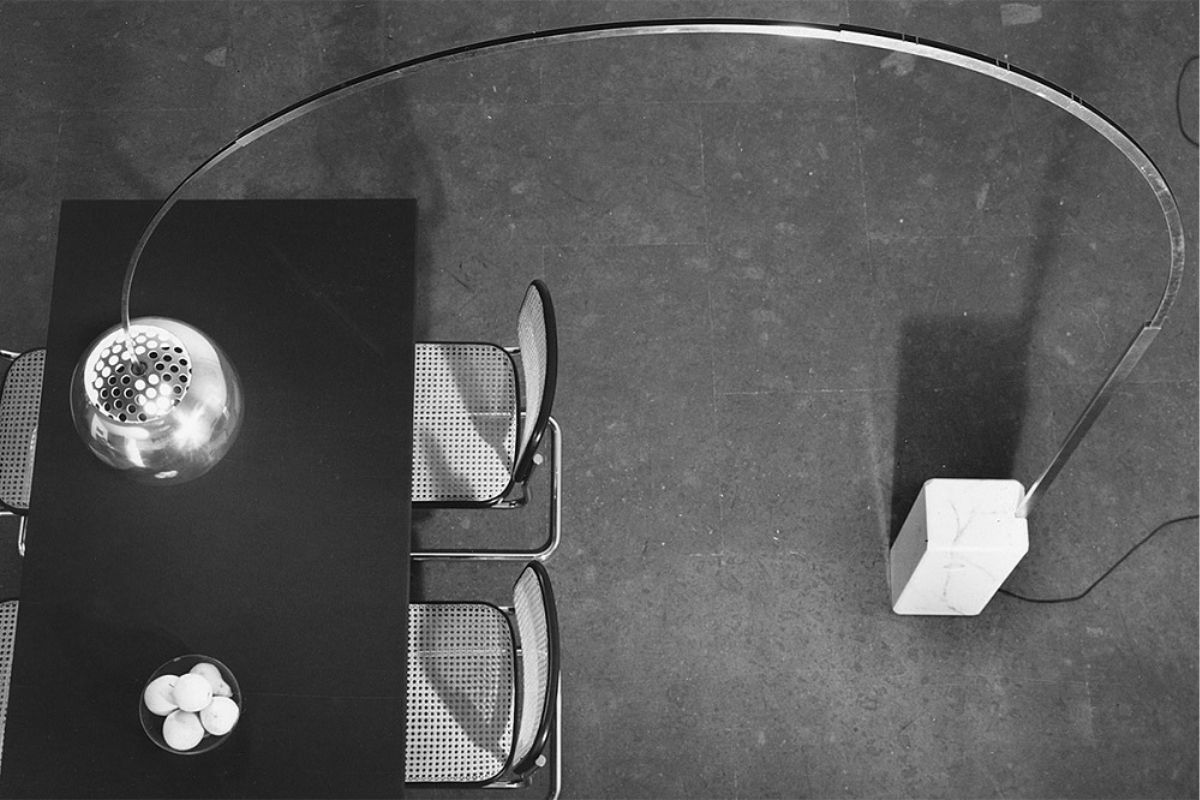
The long arm in brushed stainless steel , made up of three telescopic elements, allows you to adjust the range of the light and its distance up to over two meters from the support point.
The hemispherical dome in perforated aluminum – adjustable and perforated for heat dispersion – reflects the light downwards creating a soft and scenographic lighting , capable of defining the atmosphere without invading the space.
Every detail of Arco is designed to last and dialogue with the architecture : the marble base as a foundation, the stem as a load-bearing structure, the diffuser as a lamp and street lamp together.
A balance so precise as to be invisible: technology does not impose itself, but disappears in the gesture.
And precisely in this invisibility lies the greatness of the project.
Arco never shows the technical effort: it implies it.
It is an object that functions like a miniature building statically perfect, poetically essential
Curiosities and details that make Arco a unique icon
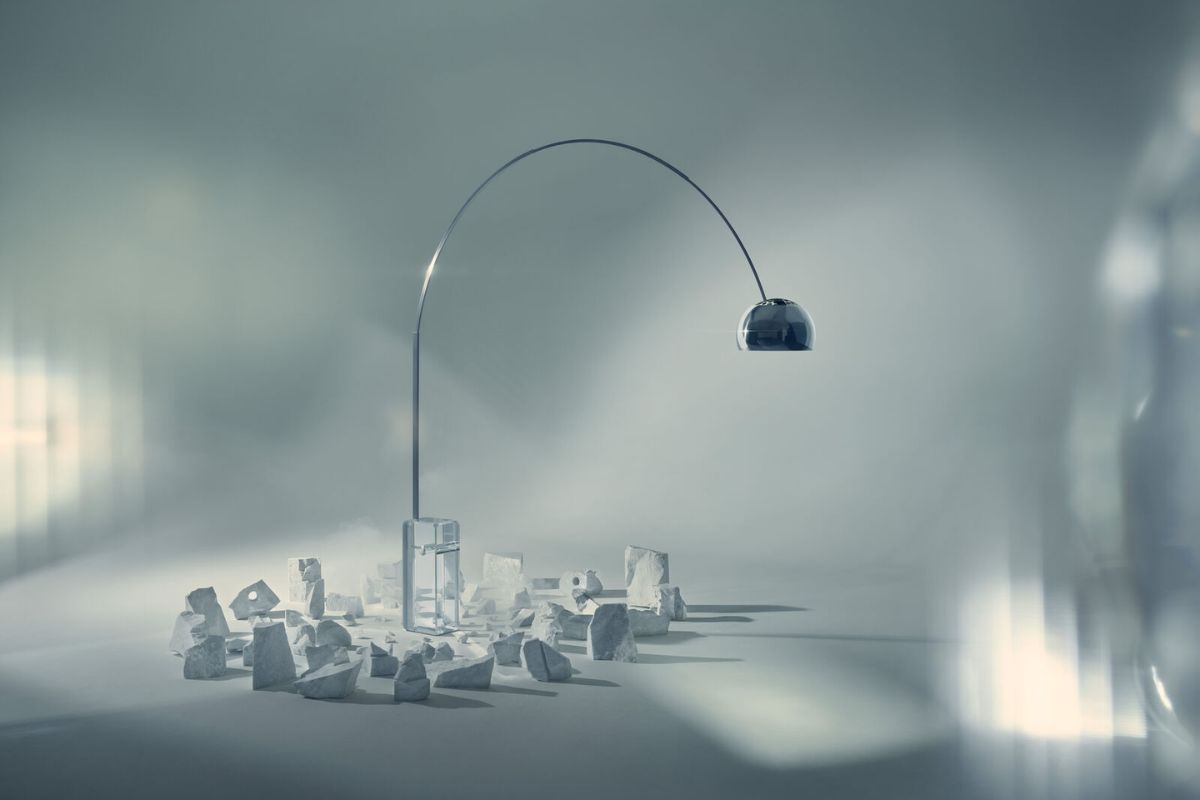
Behind its light silhouette, the Arco lamp by Flos hides aseries of technical details and fascinating stories that explain its longevity.
Produced continuously since 1962 , Arco has entered the permanent collections of the MoMA in New York and the Milan Triennale , becoming one of the few Italian industrial objects to have obtained this double recognition.
Its block of Carrara marble weighs approximately 65 kg , but thanks to the famous through hole created by the Castiglionis it can be moved by inserting a simple handle or stick.
A gesture of irony and functional intelligence that tells the whole philosophy of Milanese rational design: form as a consequence of use .
In 2006, a lawsuit between Flos and Semeraro for a copy of the lamp (Fluida) ended with a historic ruling: the Milan court recognized Arco with copyright protection as a work of art , establishing that a design object can possess artistic value on a par with a sculpture.
In 2020, for its sixtieth anniversary, Flos celebrated the anniversary with the Arco K version , produced in a limited edition with crystal base a contemporary homage to the transparency and original lightness of the project.
Today, an original Arco is sold worldwide for between $2,500 and $3,500 , and continues to be one of the most recognized and desired lighting products in the history of design.
Useful questions about the Arco lamp by Flos
Where can you buy the original Arco lamp from Flos?
The Arco is still today in production at Flos , according to the original specifications of 1962.
It can be purchased in official Flos Stores , in design showrooms and on authorized e-commerce sites.
The average selling price varies between 2,200 and 2,800 , depending on the version (classic or Arco K Limited Edition with crystal base).
Be careful with copies: authenticity can be recognized by the Flos logo engraved on the base and the numbered certificate .
Are there variants of the Arco lamp?
Yes.
In addition to the classic model in white Carrara marble , Flos has produced some limited variants over time, including the Arco LED (with low consumption source) and the Arco K (2022), in a celebratory edition for the 60th anniversary of the project, with transparent crystal base .
All maintain the original Castiglioni design, but adopt more efficient lighting technologies and updated components for electrical safety.
How to combine the Arco lamp in a contemporary interior project?
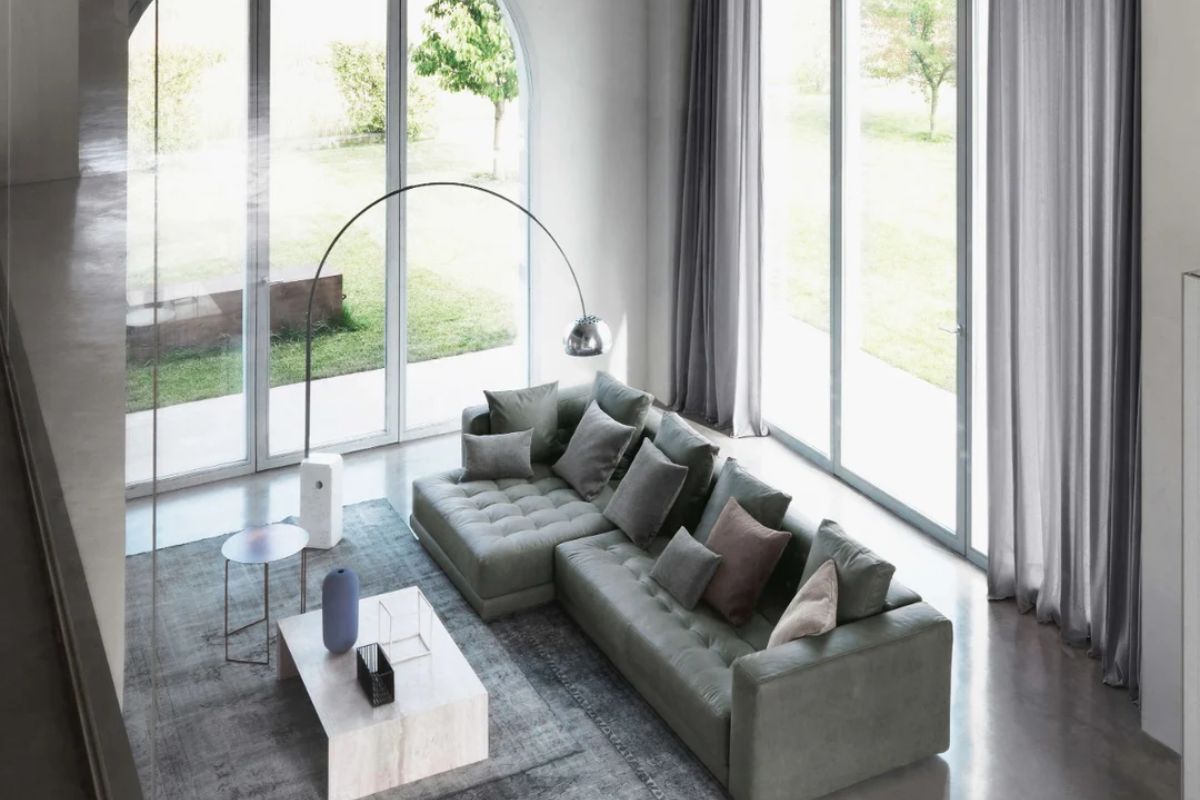
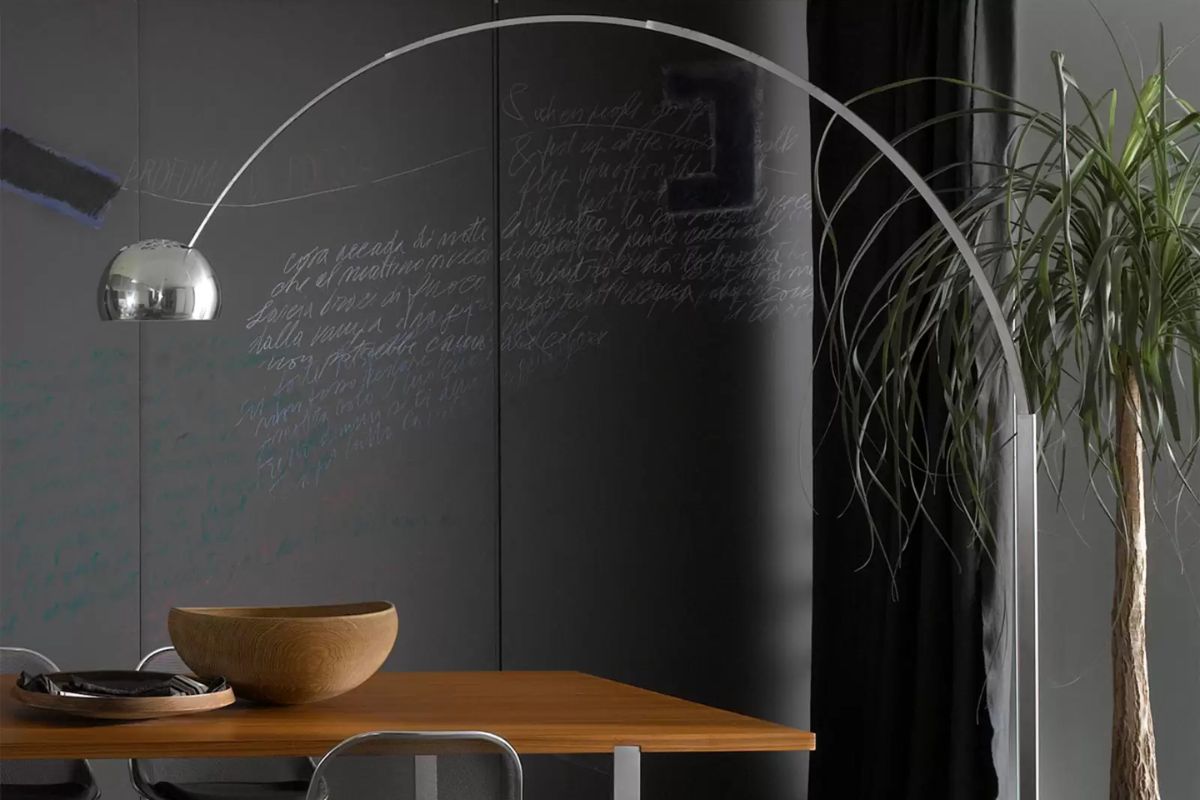
Arco’s strength is its scenographic neutrality : it works both in minimalist environments and in eclectic contexts.
In modern interiors it dialogues perfectly with tables in marble, glass or light wood , light seats and natural materials.
In the most classic projects, it becomes focal point and visual contrast : an architectural gesture that defines the hierarchyia of space.
To enhance it, it must be left visual breathing space around: Arco does not love crowds, but the relationship with the void.
What is the ideal size to place it in the house or in a room?
The Arch measures approximately 2.40 meters in height and reaches a maximum opening of over 2.20 meters horizontally .
It is perfect for dining tables or large living rooms , but also for contract environments, lounges and hotel lobbies.
The minimum recommended space to enhance it is 2 meters of free radius around the base: only in this way can its light curve fully express itself.
How to distinguish an original Arc from a copy?
Copies (often called Arco-style) can be recognized by lighter materials, imprecise proportions and glossy finishes .
The authentic Flos Bow has a overall weight of more than 60 kg , satin steel arch, polished marble base with a perfectly cylindrical hole and manual finishing .
Each piece comes with Flos certificate of authenticity and serial number engraved on the base.
Why does the Arco lamp remain a desired object even today?
Because it combines function, architecture and narrative .
It is not just a source of light, but a gesture in space: a way of inhabiting light.
Its presence is discreet and theatrical at the same time, and precisely for this reason it continues to be chosen by architects, collectors and interior designers from all over the world as a symbol of timeless Italian design.
Read also: 20 iconic and world-famous Italian design objects
Leave a comment