During the twentieth century, the mirror ceased to be a simple functional object to transform itself into a conceptual surface , capable of reflecting not only images but also thoughts, emotions and perceptions.
From a practical furnishing element, it becomes an artistic instrument , a canvas for painters, a poetic support and a means of philosophical exploration.
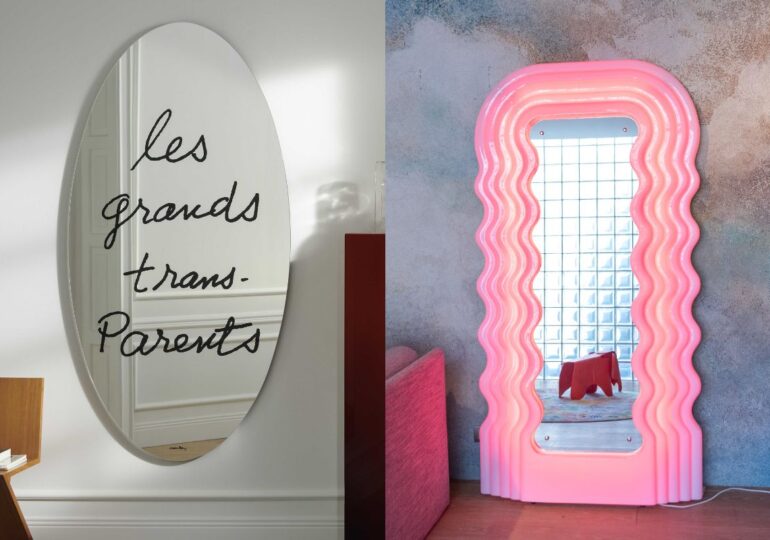
Two works in particular Les Grands Trans-Parents by Man Ray and Ultrafragola by Ettore Sottsass Jr embody two opposite but complementary approaches:
-
one minimal, enigmatic and philosophical ;
-
the other pop, bright and ironic .
In both cases, the mirror goes beyond its reflective function, transforming itself into a threshold towards new dimensions of meaning.
Les Grands Trans-Parents Man Ray (1938)

Mirror of the invisible, surrealist symbol and philosophical reflection
In 1938, Man Ray , a key artist of Dadaism and Surrealism , conceived Les Grands Trans-Parents , later re-edited by Simon by Cassina in 1971.
This elliptical mirror in silk-screened glass , devoid of decorations and supported by a sculptural base, is dominated by the title that runs across the entire surface. The French expression Les Grands Trans-Parents can mean both the great parents and the great transparent ones.
This linguistic ambiguity is the heart of the project: for Man Ray , transparency is a metaphor for the invisible , of what often escapes superficial perception but contains profound meanings.
The mirror does not restore a face, but invites introspection . It is a work-manifesto of surrealism, which subverts the traditional idea of ??the mirrored image and stimulates a destabilizing reflection.
Ultrafragola Ettore Sottsass Jr (1970)
Icon of Radical Design, between pink light and pop irony
More than thirty years later, in 1970, Ettore Sottsass Jr designed for Poltronova one of the most famous mirrors in the history of design: Ultrafragola .
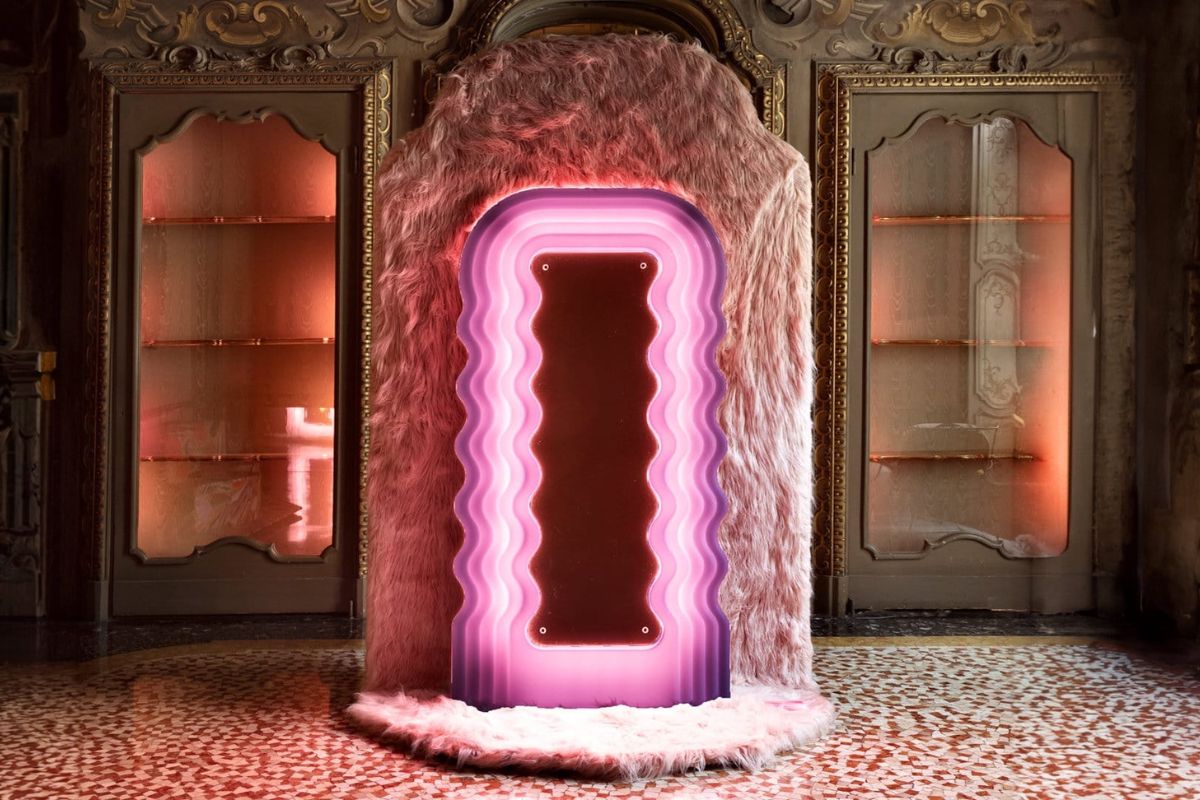
Part of the experimental series Mobili Grigi , this work challenges the traditional canons of furniture. The wavy frame, made of thermoformed PETG , envelops the mirroring surface and lights up thanks to a system of pink neon (now also LED), transforming the mirror into a luminous sculpture .
When turned off, it appears like a furnishing element with a strong visual impact; when turned on, it becomes a sensual and scenographic object, capable of modifying the atmosphere of the environment.
The reference to the world of Alice in Wonderland and to fairy-tale imagery underlines its visionary character: as in Wonderland, “nothing is as it seems”.
Two complementary visions of the mirror in design
Despite the differences in style and context the Parisian avant-garde for Man Ray and Italyof radical design for Sottsass both mirrors share the desire to transform a passive object into an active subject .
| Work | Year | Materials | Function | Aesthetics | Symbolism | Message |
|---|---|---|---|---|---|---|
| Les Grands Trans-Parents Man Ray | 1938 (reissued 1971) | Elliptical glass, silk-screen printing, polyurethane | Conceptual object | Minimal, enigmatic | Surrealist, philosophical | Reality hides in the invisible |
| Ultrafragola Ettore Sottsass Jr | 1970 | Thermoformed PETG, neon/LED | Mirror + ambient light | Pop, sinuous, provocative | Fairytale, ironic | Contrast between appearance and essence |
The mirror between visible and invisible
Both Les Grands Trans-Parents and Ultrafragola operate on the border between art and design , between visible and invisible :
-
the first invites an intimate and conceptual exploration ,
-
the second seduces with color, shape and light .
Both demonstrate that the mirror, in twentieth-century design, is no longer a simple tool for reflecting an image
Leave a comment