In the international design panorama, few countries can boast such an intense and deep-rooted history as Italy. More than a question of style, Italian design is a cultural language, a collective gesture that spans generations. But what makes those furniture, lamps and seats that we call “author’s pieces” really special?
What is meant by “author’s piece”
An author’s piece is much more than a well-made piece of furniture. It is a creation that carries with it the design, emotional and conceptual imprint of the designer who conceived it. It is an object that communicates, expresses a vision of the world, and often marks a turning point in the history of design.
These objects were designed to last, not only in physical time but in cultural time. They don’t follow fashions: they anticipate them, or surpass them. They carry with them a signature, a story, an intention.
Because Italian design is the home of designer pieces
Design culture in Italy has always been closely linked to craftsmanship, the quality of materials, experimentation and beauty. Italian companies, especially between the 1950s and 1970s, had the courage to invest in the creativity of designers, giving them space to innovate.
An immense heritage was born from this, recognized internationally and preserved in the most important museums in the world: from the MoMA in New York to the Center Pompidou in Paris, up to the Triennale in Milan.
The great classics: author’s pieces that made history
1. Superleggera Gio Ponti for Cassina (1957)
A chair that weighs only 1.7 kg, but with a very solid ash structure. It is the perfect synthesis of Ponti’s thought: removing everything superfluous to get to the essence. It is still among the most loved and imitated seats today.

2. Arco Achille and Pier Giacomo Castiglioni for Flos (1962)

With its Carrara marble base and steel arm, the Arco lamp is a functional sculpture that brings light where it is needed without the need for suspensions. An icon that revolutionized domestic lighting.
3. Sacco Gatti, Paolini, Teodoro for Zanotta (1968)

The free-form armchair, without a rigid structure, which embodied the free spirit of the Sixties. A symbol of informality, non-conformism and freedom.
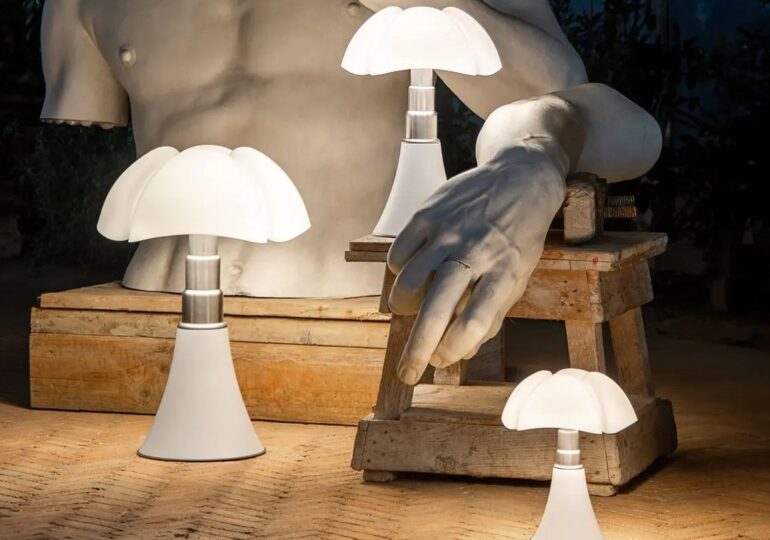
4. Pipistrello Gae Aulenti for Martinelli Luce (1965)

A lamp inspired by nature and equipped with a telescopic mechanism that adjusts its height. Its wavy white diffuser makes it a poetic and recognizable presence in any environment.
5. Eclisse Vico Magistretti for Artemide (1965)

Winner of the Compasso d’Oro in 1967, this lamp is a play between form and function: a rotating cap allows you to “eclipse” the light, creating different effects. Small, essential, brilliant.
6. Maralunga Vico Magistretti for Cassina (1973)

The first sofa with integrated reclining backrest. Comfortable and robust, it has become a reference in the history of home furnishings, a symbol of the Italian lounge.
7. Ultrafragola Ettore Sottsass for Poltronova (1970)

Mirror with bright pink neon light: a pop, cult and Instagrammed piece. It is part of a broader discussion on unconventional form, and anticipates the spirit of the Memphis group.
The generational transition: contemporary authors and new iconic pieces
8. Husk Patricia Urquiola for B&B Italia (2011)

An armchair that combines ergonomics and soft design, with padded cushions that seem to embrace. Urquiola is among the most influential figures in world design today, and this seat is one of her recognizable signatures.
9. Ghost Cini Boeri for Fiam (1987)

An armchair made from a single sheet of curved glass: an incredible example of technical challenge and ethereal beauty. A design that still amazes today for its transparency and lightness.
10. Bombo Stefano Giovannoni for Magis (1997)

A swivel chair with a bold and futuristic design, which has entered bars and kitchens around the world. Synthesis of pop culture, ergonomics and innovation.
11. Big Table Alain Gilles for Bonaldo (2009)

Sculptural table with crossed colored legs and thin top: an icon of new Italian design for contemporary environments. It marked a new aesthetic phase in dining.
12. Outdoor Cliff Collection Ludovica + Roberto Palomba for Talenti (2019)

An outdoor collection that blends comfort and sophisticated lines. Inspired by the Mediterranean, it has become a standard of outdoor luxury.
Beyond the signature: what makes an object an “author’s piece”
A strong and recognizable identity.
An author’s piece does not go unnoticed: it has an unmistakable shape, presence and soul.
Innovation, not just aesthetic.
They often introduce new technologies, materials, functional approaches.
The ability to resist time.
They do not follow fashions, but are part of a historical continuity that makes them eternal.
Dialogue with culture.
The best designer objects speak to art, architecture and society. They are cultural acts before they are products.
The presence in museums, in books, in memories.
When an object becomes part of the collective imagination, that is where it becomes truly authoritative.
Why knowing them is important (even if you are not a designer)
Knowing the author’s pieces means knowing the history of our time through objects. Every chair, every lamp, every table tells something about whoever thought of it, who produced it, who chose it to furnish their home.
They are symbols, tools, emotions in physical form.
Italian design has given shape to an important part of our cultural identity. Author’s pieces are the perfect synthesis: objects that last over time because they tell something that goes beyond the material. Studying their history, knowing their protagonists, choosing them to inhabit our spacesit means carrying a part of that story with us . It’s not just a question of style: it’s a question of outlook on the world.
Leave a comment