The Sanremo Festival was born on 29 January 1951 , at the Casino: at the beginning it was “just” a radio evening, then it became a popular liturgy which – year after year – measures the country better than many sociological analyses. Because Sanremo doesn’t just tell the music: it tells the emotional climate , the words that remain with us, the bodies, the languages, the very idea of ??”success” in a specific historical moment.
Its international weight is more structural than it seems: when the EBU (European Broadcasting Union) planned a European music competition in the mid-1950s, it also took as reference the Sanremo model not copying it in every detail, but adopting its logic: a live event, collective ritual, competition and television narration. In this sense, Eurovision also develops thanks to that precedent , which had already demonstrated that a festival can become exportable mass culture.
It is within this framework that the editorial staff of Archieinteriors.com choose, in 2026, to look at the Festival from another angle: not “how beautiful the stage is”, but what role design has in making it a total experience. Because today Sanremo is also temporary architecture, light as direction, graphics as identity, urban space as an extension of the story : the song enters the ear, yes – but it is the designed environment that decides how we live it, and what remains for us.
The stage as temporary architecture: the design that “builds” the song
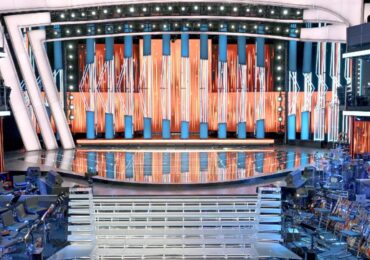
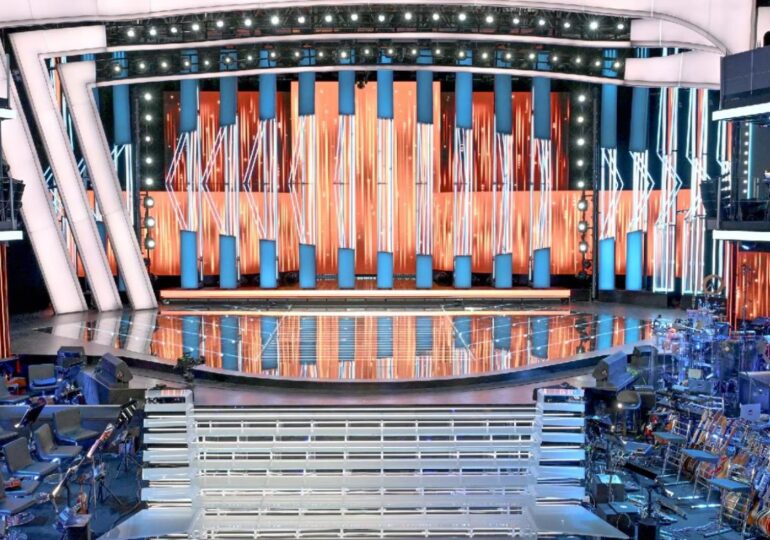
In 2026 the first level of design in Sanremo is literal: the space . The scenography designed by Riccardo Bocchini works on the concept of expansion and on an asymmetric design that avoids the “backdrop” effect and treats the Ariston as a temporary architecture to be inhabited, not as a frame to be filled. Within this logic, the numbers are not technical performances but project materials: a 120 m2 stage , a 250 m2 LED wall , 2,800 meters of luminous strips , a motorized staircase and mobile surfaces that allow the set to change role with each song (intimate space, arena, theatre, video clips). The result is that the song stops being just a performance and becomes perceived environment : a system of depth, rhythm and visual hierarchies designed for the camera and for the memory because in Sanremo we don’t just “see”, we learn what to remember.
Light as an invisible director: when thelighting becomes narration
At Sanremo 2026 the light is not a “technical department” that enhances the scenography: it is the device that decides the meaning of each performance. It is the light that establishes whether a piece is intimate or spectacular, whether a face remains human or becomes an icon, whether the stage is perceived as theatre, video clip or installation. The RAI TV Production Management declares it without ambiguity: the image is “modelled” precisely through the lighting system (entrusted to Mario Catapano), powered by motorized trusses that make the “pictures” of the songs dynamic, with over 900 lighting fixtures managed by 4 consoles and completed by 7 follow-persons . And when this system synchronizes with direction, graphics and scenographic movements in native 4K SDR and with centralized cueing the set stops being a background and becomes functional narrative environment , that is, a project that accompanies the song instead of chasing it.
Graphics and camera direction: design as workflow (not as decoration)
The third level the least visible but most decisive is the process design : how graphics, lights, scenographic movements and camera movements align in real time until they seem natural. In the RAI production story of 2026, Sanremo is built as a synchronized performance: production in native 4K SDR , a direction that works in frames and transitions, and a cueing system (CuePilot) that keeps the departments together so that each performance functions as a coherent narrative environment, not as a sum of effects. Pre-visualization is also part of the project: we work on a digital replica of the stage to test camera and light choices in advance, reducing improvisation and increasing the precision of the result. This is where we understand the leap: design in Sanremo is not just “how it appears”, but how it is orchestrated with an implicit risk, however, which is worth keeping in mind: when the workflow becomes perfect, the temptation is to standardize the language and lose a bit of surprise.
Between stage and city: urban design that multiplies the Festival
In 2026 Sanremo does not remain closed in the Ariston: it behaves like a temporary urban project , made up of places, routes, garrisons and “widespread sets” that shift the attention from the single stage to a broader experience. RAI itself describes the formula Between stage and city as a productive and creative system that also involves other spaces of the Festival, with an extensive organizational machine and a precise idea of ??presence in the territory.
Here design plays a delicate role: making coherent what, by nature, is fragmented (live broadcasts, backstage, events, activations), giving visual and narrative continuity without losing authenticity. And it inevitably crosses the theme of the brand: the press conferences and the 2026 trade coverage make it clear that the Festival also lives on a structured partnership model, with the main partners mentioned (among others) Suzuki, Eni, TIM, Costa Crociere .