How was the Salone del Mobile born?
Everyone talks about it, every April. But who really knows the story behind the Salone del Mobile ? Who knows where this event comes from which, year after year, transforms Milan into the world capital of design?
It all begins in 1961, in an Italy that wants to get back on its feet, create and export beauty. Those who believe in the project are men like Giulio Castelli (founder of Kartell), Cesare Cassina , Aldo Fossati (Arflex), Giuseppe Ciribini , in collaboration with FederlegnoArredo and with the support of the newborn Cosmit , Organizing Committee of the Salone del Mobile Italiano.
They are entrepreneurs, of course. But first of all visionaries . They understand that Italy has something to say to the world: its design. Word of mouth is no longer enough, general trade fairs are not enough. We need an international platform where the Italian genius of the project can shine. And so the first Salone del Mobile was born, with 328 exhibitors and a clear ambition: to give a face to Italian design .

What did it represent then?
Much more than a fair. It was a declaration of identity. A place where manufacturing became culture , where furniture left the workshop and entered the history of customs. Where you could experience first-hand the evolution of contemporary living .
In the 60s and 70s, the Salon exploded. It grows in size and prestige, and welcomes the Italian design revolution: that of Zanuso, Magistretti, Sottsass, Scarpa. But also of international architects and designers who find fertile ground for new ideas in Milan.
When was the Fuorisalone born?
Spontaneously. It’s the city that invented it.

At the beginning of the 1980s, some companies decided not to limit themselves to the fair but to open their own showrooms in the city. They invite clients, press, friends, architects. The response is enthusiastic. In a short time, the Fuorisalone became a parallel phenomenon. Freer, more fluid, more unpredictable.
Neighborhoods such as Tortona, Brera, Lambrate, Isola, 5Vie become theaters of urban experimentation . Events, installations, exhibitions and talks are born. Design leaves the stands and meets people in the places of everyday life .
Why are big brands reviewing their presence at the fair today?
Because times have changed . The costs of participating in the Salone del Mobile are high, communication needs have changed. Digitalization has redefined the times and ways of the relationship between companies and the public. Some large groups, such as B&B Italia, Poltrona Frau, Cappellini or Zanotta, today choose the Fuorisalone or their own spaces, for more intimate, experiential, targeted meetings .
But be careful: they are not denying the Salon . They are looking for new ways to experience it . More elastic, more sustainable, more consistent with a contemporaneity that rewards authenticity more than hype.
Is the Salone del Mobile still important?
Yes. In a different way. Today the Salon is a mirror of the time . No longer just exposition, but reflection. Not just a product launch, but an open dialogue on the future of design, living and sustainability.
Its value lies in being a cultural platform , a point of convergence where designers, companies, students, journalists, artisans and institutions meet. It is here that we see trends that do not yet have a name , but which will change the world of design.
And 2025?
The 2025 edition will be delicate, perhaps even controversial. Some historical names will not participate , others will return in new forms. There will be a balance between large and small, between mainstream and independent. And Milan will be more than ever the beating heart of a design that is renewing itself .
We expect more depth, less superstructure. More content, less show. More quality of experience. Less background noise.
Does the Salon still have a future?
Not only does he have a future: he is called upon to design it .
The challenge is not to survive, but to evolve . The Salone del Mobile can become a widespread ecosystem . It can also enhance micro-realities, young people, artisans, those who experiment on the fringes of the spotlight. It can become hybrid , capable of blending physical presence and digital content. It can enter neighborhoods, dialogues, schools, research.
Why does it concern us, even if we are not designers?
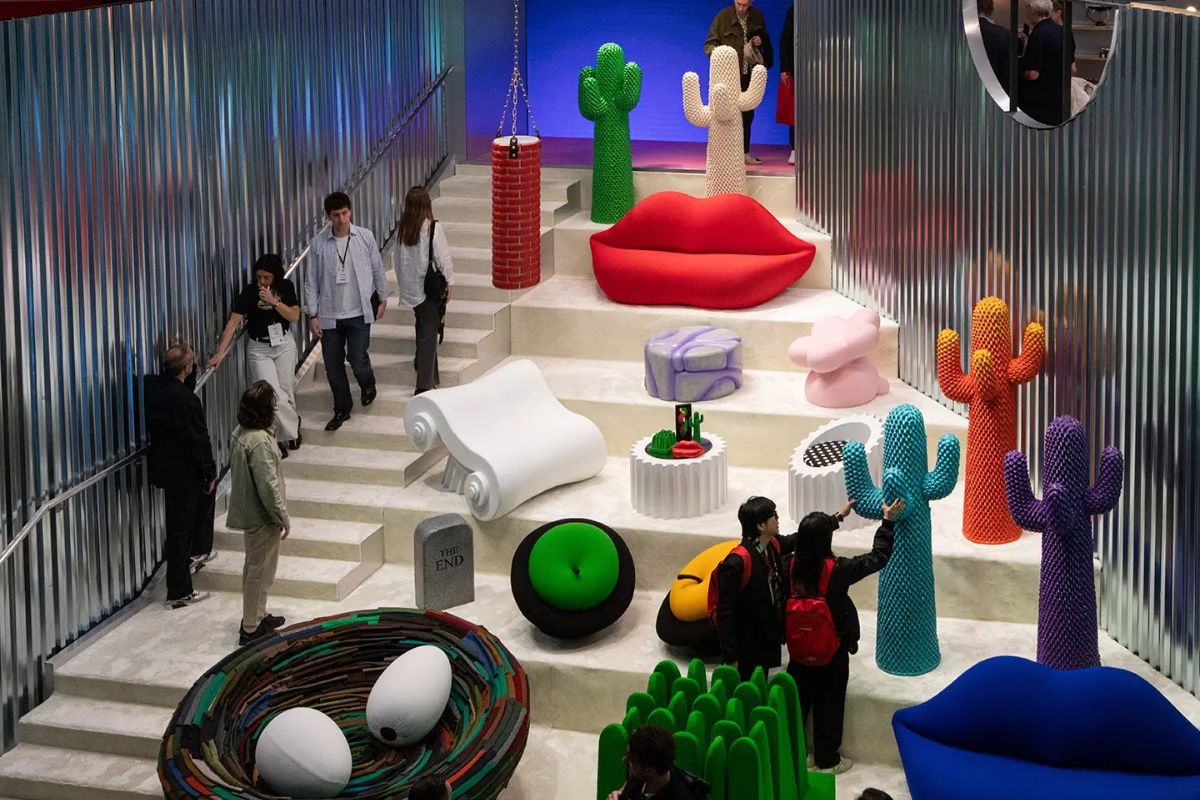
Because design tells us about how we live . About what we choose for our spaces, our bodies, our communities. The Show is not a sector trade fair. It is a laboratory of possibilities . A theater where new ways of being in the world are told.
Every object, every display, every installation can spark questions: how do I want to live? What relationship do I have with matter, with color, with time? Can I surround myself less, but better?
The Salone del Mobile concerns us because it talks about us . Of our choices. Of our desires. Of the cities we want to build.
And as long as there are questions like this, the Salon will be the right place to look for the answers.
Read also: The calendar of design and furniture fairs in 2025
Leave a comment