February 13, 2026 marks a special anniversary for the world of design: one hundred years since the birth of Verner Panton , one of the designers who had the greatest impact on the imagination of the twentieth century. Born in 1926 in Gamtofte, Denmark, Panton shifted the center of gravity of the project: no longer …
February 13, 2026 marks a special anniversary for the world of design: one hundred years since the birth of Verner Panton , one of the designers who had the greatest impact on the imagination of the twentieth century. Born in 1926 in Gamtofte, Denmark, Panton shifted the center of gravity of the project: no longer just form and function, but perception , atmosphere, involvement.
A century after its birth, its language remains current because it speaks of a theme that returns cyclically in the contemporary debate: how much we want to “feel” within the spaces we inhabit . And how willing are we to use color not as a finish, but as a structural idea.
The challenge to Nordic minimalism: imagination and color as a cultural position
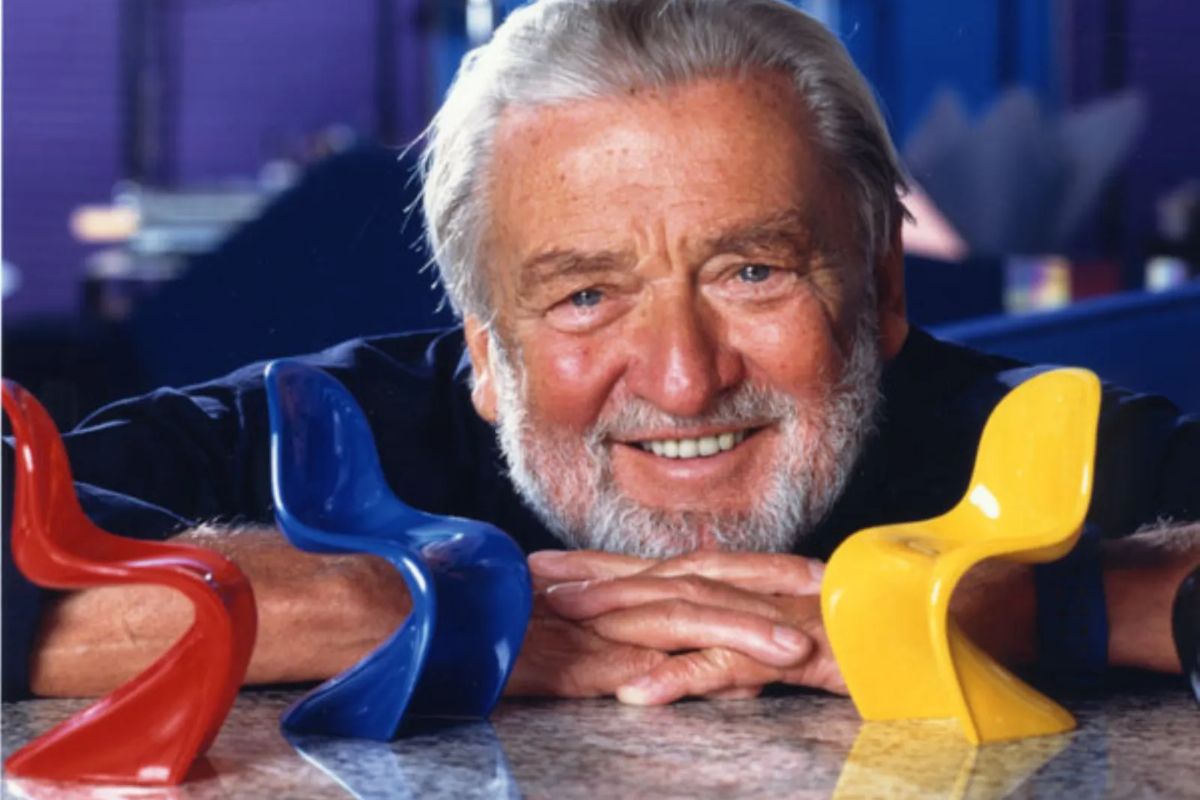
Scandinavian design has accustomed us to sober lines, natural materials and neutral palettes. Panton represented the exact opposite: experimental, bold, unconventional , capable of treating the project as a total scene.
After studying at the Royal Academy of Fine Arts in Copenhagen and a period of collaboration with Arne Jacobsen , in 1955 he opened his own independent studio. It is the beginning of a research that is not limited to “designing objects”, but aims to change the way in which an environment behaves : how it welcomes, how it orients, how it influences mood.
Reducing Panton to the formula “anti-minimalism” is convenient, but partial: his is not just an aesthetic rebellion. It is a precise project idea, summarized in a sentence that sounds like a manifesto: «The main purpose of my work is to provoke people to use their imagination». The rest – the criticism of the “grey-beige” of conformism – is the consequence.
Panton Chair: sculptural and futuristic, an icon that changed history

Among all the works of Verner Panton, there is one that more than any other has marked the history of design: the Panton Chair .
Designed at the end of the 1950s and developed through prototypes and tests, it reached industrial production with Vitra in 1967: a cantilevered chair, made from a single piece of plastic material (in the first versions) and conceived as a continuous gesture, almost an “S” drawn in space.
The Panton Chair is not just a piece of furniture: it is an object that made credible a then radical idea, that is, that plastic could become classic , not temporary. And this is why, even today, it continues to be revived and discussed: not only for its iconic profile, but for what it represents in terms of industry, technology and culture of living .
Vitra celebrates its centenary with a public vote on color
To celebrate 100 years since the birth of the Danish designer, Vitra has activated an initiative designed to involve the public: a public vote (also promoted via social media) to decide the colors of the Panton Chair Limited Edition 2026 . The idea is simple but effective: transforming an already canonical object into a still “alive” piece, which in 2026 continues to dialogue with contemporary desires, tastes and imaginations.
Visiona: when the pop utopia ofbecomes a habitable interior
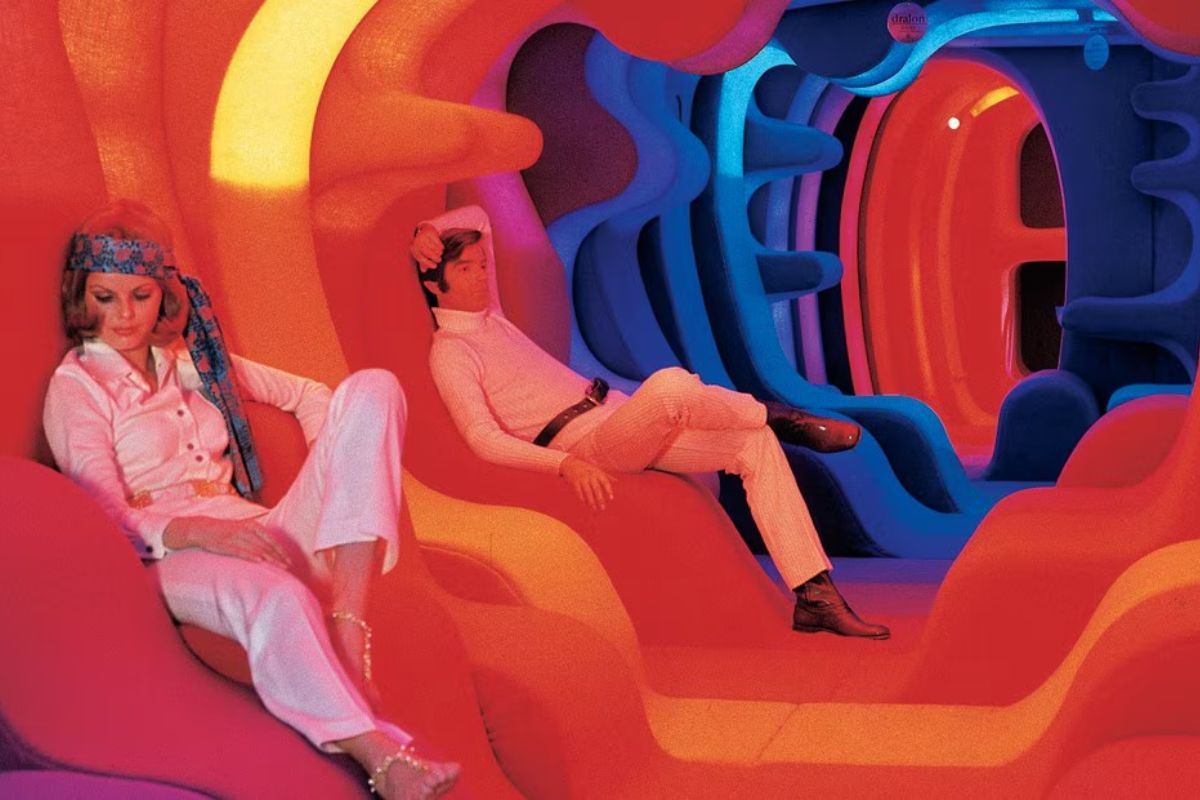
If the Panton Chair is the most famous work, the projects that best describe Verner Panton’s “total” vision are the installations Visiona (in particular Visiona 0 and Visiona 2), created between the end of the Sixties and 1970 for the Cologne Furniture Fair , as part of the initiatives promoted by Bayer .
Invited to transform a ship on the Rhine into an exhibition space, Panton creates psychedelic and enveloping environments: organic shapes, soft surfaces, innovative materials, bright colours. This is how the concept of Total Environment was born, in which furnishings, walls, floors and lights are not separate elements, but components of the same direction.
Here Panton is more “architect” than product designer: he builds domestic landscapes and demonstrates that the interior can be a true sensorial experience.
Total Environment: the project as an immersive experience
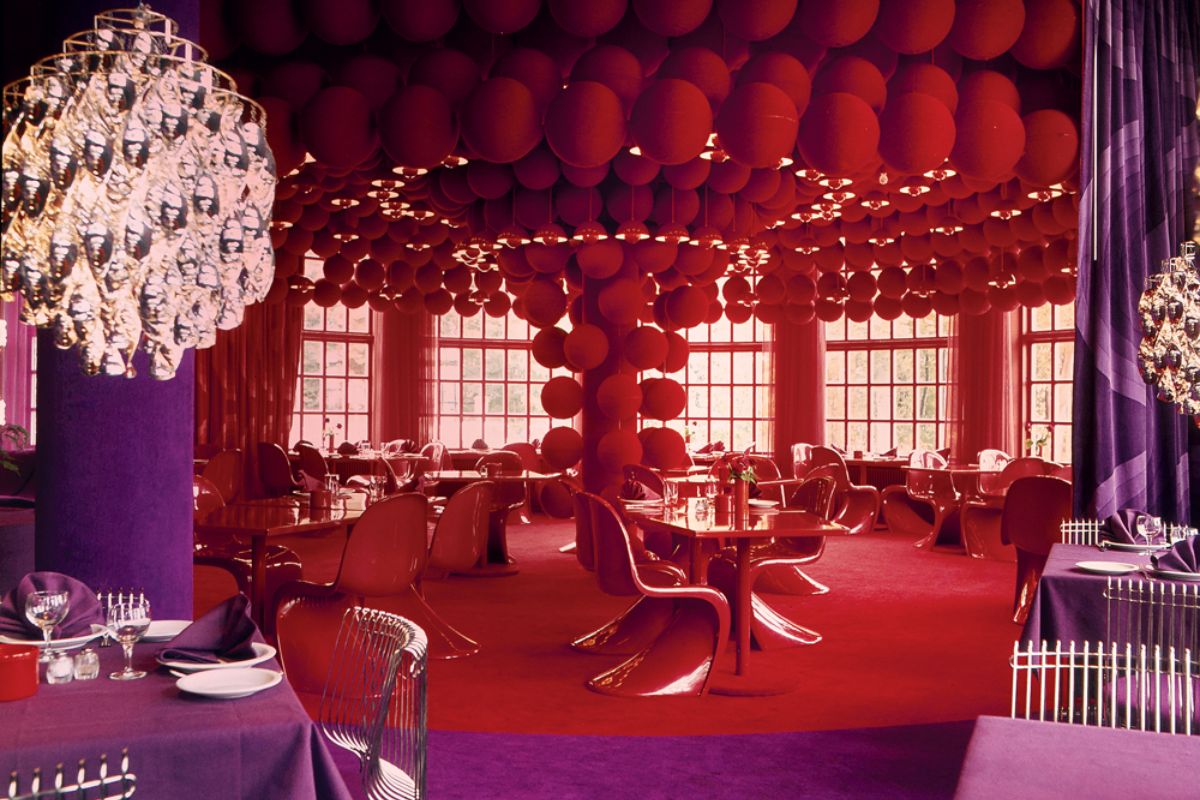
For Verner Panton, designing meant going beyond the single object. Each space had to be thought of as an integrated system of shapes, materials and colors: a coherent, almost cinematic unity.
An emblematic example is the interior design of Der Spiegel in Hamburg (1969): lobbies, rooms, common areas and work environments are re-orchestrated according to a coordinated vision. The same approach appears in the project of the Varna restaurant in Aarhus, where each environment is characterized by a dominant color and furnishings designed to create recognisable, identifying and memorable atmospheres.
Lamps and furniture: the boundless creativity of Verner Panton
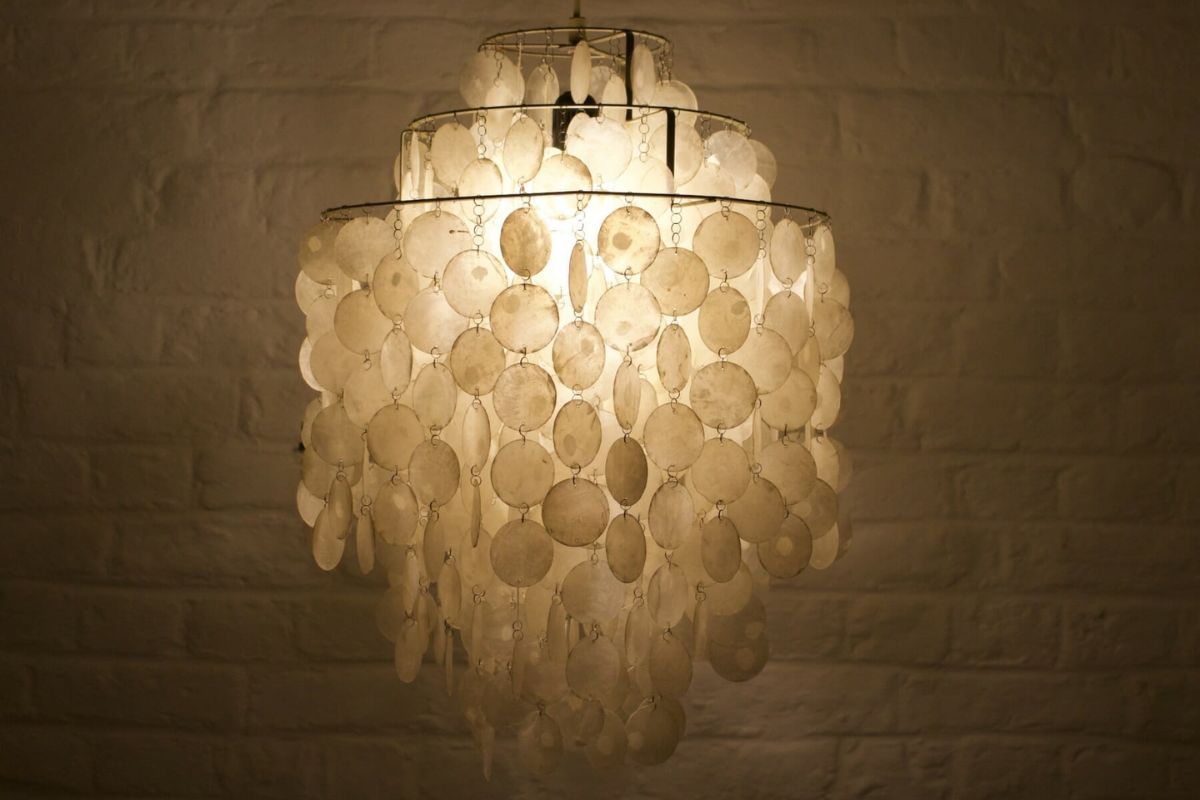
Verner Panton has designed a long list of products that have become icons of contemporary design. Among the best known:
-
Fun / Mother of Pearl (1964): a family of lamps built with mother-of-pearl discs, capable of transforming light into movement and vibration.
-
Shell lamp / shell installation (1972): a large luminous intervention composed of thousands of shell elements, originally created for his home near Basel and then rearranged over the years as a scenographic presence in a public setting.
-
Flowerpot (1968): iconic lamp, with soft and immediate geometries, often associated with the imaginary flower power.
-
Living Tower (1969): a habitable sculpture, multifunctional ergonomic platform.
-
Spiral Lamp and Ball Lamp (1969/1970): suspensions with a high visual impact, which work more on the space than on the object.
Each project bears witness to his curiosity for new technologies and materials that were pioneering at the time, and a constant: the desire to make light and color instruments of architecture.
A year of celebrations: exhibitions, re-editions, limited editions
The centenary campaign is not limited to the Panton Chair. 2026 is set to be a year of initiatives, including re-editions , new finishes and special projects. Among the main eventsipali, the Vitra Design Museum dedicates a major exhibition to Panton at the Vitra Schaudepot: a journey that embraces seating, lights, textiles and even lesser-known architectural works, with an installation designed in an immersive key.
Alongside this, celebratory editions are presented, including a Heart Cone Chair Anniversary Edition 2026 , which incorporates Panton’s formal and chromatic lexicon in a collector’s key.
Why this centenary matters in the world of design
The centenary of Verner Panton is not just a historical anniversary: it is a lens on the present. In a phase in which the project often tends towards neutrality (for cultural, commercial reasons, or simply for “prudence”), Panton reminds us that design can also be position , not just style.
His legacy is not the invitation to “color everything”, but to recognize that color, light and shape can become language : they can guide behaviors, generate comfort, produce emotional energy.
Celebrating Verner Panton therefore means celebrating an idea of design that is both free and rigorous: a design that requires imagination, and that is not afraid to declare itself.
Curiosities about Verner Panton
When was Verner Panton born?
Verner Panton was born on 13 February 1926 in Gamtofte , Denmark.
Why is the Panton Chair so important?
Because it made possible, on an industrial and cultural level, the idea of a cantilever chair made of a single piece of plastic material: a paradigm shift in form, technology and imagery.
What does Total Environment mean?
It is the idea that space is designed as a single system: furnishings, surfaces, colors and light work together to produce a coherent and immersive experience.
What are Visiona installations?
They are experimental environments created between the late 1960s and 1970s for the Cologne Furniture Fair (with Bayer), in which Panton stages “total”, organic and chromatically radical interiors.
What are Panton’s best-known lamps?
Among the best known: Flowerpot , the Fun / Mother of Pearl series, and various scenographic suspensions such as Spiral and Ball , as well as large light installations.