Suspended lighting is often one of the most decisive design devices in an environment: it defines the proportions of the space, governs its perception, establishes a visual rhythm and, in many cases, becomes the true narrative fulcrum of the environment. In residential projects as well as in hospitality, office or retail ones, the chandelier acts …
Suspended lighting is often one of the most decisive design devices in an environment: it defines the proportions of the space, governs its perception, establishes a visual rhythm and, in many cases, becomes the true narrative fulcrum of the environment.
In residential projects as well as in hospitality, office or retail ones, the chandelier acts as an architectural sign: it dialogues with the volumes, accompanies the materials, builds hierarchies. A well-designed light can amplify a ceiling, make a large space intimate, guide the gaze without ever imposing itself in a didactic way.
This is why, over time, some chandeliers have gone beyond their technical function to become icons of design . Recognizable, signed objects, capable of crossing eras and languages ??without losing relevance. Not simple “beautiful pieces”, but projects that have influenced the very way of thinking about interior lighting.
Selecting iconic models therefore means making a precise choice: not chasing the fashion of the moment, but recognizing those chandeliers that have been able to build an imagination, introduce new formal or technological solutions, and become constant references for architects, interior designers and lighting designers.
In this article we have collected a selection of designer chandeliers and iconic chandeliers that have marked and continue to mark contemporary design. A cultural map, even before an aesthetic one, to orient yourself in the world of lighting design with awareness.
Designer chandeliers and iconic chandeliers: our selection
Not a ranking, not an exhaustive list. What follows is a curatorial selection of designer chandeliers that have built a recognizable language in contemporary design. Objects that do not simply illuminate, but give shape to the space, determine its interpretation and often become its symbolic centre.
Each model has entered the lexicon of interior design for precise reasons: an innovative technical solution, a radical shape, a strong authorial signature or a rare ability to cross time without losing relevance.
IC Lights Michael Anastassiades for Flos


Designed by Michael Anastassiades for Flos , IC Lights is one of the most successful examples of balance between conceptual rigor and visual poetry. The luminous sphere, suspended as if in an instant of calm on a minimal structure, works on the theme of gravity and balance.
It is a chandelier that communicates with the architecture without dominating it, perfect in residential projects as well as in contract spaces, where the light must be present but never intrusive.
PH 5 Poul Henningsen for Louis Poulsen


The PH 5, designed by Poul Henningsen for Louis Poulsen , is one of the most studied and replicated chandeliers in the history of lighting design. His system of overlapping screens is not a formal exercise,but a precise design response: diffusing light uniformly, without dazzling.
Even today it is an absolute reference when it comes to functional lighting and quality of light in interiors.
Caboche Patricia Urquiola & Eliana Gerotto for Foscarini
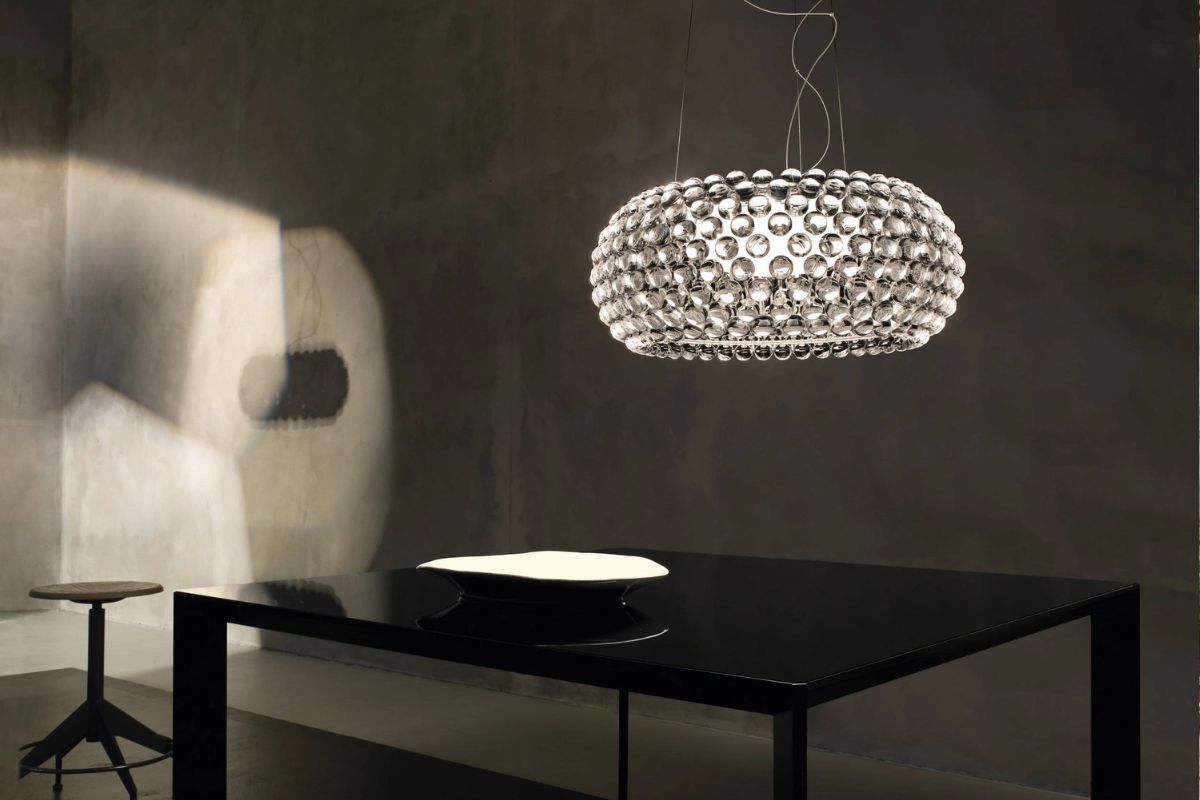
Caboche is one of those chandeliers that have been able to combine spectacularity and design control . Designed by Patricia Urquiola and Eliana Gerotto for Foscarini , plays with the refraction of light through spherical elements that evoke a contemporary jewel.
It is an iconic chandelier especially in hospitality projects, where it becomes a scenographic element without slipping into decorative excess.
Melt Tom Dixon


With Melt, Tom Dixon introduced a more experimental and material language into lighting design. The mirrored and deformed surface creates iridescent reflections and an almost liquid perception of light, which changes depending on the point of view and the lighting.
It is a chandelier that functions as a sculptural object, often used in contemporary spaces where light becomes part of the sensory experience.
28 Series Omer Arbel for Bocci


The 28 Series, designed by Omer Arbel for Bocci , redefined the concept of the chandelier modular. Each blown glass element is unique, imperfect, unrepeatable. The result is not a rigid composition, but an open system that grows in space.
It is one of the most used solutions in large atriums, staircases and double height projects.
Lederam Enzo Catellani for Catellani & Smith


Designed by Enzo Catellani for Catellani & Smith , Lederam represents one of the most refined expressions of contemporary Italian lighting design. A thin disc that works on reflection, on subtraction, on the absolute control of light.
It is a chandelier that does not seek centrality, but builds atmosphere, becoming a frequent choice in high-level residential projects.
2097 Gino Sarfatti for Flos


Designed in 1958 by Gino Sarfatti for Flos , 2097 it is one of the most recognizable chandeliers of Italian design. An industrial, almost technical chandelier, which breaks with the classic idea of ??a decorative chandelier and introduces a functional aesthetic, made of exposed cables, arms and light bulbs.
Againtoday it is a constant presence in lofts, double-height spaces and contemporary interiors where the contrast with the architecture becomes part of the project.
Skygarden Marcel Wanders for Flos


With Skygarden, Marcel Wanders overturned the idea of decoration applied to lighting design. On the outside an essential dome, on the inside a rich ornamental display that recalls historic stuccoes and ceilings.
It is a chandelier that works by contrast, often used in contemporary designs to introduce an element of surprise and memory.
Aim Ronan & Erwan Bouroullec for Flos


Aim was born as a response to a very current design need: flexibility. Designed by Ronan Bouroullec and Erwan Bouroullec for Flos, it is a suspension adjustable in height and position, designed for adapt to fluid and non-hierarchical spaces.
It has become iconic precisely for its ability to interpret changing lifestyles and contemporary interiors.
Moon Davide Groppi


Moon is a poetic statement even before being a design object. Davide Groppi works on extreme subtraction: a luminous surface that evokes the moon, suspended in space with an almost immaterial presence.
It is a chandelier often chosen in more conceptual projects, where light becomes a story and atmosphere, rather than a functional element.
Artichoke (PH Artichoke) Poul Henningsen for Louis Poulsen


Designed in 1958 by Poul Henningsen , Artichoke is one of the most studied chandeliers in the history of lighting design. The overlapping slats, arranged on several levels, guarantee a completely anti-glare light, visually powerful but technically controlled.
It is a monumental chandelier, often chosen for large spaces, restaurants, atriums and institutional projects where light must be the protagonist without losing design rigor.
Taraxacum Achille Castiglioni for Flos


Designed by Achille Castiglioni , Taraxacum is one of the most radical chandeliers of Italian design. A luminous explosion made up of exposed light bulbs, which transforms a technical element into an architectural gesture.
It is iconic because it overturns the concept of the classic chandelier: no decorative structure, just pure light and exhibited function.
Wireflow Arik Levy for Vibia


Wireflow, designed by Arik Levy for Vibia , is a contemporary reinterpretation of the traditional chandelier. Thin lines, almost graphic structure, volumes drawn in the air rather than built.
It is a model widely used in contemporary residential and contract projects, where the chandelier becomes a light and not bulky sign.
Mesh Francisco Gómez Paz for Luceplan


Mesh was born from the encounter between parametric design and LED technology. Designed by Francisco Gómez Paz for Luceplan , it is a modular chandelier that allows infinite configurations and lighting scenarios.
It is iconic for its systemic approach: not a closed object, but a light platform designed for contemporary architecture.
Heracleum Bertjan Pot for Moooi


With Heracleum, Bertjan Pot brought an organic and natural dimension to lighting design. The chandelier recalls the structure of a flowering plant, but uses integrated LEDs in an almost invisible way.
It is an iconic suspension especially in high-end hospitality and residential projects, where light becomes a scenographic and identifying element.
Crown Jehs + Laub for Nemo Lighting

Crown is a chandelier that reinterprets the classic chandelier in an industrial and contemporary key. Designed by Jehs + Laub for Nemo Lighting , it uses metal arms and exposed bulbs with a strong graphic presence.
It is often used in contract projects, restaurants and public spaces where a strong but legible sign is needed.
Agnes Lindsey Adelman

Agnes has become one of the most recognizable chandeliers in contemporary interior design. Designed by Lindsey Adelman , it combines a modular structure with luminous orbs that can grow in space like a constellation.
It is a chandelier that is very present in high-end residential projects and hotels, because it manages to be both sculptural and refined at the same time.
How to choose a chandelier in an interior design project