Why handmade ceramics still fascinates us (and more and more) There are materials that never stop talking. Even when the world is moving towards total dematerialisation, even when everything seems fluid, smooth, polished by algorithms and 3D rendering, artisanal ceramics remains there, reminding us that beauty comes from fire, from earth, from hands. It is …
Why handmade ceramics still fascinates us (and more and more)
There are materials that never stop talking. Even when the world is moving towards total dematerialisation, even when everything seems fluid, smooth, polished by algorithms and 3D rendering, artisanal ceramics remains there, reminding us that beauty comes from fire, from earth, from hands.
It is not just an aesthetic question. It’s something more visceral. Perhaps because every piece of ceramic carries within it a story, a temperature, an unrepeatable gesture. Or perhaps because it takes us back to something familiar, ancestral. The fact is that handmade ceramics – imperfect, vibrant, alive – are returning to occupy an important place in the panorama of contemporary interior design. Not as a simple ornament. But as a planning act , as a declaration of identity.
Whoever today chooses to cover a wall, a kitchen, a sink with artistic tiles, handmade decorations, iridescent glazes or local terracottas , is making a cultural gesture. He’s saying: “I don’t want seriality, I want uniqueness. I don’t want plastic, I want real material”.
And this desire, silent but powerful, is generating a real rebirth of Italian ceramic craftsmanship , which finds new life precisely in the most visionary interior projects. From new generation boutique hotels to designer homes, from concept stores to designer restaurants, ceramics is back, but comes back different . With an ancient strength and a new aesthetic.
A new grammar of the project: from the workshop to the concept
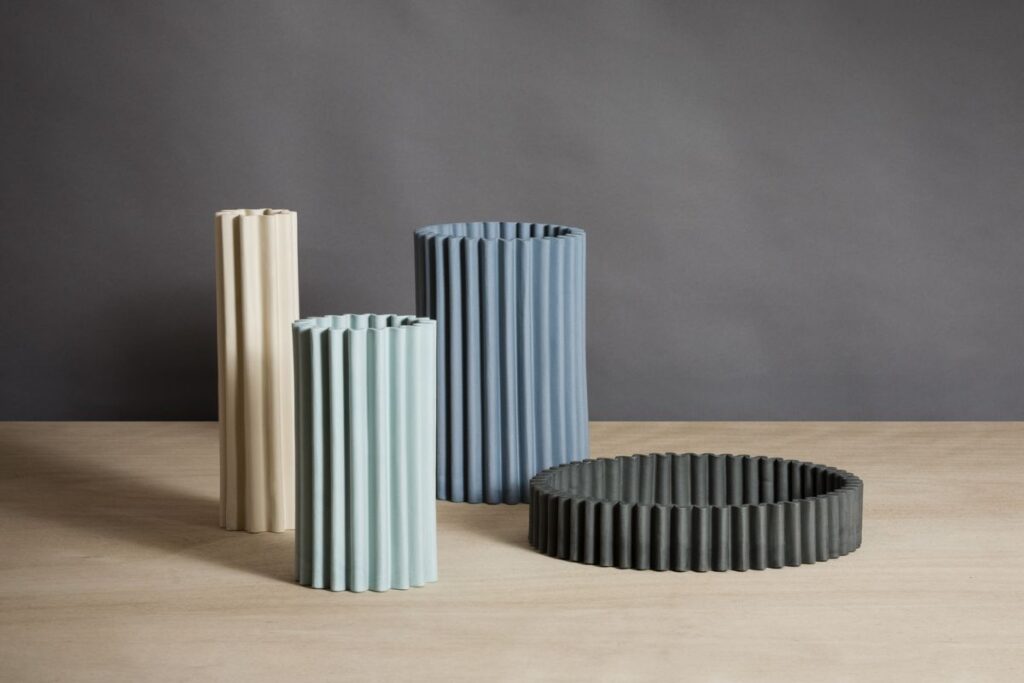
There was a time brief, but intrusive in which artisanal ceramics had been relegated to a symbol of provincial nostalgia. The large industrial brands looked at it with condescension, the designers considered it not very compatible with the minimal lines of international design. Yet, while furnishings pursued total white and total flat, something continued to move in Italian shops.
Italian ceramists , often children or grandchildren of artisans, began to experiment with new forms, oxidized glazes, lava clays, vegetable pigments. They started collaborating with architects, chefs, interior stylists. They understood that their strength was not in quantity, but in the expressive power of the single tile , of the single bowl, of the single decorative element.
In the meantime, design has also taken a big turn, and has returned to desiring what is unique, tangible, emotional. The result? A silent but solid alliance between workshops and architectural firms, between territories and projects, between memory and vision.
Ceramics today have returned to speaking the language of the present . But it does so with archaic grammar: that of fire, time, patience.
Italian ceramists: some names to know
1. Francesca Verardo Udine (Friuli Venezia Giulia)
Organic geometry, silence and stratification
Francesca Verardo is a contemporary ceramist who works in her studio in Udine, with an essential, dry, profoundly architectural aesthetic. Each piece tile, vase, decorative panel is the result of research on primary form and the relationship with space .
His collections are often used in interior projects for boutiques, galleries or contemporary homes: sandy surfaces, neutral colors, traces that seem like engravings of time. He collaborates with architecture studios and galleries, and his work has also been exhibited at Milan Design Week.
“I seek calm, the balance between gesture and matter. Each object must be able to remain silent and resist.”
It is a strong and subtle voice, which interprets ceramics as presence and void , as an architectural gesture .
2. Made a Mano Caltagirone, Sicily
Lava stone and artisan rigor for signature surfaces
Founded in 2001 by Rosario Parrinello with headquarters in Caltagirone, Made a Mano produces surfaces in lava from Etna and glazed terracotta exclusively handmade in Italy. The collections such as Cristalli , Ossido , Komon , Novecento combine Mediterranean aesthetics and contemporary geometries, applied to contract furniture and luxury interiors.
The coverings created are unique pieces, worked with a brush, with decorative motifs that combine sculpture and function. These creations have been adopted by showrooms, restaurants and hotels around the world.
3. Giacomo Alessi Caltagirone (CT)
Baroque ceramics that are not afraid to exaggerate
Giacomo Alessi is a master, but also a character. His dark brown heads, his figurative plates, his exuberant decorations do not limit themselves to reproducing the Sicilian tradition: they amplify it, renew it, stage it with courage and irony.
His pieces are also used in avant-garde interiors, combined with concrete walls or minimalist furniture. The contrast is explosive.
Ceramics is never neutral, he says. It is expression, identity, story.
And his story theatrical, cultured, generous went around the world.
4. DWA study for Mutina Fiorano Modenese (MO)
When industrial ceramics becomes wall art
Mutina is not an artisan workshop, but a brand that has chosen to restore ceramics to its artistic status . It does so by inviting designers and studios to work on the tile as if it were canvas, sculpture, composition.
One of the most interesting projects is Materia by Studio DWA (Davide Fabio Colaci and Luca Macrì), which reinterprets coverings as landscapes.
Each collection is made of rhythms, reliefs, nuances that change with the light. The production is industrial, but the concept is artisanal. And the result is often present in the most sophisticated interior projects, from Paris to Tokyo.
A ceramic that does not imitate , but takes its word.