Photographed, filmed and studied like few homes in the world, Pierre Koenig’s Case Study House #22 has yet to find a buyer. After almost ten months on the market and a $5 million price cut, the future of the modernist icon remains in limbo. Some buildings become famous because someone famous lived in them. The …
Photographed, filmed and studied like few homes in the world, Pierre Koenig’s Case Study House #22 has yet to find a buyer. After almost ten months on the market and a $5 million price cut, the future of the modernist icon remains in limbo.
Some buildings become famous because someone famous lived in them. The Stahl House took the opposite route: it never needed an illustrious owner, because the house itself became the celebrity.
The name may not ring a bell for everyone. The image almost certainly does. A glass room glowing in the dark, two women seated in conversation, Los Angeles spread out below them like a carpet of constellations. Julius Shulman’s 1960 photograph has traveled through books, exhibitions and advertising campaigns, becoming more than the depiction of a house: the visual shorthand for an entire idea of California.
Today that house is for sale. And, against all expectations, no one has bought it yet.
The Stahl House is still for sale at $20 million
The Stahl family put the property on the market for the first time on November 21, 2025, after sixty-five years of continuous ownership. The initial asking price was $25 million. On April 14, 2026, it was cut by 20%, bringing the price down to $20 million. As of September 14, 2026, the real estate listing is still active.
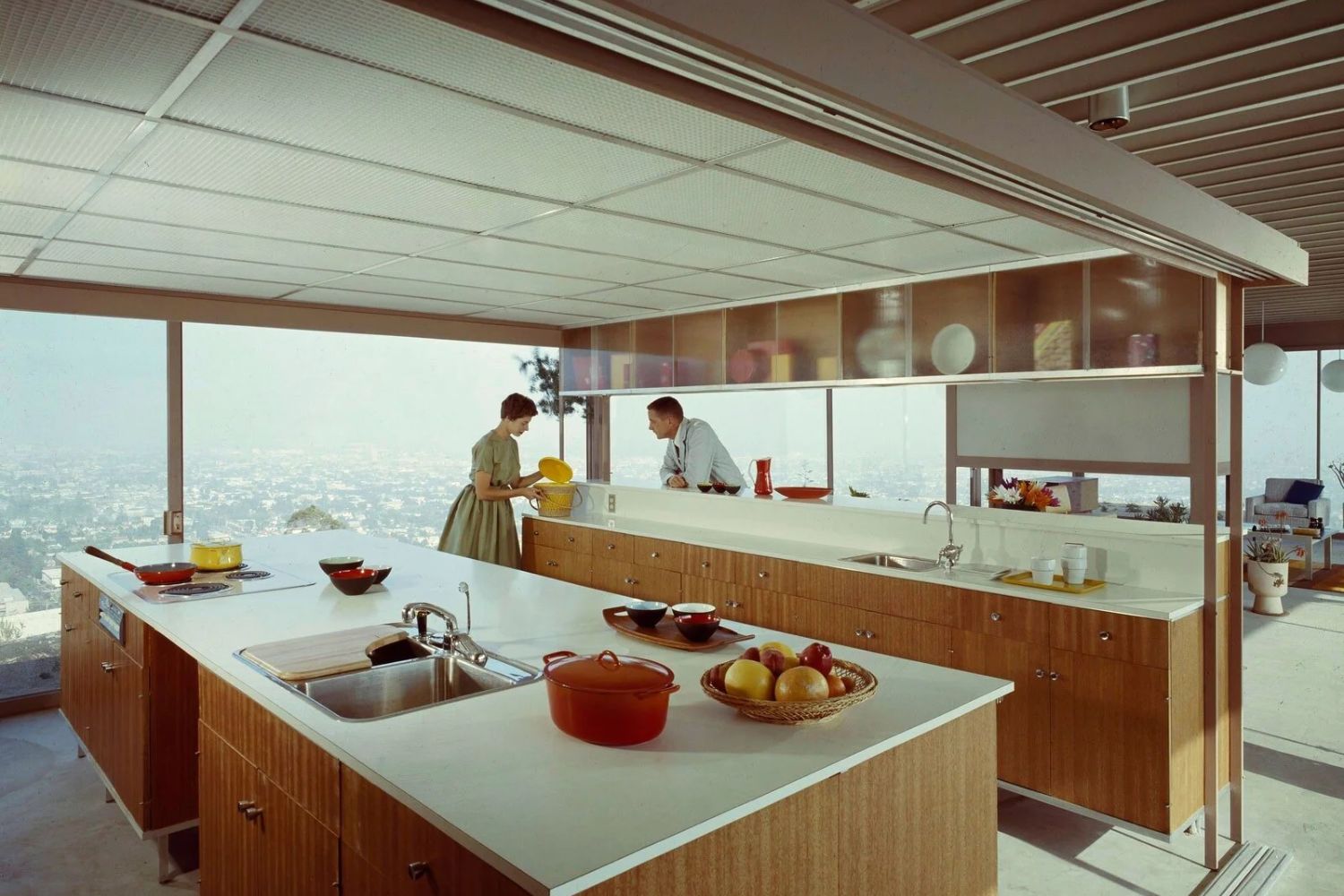
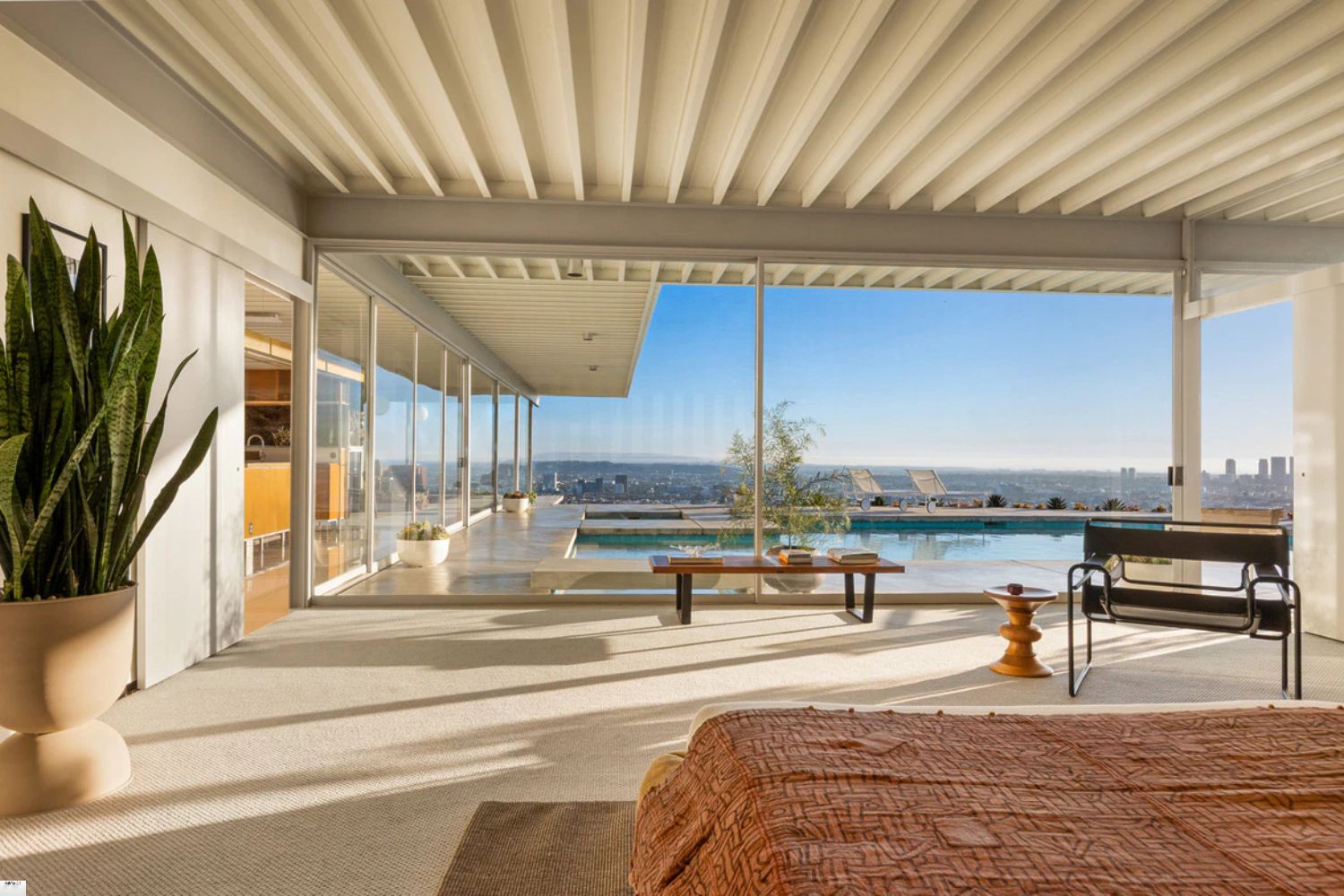
The numbers immediately reveal how unusual this sale is. The house measures 2,200 square feet, just over 204 square meters, with two bedrooms and two and a half bathrooms. There’s a pool, a two-car carport and an advertised 270-degree panoramic view over the city, the hills and, on the clearest days, all the way to the ocean.
The asking price works out to about $9,091 per square foot: almost $98,000 per square meter. That isn’t a normal value for a residence, even in the most exclusive tier of the Los Angeles market. It’s a price placed on its uniqueness, on Pierre Koenig’s signature, on Shulman’s photograph and on the building’s place in 20th-century history.
And yet cultural prestige, however enormous, doesn’t automatically translate into a sale. That’s where the paradox begins.
Before the icon: a difficult lot and the Stahls’ dream
The story begins in May 1954, when Clarence “Buck” Stahl and Carlotta Stahl bought a steep lot above Sunset Boulevard. The promontory, jutting out over the void of the Hollywood Hills, seemed ill-suited to support a house. Buck, however, didn’t just see the slope: he saw the chance to live facing the entire city.
For two years the couple spent their weekends preparing the land. They salvaged chunks of concrete from Los Angeles construction sites, hauled them up the hill and built the retaining walls needed to enlarge the usable area. In 1956 Buck even built a small three-dimensional model of the house he imagined: an L-shaped plan, transparent walls and a section cantilevered over the slope were already part of the original idea.
Several architects considered the site too complicated. Pierre Koenig, whom the Stahls met in November 1957, reacted the opposite way: he understood that the difficulty didn’t need to be hidden but could become the heart of the architecture.
On April 8, 1959, the project officially joined Arts & Architecture magazine’s Case Study House program as number 22. Construction began the following month and was completed in May 1960. The build cost about $37,500: a figure in line with the means of an American middle-class family, a world away from the multimillion-dollar value attached to the property today.
Case Study House #22: Pierre Koenig’s precise architecture
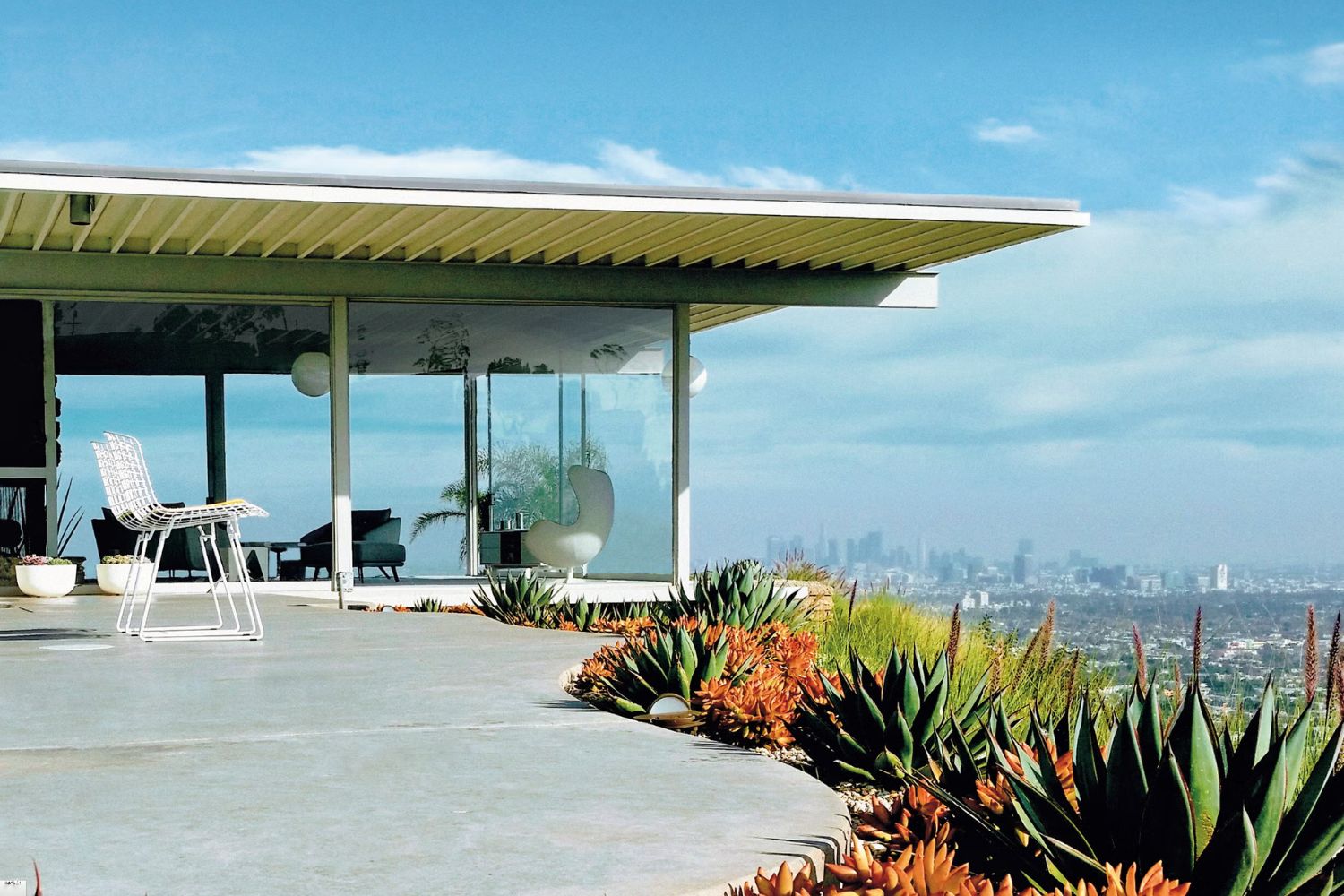
Seen in plan, the Stahl House is almost disarmingly simple. Two perpendicular wings wrap around the pool. One contains the living room, dining area and kitchen; the other holds the bedrooms and the carport. The service spaces are concentrated where the two meet. No superfluous rooms, no ceremonial corridors, no concessions to domestic monumentality.
Koenig worked with a steel frame, a flat roof, deep overhangs and large floor-to-ceiling sheets of glass. The living room projects out over the slope, and the slender grid of mullions leaves the view almost unobstructed. The pool isn’t an accessory placed in front of the house: it’s the void around which the whole composition finds its balance.
The design contains many of the ideas that would define the Mid-Century Modern style: structural lightness, industrial materials, an open plan, minimal ornament and continuity between inside and outside. Here, though, those features don’t become a style. They serve to resolve a specific site.
The Stahl House has no main facade in the traditional sense. Its real facade is Los Angeles. Every decision leads toward the view; the architecture thins out so the city can enter domestic life. Glass, steel and light don’t build a transparent box to be looked at, but a device that constantly shifts the perception of distance.
It’s a lesson that still holds: natural light at home isn’t simply a matter of how much glass you have. It depends on orientation, overhangs, shadows, the relationship with the landscape and the way a space accompanies the different hours of the day.
Julius Shulman and the photograph that created the myth
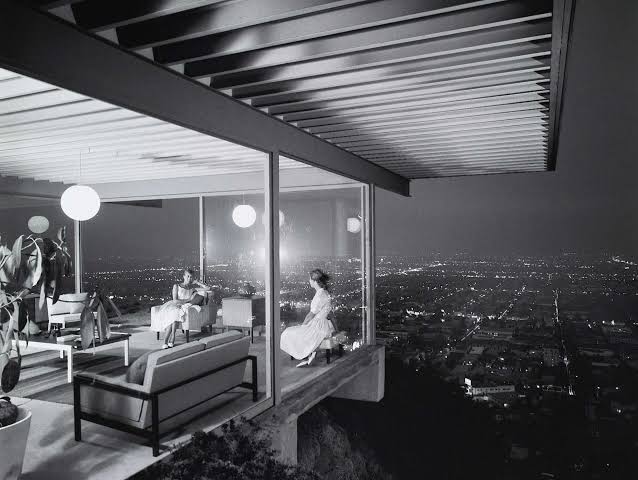
On May 9, 1960, shortly after construction was completed, Julius Shulman arrived on the hill to photograph the house. He waited for the moment when the sky lost its light and the city began to switch on. Then he placed two young women in the glazed corner of the living room.
The image is built on a very subtle contradiction. Inside, the figures chat naturally in a bright, orderly, seemingly safe space. Beyond the glass stretches an immense nocturnal expanse. The transparent wall protects them and, at the same time, seems to vanish. Comfort and vertigo share the same frame.
Shulman didn’t just document the project. He gave it a destiny. Koenig had designed a home; the photographer turned it into the image of a possible life: modern, free, elegant, suspended above the metropolis and yet far from its noise.
Curiously, the shot with the two women—the one destined to become the most famous—did not appear in the feature on the house in the June 1960 issue of Arts & Architecture. Its fame grew later, through publications and reproductions that ended up almost detaching it from the actual building.
The Stahl House thus has two inseparable authors: Pierre Koenig gave it form, Julius Shulman gave it an imagination.
Behind the glass walls was a real home
The power of the photograph also created a misunderstanding. Case Study House #22 seems to have always belonged to the rarefied realm of museums, perfect images and untouchable architecture. For the Stahls, though, it was simply home.
In the exact spot where Shulman had seated his two models, the Christmas tree went up every December. The children, Bruce, Shari and Mark, played around the pool and remember diving off the roof. When Shari became interested in photography, a small utility area was turned into a darkroom: prints were developed next to the washing machine.
The house changed with the family, too. A bedroom was divided to give the children more privacy; a hot tub, some changes to the fireplace, new appliances and upgrades to the systems followed. It was never a static object. Its authenticity lies not in having stayed outside time, but in having passed through time without losing its identity.
Film, television, fashion and advertising then amplified its fame. The house has appeared in movies, music videos and international campaigns; its silhouette has even been referenced in The Simpsons and Grand Theft Auto: San Andreas. In 1989 the Museum of Contemporary Art, Los Angeles built a full-scale replica for the exhibition Blueprints for Modern Living.
Since 2007 the Stahl House has no longer been lived in full-time. For more than seventeen years the family opened it to tours, also using the proceeds to fund its maintenance and restoration. When Bruce and Shari Stahl announced their decision to sell, they didn’t talk simply about a new owner. They chose a more demanding word: steward.
Why hasn’t anyone bought the Stahl House yet?
The most accurate answer is that there is no single reason, at least not publicly. An active listing reveals nothing about any private negotiations, rejected offers or terms discussed between the parties. Reducing it all to “it’s too expensive” would be easy, but not enough.
There are, however, a few factors that help explain why a house desired by millions of people may have very few real buyers.
The price measures a symbol, not an ordinary property
The real estate market normally sets value through square footage, location, condition and comparison with similar properties. The Stahl House removes the last of these from the equation: there is no truly comparable house.
The $20 million asking price includes a cultural premium that is hard to quantify. The buyer isn’t just purchasing 204 square meters in the Hollywood Hills; they’re buying provenance, the architect, public recognition and one of the founding images of California’s visual culture. The problem is that an aura can be immense without having an agreed-upon price.
It’s a masterpiece, but not today’s idea of a mega-mansion
In the eight-figure real estate segment, Los Angeles offers residences of thousands of square meters, guest suites, home theaters, gyms, spas, large garages and near-total privacy. The Stahl House offers the opposite: two bedrooms, essential spaces, an exposed structure and proportions that remain faithful to a design created for an ordinary family.
Its luxury isn’t accumulation. It’s precision. To recognize it, you have to want architecture more than space, history more than amenities, emptiness more than abundance. That’s a cultural disposition far rarer than the wealth needed to buy it.
Buying it means accepting a responsibility
The Stahl House was declared a Historic-Cultural Monument by the City of Los Angeles in 1999 and was added to the National Register of Historic Places in 2013. Listing on the National Register alone does not amount to an absolute federal ban on altering a private property. The house is, however, also subject to a Mills Act contract, which transfers to the new owner and ties property tax relief to a commitment to preserve, maintain and restore the building under defined conditions.
The listing itself allows for restoration, updates and personalization, but makes them subject to the building’s architectural value and the applicable preservation rules. In other words, whoever buys it can’t treat the design like any other villa to be freely adapted to their own taste.
Even for an institution, the cost doesn’t end with the purchase
A museum, foundation or university might seem the natural home for such an important house. But the $20 million would only be the entry ticket. Then comes the upkeep of a glass-and-steel structure perched on a delicate slope, managing tours, security, restoration and the need to fund it all over time.
Architectural historian Alan Hess has expressed surprise at the lack of a buyer and has raised precisely the issue of major institutions’ and wealthy collectors’ lack of interest in architectural preservation. It’s a question that goes beyond this single sale: can we recognize a building as collective heritage without having built the tools to look after it?
Built for the middle class, now almost out of reach
The comparison between $37,500 in 1960 and $20 million today can’t be read as a simple rise in value: in between lie more than sixty years of inflation, the transformation of the Los Angeles market and the house’s entry into America’s cultural heritage. And yet the gap between the two figures holds the most meaningful part of the story. The Case Study House program, launched in 1945 by Arts & Architecture editor John Entenza, set out to experiment with modern, efficient and potentially replicable homes to meet postwar housing demand. Architects such as Charles and Ray Eames, Richard Neutra, Eero Saarinen, Craig Ellwood and Pierre Koenig explored industrial materials, prefabrication, open plans and new relationships between house and landscape.
The Stahl House was born within that promise. Not as a villa for a billionaire, but as a buildable home for a determined couple with limited resources and a very clear idea of their future. Today it ranks firmly among the iconic houses of the 20th century, but it has ceased to be financially accessible to the very social class that its design language was imagined for.
Society has absorbed almost everything the Case Study Houses proposed: open-plan living, sliding doors, large windows, flat roofs, indoor-outdoor continuity. We copied their vocabulary, not their affordability.
Case Study House #22 has thus become the most reproducible of images and one of the least reproducible of experiences. It appears everywhere, but almost no one can own it.
The future of the Stahl House is about more than who signs the deed
The building’s fragility doesn’t end with its glass walls. The Los Angeles Conservancy has also flagged plans for a new residence at the base of the hill, arguing that excavation and large retaining walls could compromise the stability of the slope. An appeal has been filed, and the matter is reportedly still under review.
There’s no evidence that this dispute has prevented a sale. But it shows clearly that preserving the Stahl House means protecting a wider system: the structure, the land, the line of the slope, the view and the unrepeatable relationship between the building and Los Angeles.
The family is looking for someone willing to take on this legacy without turning it into a mere real estate trophy. The next owner will have to decide how much of the house remains accessible, how it will be restored and how it can go on existing without becoming either an empty relic or a villa stripped of its character.
Perhaps the Stahl House is still for sale precisely because the wealth it requires isn’t only financial. A billionaire can buy many houses. It’s rarer to find someone willing to accept that, in this story, the owner will never be the protagonist.
The Stahl House isn’t looking for the richest buyer. It’s looking for one who won’t feel more important than the house.