If there is one event that truly shows how Italian design managed to become an industry, a culture and a global language, it is the Salone del Mobile, the Milan Furniture Fair. Founded in Milan in 1961, the Salone grew out of an idea shared by thirteen furniture entrepreneurs, and its very first edition already …
If there is one event that truly shows how Italian design managed to become an industry, a culture and a global language, it is the Salone del Mobile, the Milan Furniture Fair. Founded in Milan in 1961, the Salone grew out of an idea shared by thirteen furniture entrepreneurs, and its very first edition already brought together 328 companies. What now looks like the world’s largest stage for design was therefore born of a very concrete vision: turning Italian furniture into a system capable of speaking to the world.
Over time, however, Salone del Mobile.Milano has become much more than a trade fair. It is a privileged vantage point on how the way we live is changing, an accelerator of professional relationships and one of the most important contemporary design events in the world. The 2025 edition recorded around 302,548 attendees, with more than 2,100 exhibitors from 37 countries, confirming the pull of an event that keeps bringing companies, buyers, journalists, architects, designers and industry professionals to Milan from all over the world.
What is striking is not only the size of the fairgrounds, but also the effect the Salone has on the city and its entire economic and cultural ecosystem. For 2025, Confcommercio Milano (the city’s business association) estimated a spillover effect of 278 million euros, driven largely by spending from international visitors. That is also why the Salone continues to fascinate well beyond industry insiders: it matters not only to those who design, produce or communicate design, but also to those who see it as an urban, economic, social and symbolic phenomenon.
And yet, for one of the most covered, photographed and discussed events in the design world, many of its most interesting aspects often stay on the margins of the usual story. Attention goes to the most spectacular stands, new products, big names and eye-catching installations, while historical details, little-known changes, strategic turning points and small paradoxes fade into the background, even though they help explain why the Salone del Mobile still matters so much. In this article we have gathered 10 rarely told but genuinely revealing Salone del Mobile facts: not mere anecdotes, but useful keys for looking at the Salone more deeply.
1. For Many Years the Salone del Mobile Was Held Not in April, but in September

Today we are used to thinking of the Salone del Mobile as a spring ritual, almost automatically linked to Milan Design Week and the energy of April. Its origins, however, tell a different story. The first edition opened on September 24, 1961, when a group of thirteen industry entrepreneurs decided to create an event that could support and grow Italian furniture exports. In other words, the Salone was born with a deeply industrial and commercial identity, long before it became a social or urban event in the sense we understand it today.
This September origin is no minor detail, because it also changes how we read the Salone symbolically. It did not start as a “seasonal” event in today’s sense, but as a strategic tool for the Italian furniture industry, built on a precise, strongly market-oriented trade fair logic. Only later did the Salone gradually become what we know today: an international platform that brings together business, design culture, imagination and the city.
The move to April therefore marked much more than a calendar change. Several historical accounts agree that the shift took hold in the early 1990s, with the event moving to spring in 1991. It looks like a logistical change, but it was almost a cultural one: placing the Salone in April brought it closer to a season of greater international openness, encouraged participation, strengthened its dialogue with the city and paved the way for the citywide dimension that, over the years, would make Milan inseparable from the story of design.
So what we now perceive as an almost natural April fixture is actually the result of a precise evolution. Knowing that for a long time the Salone was a September event helps us grasp something fundamental: before it became a collective ritual, an urban experience and a media phenomenon, design was above all an organized entrepreneurial vision.
2. Euroluce and EuroCucina Were Not Born with the Salone: They Came Later, When the Way We Live Changed

When people think of the Salone del Mobile, they tend to imagine a system that was complete from the start, born with all its components: furniture, kitchens, lighting, bathrooms, workplace, young designers. That is not how it happened. The 1961 Salone del Mobile began first and foremost as an event dedicated to furniture and furnishings, while some of today’s most recognizable sections arrived only later, in response to deep changes in the home and in society.
Two dates are particularly revealing here: EuroCucina debuted in 1974 and Euroluce in 1976. These were not simple commercial extensions of the format, but a clear cultural shift. The fact that the Salone felt the need to dedicate two separate biennial shows to kitchens and lighting shows that, in those years, these spaces and themes were ceasing to be seen as purely functional and were becoming genuine fields of design.
It is one of the most interesting Salone del Mobile facts because it helps us read the Salone not only as a showcase, but as a tool that records how living has evolved. In the 1970s, the relationship with domestic space changed: the kitchen became central, and lighting moved beyond the technical to become language, atmosphere and architecture. The Salone picked up on this shift and translated it into new exhibition formats. In other words, it does not merely display design: it often accompanies its transformations and makes them visible.

That legacy is still very clear today. Euroluce 2025, for example, returned as a biennial with its own cultural profile and the debut of The Euroluce International Lighting Forum, a sign that lighting is considered not just a product category but a cross-disciplinary field of reflection involving architecture, technology, well-being, perception and the quality of space. And this is exactly where the Salone continues to stand out: in its ability to show, even through its structure, which design themes are becoming central at a given moment in history.
3. The Salone Created a Space for Under-35 Designers Very Early On: It Is Called SaloneSatellite and It Truly Changed the Rules of the Industry

One of the most significant Salone del Mobile facts concerns its relationship with young designers. Many assume that the focus on emerging talent is a recent achievement, a product of today’s language of creativity and scouting. In reality, the Salone had already recognized this need by the late 1990s: in 1998 it launched SaloneSatellite, conceived by Marva Griffin Wilshire, who still curates it today.
What is interesting is that SaloneSatellite was not created as an accessory space or a simple “youth area,” but as a much bolder gesture: a place designed to put designers under 35 in direct contact with international schools, companies, publishers, talent scouts and industry professionals. The Salone itself describes it as the first event to pay specific attention to young designers, and it quickly became an international point of reference. This means that, beyond representing established design, the Salone chose to structure itself as a vehicle for bringing forward design that had not yet found a market.
It is an important turning point because it reveals a less superficial side of the Salone del Mobile: its ability to shape not only the industry’s present but also its renewal. In other words, it does not just host established brands; for years it has been trying to create the conditions for new designers to genuinely enter the system. Not surprisingly, SaloneSatellite is often described as a “launch pad”, a true launching platform rather than a mere side section.
What makes it even more interesting is that the idea arrived in 1998, at a time when the debate on emerging design did not yet have the media prominence it has today. With that move, the Salone showed remarkable clarity: it understood that the future of design is not protected only by championing heritage companies, but also by creating a place where talent can be seen, selected, supported and connected with industry. It is one of the reasons why, even today, the Salone is perceived not only as a showcase but as a cultural engine capable of genuinely shaping the course of design.
4. The Fuorisalone Is Not the Salone: It Arose Spontaneously and Only Later Became Part of the Official Design Week Story
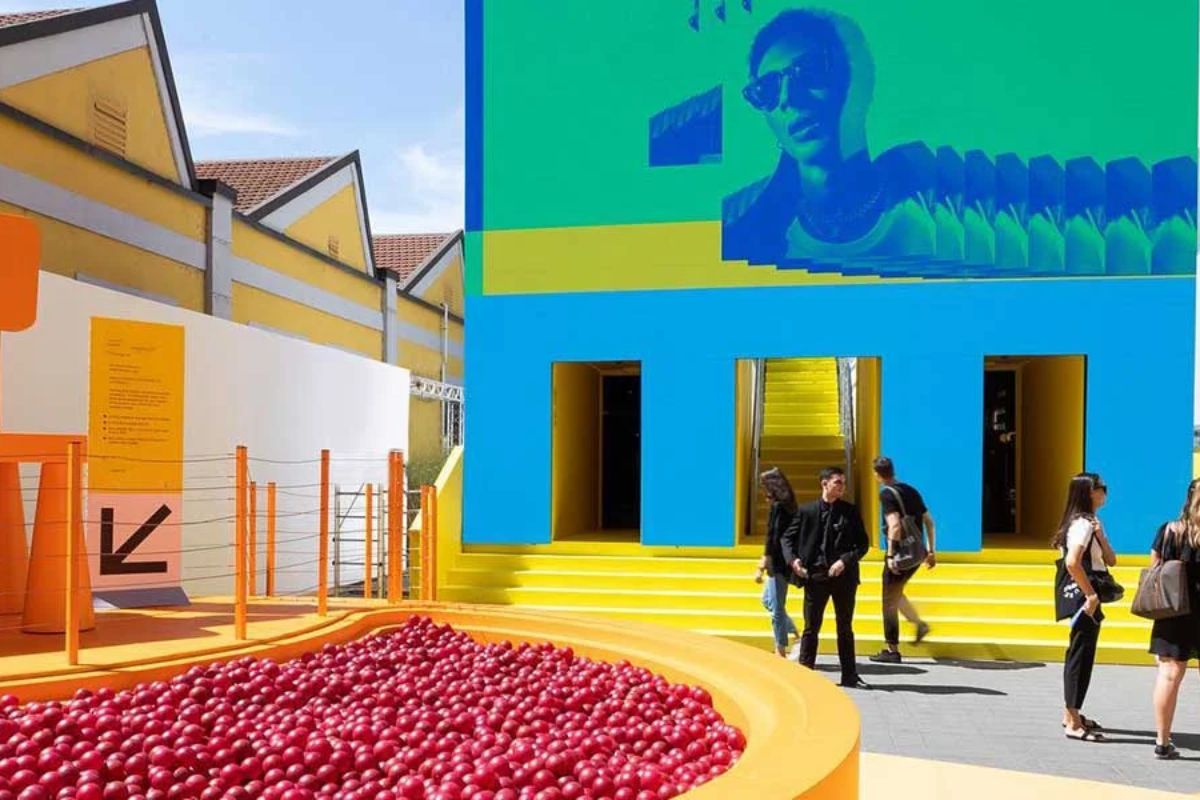
One of the most useful Salone del Mobile facts to clear up is also one of the most misunderstood: the Salone del Mobile and the Fuorisalone are not the same thing. The former is the trade fair held in the halls of Rho Fiera, the exhibition center just outside Milan; the latter is the collection of events spread across different parts of Milan that take place at the same time and that, together with the Salone, now make up Milan Design Week. The distinction may seem obvious, but it changes a great deal about how you read the whole Milan design week.
The most interesting point, though, is historical. The Fuorisalone was not born as an official, top-down format, but as a phenomenon that developed gradually and spontaneously within Milan’s urban fabric. The official history on Fuorisalone.it describes it as an event that grew over time, fueled by showrooms, installations, exhibitions and citywide initiatives running alongside the Salone, until it built an identity of its own. As early as the late 1970s and early 1980s, some companies began using their city spaces as an extension of the trade fair.
There is also a lovely, little-told detail: the word “Fuorisalone” was coined by the magazine Abitare in 1983, when it realized that something new, different from the traditional fair, was happening around the city. It was an important moment, because it marks when what had begun as an almost peripheral practice started to be perceived as a cultural phenomenon in its own right. In other words, the “outside” was not just a sideshow to the Salone: it was already becoming another way of experiencing, telling and showing design.
Even more interesting is that only in 2022 did Salone del Mobile.Milano and Fuorisalone.it announce an official collaboration for the first time. This means that for decades the two worlds coexisted symbiotically but separately: on one side, the great international exhibition machine; on the other, the city as a widespread platform for installations, encounters, culture and visibility. It is perhaps precisely this dual nature that has made Milan unique in the global design landscape.
5. In 2020 the Salone Really Did Stop, and in 2021 It Returned in a Highly Unusual Form: “supersalone”

For an event that has been one of the firmest fixtures on the international design calendar for decades, the real anomaly is not a change of format or setup, but the fact that it stopped at all. And yet it happened: the 2020 Salone del Mobile was canceled, marking a historic break in the event’s continuity. It is one of the less “lighthearted” Salone del Mobile facts, but also one of the most revealing, because it shows that the Salone is not just a trade fair but a cultural and economic infrastructure whose absence is felt immediately.
The following year, however, its return did not follow the usual rules. In 2021 the Salone chose to come back in a special form called “supersalone”, an extraordinary edition that, as the Salone itself recalls, “overturned established exhibition conventions”. It was not just an emergency adaptation but a genuine experiment: greater openness to students and makers, a focus on the Forestami urban forestation project, a program of talks and a less rigidly traditional approach than the trade fair machine the industry was used to.
This episode is interesting because it shows something that is often forgotten: even a seemingly rock-solid institution like the Salone can become a laboratory when it is put under pressure. “supersalone” was not just a parenthesis, but a kind of public stress test of design’s ability to rethink itself, its rituals and its ways of gaining visibility. In other words, the Salone showed that it could be, at least for a moment, less of a showcase and more of a critical platform.
That is exactly why this fact really matters. Knowing that the Salone went through a total cancellation in 2020 and an experimental relaunch in 2021 helps us read it less automatically. It reminds us that even the great rituals of design are not immutable, and that their strength depends not only on continuity but also on the ability to come through a crisis without losing their symbolic centrality.
6. Not Everything We Associate with the Salone del Mobile Happens Every Year: Some Key Sections Are Biennial

One of the Salone del Mobile facts that most surprises outside observers is this: the Salone is not an identical block that repeats itself every year. Although it is an annual event, its internal structure changes, because alongside the fixed exhibitions there are also alternating biennials. This means that not every section the public associates with the “big Salone system” returns every year at the same time.
Today, Salone del Mobile.Milano consists of annual exhibitions such as the Salone Internazionale del Mobile, the International Furnishing Accessories Exhibition, Workplace3.0, S.Project and SaloneSatellite, while Euroluce is held in odd-numbered years and EuroCucina, with FTK – Technology For the Kitchen, together with the International Bathroom Exhibition, in even-numbered years. This is no minor organizational detail: it is a choice that affects the very rhythm at which the industry presents innovations, investments, scenarios and visions.
Understanding this also helps explain why different editions leave such different impressions. In some years the debate focuses more on lighting as a design and technological language; in others, the kitchen and bathroom culture take center stage, two spaces that have become increasingly central to the evolution of the home in recent decades. In this sense, the Salone changes not only in size but also in atmosphere, content and narrative priorities.
This is where the fact becomes genuinely interesting. Many think of the Salone as a single, perfectly stable container; in reality it is a far more dynamic machine, built to alternate different focuses without losing overall coherence. Perhaps that is also why it remains so central: it manages to renew its story not only through brands and stands, but also through its internal exhibition architecture.
7. The Salone del Mobile Has Even Won a Compasso d’Oro: It Is Not Just a Fair, but a Cultural Institution of Design

Among the lesser-known Salone del Mobile facts is one that says a lot about its real weight in the design world: the Salone is not considered important only for its numbers, its business or its ability to attract brands and visitors from around the globe. In 1987, Cosmit – Comitato Promotore del Salone del Mobile Italiano, the committee that organized the Salone, received the Compasso d’Oro, one of the most prestigious awards in Italian design, “for its important contribution to promoting and raising awareness of the sector most attuned to design”.
This is interesting because it places the Salone on a different level from a purely commercial trade fair. An award like the Compasso d’Oro does not simply validate good commercial organization: it recognizes a cultural role, an ability to influence the way design is presented, discussed, understood and valued. In other words, as early as the 1980s the Salone was perceived not only as a platform for economic exchange, but as a driver of reputation and awareness for the entire furniture and design sector.
That is what makes this fact truly significant. When people today describe the Salone del Mobile as an event that shapes brands’ languages, imagery and strategies, they are not using a rhetorical formula invented after the fact. This authority has precise roots, recognized long ago. The Compasso d’Oro awarded to Cosmit in 1987 shows that the Salone had already moved beyond the scope of a simple trade show years earlier, becoming a structural reference point in Italian and international design culture.
8. Despite Its Huge Media Visibility, the Salone del Mobile Is Still First and Foremost a Trade Event

There is a fairly widespread perception, fueled by the enormous social and media exposure of Design Week, that the Salone del Mobile is an event fully open to everyone for its entire duration. That is not the case. And this is one of the most interesting Salone del Mobile facts to clarify: although it has become a popular cultural phenomenon, highly visible even outside the industry, the Salone is still first and foremost a trade event, designed from the outset and in its underlying structure for industry professionals, companies, buyers, the press and the design supply chain.
The official information for the 2026 edition states it clearly: the event is reserved for trade professionals throughout the week, while general public access is limited to Saturday, April 25, and Sunday, April 26. Students can attend from Friday, April 24, to Sunday, April 26. It is a practical detail, of course, but it says much more than it seems: the Salone was not born as a general-interest festival, but as a platform for work, business relationships and strategic positioning for the furniture and design industry.
This distinction also helps clarify the gap between the image of the Salone and its real nature. From the outside, especially online, it often looks like a huge urban event made of images, iconic installations and spectacular atmospheres. Inside, however, it remains a place where orders are placed, distributors are met, materials are examined, collections are assessed, international relationships are built and the health of the industry is measured. Its ability to captivate a very broad audience has not erased its original identity: if anything, it has made it more complex.
Perhaps it is precisely this dual identity that makes it so central. The Salone manages to speak to two different worlds at once: on one side, industry insiders, who experience it as a concrete tool for business and direction; on the other, a wider public, who see it as a showcase of design, a litmus test of contemporary taste and an opportunity to understand where design is heading. Knowing that, despite all this, it remains primarily a B2B event helps you look at it with greater precision and less superficiality.
9. The Salone del Mobile Was Founded by Thirteen Real Entrepreneurs, Not by an Abstract Idea

Among the most interesting Salone del Mobile facts is one that sheds light on its origins: at the start there was no impersonal entity or mere trade fair machine, but a very real group of thirteen Italian furniture entrepreneurs who decided to give shape to a shared project. On September 24, 1961, the first edition of the Salone opened, created to support Italian furniture exports and build a platform that could give international visibility to an industry in the midst of transformation.
The less-told detail is that those thirteen names are known, and on their own they tell an important part of the history of Italian industrial design: Michele Barovero, Alessandro Besana, Franco Cassina, Piero Dal Vera, Vittorio Dassi, Angelo De Baggis, Mario Dosi, Aldo Falcioni, Angelo Marelli, Silvano Montina, Mario Roncoroni, Vittorio Villa and Angelo Molteni. This is not a decorative list. It is proof that the Salone was born of a very precise entrepreneurial will, expressed by figures who truly belonged to the productive heart of Italian furniture-making.
That is what makes this fact significant. Today the Salone is seen as a great international institution, almost inevitable, but at its origin lies a bold and very concrete choice: pooling expertise, industrial vision and international ambition to give Italian design a stage of its own. In this sense, knowing who the thirteen founders were adds more than a historical detail: it restores the Salone’s original nature as a project built by recognizable people, companies and visions, before the pavilions, the numbers and the rhetoric of the big event.
10. Today the Salone del Mobile Is No Longer Confined to Milan: It Is Exporting Its Language Abroad

Among the most interesting Salone del Mobile facts of recent years is one that shows how much the event has changed: the Salone is no longer just Milan’s big April event, but is increasingly becoming an international cultural brand. In 2024 it debuted at Art Basel Miami Beach, and in 2026 it strengthened this trajectory with a new stop at Art Basel Hong Kong, where it curated the Collectors Lounge as part of a broader strategy to internationalize Italian design.
What is interesting is that this is not a simple promotional exercise or a token presence. In its official communications, the Salone describes these initiatives as a way of bringing Italian design into ecosystems of high cultural and economic value, where art, collecting, architecture, investment and international relations intertwine. It is a significant change of scale: the Salone no longer just hosts the world in Milan, but seeks to go directly to the places where the global markets and imagination of design are being redefined today.
This evolution also says a lot about its contemporary identity. Founded in 1961 to support Italian furniture exports, the Salone seems in a sense to be returning to its original mission today, but with completely different tools. If at first its task was to give the furniture industry a strong trade fair platform, today its role is also to represent Italian design as a global cultural language, able to move between business, research, art and economic diplomacy.
It is an important fact, because it neatly captures the trajectory of the Salone del Mobile: founded by thirteen Italian entrepreneurs, grown into the leading international fair, transformed over time into a complex cultural platform, and now increasingly able to act beyond its traditional borders. And perhaps this is the most revealing fact of all: the Salone still bears the same name, but it has long been much more than a salone, or trade show.