


Completed after 5 years, immersed in the historic park of Villa Paglia and at the forefront of spatial innovation and energy sustainability, the new nursery school Noah’s Ark in the municipality of Alzano Lombardo, designed by C+S Architects in collaboration with the Capitanio Architetti studio, is rooted in the territory but also in the history of Italian design. Maria Alessandra Segantini: It is an innovative project to conceive spaces, a form of breaking down walls which, through transparency and intervisibility, favors socialisation, the creativity of children and their teachers, also involving families and the community.
On 7 January 2025, 125 children from Alzano Lombardo, in the province of Bergamo, entered the new ‘Noah’s Ark’ nursery school for the first time: a precious pavilion covered in white glass mosaic and bronze windows, punctuated by a series of sheds on the roof and immersed in the historic park of Villa Paglia. The intervention, whose cost is equal to 5.5 million euros, financed by the Lombardy Region, GSE, the Cariplo Foundation and the Municipality of Alzano Lombardo, develops on a portion of approximately 3,380 m2 of the Villa Paglia complex and its park, both bound by the Superintendency of the BBAA and extending over an area of ??15,865 m2.
The project is designed by the C+S ARCHITECTS studio of Carlo Cappai and Maria Alessandra Segantini, with offices in Treviso and London, in collaboration with the Capitanio studio of Bergamo (local coordination, works management, safety and calculations), and with the structural consultancy of the Myallonier studio, plant engineering by the MCZ studio, acoustics by Andrea Breviario and geological consultancy by the Castaldia studio.
Cappai and Segantini have been working on school building projects for more than twenty years. Their schools are internationally known, have been used as best practices to write the MIUR guidelines and have been exhibited at the 15th Venice Architecture Biennale. Carlo Cappai and Maria Alessandra Segantini write: “As architects and researchers, we recognize an important political role for schools – from the Greek polis, community – to the space of the school. They are public spaces that build communities. We like to think of our schools as squares of small urban centres. The childhood center of Alzano Lombardo is for us an opportunity to translate part of the legacy of that territory and transform it into a resource for the community. The transformation of the Villa Paglia park is one of these legacies that is transformed into potential, at the urban scale, at the architectural scale and at the scale of the physical experience of citizens. We conceived this school building imagining the possibility of creating a space that can be used by the whole community, at different times and experienced by students, teachers and children as a large transparent and open cultural hub that stimulates curiosity and the exchange of experiences and knowledge”.
The area where the new school is located has a surface area of ??3,380 m2. and it was the “vegetable garden” area of ??Villa Paglia to the north of the ornamental garden, from which it is separated to the west by a pergola made up of a double row of concrete grit columns. To the north and east it is bordered by high walls partly in stone and partly in concrete which separate it respectively from Via Montelungo and a private property. Altimetrically it is divided into several levelsthere, with an average difference in height of approximately 3.50 m, separated by a retaining wall made of river pebbles.
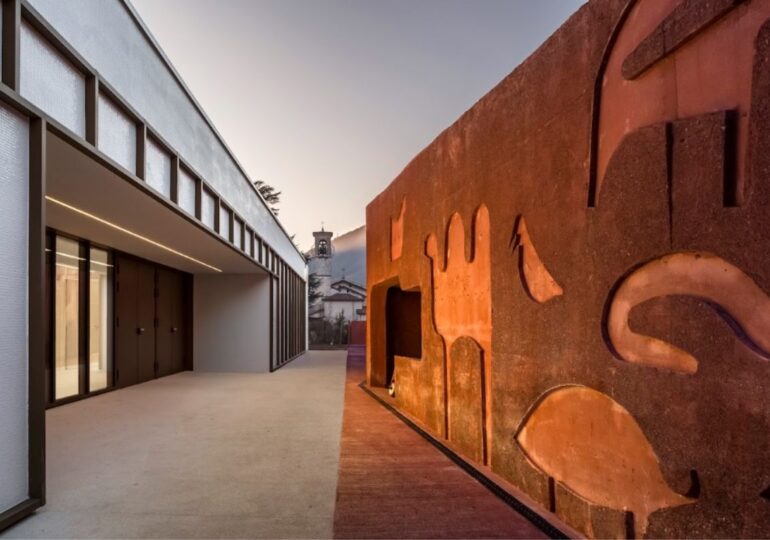
In continuity with the stone retaining walls that draw continuity between the different levels of the Val Seriana landscape, the project adopts the topographic rule of the construction of retaining walls – the DNA of the place – by grafting, on the entrance from Via Montelungo, a new wall in reinforced concrete pigmented red and deactivated with exposed aggregates to create continuity and harmony with the surrounding landscape. At the entrance, the wall becomes a space to house the meters, but also a texture with the metal fence that follows the bends of the road and a red gate with the logo of the new school. Upon arrival from Via Montelungo, only the roof sheds can be seen, a tribute to Alzano’s glorious industrial past, which suggest the metaphor of the school as a ‘factory of knowledge’. An industrial past that made Alzano Lombardo famous for the white concrete that is still called ‘Alzano white’ today: a color that defines the identity of the new school, which the architects want covered in white glass mosaic tiles. A detail that is also a tribute to the Masters of post-war Italian architecture.
The deactivated red concrete wall affects the landscape, transforming into a play ramp that children will recognize as the identity of their school. A ramp, which is also sitting where the animal figures of the famous puzzle that Enzo Mari designed for Danese in 1957 are engraved.
“On Sundays, on a table in front of the fireplace, my mother and grandmother scattered Enzo Mari’s animals and my sister and I played to reconstruct the puzzle. I loved that game, I loved touching the wood, I loved seeing how all the pieces made up a whole where all the figures hugged each other… the warmth of that moment was kept somewhere in my memory to resurface when I started thinking about the Alzano school… I wanted every child to feel that warmth in my school… that idea of being together, that pleasure of playing while learning. This is why I proposed to the team to engrave those animals along the path that leads to the school, as if the school became Noah’s ark that saves the world… and where everyone, animals, children, plants embrace each other”, thus the architect Maria Alessandra Segantini describes the incipit of the project.
During the journey, the school begins to appear between the faults of the ramp, which, at the entrance level, becomes space: the hippopotamus houses the stroller and tricycle storage area, the pig and the bull become the ventilation of the thermal power plant. This project is a delicate theme, it stands on the threshold between architecture and landscape and is developed by making the volume of the rough red wall of the engraved animal ramp converse with a precious transparent volume in white glass mosaic tiles and large windows framed by a thin bronze structure, which reflects the colorful play of children and, at the same time, the landscape and the change of seasons of the centuries-old garden.
And here the white glass mosaic facades provide a precious counterpart to the landscape of the colored wall: the two materials meet on the ground in a precise line: on one side the rough red concrete laid at the foot of the wall which changes color and becomes white fine-grained Levocel at the foot of the mosaic facade. The latter,built with 14 mm tiles worked in section, it lights up with ever-changing shades at every moment of the day and evening, playing with the shadows and reflections of the lights and the landscape.
Despite developing on a single level, the school explodes in height inside thanks to a complex section that collects light not only from the large windows of the facade, but also from the shed roof, a memory of the industrial vocation of the Bergamo area, which remains as the identity of this land and which will contribute to consolidating itself in the children’s experience, transforming itself into a future legacy.
The layout of the school is tripartite. Flexibility is the determining element of the project. Although a name has been given to all the rooms, the central hall and the relationships with the lateral wings allow the spaces to be used in multiple ways and to invent special methods for teaching, allowing teachers to express their creativity to the fullest for the benefit of the education of the little ones: all the spaces can easily be transformed into art laboratories, spaces for digital and theatrical activities, gymnasiums, spaces for the theatre. The same flexibility allows the use of the school by the community even beyond school hours, thanks to the presence of the large empty central hall which allows the greenery of the park to flow in all directions through the windows that delimit the space.
The hall is a central distribution space but also a multifunctional space, a space of potential, of the invention of special events. Two internal courtyards excavate the building as ‘special open-air rooms’ allowing even the little ones to stay outdoors as much as possible without danger, being floored with a soft anti-shock carpet and populated by the same colorful animals as Mari. The central space explodes in height, punctuated by a sequence of shed skylights set at 240 cm which also bring light into the innermost areas of the school: an indirect, diffused light which counterbalances the brightness of the windows and courtyards.
From the entrance, the transparency of the courtyards allows you to view the garden on the opposite side.
The choice of materials is delicate: it entrusts the points of contact between the children and the space to wood and promotes intervisibility between all the school environments. Great attention was paid to the use of materials to ensure excellent acoustics in every space.
“We have designed a ‘space of potential’, where each environment can be transformed by the creativity of the teachers or the community that revolves around it. All the distribution spaces are generous and can be transformed into ‘spaces for special activities’ even during extra-school hours. In this way the school becomes an epicenter for the community and strengthens its identity”-writes Carlo Cappai.
On the west side there are the 6 sections of the school which overlook the park of Villa Paglia with its centuries-old trees and the historic pergola, while towards the hall a glass door and a large window tell the story of the flow of life in each section. The white linoleum floor, laid over the entire surface of the school (including the toilets), is engraved in each classroom by an animal with a different colour, the same color used for the shiny ceramic tiles of the corresponding bathroom of the section.
Each classroom is equipped with a fixed wardrobe that can be openedextends the entire length of the section, while on the opposite side Mari’s same animals, this time in plywood, become teaching equipment and large-scale games designed specifically.
Each classroom has a direct exit towards the external portico, which pays homage to Terragni’s detail for the Sant’Elia nursery school in Como with a series of metal pillars on which external curtains are mounted that approach the facade without touching it. The external lighting of the school is also included on the system of detached pillars.
On the side opposite the classrooms are the gym, infirmary, teachers’ rooms and kitchen with separate entrance.
Opposite the entrance is the generous canteen space which opens onto the garden and the play areas, two large circles in colored anti-shock carpet on which the silhouettes of the animals are once again engraved.
The canteen space is also marked by the sequence of sheds with a warm and diffused light that contrasts with the light that, at sunset, enters from the large windows overlooking the garden.
Thanks to the use of alternative energies, the building reaches the highest levels of energy efficiency, representing the first public building classified NZEB (Nearly Zero Energy Building) for the community of Alzano Lombardo.
Mayor Bertocchi states: “The project was born from the awareness that the old Busa school, built in the 1950s, could not be made more efficient and earthquake-proof with satisfactory results and so the choice was to demolish and rebuild the school in a different area, with better solar and climatic exposure and a more central position with respect to the city, in order to facilitate accessibility and proximity to public services by encouraging teaching.
It is a building built to be safe, functional and highly performing and which brings together all the best technologies available today. A school conceived and designed to encourage new learning models, hosting them in a welcoming and flexible place.
Carlo Cappai and Maria Alessandra Segantini conclude: “The experience of this project gave us the opportunity to get to know an area rich in ancient and recent memory and, thanks to the collaboration with the Capitanio studio and the Perico company, who were able to translate the needs of the community and the territory well for us and with whom we worked in great harmony, we have sown another school by giving back to the citizens of Alzano a part of the landscape which is now closed off. We are honored to have worked with the community of They raise up to take care of the precious historical, artistic and landscape resources and return them to the inhabitants through children.”
CREDITS
Client: Municipality of Alzano Lombardo
Project: Carlo Cappai and Maria Alessandra Segantini, C+S ARCHITECTS,
PM: Maria Alessandra Segantini with Tommaso Iaiza, Stefano Di Daniel, C+S ARCHITECTS
Local coordination, works management, safety, calculations: Remo Capitanio, with Alberto Valtulini and Marina Brambati, STUDIO CAPITANIO ARCHITECTS
Structures: Sergio Myallonier, Myallonier Engineering srl
Systems: Enrico Zambonelli, Loris Doneda, MCZ Engineering srl
Acoustics: Andrea Breviario
Geology, geotechnics, Giulio Mazzoleni, CASTALDIA
Photographs: Alessandra Bello, Maria Alessandra Segantini
Construction: Impresa Perico, Giacomo Algisi, Enrico Signorelli, Andrea Persico


