


Renzo Piano is one of the greatest exponents of contemporary architecture, a visionary who was able to combine technology, aesthetics and humanity in each of his works. With over fifty years of career, Piano has stood out for a profoundly humanist approach, capable of bringing people together through buildings that respect the environmental, social and cultural context. His works are not simple structures, but bridges between nature and the city, between past and future, between beauty and functionality.
Who is Renzo Piano?
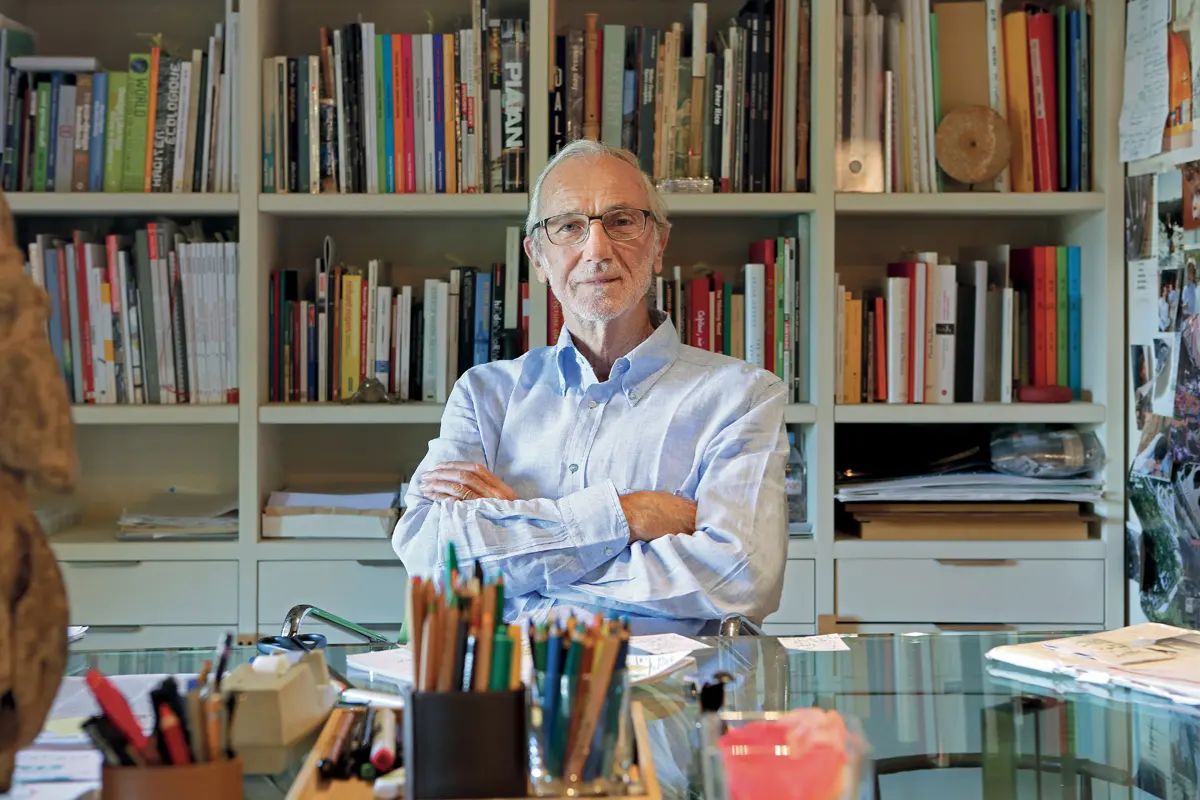
Renzo Piano was born in Genoa on 14 September 1937 into a family of builders. From a young age, observing his father’s work, he developed a deep passion for construction. After graduating in Architecture at the Polytechnic of Milan in 1964, he began an international career that led him to collaborate with iconic personalities such as Louis Kahn.
1971 marked a turning point in his career: together with Richard Rogers, he founded a studio in London and created one of the most revolutionary works of the 20th century, the Center Pompidou in Paris. With its exposed technical structures and bright colors, the building challenges architectural conventions and redefines the concept of public space.
The Studio: Renzo Piano Building Workshop
In 1981, Piano founded the Renzo Piano Building Workshop (RPBW) , with offices in Genoa, Paris and New York. The studio, organized as a modern “ Renaissance workshop “, involves architects, engineers, craftsmen and designers in interdisciplinary and collaborative work. Each project is based on a deep analysis of the context, a sustainable use of materials and a continuous search for innovation.
To date, the RPBW has implemented hundreds of projects around the world, each with its own unique identity and with the aim of improving people’s quality of life .
The most iconic works of Renzo Piano
Center Pompidou (1977) Paris, France
The Center Pompidou , designed with Richard Rogers, was a turning point for contemporary architecture. The structure, with the colored tubes and technical elements on display, transforms the museum into an open and accessible space, making it an icon of modernity.
The Shard (2012) London, United Kingdom
At 310 metres, The Shard is the tallest skyscraper in the United Kingdom. The project combines aesthetics and functionality, creating a multifunctional building that hosts offices, homes, restaurants and public spaces, interacting harmoniously with the urban context.
Fondation Beyeler (1997) Basel, Switzerland
This modern art museum is a perfect example of the balance between architecture and nature. Natural light plays a fundamental role, accompanying visitors on an immersive journey between art and landscape.
Parco della Musica (2002) Rome, Italy
A cultural complex that combines three concert halls with large green spaces, becoming a point of reference for the Roman community. The Parco della Musica reflects Piano’s ability to create places that encourage meeting and cultural sharing.


