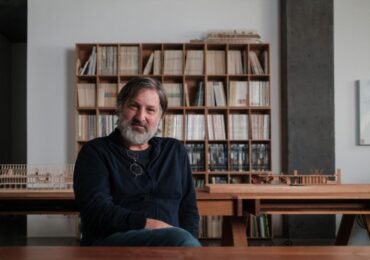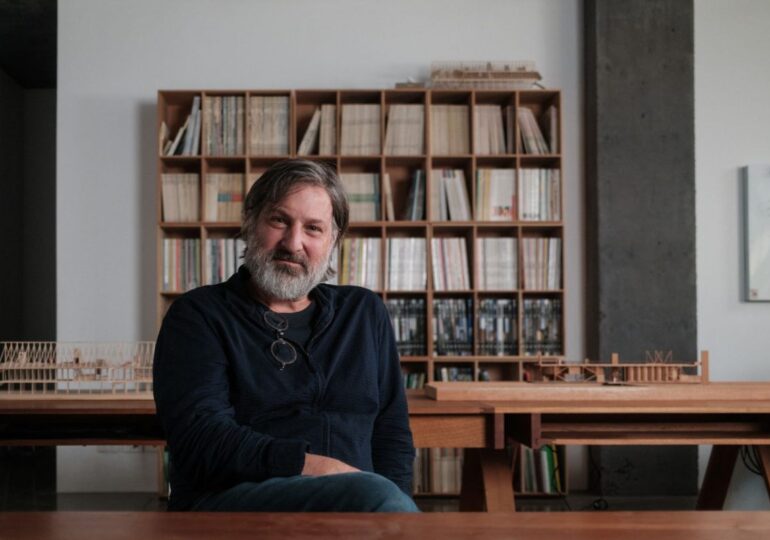
Smiljan Radić Clarke is the winner of the 2026 Pritzker Architecture Prize, the international award founded in 1979 by the Pritzker family and widely regarded as architecture’s highest distinction. The official announcement confirms the global consecration of a designer who has long occupied an unusual, and therefore decisive, place in contemporary debate. Far from the spectacularization of form, Radić has built a personal, learned, and restless language, one capable of moving between memory, material, landscape, and human fragility.
Born in Santiago, Chile, where he still lives and works, Radić founded his practice in 1995 after studying at Pontificia Universidad Católica de Chile and broadening his education through a formative period in Venice, an experience that expanded his outlook across history, art, thought, and references beyond strict disciplinary boundaries. Over the course of his career, he has designed works that differ widely in scale and programme yet remain united by a strong poetic and constructive tension, from the 2014 Serpentine Pavilion in London to Teatro Regional del Biobío in Chile, as well as houses, installations, and cultural spaces that consistently resist easy formulas and immediate effect.
Why did he win this prestigious prize? In its official statement, the jury points to an architecture situated at the intersection of uncertainty, material experimentation, and cultural memory, one that prefers fragility over any claim to false certainty. His buildings, often suspended between temporariness and permanence, do not seek to dominate through noise or spectacle. Instead, they offer shelter, emotional intensity, and a quiet form of presence that feels especially necessary today. It is precisely this ability to shape an architecture that is at once cultured, humane, and never overstated that brought Radić to the summit of the 2026 Pritzker Prize.
Who Is Smiljan Radić Clarke

Smiljan Radić Clarke is not an architect who can be easily reduced to a formula, a signature style, or a recognisable image repeated from project to project. Born in Santiago, he belongs to that rare group of designers who built their language not through obsession with visual branding, but through a slow, layered, almost literary inquiry into the meaning of architecture itself.
His biography helps explain why. He graduated from Pontificia Universidad Católica de Chile in 1989, then expanded his intellectual horizon through further study in Venice and years of travel, experiences that opened his practice to history, art, philosophy, and cultural memory. In 1995, he founded his studio in Santiago, and it has deliberately remained intimate in scale rather than following the logic of the global office that replicates itself everywhere.
Radić does not belong to the generation of star architects who built their reputation primarily through the media recognisability of iconic objects. His work unfolds instead as a sequence of questions about the relationship between construction and landscape, permanence and precariousness, protection and vulnerability. His intellectual and creative dialogue with sculptor Marcela Correa, his wife and long-time interlocutor, also helps explain the almost plastic, tactile, and sensorial nature of his architecture.
What Is the Pritzker Prize and Why It Really Matters

The Pritzker Architecture Prize is not just another award. Established in 1979, it is presented each year to a living architect, or living architects, whose built work demonstrates talent, vision, and commitment, while making a significant contribution to humanity and the built environment. That framework is exactly what makes it the most authoritative recognition in the field: the Pritzker does not reward a single successful building, but rather a body of work that has genuinely shaped international architectural culture over time.
It is often described as the “Nobel Prize of Architecture”, or more precisely, as the profession’s highest honour. The laureate receives 100,000 dollars and a bronze medallion, but the real value of the prize goes far beyond its financial component. To enter this list of laureates means being recognised as a figure who has redefined, or at the very least decisively redirected, the way architecture is understood in a given era. In 2026, the official prize recognised Smiljan Radić Clarke as the 55th Laureate, confirming his centrality in the contemporary architectural landscape.
Why Smiljan Radić Won the 2026 Pritzker Prize
The 2026 Pritzker jury stresses that Radić’s work stands at the crossroads of uncertainty, material experimentation, and cultural memory. That is a crucial formulation because it identifies exactly what distinguishes his work from much of the international architecture of recent years. Radić does not pursue monumental certainty, polished perfection, or definitive form. On the contrary, his buildings can appear temporary, unstable, even intentionally unfinished. Yet it is precisely in that apparent fragility that they succeed in offering shelter, intensity, and a way of inhabiting space that feels structured, optimistic, and quietly joyful.
There is also a second element, less obvious but perhaps even more important. Radić is being recognised because he rejects formula. His work is not based on a repeatable language exportable anywhere, but on a project-specific inquiry in which context, use, history, social practice, and even political circumstance genuinely shape the final result. At a moment when much global architecture risks producing interchangeable buildings, Radić’s victory signals a precise cultural stance: the value of architecture still lies in its ability to read place, absorb complexity, and create experiences that do not end with photographic impact.
The Works That Best Explain His Architecture
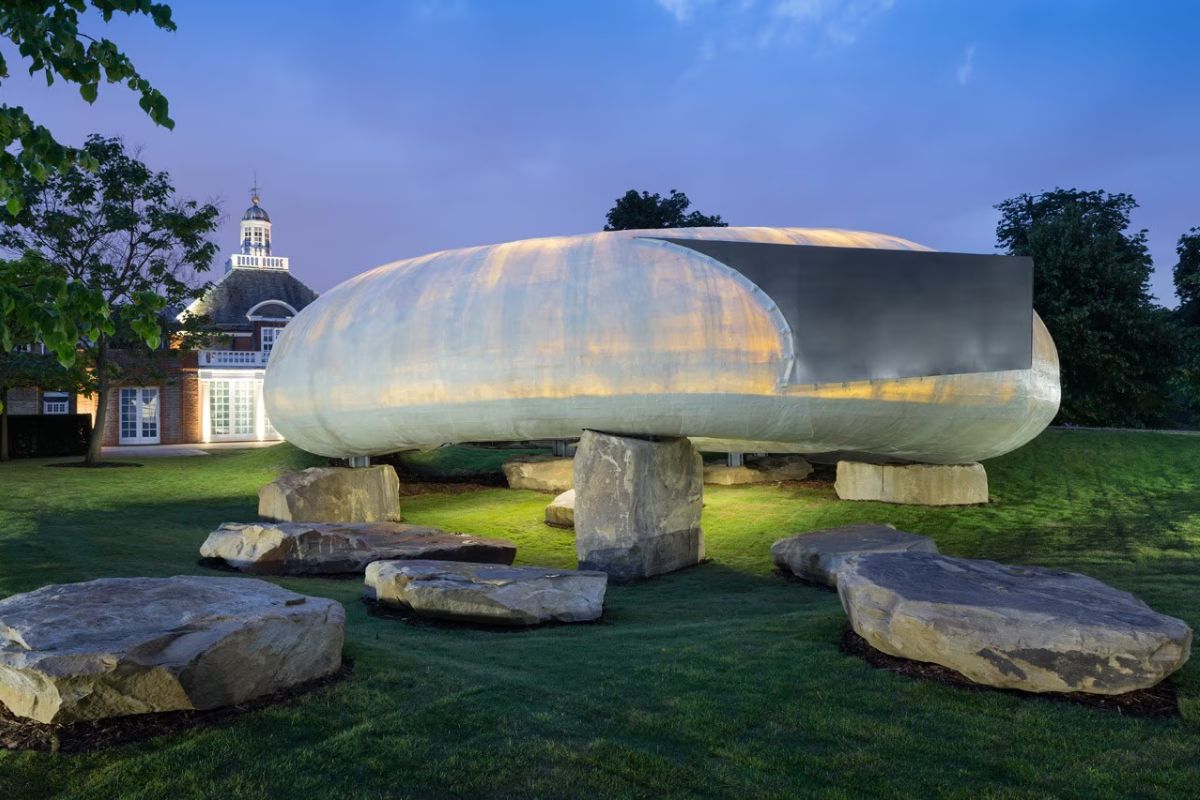
Among the projects that made Smiljan Radić an international reference point, the Serpentine Pavilion 2014 in London remains one of the most widely known. It is a semi-translucent cylindrical structure resembling a shell, resting on large quarry stones. It was a temporary work, but one that made his poetics unmistakably clear: an architecture that does not dominate its context, but rather settles into it with a suspended tension between weight and lightness, protection and openness.
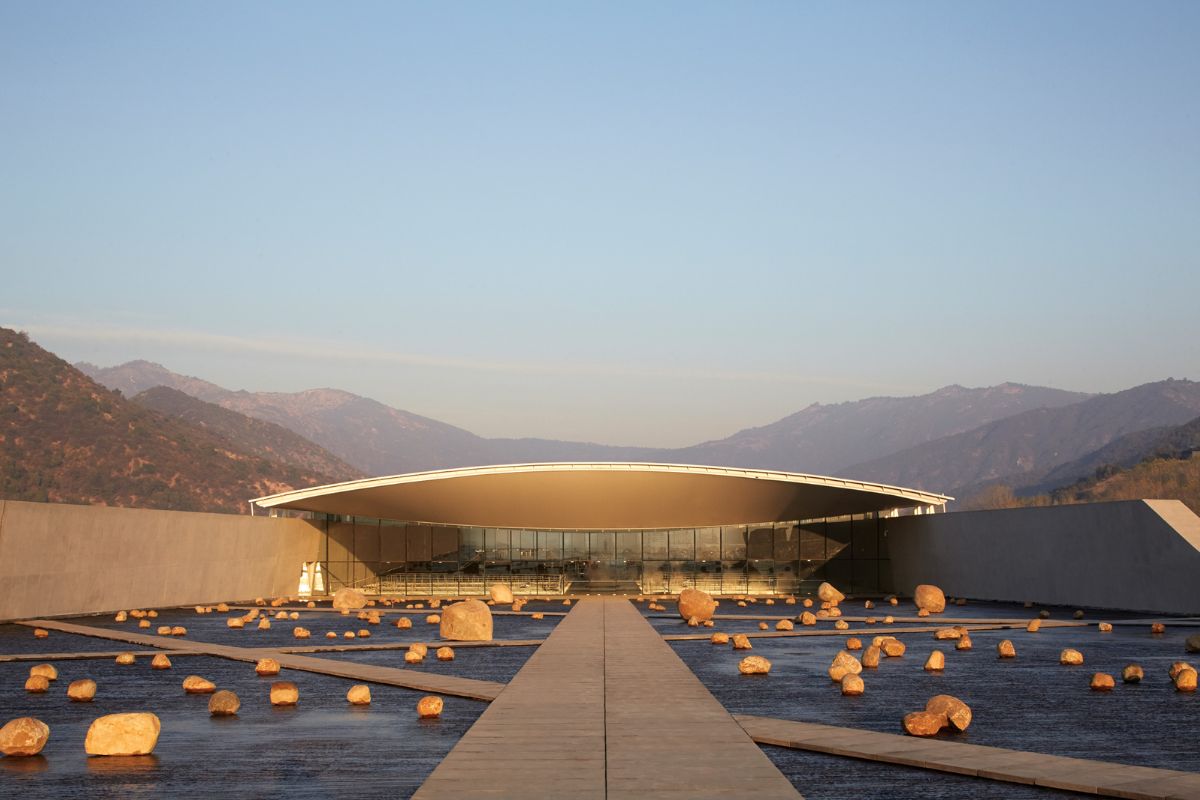
Alongside the London pavilion, Radić’s trajectory includes very different works such as Teatro Regional del Biobío in Concepción, Restaurant Mestizo in Santiago, Pite House in Papudo, the extension of the Chilean Museum of Pre-Columbian Art, and Vik Millahue Winery. That plurality is precisely what makes his work so relevant: private houses, civic buildings, cultural spaces, and temporary structures are not treated as separate categories, but as different opportunities to interrogate the same enduring themes — ground, matter, light, shelter, and time.
The point, then, is not only that Smiljan Radić won the 2026 Pritzker Prize. The point is why he won it now. His recognition comes at a moment when international architectural discourse seems increasingly interested in practices that are less loud, more reflective, and more capable of holding together imagination, landscape, technique, and human vulnerability. Radić represents exactly that direction: an architecture that does not shout, does not simplify, and does not look for shortcuts, but continues to question the very meaning of building.
What Smiljan Radić’s Victory Means for Contemporary Architecture
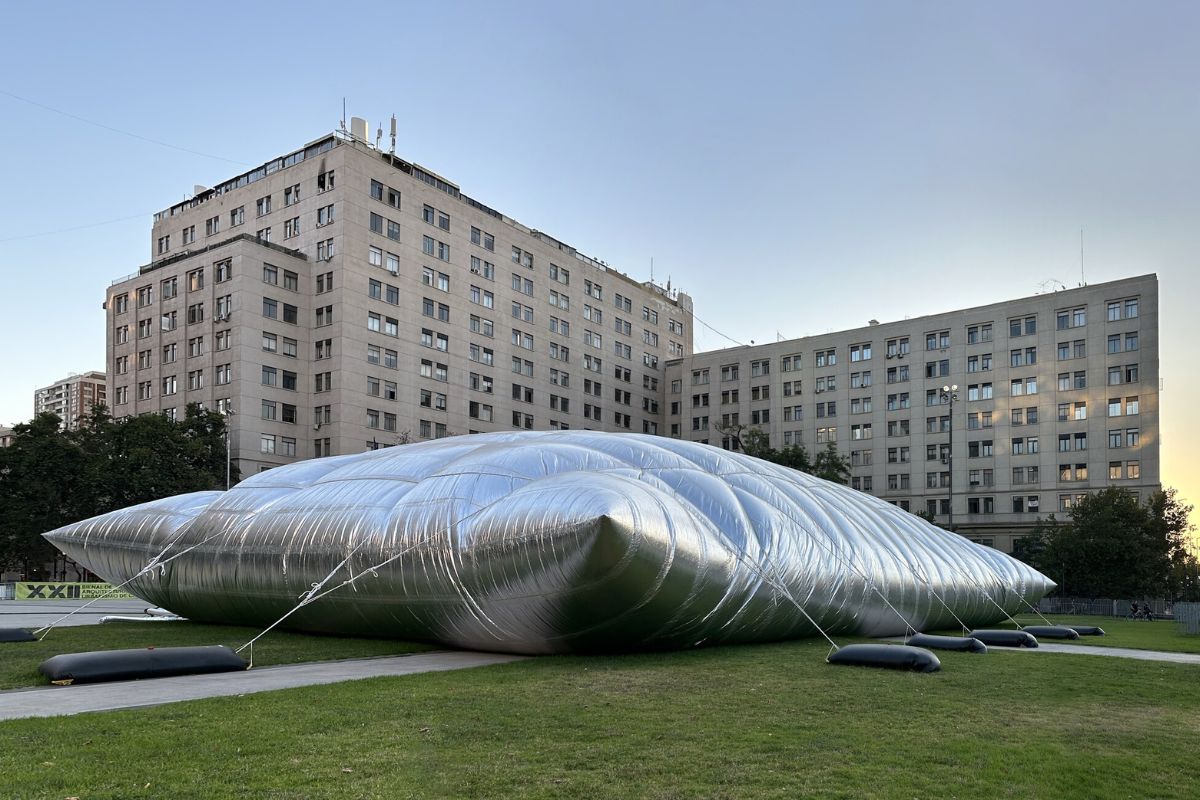
The choice of the 2026 Pritzker Prize does not reward only an author; it also sends a clear signal to architectural culture at large. The jury returns to words such as fragility, uncertainty, cultural memory, material experimentation, and the ability to provide a quietly joyful shelter in an unstable age. That is not a minor lexical detail. It means that the most authoritative prize in international architecture is recognising as central a set of qualities very different from those that for years dominated the media narrative of the discipline, often more attracted to exceptional imagery than to the depth of spatial experience.
In that sense, Radić stands for a line of practice that is becoming increasingly relevant: an architecture that does not seek spectacle, does not depend on a repeatable signature, and does not produce objects designed mainly to circulate as icons. His work refuses a standardisable language and treats every project as a singular investigation in which context, use, history, social practice, and political circumstance all matter. It is precisely this absence of formula that makes his victory so meaningful today.
A Recognition That Strengthens Chile’s Role in the Global Debate
Smiljan Radić’s victory also confirms Chile’s central place in international architecture over the last decades. In 2016, the Pritzker Prize had already recognised Alejandro Aravena as the first Chilean laureate. With Radić’s selection in 2026, Chile now has a second architect in the prize’s official canon. This is not merely a geographic coincidence, but a sign of a cultural scene capable of producing very different voices united by a strong attention to the relationship between architecture, territory, resources, responsibility, and the human condition.
From this perspective, Radić’s profile is especially interesting because it does not correspond to the model of the global architect who builds authority through sheer scale and quantity. His Santiago-based practice, founded in 1995, has remained intentionally compact even as his international recognition has grown enormously. His trajectory suggests a different idea of authority: not expansion at any cost, but the coherence of a research-driven practice that remains rooted in its own context while still speaking to the world.
Why This Win Matters Now, in a Time of Global Crisis
The Pritzker Architecture Prize was created to honour a living architect whose built work demonstrates talent, vision, and commitment while making a significant and enduring contribution to humanity and the built environment. For that reason, each award also functions as a statement of values about what architecture should be in its own time. In Radić’s case, the message is clear: today, the discipline’s highest recognition goes to a designer who accepts imperfection, works on the threshold between matter and imagination, and creates spaces that do not want to impose themselves, but to receive and shelter.
And that is exactly why Smiljan Radić’s victory matters beyond the prize itself. At a moment shaped by climate crisis, political instability, social transformation, and growing visual saturation, the 2026 Pritzker Prize seems to suggest that the architecture most needed today is not the one that raises its voice, but the one still capable of giving form to an intense, human, and unsimplified presence. Radić wins because his work shows that it is possible to be radical without becoming eccentric, international without turning generic, and poetic without losing constructive rigour. That may be the strongest lesson of the 2026 prize.
Read more: The most famous architecture awards in the world – Archi & Interiors
Leave a comment