Do 7-star hotels around the world really exist? Technically, no. Official hotel classification systems generally stop at five stars, as in the European Hotelstars Union system, which includes five standard categories, and in the international Forbes Travel Guide model, built around the Five-Star evaluation. And yet, few expressions capture the imagination of contemporary luxury better …
Do 7-star hotels around the world really exist? Technically, no. Official hotel classification systems generally stop at five stars, as in the European Hotelstars Union system, which includes five standard categories, and in the international Forbes Travel Guide model, built around the Five-Star evaluation. And yet, few expressions capture the imagination of contemporary luxury better than this unofficial formula, created to describe places that seem to go beyond the simple idea of a hotel.
Talking about 7-star hotels, therefore, means entering a territory that is more cultural than regulatory: a world of addresses where hospitality becomes spectacular architecture, total control of the guest experience, theatrical interior design, bespoke service, and the construction of a myth. The most emblematic case remains Burj Al Arab Jumeirah in Dubai, a global icon instantly recognizable for its sail-shaped silhouette and for interiors where opulence, craftsmanship, and precious materials are an integral part of the design narrative. The recent restoration project entrusted to interior architect Tristan Auer confirms how these hotels are not only travel destinations, but true architectural objects to be preserved, updated, and reinterpreted.
From this perspective, the question is not only which are the 7-star hotels around the world, but why certain properties have managed to become absolute symbols of status, desire, and representation. From the monumental scale of their lobbies to the design of their suites, from marble selections to lighting, from signature restaurants to their relationship with the urban or natural landscape, these places show that extreme luxury is never just accumulation. It is spatial direction, visual identity, service precision, and the ability to turn a stay into a memorable experience.
7-star hotels around the world: what this definition really means
Before building a list of 7-star hotels around the world, it is necessary to clarify one essential point: seven stars are not a universally recognized hotel category. In the most structured official classification systems, such as Hotelstars Union in Europe, categories reach up to five stars; Forbes Travel Guide, an international reference in luxury hospitality, also evaluates hotels, restaurants, spas, and cruises through its Five-Star system.
And yet, the expression 7-star hotel continues to work because it responds to a specific desire: to identify places that seem to go beyond the traditional concept of luxury. Not simply high-end hotels, but symbolic architectures, self-contained destinations, microcosms where every detail — from the entrance sequence to the texture of fabrics, from suite lighting to service rituals — contributes to creating an experience on another scale.
In this sense, 7-star hotels around the world are less a technical category and more a narrative of controlled excess. Their value does not lie only in price, room size, or the number of services available, but in their ability to build a recognizable imaginary. They are places where hospitality design meets iconic architecture, theatrical interiors, service culture, and, increasingly, a new idea of exclusivity: not only being seen, but accessing an unrepeatable experience.
Why people talk about 7-star hotels: from the Burj Al Arab myth to new iconic hospitality
The expression “7 stars” entered the collective imagination above all thanks to Burj Al Arab Jumeirah in Dubai, often described as the most luxurious hotel in the world. Its strength does not come only from its services, but from the iconographic power of the building itself: a sail suspended over the Arabian Gulf, designed as an urban landmark and as a manifesto of contemporary Dubai. The official Jumeirah website presents it through its sail-shaped facade, suites, high-end dining, and hospitality offering built around the spectacular nature of the experience.
Since then, the formula has been applied — often in journalistic or promotional language — to several hotels around the world: converted historic palaces, private resorts on remote islands, hotels inside skyscrapers, and urban properties where luxury becomes an architectural performance. Not all of these addresses can truly be compared. Some focus on opulence, others on absolute privacy, and others on transforming a monument or landscape into a stay experience.
The real question, therefore, is not whether a hotel “really” has seven stars, but what makes it perceived as superior to ordinary classification. For Archi&Interiors, the answer lies in four elements: recognizable architecture, distinctive interior design, highly personalized service, and the ability to turn the hotel into a cultural destination.
Burj Al Arab Jumeirah, Dubai: the hotel-symbol of theatrical luxury
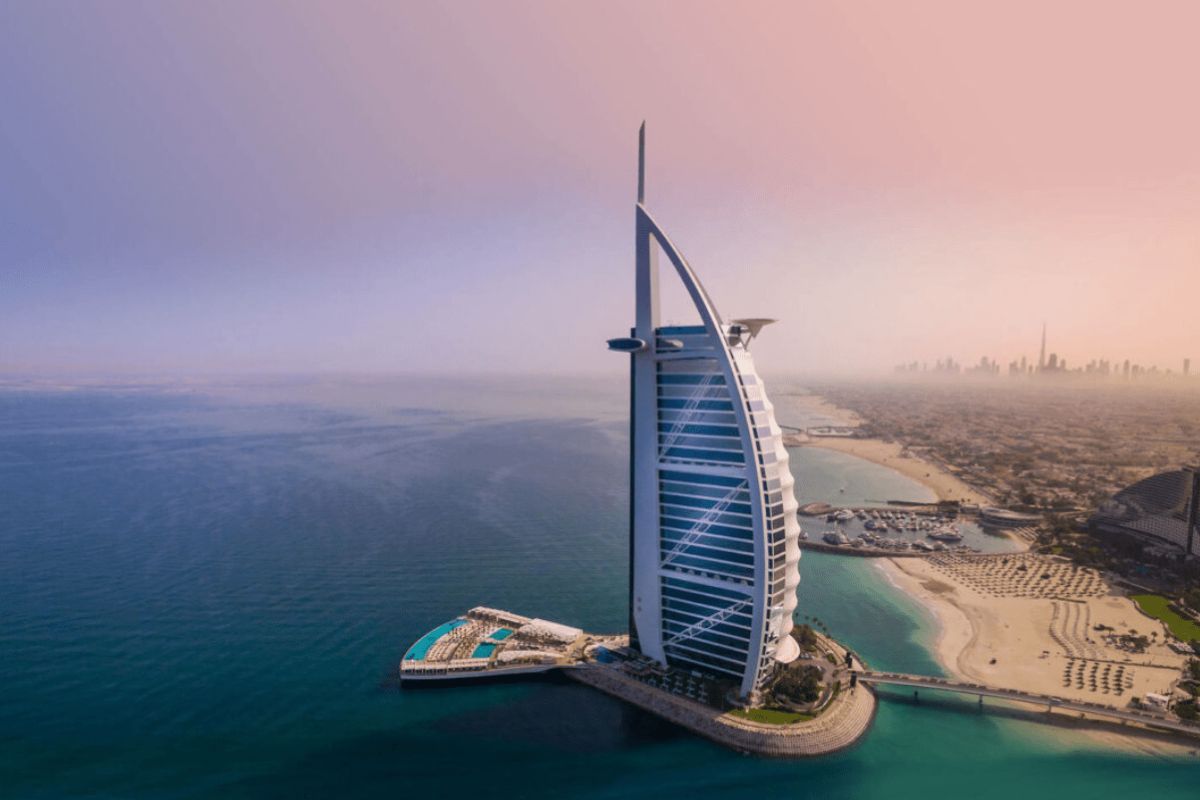
Among the hotels associated with the definition of 7-star hotels around the world, Burj Al Arab Jumeirah remains the most famous case. Its image has entered global visual culture: not a neutral volume, but an architectural figure designed to be instantly recognizable. The sail is not only a formal reference to the sea and the nautical tradition of the Gulf; it is an urban sign, a declaration of ambition, and a tool of territorial branding.
From an interior design point of view, Burj Al Arab belongs to a phase of luxury in which material abundance was an essential part of the experience: marble, gilding, great heights, intense colors, scenic staircases, and vertical perspectives. It is a language that does not seek silence, but wonder. Every space is designed to generate a sense of exceptionality: the guest does not simply enter a hotel, but a stage machine.
Today, the value of Burj Al Arab also lies in its ability to remain an icon within a luxury market that is changing. Contemporary luxury hospitality often moves toward quiet luxury, reduction, a relationship with place, and more discreet design. Burj Al Arab, instead, continues to represent the monumental and theatrical side of hospitality: a declared, almost ceremonial luxury that turns the hotel into an experience of representation.
Emirates Palace Mandarin Oriental, Abu Dhabi: luxury as architecture of representation
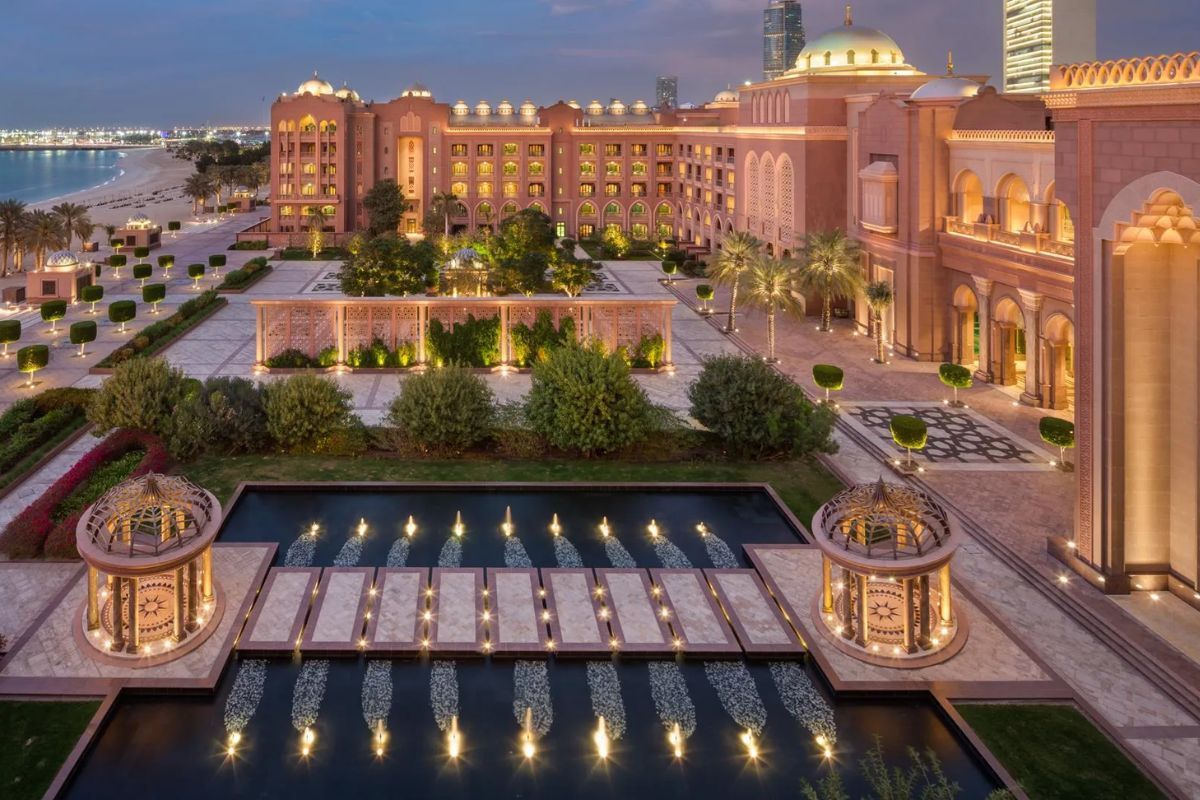
If Burj Al Arab is the symbol of Dubai’s theatrical verticality, Emirates Palace Mandarin Oriental in Abu Dhabi works with a different language: that of the contemporary palace. Here, luxury is not expressed through the isolated form of a landmark, but through scale, symmetry, monumental spaces, and a certain idea of royal hospitality. The official Mandarin Oriental website presents rooms and suites defined by bespoke furnishings, luxury bathrooms, and views over the gardens or the Gulf, confirming the central role of spatial and decorative qualities in the hotel experience.
It is one of the most frequently cited addresses when talking about 7-star hotels around the world, although here too the definition should be understood as a narrative formula, not an official classification. Its strength lies in its ability to merge hospitality, institutional representation, and the Middle Eastern palace imaginary: domes, solemn perspectives, grand volumes, generous pathways, rich materials, and spaces designed to communicate prestige even before comfort.
For architects and interior designers, Emirates Palace is interesting because it shows a form of luxury based on continuity between urban scale and domestic scale. The hotel does not simply host: it builds a world. The landscape, common areas, suites, dining, and service become parts of the same direction, where the stay takes on the rhythm of a palatial experience.
Galleria Vik Milano: the Italian case between art, monument, and hospitality
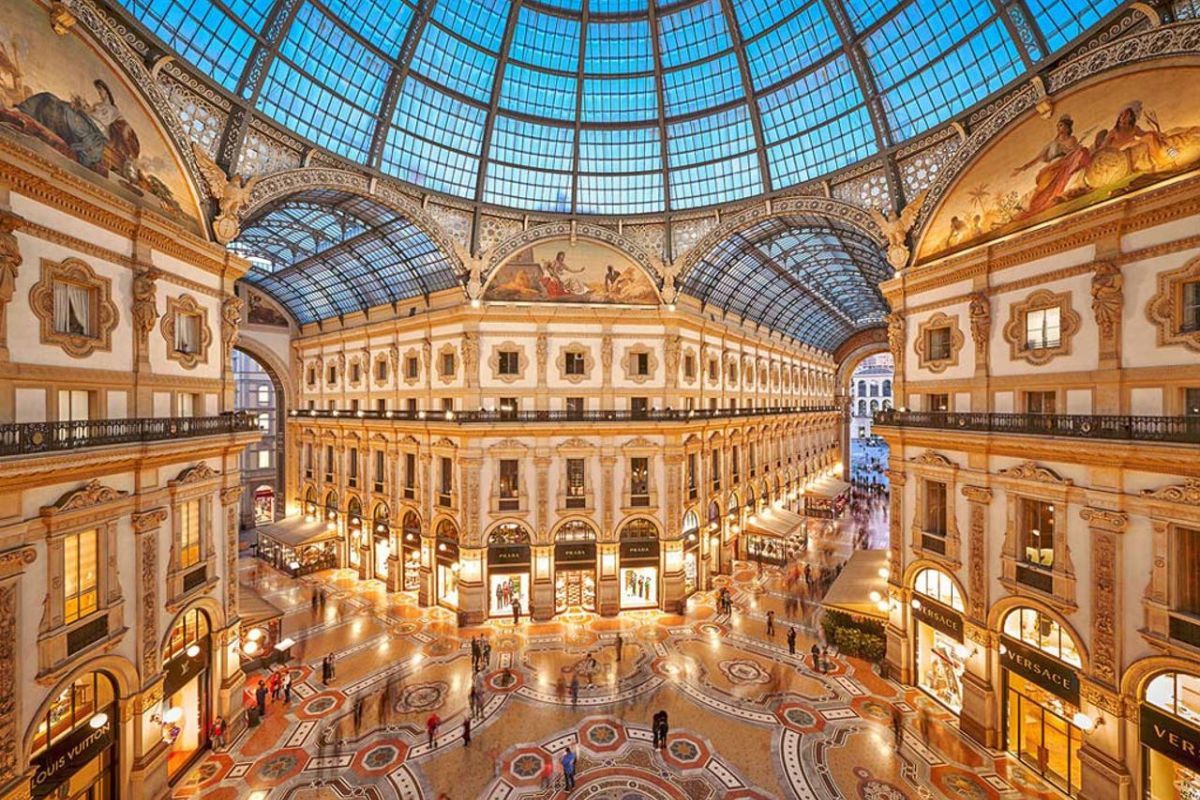
Within the story of 7-star hotels around the world, Milan holds a special place thanks to Galleria Vik Milano, formerly known as TownHouse Galleria and historically connected to the narrative of the Seven Stars Galleria. Today, the property should be read with precision: its official website presents it as a luxury hotel located in the heart of Milan, inside the Galleria Vittorio Emanuele II, one of the city’s most recognizable monuments.
Here, the theme is not volumetric excess or the spectacle of a private island, but the relationship with historic architecture. Sleeping inside the Galleria means temporarily inhabiting an urban space that is at once a passageway, a city salon, a 19th-century commercial machine, and an icon of Milanese identity. For this reason, the value of the experience does not depend only on the suite, but on the context: the view over the Galleria, the proximity to the Duomo and La Scala, and the dialogue between art, fashion, architecture, and the city.
From an interior point of view, Galleria Vik Milano is interesting because it shifts the concept of luxury toward a curatorial dimension. Not only precious furnishings, but an idea of the hotel as a space inhabited by art, set inside a monument, and capable of transforming hospitality into a cultural experience. In an SEO-oriented article, this case is important because it also captures searches related to 7-star hotels in Italy, luxury hotels in Milan, and hotels in Galleria Vittorio Emanuele II, without forcing the truth of the classification.
Laucala Island, Fiji: luxury as isolation, landscape, and absolute privacy
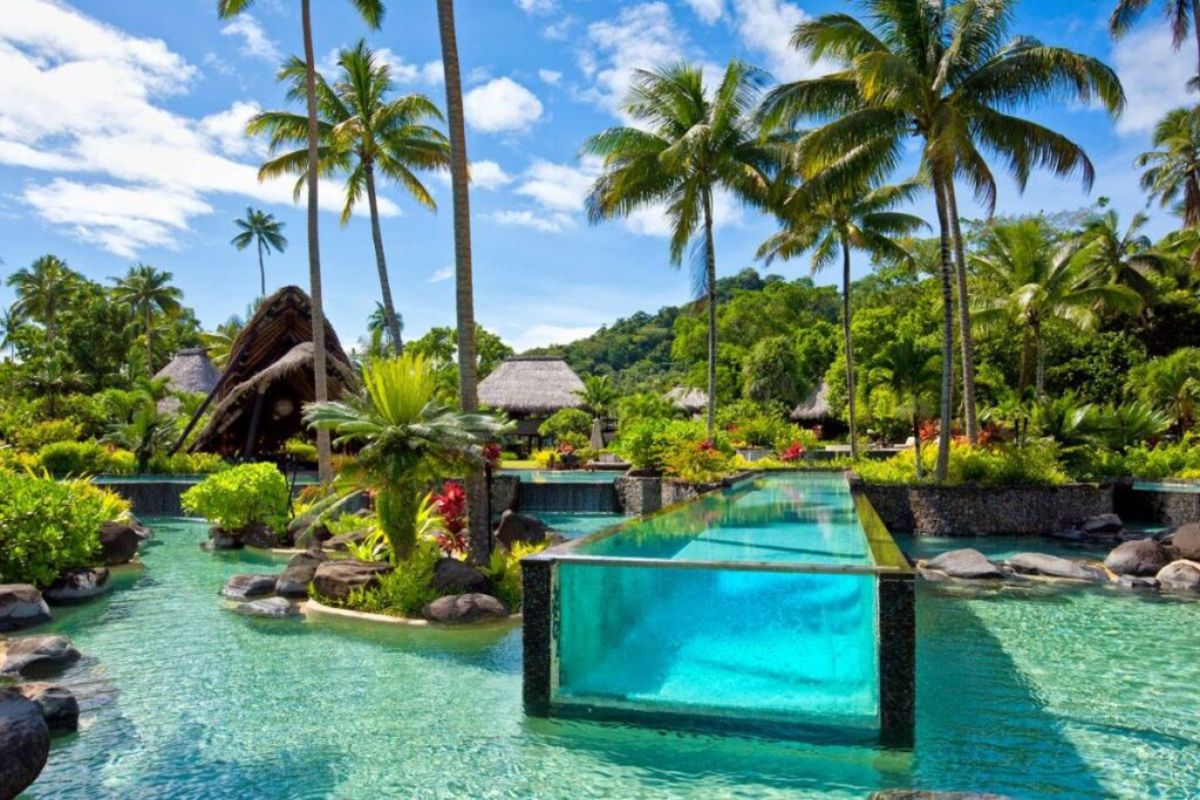
Not all hotels associated with the “7-star” formula speak the language of gold, marble, and monumentality. Some tell a different story of luxury: withdrawal from the world. This is the case of Laucala Island in Fiji, a private resort often mentioned among the most exclusive experiences on the planet. The official website describes twenty-five villas, each with its own horizon and a level of absolute privacy, set within a rhythm shaped by the ocean and nature.
Here, the project is not measured only by the quality of the interiors, but by the ability to orchestrate the relationship between architecture and landscape. Luxury coincides with distance, silence, and the possibility of inhabiting an island not as a tourist, but as the guest of an ecosystem that is both controlled and immersive. It is a very contemporary idea of luxury hospitality: less urban, less theatrical, and more experiential.
For the world of interiors and design, Laucala Island introduces a decisive theme: luxury is not always density. It can be rarefaction. It can lie in the management of empty space, in the quality of thresholds between indoors and outdoors, and in the choice of materials that do not compete with the landscape, but accompany it. In this sense, the 7-star hotel is no longer only the palace of excess, but the place where every element seems designed to disappear into the experience.
Pangu 7 Star Hotel Beijing: East, monumentality, and hybrid design
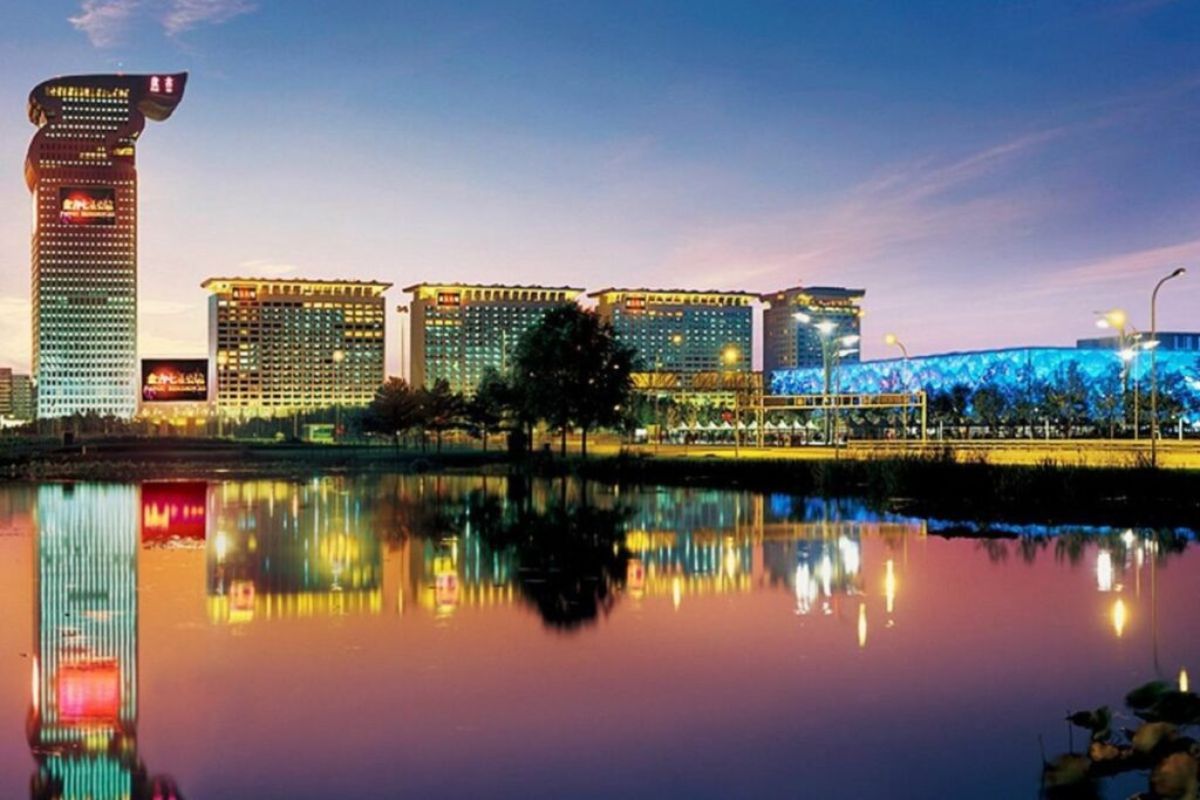
Among the addresses most frequently associated with the phrase 7-star hotels around the world is Pangu 7 Star Hotel Beijing, part of the Pangu Plaza complex. Its very name has helped reinforce the association with the seven-star myth. Sources dedicated to the project describe a design that combines Chinese tradition and contemporary European glamour, with particular attention to the bathroom spaces and the material dimension of the interiors.
The Beijing case is interesting because it shows another trajectory of global luxury: hybridization. Not an indistinct international minimalism, but a search for balance between local symbols, Eastern codes, Western references, and theatrical service. The result is hospitality designed to communicate status, but also a sense of belonging to a layered visual culture.
In architectural terms, Pangu 7 Star Hotel belongs to an imaginary of large-scale development: multifunctional complexes, skylines, relationships with international events, and buildings that do not merely welcome guests but participate in constructing a new urban image. It is a different model from the isolated resort or the European historic palace, but just as useful for understanding how extreme luxury is often linked to the ability of a building to become a symbol.
SIGNIEL Seoul: the vertical hotel inside the contemporary city
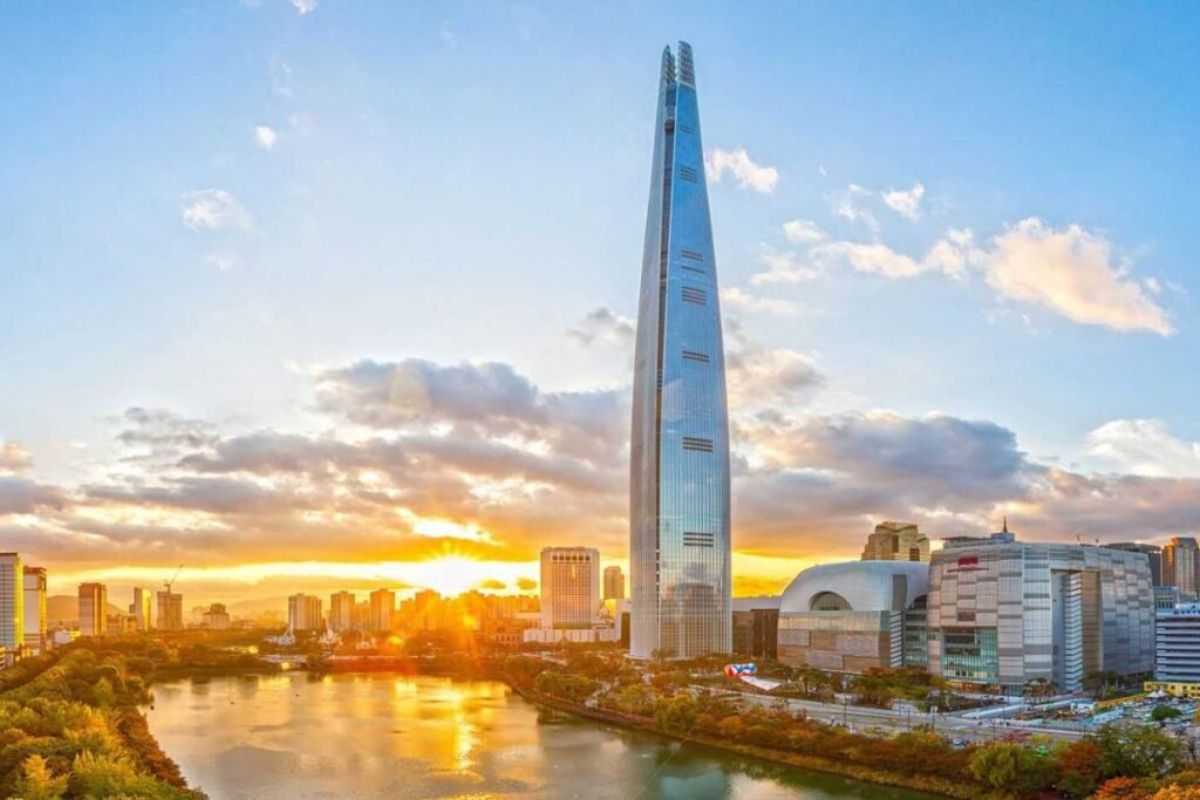
Another interpretation of the “7-star hotel” formula comes from South Korea with SIGNIEL Seoul, located inside Lotte World Tower. The property occupies the upper floors of the skyscraper and is described by Leading Hotels of the World as an urban sanctum spread across twenty-five floors, with city views and a language that combines Eastern and Western influences.
Here, luxury is born from height. The experience is not built around a garden, a beach, or a historic monument, but around the perception of the city from above. Seoul becomes an interior landscape: it enters the rooms through the windows, changes with the light, and becomes part of the hospitality scenography. Design therefore works on verticality, suspension, and the relationship between the intimacy of the suite and the metropolitan scale.
SIGNIEL Seoul represents a new generation of ultra-luxury hotels very well: less tied to ostentatious decoration and closer to the idea of precision, views, atmosphere control, technology, and service. It is an urban luxury designed for global travelers seeking a highly coded experience, though not necessarily a baroque one.
7-star hotels around the world: the real criteria beyond the formula
When talking about 7-star hotels around the world, the risk is to turn everything into a superficial ranking: the most expensive, the tallest, the most exclusive, the most photographed. But to truly read these places, especially from an architecture and interior design perspective, more solid criteria are needed.
The first is architectural identity. A truly memorable hotel is not only well furnished: it has a form, a relationship with its context, and a recognizable presence. It can be a sail on the Gulf, a palace by the sea, a suite inside a 19th-century gallery, a private villa on an island, or a hotel suspended inside a skyscraper.
The second criterion is the coherence of the internal experience. In major luxury hotels, interior design does not only decorate; it guides the guest’s perception. Materials, lighting, proportions, furnishings, circulation, and even the way staff inhabit the space all contribute to defining a precise idea of hospitality.
The third element is personalized service, which in the most exclusive places becomes almost invisible. The goal is not only to respond to a request, but to anticipate it. For this reason, the highest form of luxury does not always coincide with theatrical effect: it is often recognized in fluidity, discretion, and the absence of friction.
The fourth criterion is narrative power. Hotels that have entered the realm of myth do not only sell rooms, but stories: the story of a city that wants to become a capital of the future, of a palace transformed into a destination, of an island made accessible to very few, or of a skyscraper reshaping the skyline. At this point, the hotel becomes cultural content, not just a tourism product.