In every era, the mirror has played a central role in the history of living. More than a simple functional object, it reflects the identity of a space, amplifies its light, defines its perception. In the hands of designers, artists and architects, the mirror transforms from a reflective surface to symbolic form , sculptural element …
In every era, the mirror has played a central role in the history of living. More than a simple functional object, it reflects the identity of a space, amplifies its light, defines its perception. In the hands of designers, artists and architects, the mirror transforms from a reflective surface to symbolic form , sculptural element , visual installation .
From the baroque to the masters of modernism, from the radical experiments of the 70s to contemporary brands of Nordic and international design, the mirror has become a language . And it never stops evolving.
Today we take you on a virtual journey to discover famous and iconic mirrors , designed by big names in design and visual culture. Some entered museums, others into the finest homes. They all tell a story: of research, innovation, style.
Great classics of the twentieth century: the mirrors that made the history of design
Ultrafragola Ettore Sottsass, Poltronova (1970)
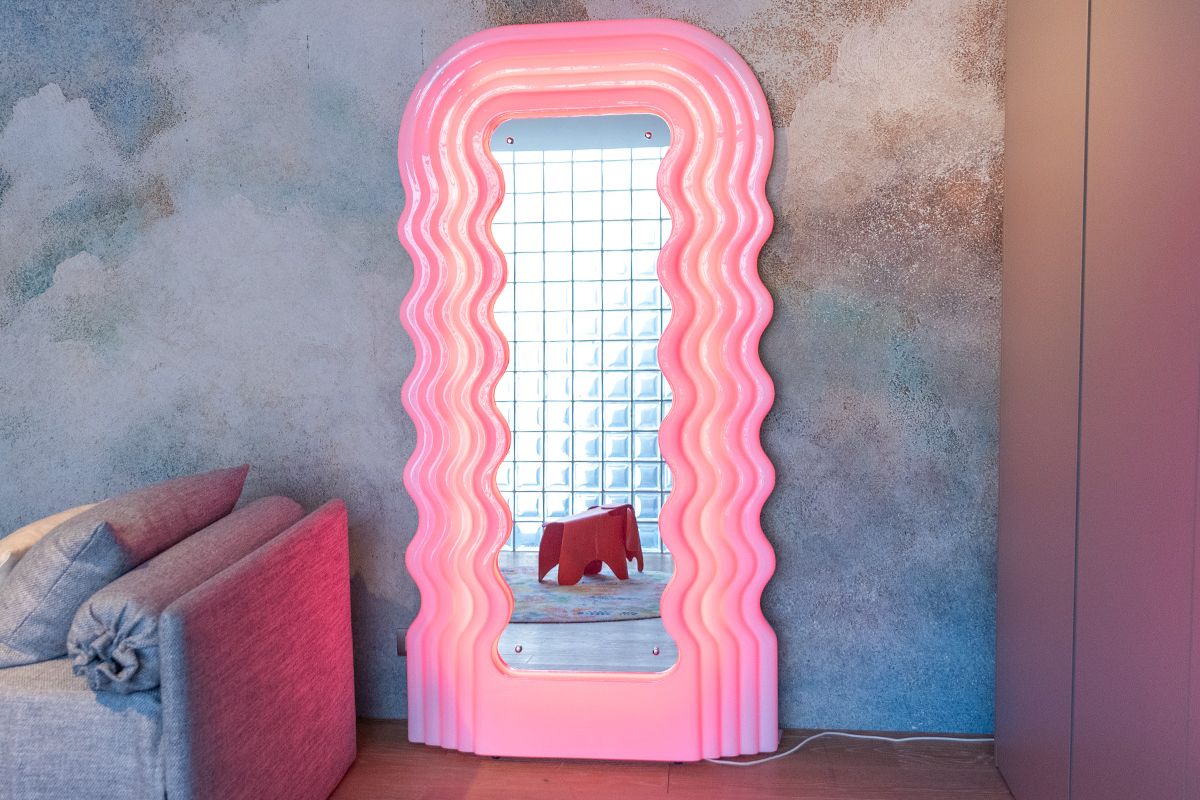
The mirror Ultrafragola is an absolute icon of Italian design. Designed by Ettore Sottsass in 1970 for Poltronova , it was born as part of the Mobili Grigi series, but it is the only piece to have actually been produced.
The sinuous frame in thermoformed plastic material and the pink backlighting make it a luminous and sensual sculpture. The design is inspired by the female figure and the waves of long hair: a mix of irony, sensuality and avant-garde.
Today it is one of the most photographed and desired mirrors in the world of interior design and contemporary art, which has become a symbol of visual culture also for its pop and Instagram-friendly aesthetics.
Caadre mirrors Philippe Starck for Fiam Italia (1998)

When in 1998 Philippe Starck designed for Fiam Italia the mirror Caadre , he introduced a new idea of domestic monumentality. Made of curved glass, a material that has always represented the DNA of the Marche company, Caadre is at the same time a reflective surface and architectural sculpture.
Its extralight glass frame, ground and shaped with innovative techniques, creates a depth effect that transforms the mirror into a visual portal, capable of expanding the space and communicating with the surrounding environment. Available in different sizes, including large formats, it has become a recognized icon of international design, present in private residences, hotels and galleries.
With Caadre , Fiam Italia confirms its vocation for artisanal and technological excellence, demonstrating how a fragile material like glass can become a monument, story and poetry.
Adnet Circulaire Jacques Adnet (1950s)

In the 1950s, the French designer Jacques Adnet known for his collaboration with Hermès designed a series of mirrors in glass and leather with brass details, which became a symbol of refined and timeless elegance.
The Circulaire model, round with leather frameio sewn and adjustable strap, is now reissued by Gubi and much appreciated for its versatility: it adapts perfectly to classic, industrial or contemporary interiors, always maintaining a sober and distinct presence.
Adnet Rectangulaire Jacques Adnet / Gubi

In addition to the round model, Adnet also designed a rectangular version , with the same attention to materials: hand-worked leather, visible stitching, brass-plated metal details.
Also in this case, the re-edition curated by Gubi keeps the beauty of the original intact, updating it to the needs of modern furnishings.
It is particularly loved in environments with a masculine taste, professional offices, boutique hotels and elegant living areas.
F.A.33 Gio Ponti (1933) / Gubi (re-release)

One of the most iconic mirrors in Italian design, the F.A.33 was designed by Gio Ponti in 1933 for FontanaArte . Characterized by a rectangular shape with rounded corners and a thin frame in polished brass or matt black , it has been re-proposed by Gubi in two sizes.
Simple, elegant, proportionate, it is perfect for those looking for a refined object, capable of reflecting light and style with discretion. It is widely used in high-end residential and hospitality projects.
Mirror Painting Michelangelo Pistoletto (from 1962)

It is not a furnishing mirror, but it cannot be missing among the great classics. The mirror paintings of Michelangelo Pistoletto are among the most revolutionary works of the twentieth century: figures silk-screened on mirrored stainless steel plates, where the observer becomes part of the work.
They are collector’s items, exhibited in the main museums of the world (from MoMA to Tate), and have forever changed the way of conceiving the relationship between space, image and identity.
A bridge between art, design and architecture, which still dialogues with contemporaneity today.
Contemporary and cult: the mirrors that set trends today
Pond Mirror Ferm Living (2020)

With its soft and irregular curves inspired by water, the Pond Mirror is among the most photographed and appreciated contemporary mirrors of recent years. Designed by the Danish brand Ferm Living , it is available in different sizes and can be mounted in multiple orientations.
Its organic aesthetic, combined with the thin metal profile, makes it perfect for soft minimal environments and interiors inspired by nature, but also for giving visual movement to rigorous walls.
Vitrail Inga Sempé for Magis (2018)

Designed by the French Inga Sempé , Vitrail is a collection of wall mirrors for Magis that combines transparent and colored mirror glass in elegant and playful geometric compositions.
Available in different shapes (round, square, rectangular), it is inspired by the graphic effect of artistic stained glass windows . Vitrail is a brilliant example of narrative and accessible design: perfect for those who love to furnish with irony and intelligence.
Mirror Palindrome Ben & Aja Blanc (2019)

Created by the American duo Ben & Aja Blanc , the Palindrome mirror stands out for its asymmetrical and sculptural composition , where free-form mirrors are combined with details in polished brass .
Each piece is handcrafted in a limited edition and often chosen for high-end interiors, galleries and boutique hotels. It is the emblem of the new American art design: functional, but also visual, poetic, distinctive.
Mirage Mirror Krøyer-Sætter-Lassen for Menu (2020)

The Danish studio Krøyer-Sætter-Lassen designed for Menu a mirror that combines industrial lines and minimalist poetics . The Mirage Mirror stands out for its bronzed or smoked mirror glass and for the dark edge which creates a subtle shadow effect.
It is widely used in contemporary Scandinavian interiors, particularly in dining rooms and bedrooms, where it acts as an elegant and discreet element, capable of adding depth without dominating the space.
Arch Mirror Kristina Dam Studio (2022)

The Arch mirror by Kristina Dam , a Danish studio known for its architectural approach to minimalism, reinterprets the classic arch in a sculptural key. Made with a painted steel or brass frame, it can be placed on the floor or mounted on the wall.
Its formal language is essential, but at the same time imposing. Ideal for entrances, corridors or bedrooms, where you want to create an elegant and solid visual presence. A mirror that recalls architecture, rather than decoration.
Blanche the mirror Empire of the Senses by Studiopepe for Visionnaire

An object that is much more than a mirror. Signed by the Milanese designers Arianna Lelli Mami and Chiara Di Pinto for Visionnaire, the Blanche is part of the Empire of the Senses collection, presented during Design Week 2022 as a sensorial exploration between art and emotion.
It is an oval wall mirror, characterized by a wooden frame completely covered in leather, embellished with decorative fringes that fold over two satin steel rings placed on the sides . The reflective surface is hidden by these fringes and is revealed only through a delicate gesture: moving them with the hand to access a “hidden” image, engraved by hand, depicting either a woman or the symbolism of a snake, engraved via sand blasting .
It is not an aesthetic exercise as an end in itself, but an invitation to discovery, to touch, to the sense of mystery: a tactile and visual experience , a meeting between contemporary design and emotional narration .
Blanche is a clear example of Studiopepe’s ability to weave symbolism, anticonic and contemporary , transforming a common object into a sensorial ritual , in balance between art, design and psychology of space
Collectible mirrors: rare, poetic, unforgettable designs
Mirror mirror Mod. 1699 Max Ingrand for FontanaArte (1960s)

An emblematic piece of high glass craftsmanship. This round mirror, designed by Max Ingrand and produced by FontanaArte, incorporates a smoky colored glass and brass frame, typical of mid-century glamour. A highly coveted item, it often appears at auctions and among vintage design collectors.
Round-Round 160 Nanda Vigo for Glas Italia (1987)
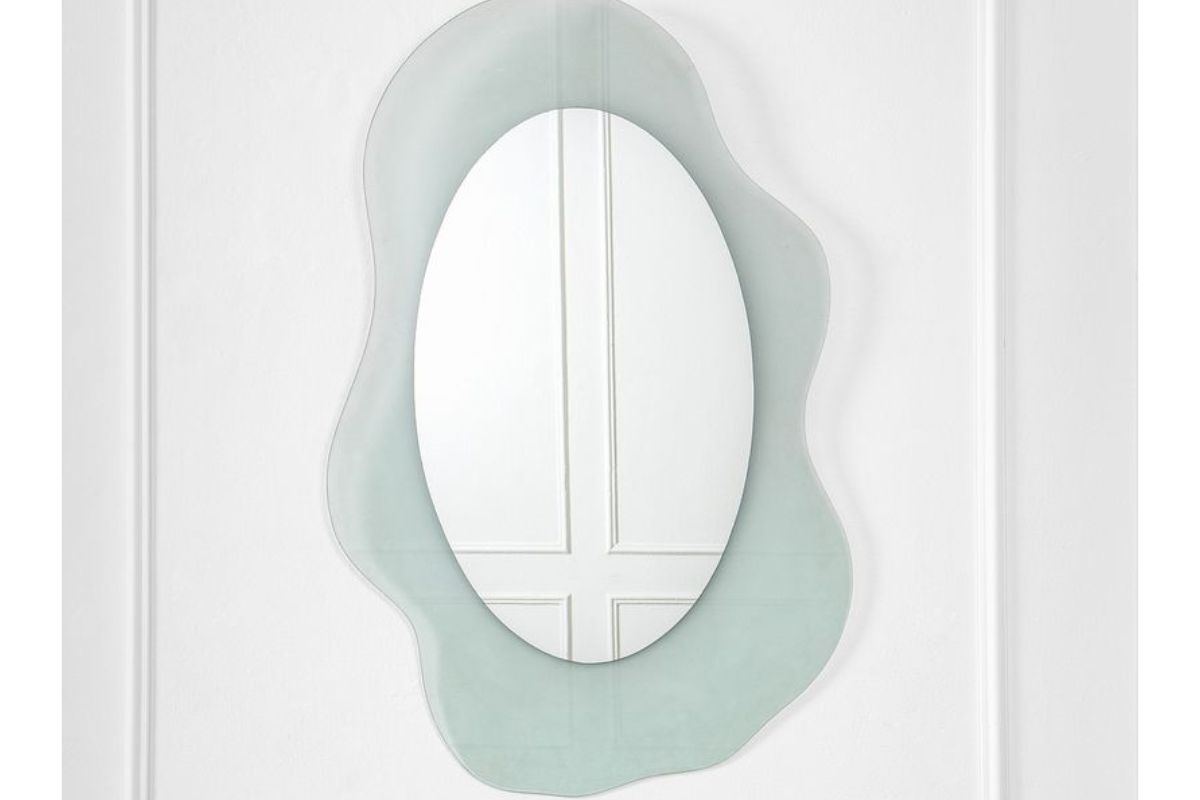
A visual and material experimentation: wall mirror in molded glass with satin/cut areas that alternate reflections and transparencies. Designed by Nanda Vigo, it represents one of his most recognized works, today republished and the subject of research in art design collections.
Andromeda Nanda Vigo for Glas Italia (1974)

A visionary example of abstractionism in glass. Nanda Vigo conceives a suspended composition of transparent and reflective mirrors, modular and adjustable, which redefines the space and the very perception of the environment. Each reflection becomes visual narration, in a work that seems to fluctuate between art and architecture.
Bavaria Mirror Studio Job (2008)

An iconoclastic homage to the Bavarian tradition, revisited with pop illustrations and graphic symmetries. Presented at Design Miami, this mirror with opening panels is conceived as a small “sacred house” of contemporary design, where provocation meets artistic craftsmanship.
Miraggio Estudio Campana for Edra (2009)

A vibrant mosaic of mirrored methacrylate modules, joined with nylon ties. The Campana brothers transform “poor” materials into an artisanal jewel, full of playful and visionary energy. More than a mirror, it is a residential sculpture that fragments and multiplies space.
Rondo Oskar Zieta (2014)

Created through FiDU technology, which inflates welded metal plates, Rondo has a monumental, fluid and organic profile. Its circular, doughnut-like shape is at once sculpture, reflection and architecture: bold, powerful and surprisingly welcoming.
Obsidian Mirror Studio Drift (2014)

A work that combines ethics and aesthetics. Made of synthetic obsidian, derived from the reuse of industrial waste, it breaks the pattern of the smooth and perfect mirror. Imperfect and material, it gives the design an almost geological dimension, bringing the material back to its authenticity.
Shimmer Patricia Urquiola for Glas Italia (2014)

Mirror with iridescent shades, which change color depending on the light and the angle. Patricia Urquiola signs a poetic and contemporary object, where the boundary between function and art dissolves in a kaleidoscope of reflections.
the mirror as vision, culture and project
During this journeythru shapes, materials, ideas and reflections , we have crossed almost a century of design history through one of the most fascinating and symbolic objects of furniture: the mirror .
From a simple functional tool to a manifestation of style , the mirror has been able to reinvent itself in every era. Some models have become icons; others – rarer, conceptual, poetic – have entered the lexicon of art and experimentation.
There are those who use it to amplify light , some to give depth to spaces, some to communicate an identity , some to disturb perception , some to create a dialogue between space and presence. In any case, the mirror is always a powerful design tool , capable of transforming environments and atmospheres.
What do design mirrors teach us?
-
That even the most everyday objects can contain extraordinary narratives .
-
That function does not exclude expressiveness , nor beauty.
-
That design, art and architecture are often one and the same thing, reflected from different perspectives.
Selecting a mirror does not simply mean “furnishing”, but choosing a gesture , a signature, an idea.
Whether it is a twentieth-century classic or an experimental collector’s item, each mirror is a threshold – between inside and outside, between self and other, between presence and representation.
And you, which mirror would you take home? The one that best reflects yourself or the one that pushes you to see things from another perspective?