From 13 November 2026 on Rathausplatz, from November to January at Schönbrunn: our guide to the Vienna Christmas markets, with official dates and the architecture of Olbrich, Wagner and Loos.
In Vienna, Christmas is a walk through the birth of modernism: between one market and the next stand Olbrich’s Secession, Otto Wagner’s pavilions and Adolf Loos’s unadorned façade.
The Vienna Christmas markets start early in 2026. The Schönbrunn market opens on 6 November, while the Wiener Christkindlmarkt on Rathausplatz, Spittelberg and Karlsplatz all open on Friday 13 November. The market in front of the City Hall runs until 26 December and Schönbrunn until 6 January 2027. It is a long season, which makes it easy to pick quieter weeks away from the busiest December weekends.
Our editorial view is simple: Vienna is Europe’s Christmas capital for anyone who cares about design. The stalls lean against a city that, between the late nineteenth and early twentieth centuries, invented a new language of living, from the furniture of the Wiener Werkstätte to the Thonet chair. Walking from one market to another means crossing that history, often without noticing.
When do the Vienna Christmas markets open in 2026?
Schönbrunn is first, on 6 November 2026, followed on 13 November by Rathausplatz, Spittelberg and Art Advent at Karlsplatz. Closing dates differ: Spittelberg and Karlsplatz end on 23 December, the Christkindlmarkt on 26 December, and Schönbrunn carries on until Epiphany. Belvedere and Maria-Theresien-Platz join from 20 November.
| Information | 2026/27 season |
|---|---|
| Dates | Rathausplatz 13 November to 26 December 2026; Schönbrunn 6 November 2026 to 6 January 2027; Spittelberg and Karlsplatz 13 November to 23 December 2026 |
| Opening hours | Rathausplatz daily 10am to 10pm; Schönbrunn 10am to 9pm; Karlsplatz 12pm to 8pm, food until 9pm |
| Spittelberg | Monday to Friday 2pm to 9.30pm; Saturday, Sunday and public holidays 11am to 9.30pm |
| Christmas Eve and holidays | On 24 December Rathausplatz closes at 6.30pm and Schönbrunn at 4pm; Schönbrunn opens 10am to 7pm from 25 December to 6 January |
| Where | Rathausplatz, Schönbrunn Palace, the Spittelberg quarter, Karlsplatz in front of the Karlskirche |
| Getting there | By train from Italy and across Europe, including night services; by air to Vienna Airport, linked to the centre by rail |
From Italy the train suits the spirit of the trip: Wien Hauptbahnhof, the main station, is served by direct connections, including night trains, and the underground reaches the Ring within minutes. Travellers flying in land at Vienna-Schwechat, linked to the centre by fast trains. A car is unnecessary in town, as the underground and trams reach every market.
Where are the markets and how are they organised?
There is no single Vienna market but a constellation of squares, each with its own character. Rathausplatz is the most theatrical: stalls line up in front of the neo Gothic City Hall, and the adjoining park hosts, according to wien.info, a Christmas world with a reindeer train, a nativity trail and a children’s rink. Next to it, the Eistraum ice rink stays open until 6 January 2027, winding through the trees of the Rathauspark.
Schönbrunn offers the opposite: the main courtyard of the Habsburg palace, a monumental staircase and a more composed market, with an ice rink and Eisstock lanes. Spittelberg is a web of Biedermeier lanes behind the MuseumsQuartier, where craft stalls fill the narrow streets and the pace is that of a lived-in neighbourhood. Art Advent at Karlsplatz is the market for makers and independent design, with installations, workshops and live music.
Why are the Vienna markets different?
Because in Vienna Christmas does not cover the city, it puts it on display. Our advice is to read the markets as stops on a route: Spittelberg for craft, Karlsplatz for contemporary design, Rathausplatz for spectacle, Schönbrunn for imperial Baroque. Each square tells a different era, and the distances between them are short.
Then there is coffee house culture, an urban institution before it is a habit. Café Museum, opened in 1899 on the corner of Friedrichstraße and Operngasse, began life with an interior by Adolf Loos: the original fit out is gone, but the address remains essential, a short walk from Karlsplatz. This is where you understand how Vienna around 1900 turned an everyday ritual into design.
Which architecture should you see in Vienna during the markets?
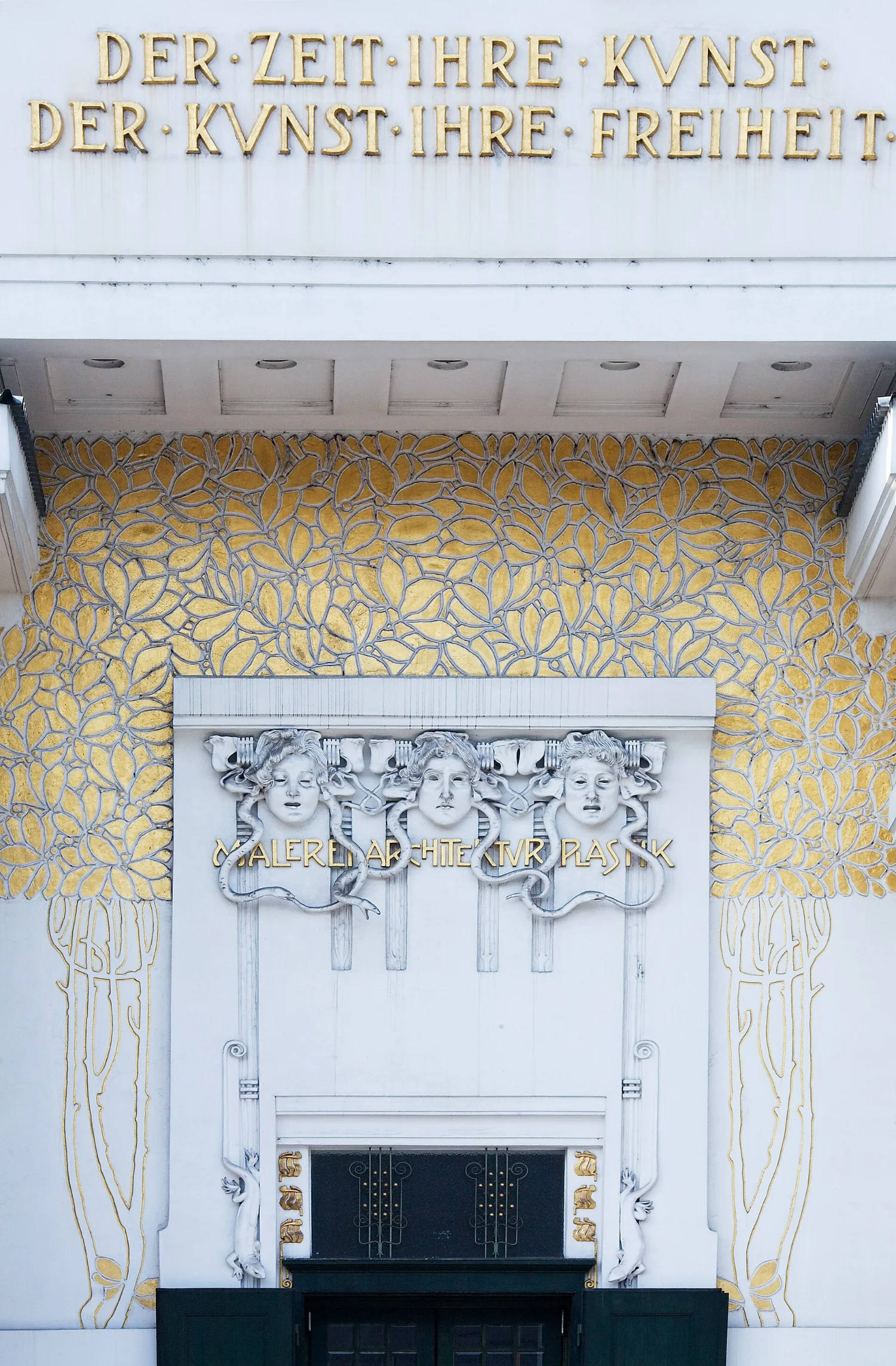
Start with the Secession Building by Joseph Maria Olbrich, completed in 1898 a short walk from Karlsplatz. Its dome, about eight and a half metres across, is covered in thousands of gilded laurel leaves, regilded during the 2017 and 2018 restoration. The motto “Der Zeit ihre Kunst. Der Kunst ihre Freiheit”, to every age its art, to art its freedom, sums up the group’s manifesto. Inside is the Beethoven Frieze that Gustav Klimt conceived in 1902 for the fourteenth Secession exhibition; opening times are on the Secession website.
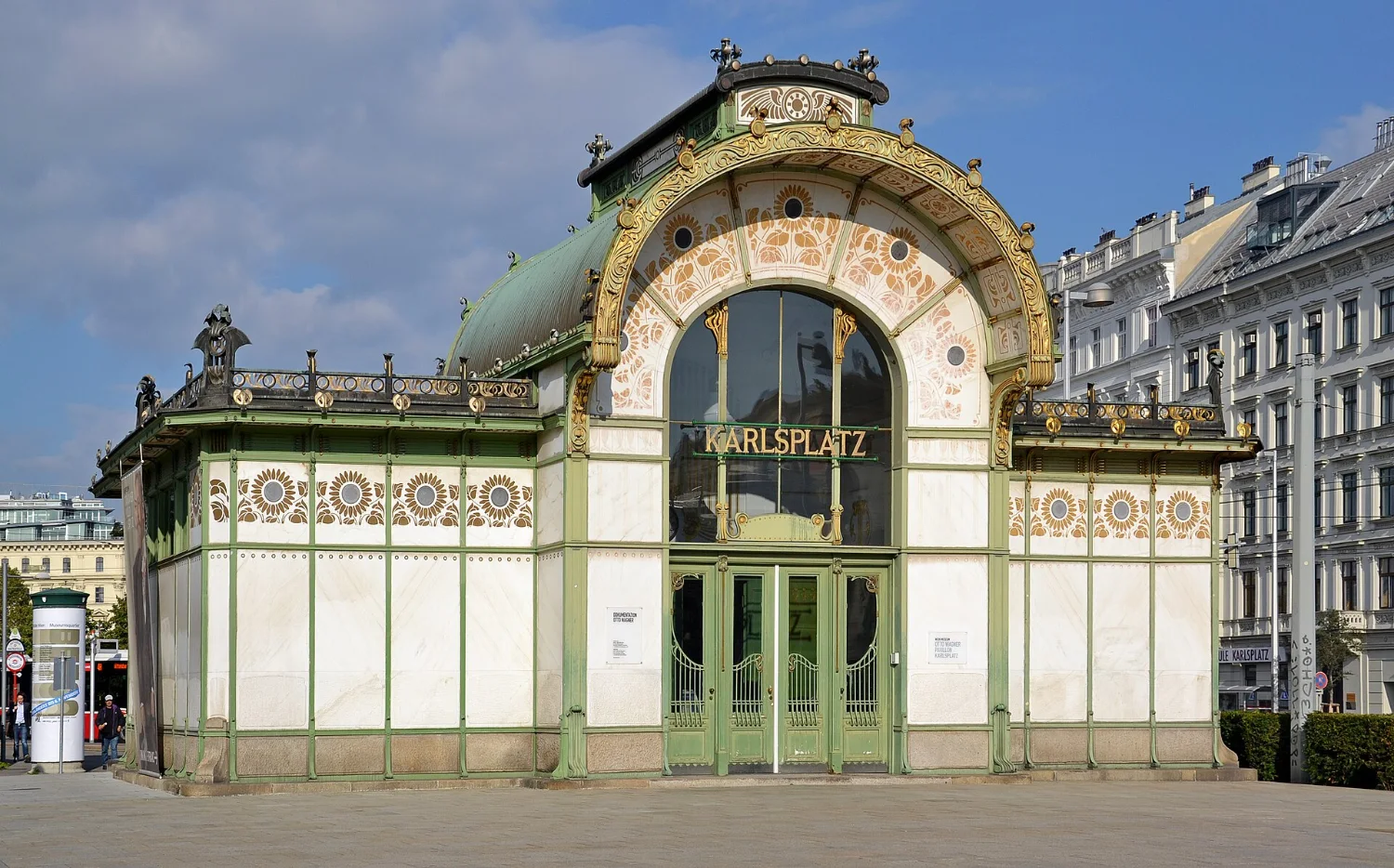
Across Karlsplatz stand the two Stadtbahn pavilions designed by Otto Wagner with Olbrich and opened in 1899. They are a lesson in elegant prefabrication: a steel frame, marble slabs fixed to the outside, gilded sunflowers along the frieze. Today one houses exhibition space for the Wien Museum, the other a café. Wagner also designed the Postsparkasse, built in 1906 on the Ring, where steel, concrete and glass anticipate functionalism.
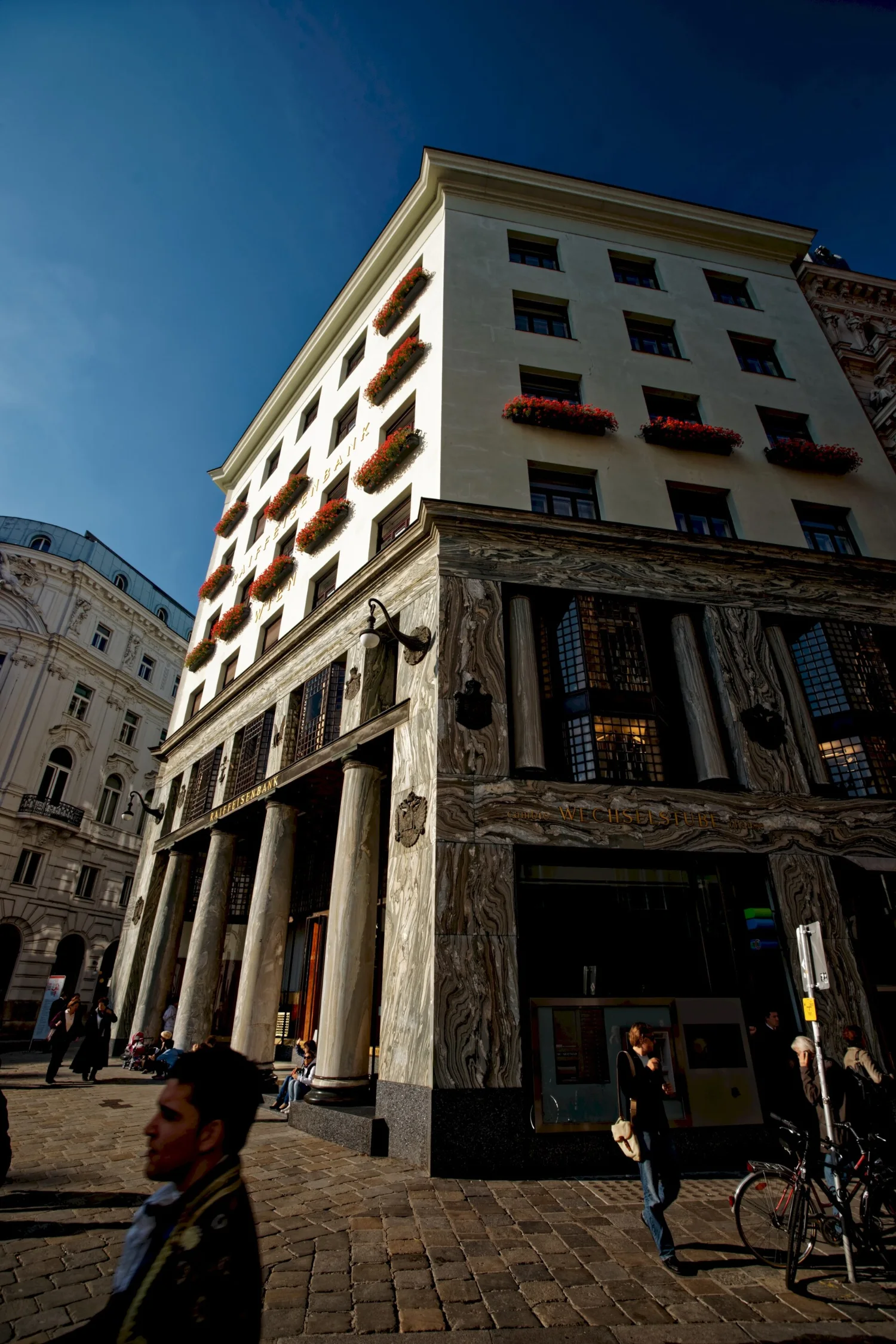
The third address is the Looshaus on Michaelerplatz, built by Adolf Loos between 1909 and 1912 opposite the entrance to the Hofburg. Its unornamented upper floors caused a scandal: one newspaper spoke of “inappropriate nakedness” and Loos had to add window boxes. Today, with the Christmas lights of the old town on the historic façades around it, its restraint looks more radical than ever.
To finish, the MAK, the Museum of Applied Arts on the Stubenring, housed in Heinrich von Ferstel’s building, which opened to the public in 1871. Its collections include the Wiener Werkstätte holdings and chairs by Thonet and Kohn: the ideal place to understand where the taste found in the best market stalls comes from. Exhibitions and opening times are on the MAK website.
What should you buy at the Vienna Christmas markets?
Our rule is the one we would use in a design gallery: honest materials, visible craftsmanship, a form that outlasts the holidays. Spittelberg and Art Advent are the best markets for this, because they favour makers and small workshops: ceramics, glass, jewellery, textiles, prints and wooden objects. Rathausplatz is more traditional, with tree decorations and seasonal food.
A practical tip: skip plastic baubles and kitsch figures and look instead for mouth blown glass and hand painted ceramics, which belong to a very specific Viennese decorative tradition. For something to keep, finish in the museum shops, where reissues of Wiener Werkstätte designs are easy to find.
Where to stay in Vienna if you love design?
Hotel Altstadt Vienna, at Kirchengasse 41 in the heart of Spittelberg, was founded in 1991 by the collector Otto Ernst Wiesenthal and displays part of his art collection; some rooms were designed by Matteo Thun. Staying here puts the Spittelberg market on your doorstep. The alternative is Hotel Daniel, at Landstraßer Gürtel 5, in a building designed by Georg Lippert in 1962: it was the first in Austria to use a glass curtain wall and is now a listed building.
If you prefer an Alpine Christmas, compare this route with the Bolzano Christmas market or the smaller Merano Christmas market. For a few days in the countryside after the city, our selection of design hotels immersed in nature offers plenty of ideas.
Frequently asked questions about the Vienna Christmas markets
When do the Vienna Christmas markets open in 2026?
Schönbrunn is first, on 6 November 2026. The Rathausplatz Christkindlmarkt, Spittelberg and Karlsplatz open on Friday 13 November 2026.
What are the opening hours of the Wiener Christkindlmarkt?
The Rathausplatz market is open daily from 10am to 10pm. On Christmas Eve it closes at 6.30pm.
Are the Vienna Christmas markets open after Christmas?
Some are. Rathausplatz closes on 26 December, while Schönbrunn stays open until 6 January 2027; Spittelberg and Karlsplatz end on 23 December.
How do you get to Vienna?
By train, with direct services including night trains to Wien Hauptbahnhof, or by air to Vienna-Schwechat, which is linked to the centre by fast trains.
How many days do you need for the Vienna Christmas markets?
We suggest three: one for Rathausplatz and the old town with the Looshaus, one for Karlsplatz, the Secession and Spittelberg, one for Schönbrunn and the MAK.