The hidden kitchen is one of the most interesting trends in current design because it is not only about the aesthetics of the home, but also about the way we live domestic spaces today. Also known as an invisible kitchen, concealed kitchen, or disappearing kitchen, this solution comes from the desire to make the kitchen …
The hidden kitchen is one of the most interesting trends in current design because it is not only about the aesthetics of the home, but also about the way we live domestic spaces today. Also known as an invisible kitchen, concealed kitchen, or disappearing kitchen, this solution comes from the desire to make the kitchen environment as clean, seamless, and integrated as possible, allowing it to interact with the living area like a fitted wall, a boiserie, an architectural volume, or a storage system.
Behind retractable doors, sliding walls, coordinated panels, and integrated appliances, however, there is more than a minimalist trend. The kitchen that “disappears” says something deeper: it reflects the need for domestic environments that are less fragmented, more flexible, more orderly, and able to adapt to different functions throughout the day.
The kitchen remains the heart of the home, but the way it presents itself is changing. It no longer has to appear as a technical, operational, visually dense room. Instead, it can become a discreet, almost silent presence that appears when needed and withdraws when the home calls for calm, continuity, representation, or simply less visual noise.
What is a hidden kitchen or invisible kitchen?
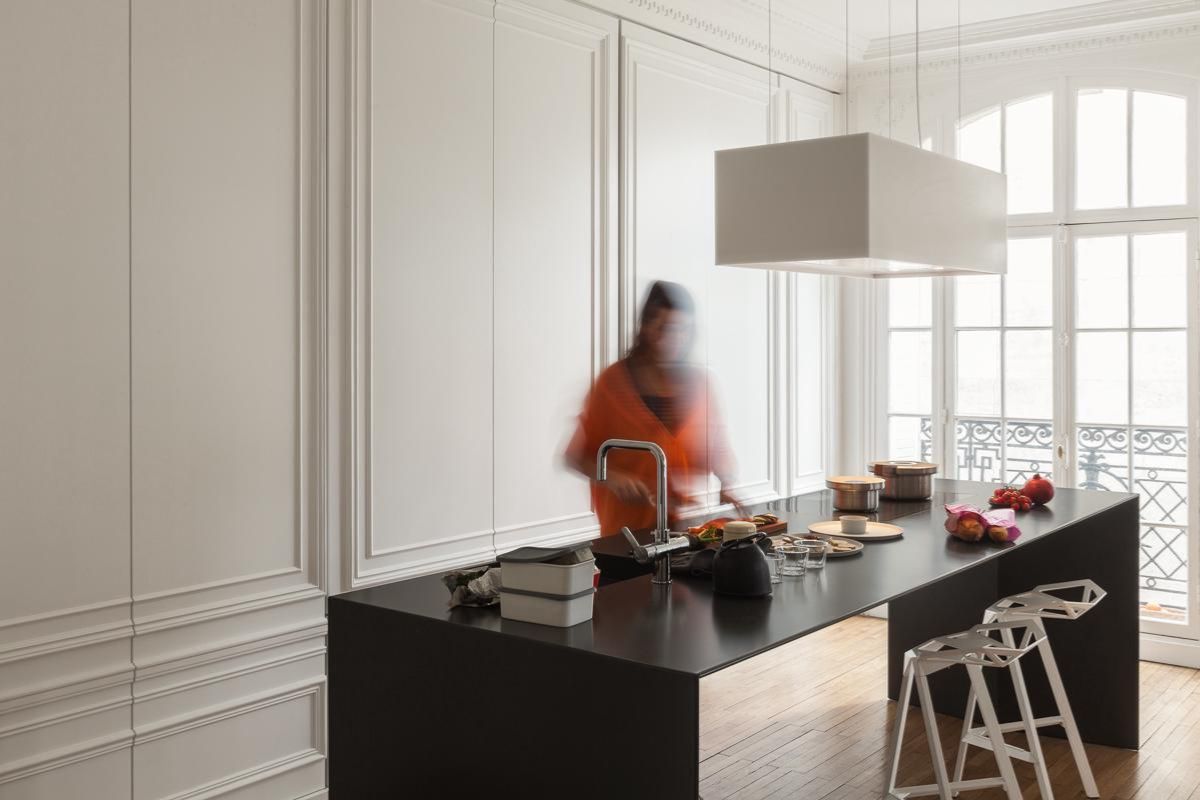 The term hidden kitchen refers to a kitchen designed to integrate completely into the interior architecture, becoming barely visible when not in use. It can be concealed behind large doors, sliding panels, folding systems, fitted walls, storage columns, or solutions with pocket doors, meaning retractable doors that slide sideways into the structure.
This does not necessarily mean a small or compact kitchen. On the contrary, many invisible kitchens belong to the high-end design segment and interpret the theme with great design complexity: sophisticated materials, advanced mechanisms, integrated lighting, equipped worktops, paneled appliances, organized pantries, and technical compartments designed to reduce the visual presence of the kitchen function as much as possible.
The point is not to eliminate the kitchen, but to control its visibility. When open, the kitchen must work perfectly. When closed, it must return an orderly, continuous, almost architectural image.
Boffi, with its Hide Pro system, describes this idea very clearly: Hide is based on the concept of concealing the kitchen within the architecture, and in the Hide Pro version the doors retract completely, returning the space to the form of a continuous wall. In essence, the kitchen appears and disappears.
Why today’s kitchen wants to become as clean as possible
The search for the cleanest possible kitchen should not be read only as an obsession with order. It is also a response to the way the modern home has changed.
In recent years, the kitchen has increasingly opened up toward the living room. The open space layout has transformed the operational area into an integral part of social life: people cook, work, entertain, watch television, take calls, study, eat, and talk. The kitchen is no longer separated from the rest of the home, and for this very reason it must learn to coexist with environments that have different functions and different rhythms.
In an open living area, a very visible kitchen can become invasive. The worktop, accessories, small appliances, shelves, hood, utensils, and everyday objects create visual accumulation that can disturb the overall balance of the space. The hidden kitchen responds to this need: it allows the function to remain while preventing it from being constantly exposed.
This is where the trend becomes interesting. The kitchen is not hidden because it loses value. It is hidden because it takes on a more sophisticated role: it becomes part of the overall home design, blends with the furnishings, interacts with materials and surfaces, and contributes to the domestic atmosphere.
Hidden kitchen: minimalist trend or new signal of contemporary living?
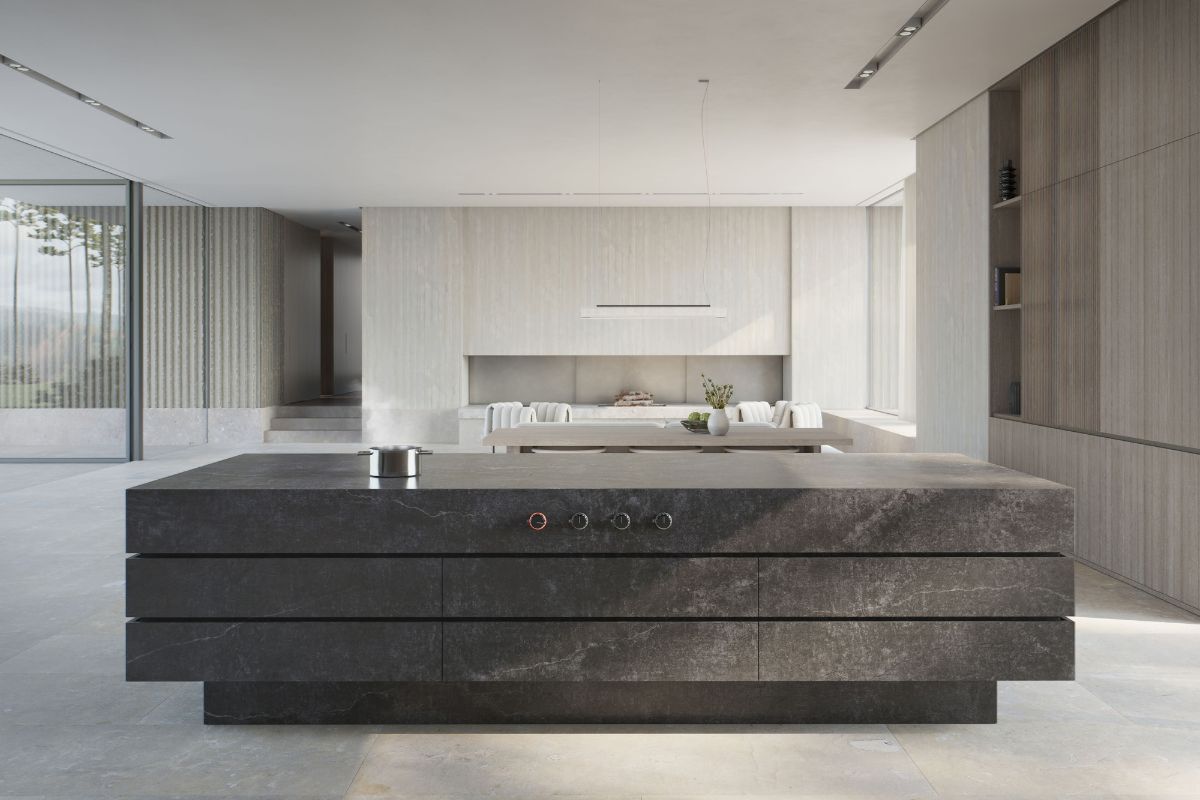
The most accurate answer is: both, but not at the same level. It is a trend in form, because today the hidden kitchen perfectly captures the current taste for continuous surfaces, orderly interiors, monolithic walls, natural materials, boiserie, neutral tones, and a “less but better” aesthetic. It is highly photogenic, very suited to social media, and closely aligned with the language of international interior design.
However, it is also a real signal in substance. The invisible kitchen speaks of increasingly hybrid homes, where rooms no longer have just one function. The living room is not only a living room, the kitchen is not only a kitchen, and the dining area is not only a dining area. The modern home works through overlapping functions: it welcomes, represents, protects, organizes, hides, and reveals.
In this sense, the invisible kitchen is not simply a minimal kitchen. It is a kitchen that interprets a new relationship between everyday life and domestic space. The function remains, but it is mediated by architecture.
The kitchen as an architectural wall
One of the most interesting aspects of the hidden kitchen is the transition from the kitchen as a composition of furniture to the kitchen as an architectural wall.
In a traditional kitchen, even an elegant one, the elements remain readable: base units, wall units, tall units, hood, sink, cooktop, and appliances. In an invisible kitchen, instead, these elements are absorbed into a broader system. The wall becomes storage, filter, scene, and backdrop.
This is an important transformation because it brings the kitchen closer to the language of interior architecture. Doors are no longer just cabinet fronts, but surfaces that create continuity. Materials are not chosen only for resistance and practicality, but also to establish a relationship with floors, boiserie, bookcases, doors, walls, and living room furniture.
A hidden kitchen works especially well when it does not feel like a trick, but like a coherent choice within the overall project. A closed kitchen wall must be believable as part of the environment, not as a technical block forcefully disguised.
Retractable doors, sliding panels, and pocket doors: how a hidden kitchen works
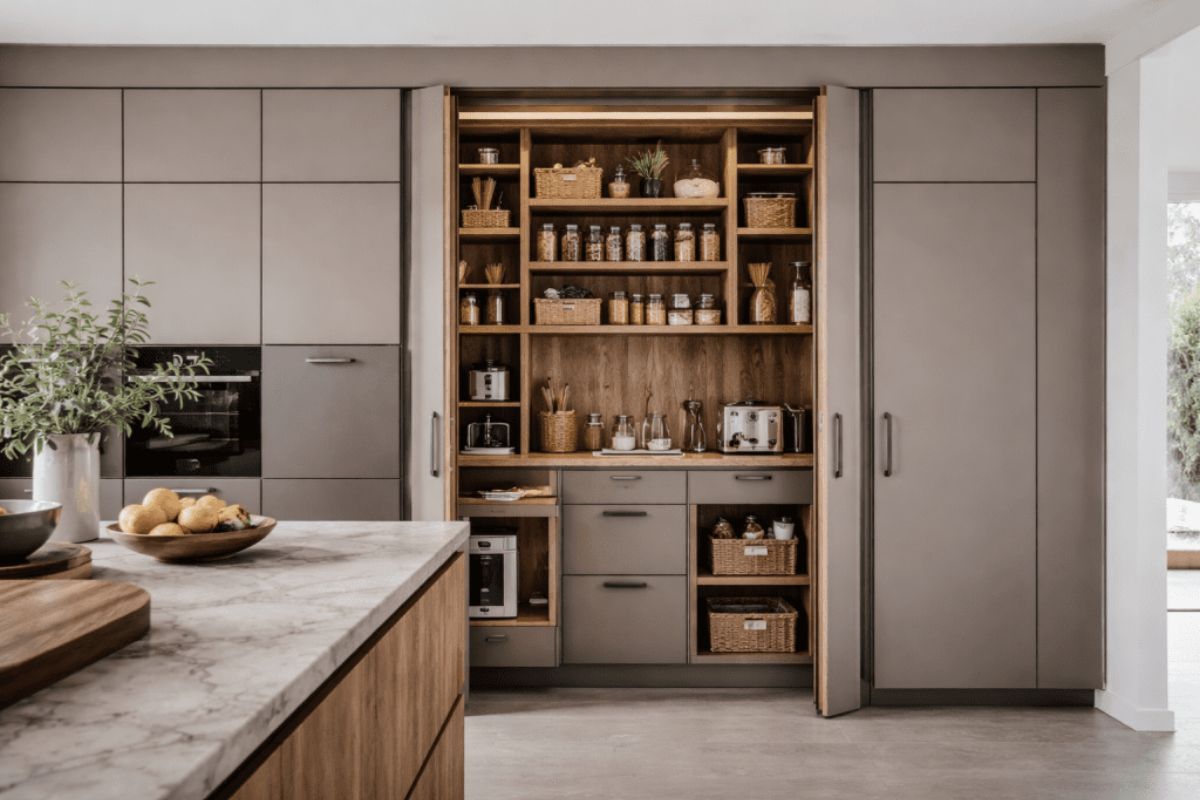 The technical solutions vary, but some appear frequently in the most interesting projects.
Retractable doors make it possible to open large kitchen columns and slide the doors sideways into the structure. This way, when the kitchen is in use, the operational area remains accessible without bulky doors open toward the outside. When the kitchen is closed, the volume becomes compact and orderly again.
Sliding panels work like movable screens: they can cover a washing area, a pantry, part of the worktop, or an entire composition. They are particularly effective in open spaces because they quickly transform the perception of the environment.
Folding or bi-fold systems are useful when the space requires wide openings but controlled dimensions. The doors fold and gather at the sides, freeing the work area.
Finally, there are kitchens integrated into large storage systems, where the operational part is inserted into equipped columns, cabinetry, or custom-made walls. This solution is increasingly close to the world of carpentry and interior contract projects, especially in luxury apartments, compact residences, hospitality spaces, suites, executive offices, and multifunctional interiors.
Ernestomeda, with the Double Indoor system of the Sign kitchen, works precisely with this logic: a work area hidden by retractable doors, designed to rationalize the layout of interiors and adapt to different spaces, with the possibility of housing a mini-kitchen, a pantry, a wine cellar, or other functional areas.
When the kitchen disappears, the living area becomes freer
The hidden kitchen has a very strong effect on the living area: it frees the space from the constant perception of a technical function.
This is especially important in modern apartments, where living room and kitchen often coexist within a limited number of square feet. In these cases, having a kitchen that can disappear behind continuous surfaces makes the living room more elegant, more neutral, and more suitable for entertaining guests or carrying out other activities.
However, the topic does not only concern small homes. Even in larger residences, the hidden kitchen responds to the desire to distinguish between different moments of living. There are times when the kitchen must be open, lively, convivial, and full of gestures. And there are times when the home calls for another atmosphere: calmer, more intimate, more orderly.
The invisible kitchen allows this transition. It does not erase domestic life, but makes it possible to modulate its presence.
The return of service kitchens and back-of-house areas
Another aspect connected to the invisible kitchen trend is the return of service areas: pantries, secondary kitchens, integrated laundry areas, butler’s pantries, and separate preparation zones.
According to several international readings of 2026 kitchen trends, there is a growing desire to keep the main kitchen cleaner and more representative, moving some of the more operational functions into secondary spaces: equipped pantries, support kitchens, areas for small appliances, and less exposed washing zones. House Beautiful links the growth of the invisible kitchen precisely to the desire to integrate the kitchen into the living area and reduce visual clutter, also through appliance garages, hidden appliances, and back-of-house spaces.
This is a very important key point: a hidden kitchen does not necessarily mean living less practically. On the contrary, when it is well designed, it can increase organization. Clutter does not magically disappear: it is managed through dedicated spaces, intelligent storage, and functional hierarchies.
Of course, this requires careful design. A poorly planned hidden kitchen risks becoming uncomfortable, artificial, and too rigid. A well-designed hidden kitchen, instead, can make daily life easier precisely because every function has a specific place.
Hidden kitchen models to know
Boffi Hide Pro: the kitchen that appears and disappears
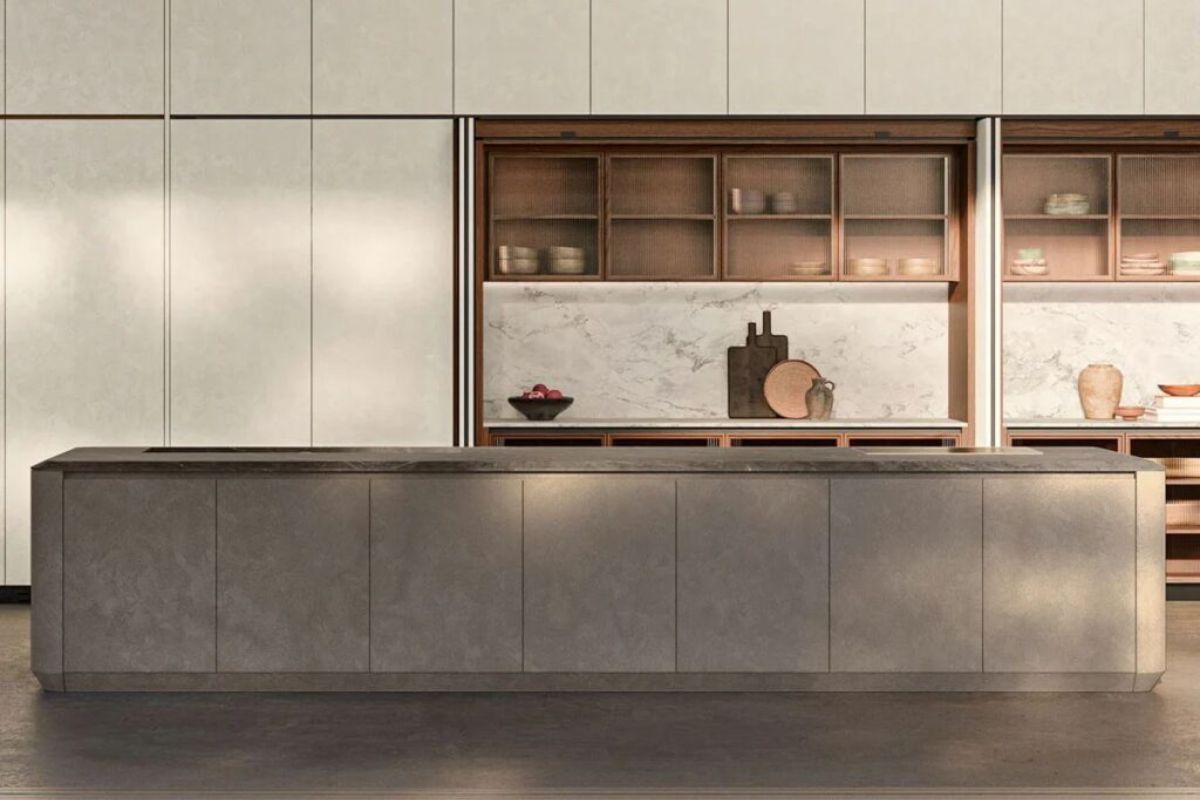
Among the most coherent references when talking about the hidden kitchen is Hide Pro by Boffi. The system interprets the kitchen as part of the architecture: the doors retract completely and the space returns to being a continuous wall. It is one of the clearest examples of a kitchen designed not as a composition to display, but as a device to open and close according to the needs of domestic life.
The strength of the project lies precisely in its radical nature. It does not simply make the kitchen more orderly; it transforms it into an architectural system. The function is not exhibited: it is preserved.
Molteni&C | Dada Tivalì 2.0: the kitchen as a stage
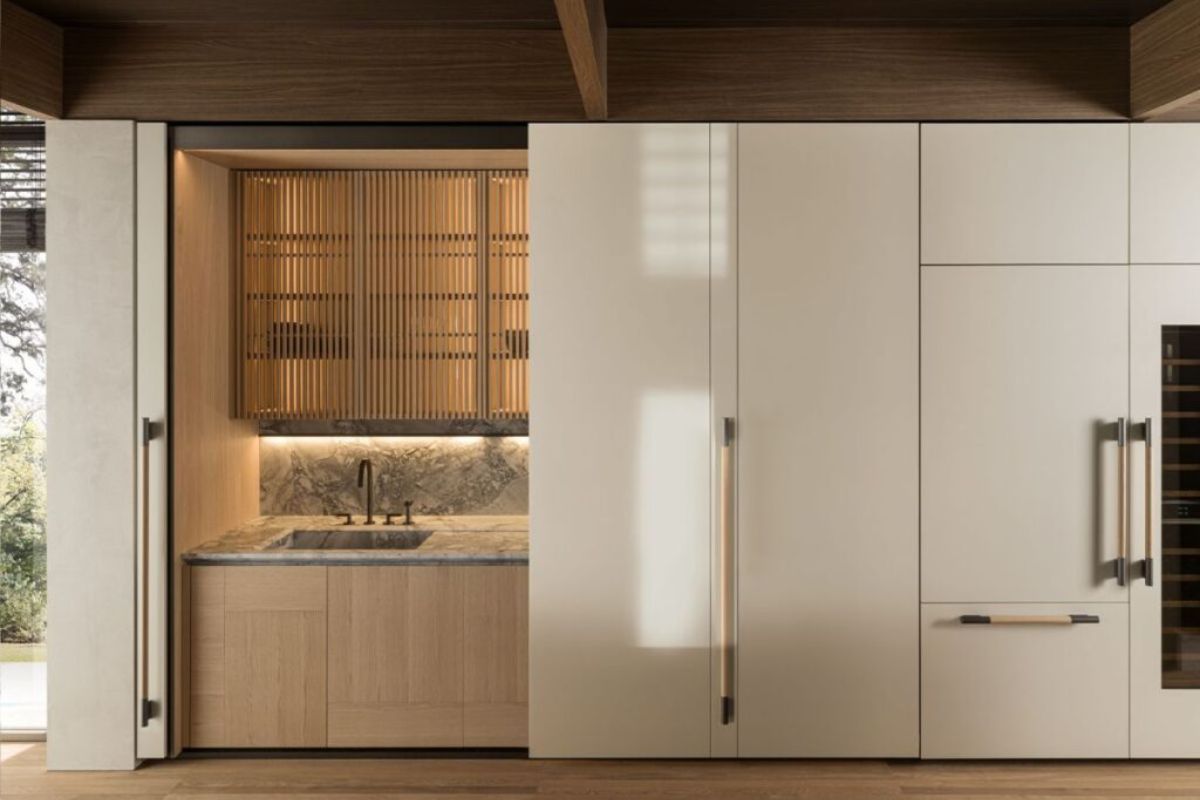
Tivalì 2.0 by Molteni&C | Dada, designed by Yabu Pushelberg, offers a more theatrical interpretation of the hidden kitchen. The project was conceived as a kitchen enclosed within a linear space, with a strong theatrical element: like a curtain, the closure hides the scene and reveals it only when needed.
It is an interesting model because it shifts the discussion from simple formal cleanliness to a narrative dimension. The kitchen becomes a domestic stage: when closed, it appears as an elegant volume; when open, it reveals the place of everyday action.
Ernestomeda Sign: hidden function inside evolved systems
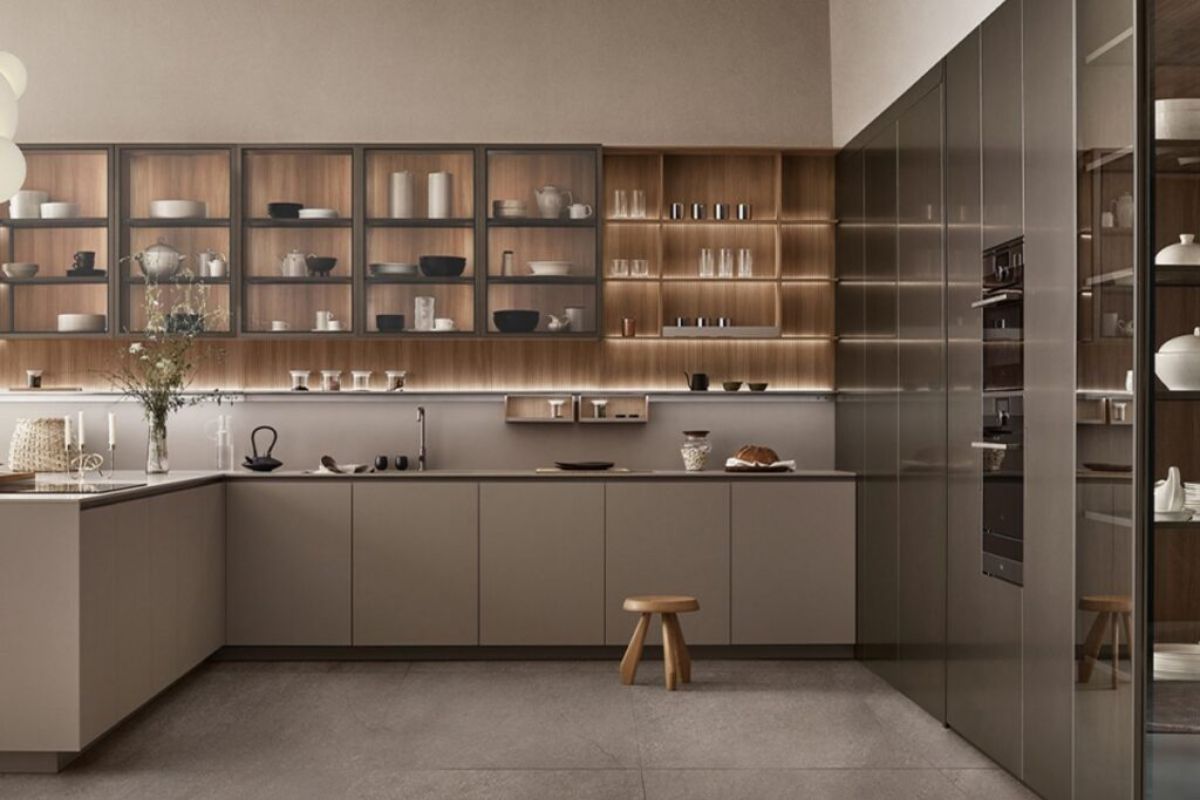
With Sign and the Double Indoor system, Ernestomeda works on the kitchen as an extension of the living area and as a set of operational zones that can be concealed from view. The brand describes Sign not as a simple closed work area, but as an extension of the living space and the convivial heart of the home.
This theme is particularly interesting because it introduces a less rigid vision of the hidden kitchen. The idea is not only to hide everything, but to create different levels of use: main area, secondary work area, storage, pantry, wine cellar, and equipped compartments. In Sign 04, for example, Ernestomeda refers to a complete and functional mini-kitchen camouflaged inside large storage units, with a second work and storage area that reveals itself when necessary.
The hidden kitchen is not always the best choice
To make the article truly solid, it is important to avoid an uncritical celebration. The hidden kitchen is a fascinating solution, but it is not automatically the right answer for everyone.
Some people need to see objects in order to use them better. In some homes, a fully closed kitchen can make daily gestures more complicated, especially if every accessory has to be searched for, opened, taken out, and put away again. The risk is turning visual order into practical fatigue.
This is even more relevant when talking about accessibility, older age, or cognitive fragility. A recent study conducted on virtual kitchens observed that open shelving can reduce object retrieval times and required movement among older adults, improving visibility and functional efficiency compared with closed wall cabinets.
This does not mean that the hidden kitchen is wrong. It means that the aesthetics of order should not be confused with residential well-being. A kitchen that looks beautiful but is uncomfortable to use is a design mistake. The real challenge is to design an invisible kitchen that is also accessible, intuitive, ergonomic, and genuinely functional.
Who is the hidden kitchen suitable for?
The hidden kitchen is particularly suitable for those who live in an open space and want a more orderly, coherent environment, less marked by the technical presence of the kitchen. It is ideal for modern apartments, lofts, high-end studios, homes with fluid living areas, and residences where the kitchen and living room share the same space.
It is also an interesting solution for those who often entertain guests and want to be able to transform the environment quickly: an operational kitchen during preparation, an elegant wall during dinner or convivial moments.
It can work very well in second homes, hospitality apartments, suites, offices with an integrated kitchen area, showrooms, hybrid spaces, and all those places where the kitchen function must exist but should not dominate the scene.
It is less suitable, however, if the kitchen is used intensively, in a very practical, family-oriented, everyday way, with many objects always in use and a strong need for immediate access. In these cases, it may make more sense to choose an orderly kitchen that is not completely hidden, perhaps with equipped columns, well-organized pantries, and a few well-designed visible elements.
Materials and finishes: why the hidden kitchen should not feel cold
One of the risks of the invisible kitchen is an effect that feels too cold, impersonal, almost showroom-like. To avoid this, materials and finishes become essential.
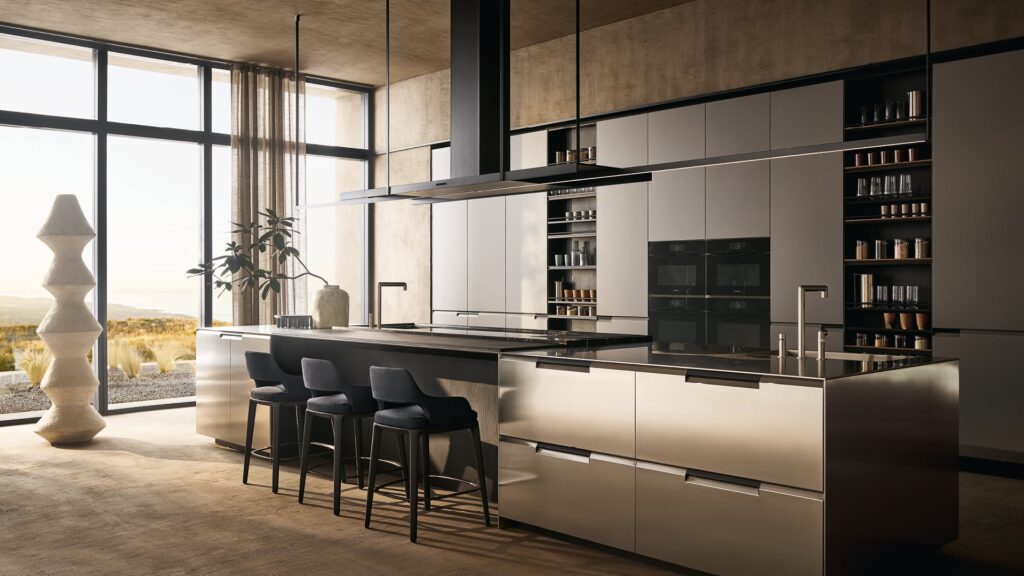
The most recent trends do not necessarily move toward glossy and hyper-minimal surfaces. On the contrary, many current hidden kitchens work with natural woods, warm wood species, textured surfaces, matte lacquers, stone, porcelain stoneware, burnished metals, fluted glass, boiserie-effect panels, and finishes capable of interacting with the living room furniture.
The kitchen disappears more successfully when it does not look like a technical block, but like a lived-in wall. The warmth of the materials helps make the solution more domestic and less aseptic. The 2026 kitchen trends reported by Elle Decor also emphasize the return of natural woods, warm tones, earthy colors, and service spaces that help keep the main kitchen more orderly.
In this sense, the invisible kitchen does not coincide with a cold or empty home. It can also be soft, warm, sophisticated, and tactile. The difference lies in the details: proportions, materials, integrated handles, light, texture, and the relationship with floors and walls.
Hidden kitchen and small appliances: the real design challenge
The real test of a hidden kitchen is not the photograph of the kitchen when closed. It is everyday life.
Where does the coffee machine go? Where is the toaster used? Where are appliances charged? Where do cutting boards, fruit, bread, utensils, spices, capsules, and food processors go? Where are outlets, cables, trash bins, and cleaning products hidden?
A hidden kitchen works only if it answers these questions before the finishes are even chosen. The project must include equipped compartments, pull-out worktops or support areas, internal outlets, lighting, ventilation, easy-to-reach storage, organized drawers, logical pantries, and resistant surfaces.
Otherwise, the hidden kitchen becomes a fragile aesthetic promise: beautiful when closed, uncomfortable as soon as it is used.
The theme of the appliance garage, meaning the compartment dedicated to small appliances and accessories, is central in the most recent interpretations of the invisible kitchen. It is not only about hiding, but about designing the way everyday objects enter and leave the domestic scene.
The hidden kitchen as a response to visual noise
One of the key phrases for understanding this trend is visual noise.
The modern home is full of stimuli: screens, objects, devices, cables, accessories, packages, work materials, toys, books, small appliances, and decorative elements. In this context, a very exposed kitchen can increase the feeling of disorder even when it is perfectly clean.
The hidden kitchen responds to the need to reduce this visual pressure. It is not only a question of minimalism, but of perceptual well-being. Entering a more continuous environment, with fewer visible fragments, can create a sense of calm and control.
Naturally, the opposite risk is to create homes that are too perfect, where every trace of life is hidden. For this reason, the topic should be approached with balance. A home should not become an untouchable set. The hidden kitchen is interesting when it improves the quality of living, not when it imposes an aesthetic discipline that is impossible to sustain.
Hidden kitchen and interior design: a trend set to grow?
The trend seems set to grow, especially in the mid-high and high-end segments of the market, where the kitchen is increasingly designed together with the entire living system.
The growth of open spaces, the demand for more flexible interiors, attention to domestic well-being, the evolution of modular systems, and the increasingly sophisticated quality of opening mechanisms make the hidden kitchen a highly relevant solution.
However, it will not necessarily become the standard for everyone. More likely, it will influence the way we design even kitchens that are not completely invisible. We will see more paneled appliances, equipped columns, integrated pantries, hidden hoods, less visible handles, freer worktops, materials coordinated with the living area, and more advanced storage systems.
In other words, even those who do not choose a fully hidden kitchen may absorb its principle: less exposure, more integration, more order, more continuity.
The real future of the kitchen is not disappearing, but choosing when to show itself
The hidden kitchen does not tell the story of the end of the kitchen as the heart of the home. On the contrary, it confirms its importance. Precisely because the kitchen has become central, visible, social, and everyday, there is a growing desire to control its presence within domestic space.
The kitchen no longer has to be fully visible at all times. It can open and close, show itself and withdraw, become stage or backdrop, laboratory or wall, operational place or silent surface.
This is the most interesting point of the invisible kitchen: it does not erase the kitchen, but makes it more intelligent in its relationship with the rest of the home. The hidden kitchen is a response to a more fluid, more hybrid way of living, more attentive to the perceptual quality of interiors.
It is not just an aesthetic trend. It is a design question: how much kitchen do we want to see, and at which moments of the day?
Increasingly, the answer is neither a separate room nor a spectacular kitchen that is always exposed. It is a kitchen capable of changing state. Present when needed. Invisible when the home asks for silence.
Hidden kitchen: questions and answers
What is a hidden kitchen?
A hidden kitchen is a kitchen designed to integrate into the architecture of the home and become barely visible when not in use. It can be closed behind retractable doors, sliding panels, fitted walls, or storage systems coordinated with the living area.
What is the difference between a hidden kitchen and a disappearing kitchen?
A disappearing kitchen is a solution in which the kitchen is closed or concealed behind doors, panels, or cabinetry. A hidden kitchen, or invisible kitchen, often has a broader meaning: it does not only disappear physically, but also integrates aesthetically with the entire interior design project.
Why is the hidden kitchen a trend?
The hidden kitchen is a trend because it responds to the spread of open spaces and the desire for domestic interiors that are more orderly, continuous, and visually lighter. It keeps the kitchen functional, while making it more discreet in relation to the living area.
Is a hidden kitchen suitable for open spaces?
Yes, the hidden kitchen is particularly suitable for open spaces because it allows the kitchen area to integrate into the living room without visually dominating it. When closed, it can appear as a fitted wall, a boiserie, or a storage system.
What are the advantages of a hidden kitchen?
The main advantages are visual order, aesthetic continuity, greater integration with the living area, flexibility of use, and the ability to quickly transform the perception of the environment. It is especially useful in modern homes where kitchen and living room coexist in the same space.
What are the disadvantages of a hidden kitchen?
The disadvantages may involve practicality, costs, mechanism maintenance, and accessibility. If poorly designed, a hidden kitchen can be uncomfortable because every function requires continuous opening and closing. For this reason, careful design focused on everyday life is essential.
Which brands offer hidden kitchens or invisible kitchen solutions?
Among the most interesting references are Boffi with Hide Pro, Molteni&C | Dada with Tivalì 2.0, and Ernestomeda with systems such as Sign and Double Indoor. They are different examples, but they share the idea of integrating the kitchen into the architecture of the space.
Is the hidden kitchen just a trend?
The hidden kitchen certainly has a strong aesthetic component, but it is not just a trend. It reflects a real change in the way we live: more fluid homes, multifunctional open spaces, the need for order, reduced visual noise, and greater continuity between kitchen and living area.