Microcement in interiors is a thin, continuous decorative coating, generally cement-based and modified with polymers, applied by hand with a trowel and protected with specific finishing systems. It can be used on floors, walls, stairs and, with suitable systems, on bathroom and kitchen surfaces. Its main advantage in renovation projects is that it can often …
Microcement in interiors is a thin, continuous decorative coating, generally cement-based and modified with polymers, applied by hand with a trowel and protected with specific finishing systems. It can be used on floors, walls, stairs and, with suitable systems, on bathroom and kitchen surfaces. Its main advantage in renovation projects is that it can often be applied over existing substrates without demolition; its most important limitation is equally clear: the final quality depends largely on the stability and preparation of the substrate, the application process and the protective finishing system. Microcement is therefore neither an “indestructible” surface nor automatically waterproof, and it should be selected by assessing the complete system rather than its appearance alone.
What microcement really is and how it differs from resin flooring
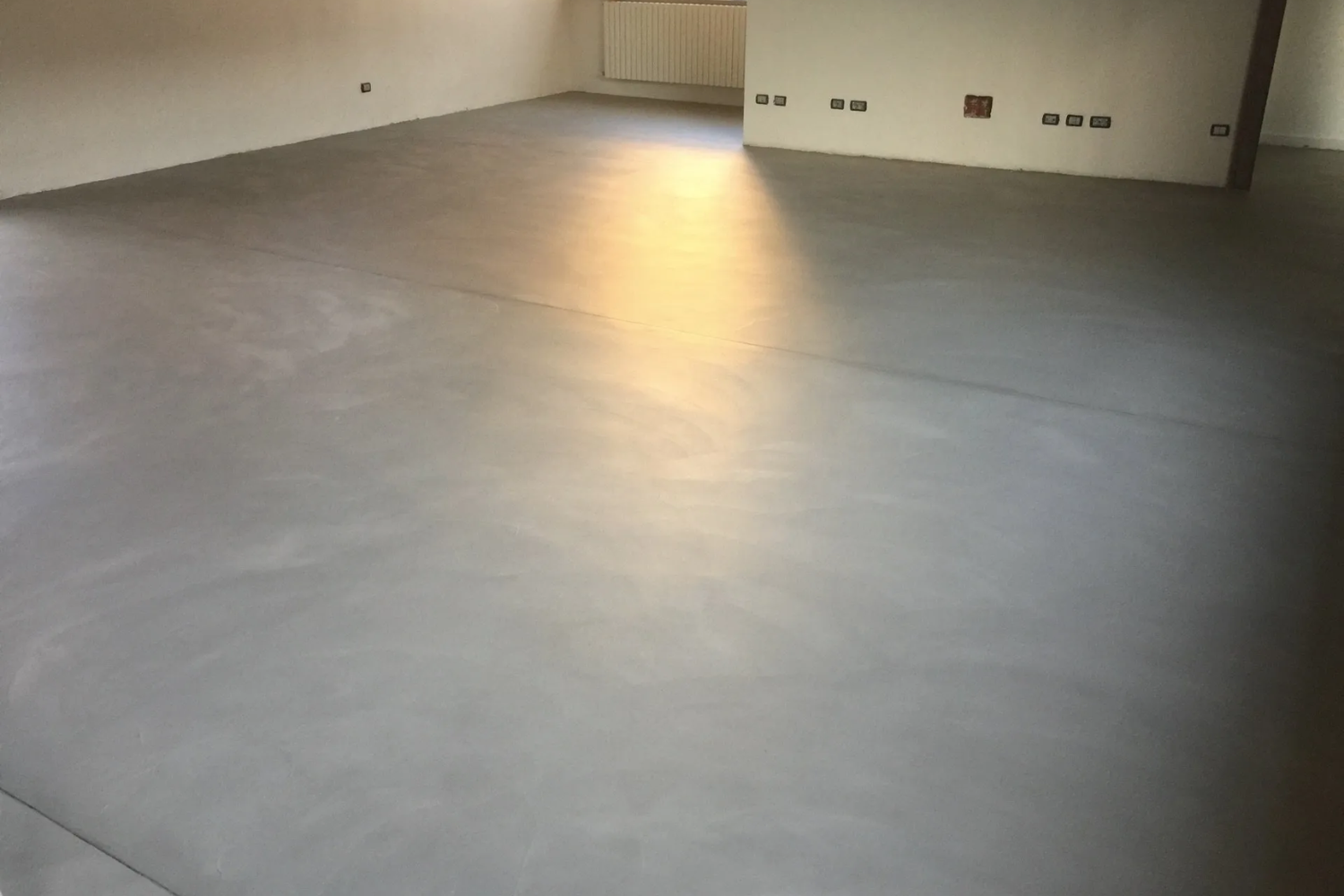
The term microcement refers to a family of thin decorative cement-based coatings. Formulations vary between manufacturers, but traditional systems generally combine cement binders, polymers, very fine aggregates, pigments and subsequent protective products. Ideal Work, for example, describes Microtopping as a two-component polymer-modified cementitious system suitable for horizontal and vertical surfaces, while Mapei classifies Ultratop Loft among its cement-based decorative systems.
Thickness is one of the features that distinguishes microcement from a screed or a traditional concrete floor. A Microtopping system can reach approximately 3 mm in total thickness, while trowel-applied cementitious products such as Ultratop Loft F are applied in layers of up to 2 mm according to the manufacturer’s specified system. There is therefore no single universal thickness for every product, but microcement is generally applied in layers measuring only a few millimetres.
It is also useful to distinguish between three categories that are often confused:
| System | Typical composition | Surface character | What to check |
|---|---|---|---|
| Microcement | Modified cement base, pigments and protective coatings | Textured, trowel-applied, with natural variations | Substrate, protective system, movement joints |
| Resin flooring | Epoxy or polyurethane resins | Can be highly uniform, glossy, satin or decorative | Type of resin, thickness, UV exposure, intended use |
| Cement-resin / hybrid systems | Variable combinations of cementitious binders and resins | Depends heavily on the formulation | Technical data sheet and actual layer build-up |
Mapei’s own technical documentation distinguishes between epoxy, polyurethane, polyurethane-cement and cementitious systems, confirming that “resin” and “cement” do not identify a single technology. Commercial terms such as “cement-resin” should therefore always be supported by the product’s technical data sheet, because the expression alone says very little about actual performance.
How microcement is applied in interiors
The finished surface may be only a few millimetres thick, but beneath it lies a complete build-up that may include substrate preparation, primer, reinforcing mesh or other reinforcement systems, base coats, finishing coats and a transparent protective layer.
The decisive factor is the substrate. Technical data sheets allow application over a range of materials, including cement screeds, concrete, ceramic tiles, plaster and plasterboard, provided that the surface is sound and prepared according to the specified system. Mapei, for example, requires substrates to be dry, solid and free from dust, loose material, wax, oil or other substances that could compromise adhesion.
This explains why the possibility of covering an existing floor without demolition does not mean simply applying microcement directly over old tiles. Existing ceramic surfaces may require mechanical abrasion, primer, treatment of tile joints and levelling. In one application documented by Mapei, for example, the tiles were mechanically prepared before the bonding promoter and cementitious layers were applied.
Cracks and movement joints cannot simply be hidden
The seamless appearance of microcement is one of its main advantages, but it requires an important technical clarification. A surface without visible decorative joints does not mean a building without movement joints.
Ideal Work’s specifications state that existing joints must be carried through into the new coating and that cracks or damaged substrates must be repaired before application. The manufacturer also links the appearance of possible cracking primarily to movement within the substrate beneath the finish.
If a screed is unstable, a tile is loose or structural movement is present, a thin coating will not solve the underlying problem: it may eventually reveal its effects.
Microcement floors and walls: where it works best
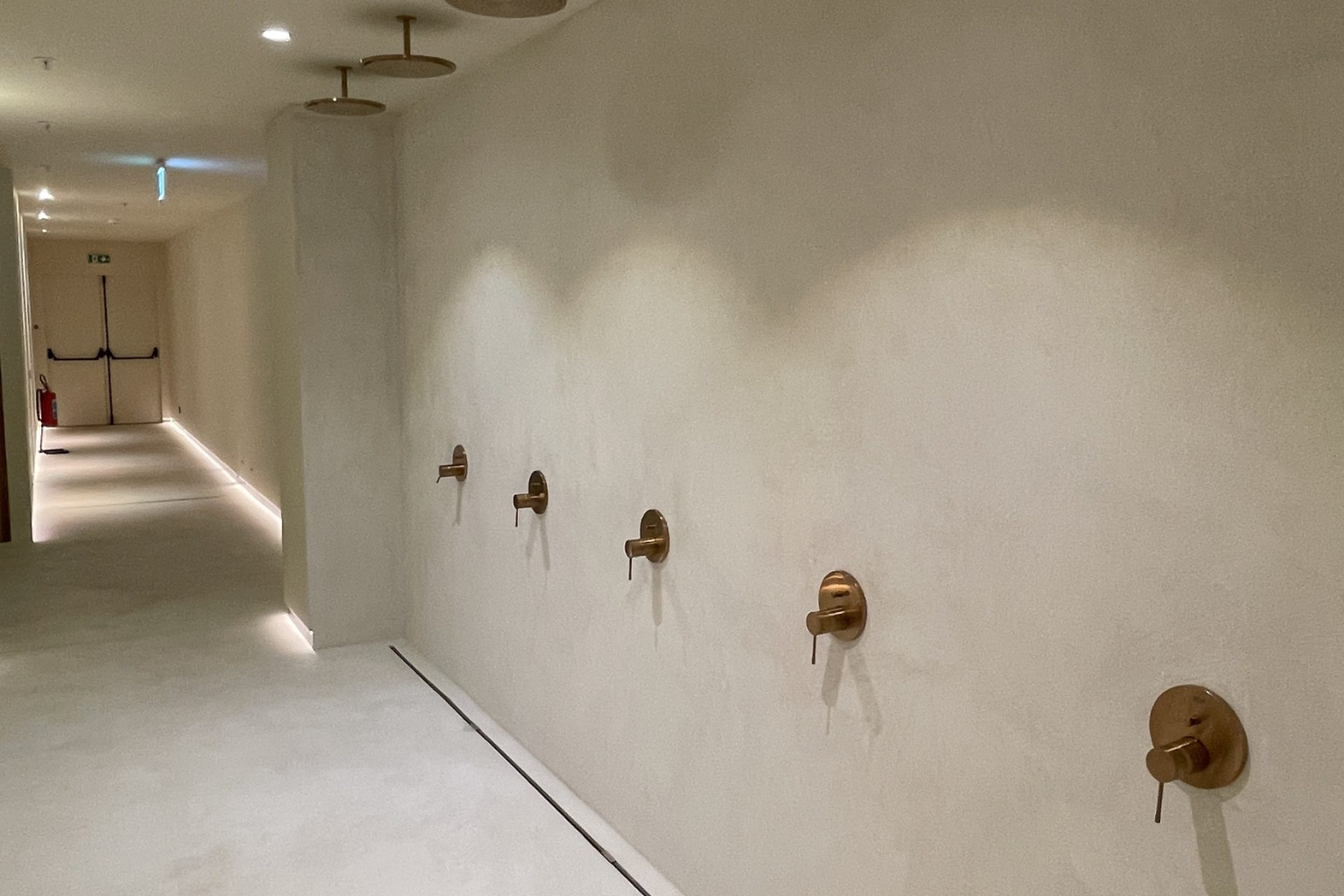
On the floor, microcement can create a visually continuous surface between the living room, kitchen, hallway and other spaces, reducing the visual fragmentation caused by tile joints. Its limited thickness is particularly useful in renovation projects, where it can help reduce some issues associated with floor levels, thresholds and demolition, provided that the existing flooring has first been technically assessed.
The final appearance varies considerably according to aggregate size, trowel technique and the protective finish selected. A perfectly uniform surface should not necessarily be expected. In hand-applied systems, clouding, subtle colour variation and visible trowel marks are part of the material’s character. Recent Mapei technical guidance recommends agreeing colour and appearance in advance through a sample, while also noting that a large hand-applied surface will not necessarily match that sample identically in every area.
On walls, mechanical stresses are lower, allowing greater freedom to work with texture. Covering every surface can create a highly enveloping interior, while using microcement only on one wall, a partition or an architectural volume preserves its tactile character without visually homogenising the entire space.
Microcement in bathrooms: waterproofing and slip resistance must be designed
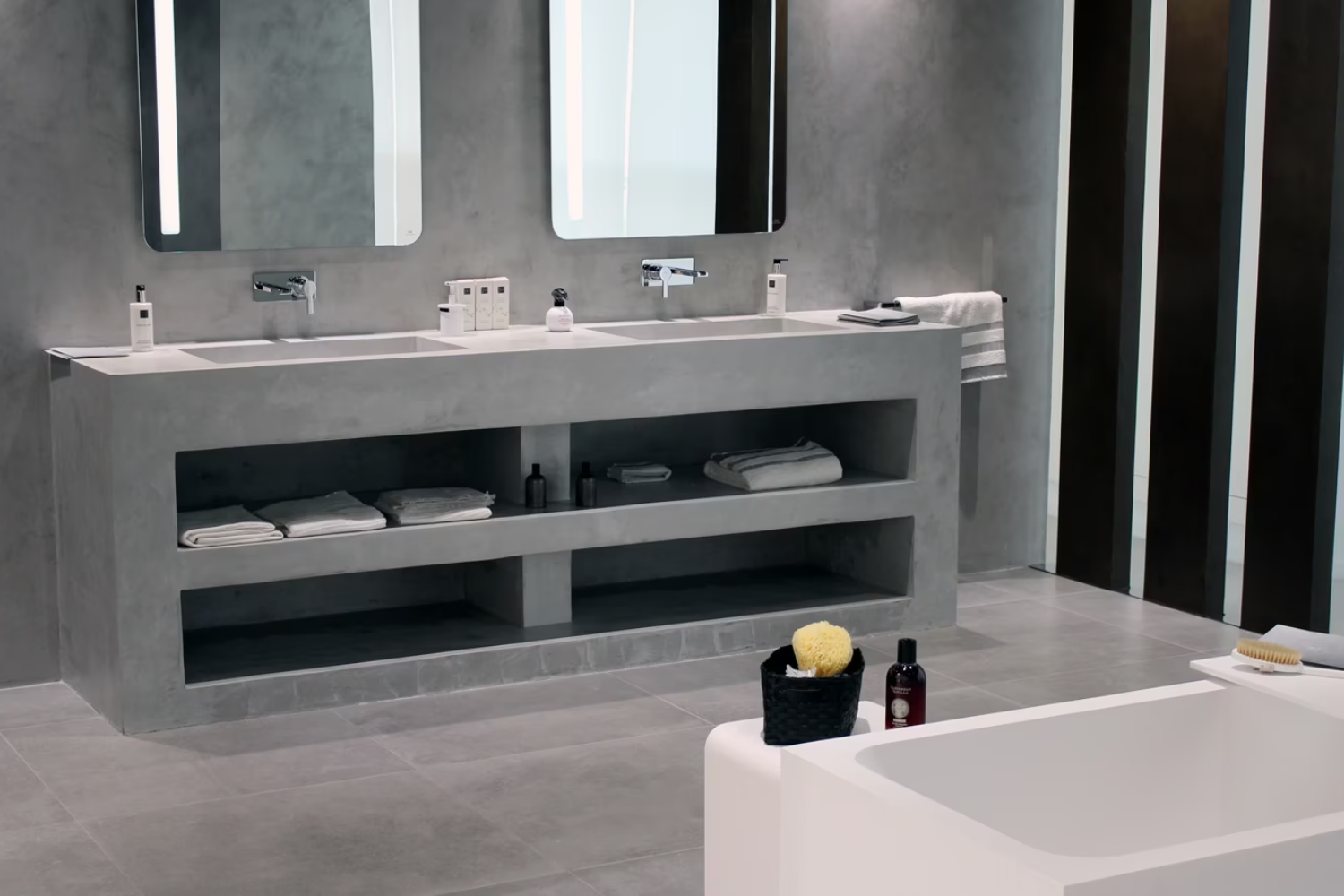
The bathroom is probably the room where the seamless appearance of microcement is most convincing: floors and walls can be finished in the same material language, visually removing the grid of tile joints.
It is also the room where oversimplification should be avoided.
Traditional microcement should not be considered waterproof regardless of the application system. Ideal Work specifies multiple coats of polyurethane sealer for its bathroom applications and recommends additional treatments to increase water repellency in showers, washbasins and worktops. Mapei likewise combines substrate preparation, cementitious coats and dedicated protective finishes within systems intended for wet environments.
The right question, therefore, is not simply “is microcement waterproof?”, but which waterproofing, sealing and protective system is specified for that particular shower or wall?
The same applies to slip resistance. Performance depends on surface texture and finishing treatment, and specific sealers are available to improve slip resistance in wet areas. A very smooth finish selected purely for aesthetic reasons should not automatically be considered suitable for a shower floor.
Microcement in kitchens: effective on floors and walls, with more care on worktops

In kitchens, microcement works well when it connects the living area floor with the cooking zone or when it is used on splashbacks, walls and custom-built volumes. Some systems can also be applied to furniture and worktops.
Worktops, however, require more careful use than walls or floors. Ideal Work recommends not placing hot pans directly on the surface, not cutting directly on the worktop and not leaving aggressive substances such as lemon juice or vinegar in contact with it for extended periods. These recommendations help correct the widespread idea that microcement is entirely maintenance-free.
In a heavily used kitchen, where the worktop is subject to intensive everyday use with few precautions, porcelain stoneware, natural stone or other materials specifically designed for worktops may be easier to manage. Microcement makes more sense when material continuity is central to the interior concept and the finish can be used and maintained correctly.
Pros and cons of microcement in the home
The real advantages
The first is visual continuity: large surfaces can be perceived without the repeated joints typical of tiled flooring. The second is its limited thickness, which makes microcement particularly interesting for refurbishment and retrofit projects. The third is versatility: the same material language can move from floors to walls, stairs and built-in architectural elements.
Application over existing finishes can also reduce demolition, but only when the underlying substrate is suitable. Some systems are compatible with underfloor heating, provided that both the design and application cycle follow the manufacturer’s technical requirements.
The limitations to understand before choosing it
The final result is strongly influenced by the skill of the applicator. A hand-finished surface is not a defect, but anyone looking for an absolutely flat and repeatable colour should take this characteristic into account before specifying the material.
Microcement also cannot stabilise an unstable substrate. Cracks and movement may become visible through the new finish; deep scratches that penetrate the protective layer should be repaired to prevent liquid absorption and colour changes. Mapei also recommends felt pads beneath chairs and movable furniture on decorative cementitious flooring.
Finally, the surface requires a properly selected and maintained protective coating. This final finish plays a significant role in resistance to staining, water and abrasion, as well as in ease of cleaning.
Microcement colours and finishes: it does not have to be grey

Microcement is immediately associated with grey concrete, but pigmented systems allow for much broader colour palettes. Warm beige, sand, taupe, greige, ivory, earthy tones and darker shades can create interiors that are far removed from a purely industrial aesthetic.
In interiors with extensive timber surfaces, warm colours and low-contrast tones can prevent the finish from appearing too cold. In very bright spaces, a medium grey or deeper mineral tone can instead emphasise light-coloured furniture and architectural volumes. In smaller bathrooms, using walls and floors from the same colour family can reduce visual interruptions.
Matt or satin finishes, texture level and intensity of trowel marks can also substantially change the result. A sample should therefore reproduce not only the selected colour but also the intended finishing system. With hand-applied coatings, colour cannot be assessed in the same way as a perfectly uniform industrial paint.
How to clean and maintain microcement
Routine maintenance is relatively straightforward, but it must be carried out without damaging the protective finish. Ideal Work recommends water and neutral detergents for its Microtopping system and advises against aggressive products, acids, ammonia, chlorine and abrasives. Other manufacturers specify their own maintenance procedures, so the care manual for the installed system should be supplied when the work is completed.
On floors, sand and abrasive particles should be removed promptly, felt pads should be placed beneath movable furniture and prolonged standing water should be avoided unless the protective system is designed for that level of exposure. When the topcoat begins to show visible wear, renewing the protective layer is generally more sensible than waiting for the underlying cementitious finish to become damaged.
How much does microcement cost per square metre in 2026?
Pricing requires caution because sources published in 2026 show significantly different ranges. Cronoshare indicates a general price range in Italy of approximately €50–100/m², with some projects starting below this level or exceeding €150/m². Topciment, a manufacturer in the sector, places a complete professional application at approximately €80–130/m², with a typical stated range of around €100–120/m².
For a preliminary interior design budget in 2026, it is therefore more prudent to consider approximately €80–130/m² for a complete professional installation, without treating this figure as a universal price list.
Costs increase when the substrate requires repair or levelling, the area is small, there are numerous corners, stairs, niches or changes in plane, bathrooms require specific waterproofing cycles, or multiple colours and special finishes are requested. On large, straightforward surfaces, the unit price may instead be lower.
A reliable quotation should clarify at least the preparation of the substrate, primer, any mesh or joint treatment, number of coats, final protective finish and VAT. Comparing quotations based solely on the price per square metre can mean comparing entirely different technical systems.
Common mistakes that can cause microcement to perform badly
The first is choosing it from a photograph alone. A physical sample makes it possible to assess texture, tonal variations and the way the surface responds to the natural light within the home.
The second is underestimating the substrate. Applying a finish only a few millimetres thick over unstable tiles, cracked screeds or damp surfaces simply transfers existing problems into the new coating.
The third is indiscriminately eliminating movement joints, confusing a visually seamless finish with the absence of structural movement.
The fourth is treating bathrooms and showers as though they were ordinary decorative walls. Waterproofing, sealing and slip resistance need to form part of the technical specification.
The fifth is choosing the applicator solely on price. With microcement, hand application directly determines texture and uniformity: technical preparation and aesthetic execution cannot be separated.
When to choose an alternative to microcement
Porcelain stoneware remains a rational choice when the priority is a highly durable surface, minimal maintenance and the possibility of replacing individual elements; large-format slabs can also significantly reduce the visual impact of joints.
An epoxy or polyurethane resin floor may be more appropriate when specific performance associated with resin systems is required or when a more uniform aesthetic is preferred. The category includes many different formulations, however, and should be selected according to actual use rather than treated generically as an alternative that simply “looks like” microcement.
Microcement is particularly effective when a project requires minimal thickness, continuity between different surfaces and a tactile, hand-applied finish. It should be reconsidered when the main objective is a completely standardised surface, when unresolved substrate problems are present or when the intended use requires performance that another system can provide with fewer compromises.
Using microcement well therefore means starting less from the colour and more from the complete build-up: understanding what it will be applied over, which stresses it will need to withstand and what type of protection will be required. That technical approach is what turns a convincing concrete-look finish into a surface designed to perform over time.