A resin floor is a continuous flooring system created through several layers applied over a properly prepared substrate: primer, any required levelling or reinforcement layers, the resin coating itself and a protective finish. There is therefore no single type of “resin”: residential projects can use epoxy, polyurethane and hybrid decorative or cement-based systems, all with …
A resin floor is a continuous flooring system created through several layers applied over a properly prepared substrate: primer, any required levelling or reinforcement layers, the resin coating itself and a protective finish. There is therefore no single type of “resin”: residential projects can use epoxy, polyurethane and hybrid decorative or cement-based systems, all with very different performance characteristics. The most obvious advantage is the continuous surface without traditional tile joints; the main critical points concern substrate preparation, scratches, UV exposure, moisture and joint management. Most importantly, resin flooring and microcement are not the same thing, even when they create similar visual effects.
What is resin flooring?
Treating resin flooring as though it were a single material can be misleading. It is better understood as a family of layered flooring systems, formulated with different binders and designed according to their intended use. Mapei, for example, explicitly distinguishes between epoxy, polyurethane and cementitious flooring, while decorative systems may combine an epoxy layer with a final polyurethane protective coating.
The finished surface can be smooth, matt, satin, glossy, trowelled, clouded or slip-resistant. Thickness also varies: there are thin decorative systems measuring only a few millimetres and more substantial technical build-ups intended for higher mechanical loads. Mapei, for example, specifies a thickness of 1.5–3 mm for Decor System 70 and 2 mm for certain polyurethane systems intended for residential and public interiors.
Epoxy resin, polyurethane and cement-based flooring: the differences
| System | Main characteristics | Where it can work well | Points to check |
|---|---|---|---|
| Epoxy resin | Rigid, continuous, resistant to abrasion and many chemicals | Interiors, kitchens, living spaces, commercial and technical areas | UV exposure, system rigidity, condition of the substrate |
| Polyurethane resin | More elastic and flexible | Residential interiors, spaces requiring greater comfort or deformability | Aromatic/aliphatic formulation, UV exposure, point loads |
| Decorative epoxy-polyurethane system | Trowelled or clouded appearance with a protective finish | Homes, showrooms, hotels and shops | Quality of the finish and maintenance of the surface layer |
| Cement-based or cement-resin system | More mineral and tactile appearance | Contemporary interiors and renovation projects | Actual system composition, elasticity and final protection |
| Microcement | Thin cementitious coating containing polymers/resins and aggregates | Floors, walls and other substrates depending on the system | Should not automatically be confused with a pure resin system |
Epoxy resin flooring: durable, but not always ideal in direct sunlight
Epoxy systems are widely used because they can create continuous surfaces with good mechanical and chemical resistance. Mapei’s Decor System 70, for example, is an epoxy-polyurethane system also intended for private homes and is declared resistant to abrasion under medium pedestrian traffic, frequent cleaning cycles and several chemical agents.
One aspect that needs particular attention is exposure to UV radiation. It is not accurate to say that every epoxy floor will inevitably yellow, but colour stability depends on the formulation and the protective top layer. For this reason, some decorative systems use aliphatic polyurethane or polyaspartic finishes specifically declared resistant to UV light and yellowing. Both Sika and Mapei document the use of UV-resistant polyurethane or polyaspartic topcoats over resin flooring systems.
Polyurethane resin flooring: greater elasticity and potential comfort
Polyurethane is used where a more elastic system is required. Mapei describes Mapefloor Comfort System AR as an elastic, self-levelling polyurethane floor that is continuous, impermeable to liquids and resistant to pedestrian traffic, while other Sika systems associate polyurethane resin with greater deformability than more rigid coatings.
Here too, it is essential to read the actual technical data sheet. An aromatic polyurethane resin does not automatically provide the same UV stability as an aliphatic formulation; some systems achieve UV resistance specifically through the final aliphatic topcoat.
Cement-resin and microcement are not the same thing
The market uses terms that can overlap, but technically they should be distinguished. Sika defines microcement as a cementitious coating that also contains polymers, resins and aggregates. Kerakoll, by contrast, describes Cementoresina as a genuine continuous resin system with a trowelled texture, created through several products and a polymer matrix.
The practical consequence is simple: a “concrete effect” does not identify the material. Two floors that look similar can have completely different build-ups, elasticity and maintenance requirements.
What are the advantages of resin flooring?
The first advantage is visual continuity. A surface without conventional tile joints can extend through the living room, kitchen and corridor, creating a uniform base for the interior design. Systems such as Sika ComfortFloor and Mapefloor Comfort are specifically designed to create continuous surfaces.
The second advantage is the relatively low thickness of many resin systems. This can be useful during renovation, particularly when the aim is to avoid removing the existing floor. The possibility of installing over an existing finish, however, always depends on the condition of the substrate: old tiles or other existing coverings must be stable, firmly bonded, intact, clean and properly prepared.
The third advantage is aesthetic freedom. Colour, sheen, trowelled effects, clouding and slip-resistant textures can all be adjusted within the selected system. Mapei documents decorative systems available in a wide range of colours and matt, satin or gloss finishes.
Finally, a continuous surface is generally straightforward to clean. Sika polyurethane finishes are described as easy to clean and low-maintenance; Mapei also recommends removing liquids and contaminants quickly and planning maintenance according to traffic levels and intended use.
Resin flooring: what are the disadvantages?
The first limitation is that the quality of the finished floor depends heavily on the substrate. A resin layer only a few millimetres thick cannot turn an unstable base into a stable structure. Sika requires cementitious substrates to be sound, dry and free from contaminants, while cracks and joints must be assessed and treated before application. Incorrect analysis of existing cracks can lead to reflective cracking through the finished coating.
The second issue is surface wear. No resin floor should be considered immune to abrasion or scratching. How visible these marks become depends on formulation, finish and colour: highly glossy, uniform surfaces generally make them more noticeable than matt or more textured finishes. Specialist Italian design publications also identify abrasion and scratches among the aesthetic drawbacks of resin floors.
The third problem is moisture. Applying resin over a substrate affected by unresolved rising damp can compromise the coating. Technical documentation from Mapei and Sika requires moisture assessment and, where necessary, dedicated barrier or moisture-mitigation systems.
Local repairs may be technically possible but are not always invisible, especially on highly uniform monochromatic surfaces. The possibility of carrying out repairs should therefore be assessed with the manufacturer and installer according to the specific system used.
Do the joints really disappear?
A “joint-free floor” and a “floor without structural movement joints” are two different concepts.
Some resin systems allow large continuous surfaces to be created without visible distribution joints. Mapei, for example, describes certain Comfort systems as continuous surfaces without distribution joints.
This does not mean that movement or structural joints should be indiscriminately covered. Sika requires existing joints and cracks to be treated in advance and distinguishes between static cracking and dynamic movement. The designer must therefore determine which discontinuities can be treated and which need to remain functional.
Can resin flooring be installed over existing tiles?
Yes, in many cases, but the correct answer is: only when the existing floor provides a suitable substrate.
Tiles must be firmly bonded, stable and free from loose areas. The surface must be cleaned of grease, wax and contaminants and often needs mechanical preparation. Deep joints, loose tiles and uneven areas must be repaired before the resin system is applied. Mapei specifically emphasises the integrity, stability and preparation of the existing covering before any overlay installation.
The real advantage during renovation is therefore not simply “applying resin over tiles”, but avoiding demolition when the existing substrate genuinely allows a technically correct overlay.
Resin flooring in living rooms and open-plan spaces
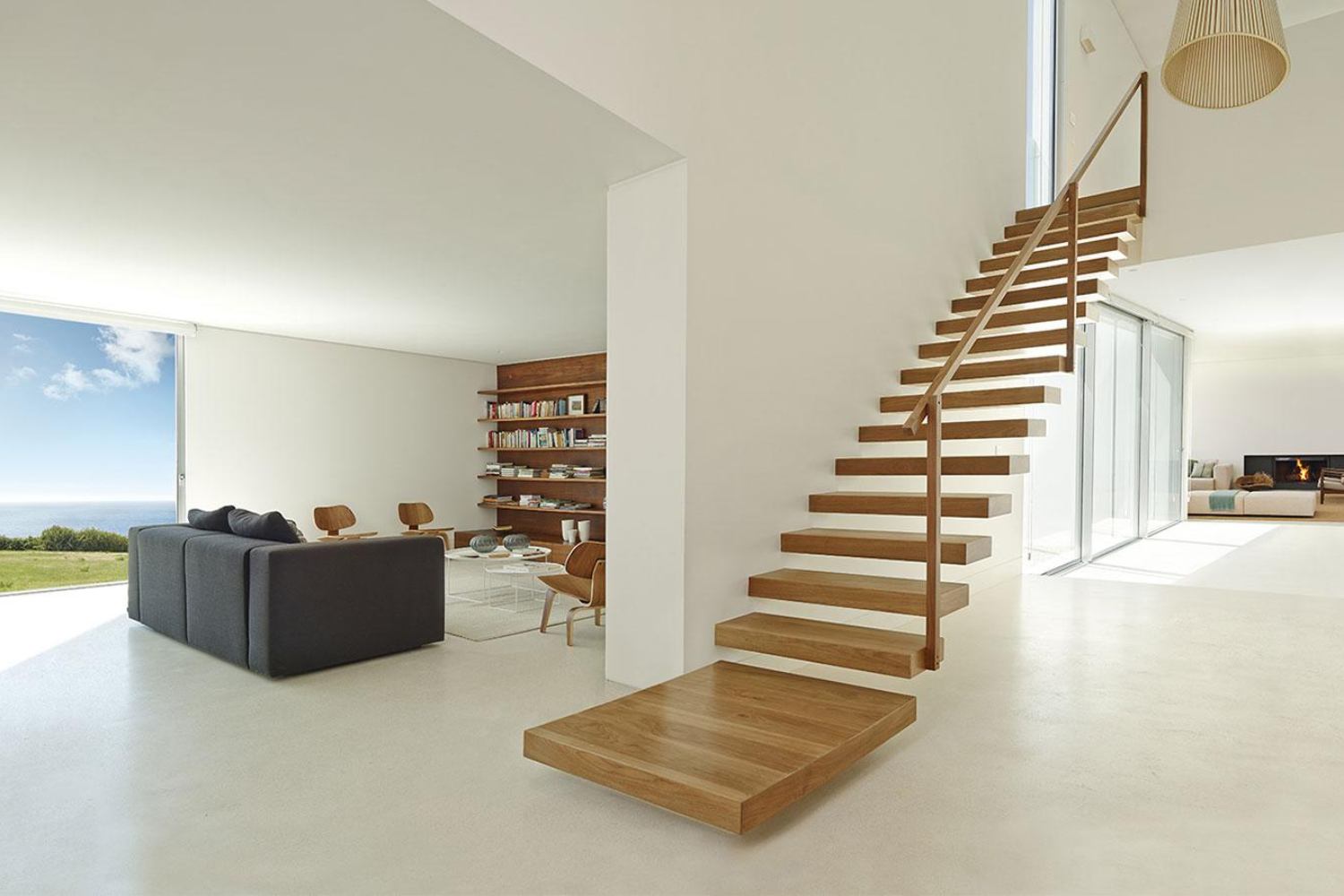
The living area is one of the most natural applications for resin flooring because it allows a continuous surface to extend across open-plan interiors.
Mineral tones, warm greys, beige, taupe and more saturated colours can completely change the character of the space. Everyday use must also be considered: chairs, tables, sofas and heavy furniture create point loads and friction. In more elastic systems, Sika notes that the combination of underfloor heating, high temperatures and concentrated loads can cause indentation; the choice should therefore be based on the full flooring system rather than appearance alone.
Resin flooring in the kitchen: continuous surface, but choose the finish carefully
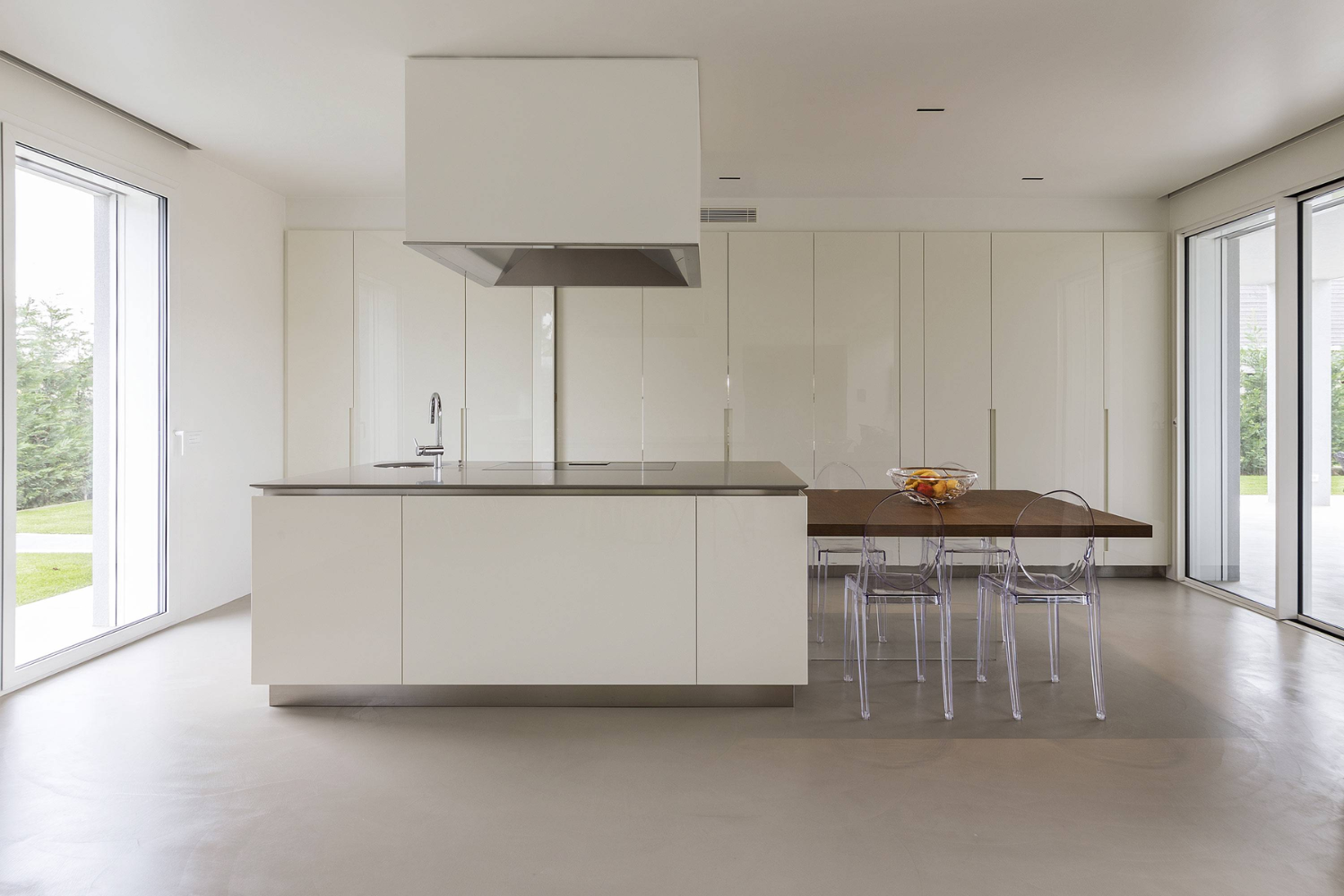
In the kitchen, continuous flooring simplifies the management of tile joints and works particularly well with streamlined cabinetry. Some decorative resin systems are specifically recommended by manufacturers for homes, restaurants and other spaces subject to frequent cleaning.
However, resistance to staining, detergents, abrasion and slipping must all be considered. An extremely smooth, glossy finish can behave very differently from a surface with a slip-resistance level designed for areas where water may reach the floor.
Resin flooring in bathrooms and showers
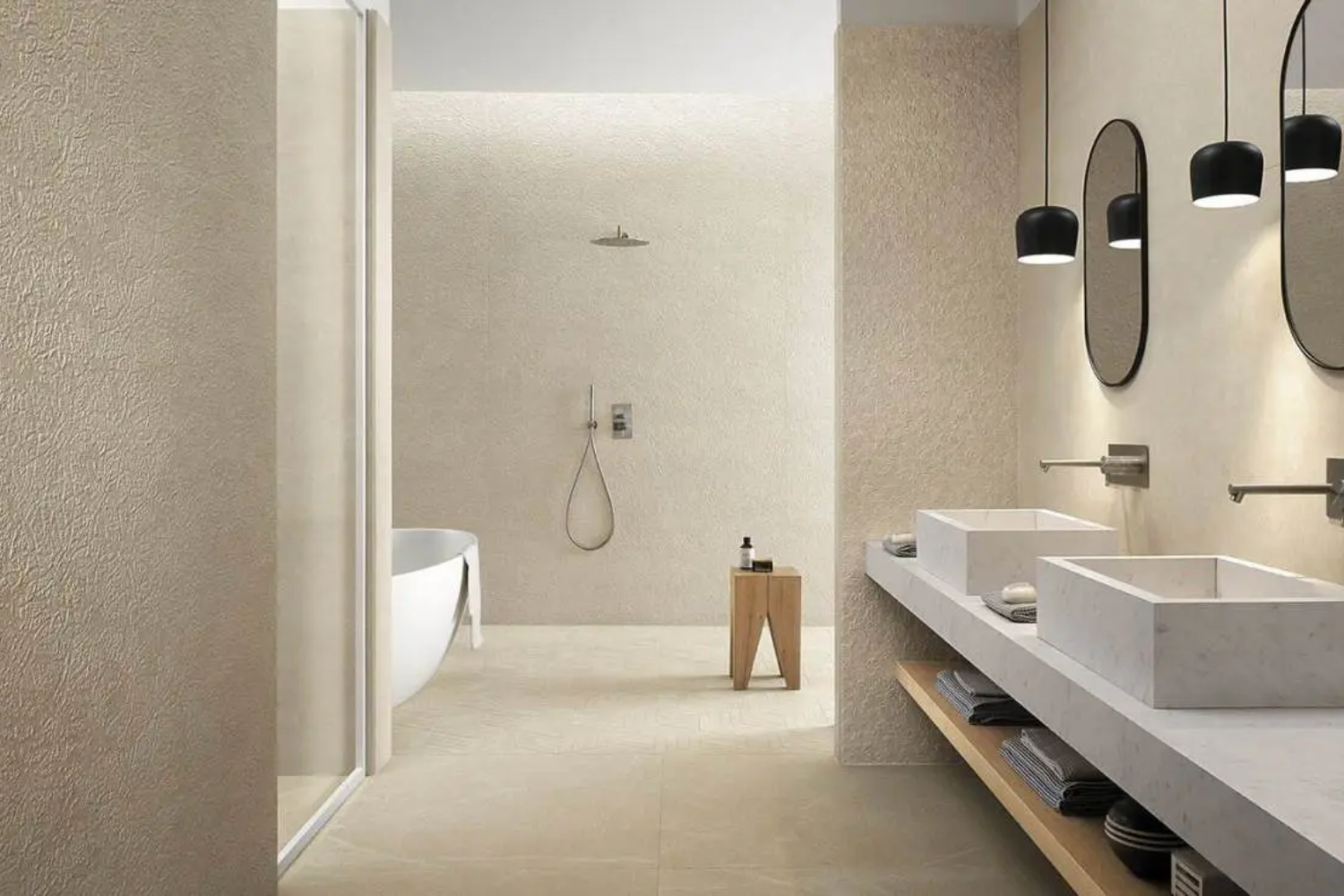
Bathrooms require greater technical attention than living rooms or bedrooms.
It is not enough for the resin itself to be generically described as waterproof. The entire system must be assessed, including any underlying waterproofing, treatment of junctions and drains, and the required slip-resistance classification. Kerakoll, for example, documents a specific Cementoresina R11 system intended for applications including shower trays, with declared slip-resistance classifications.
A standard decorative resin system designed for a living room should therefore not automatically be extended into a shower without specific technical verification.
Bedrooms and entrance halls
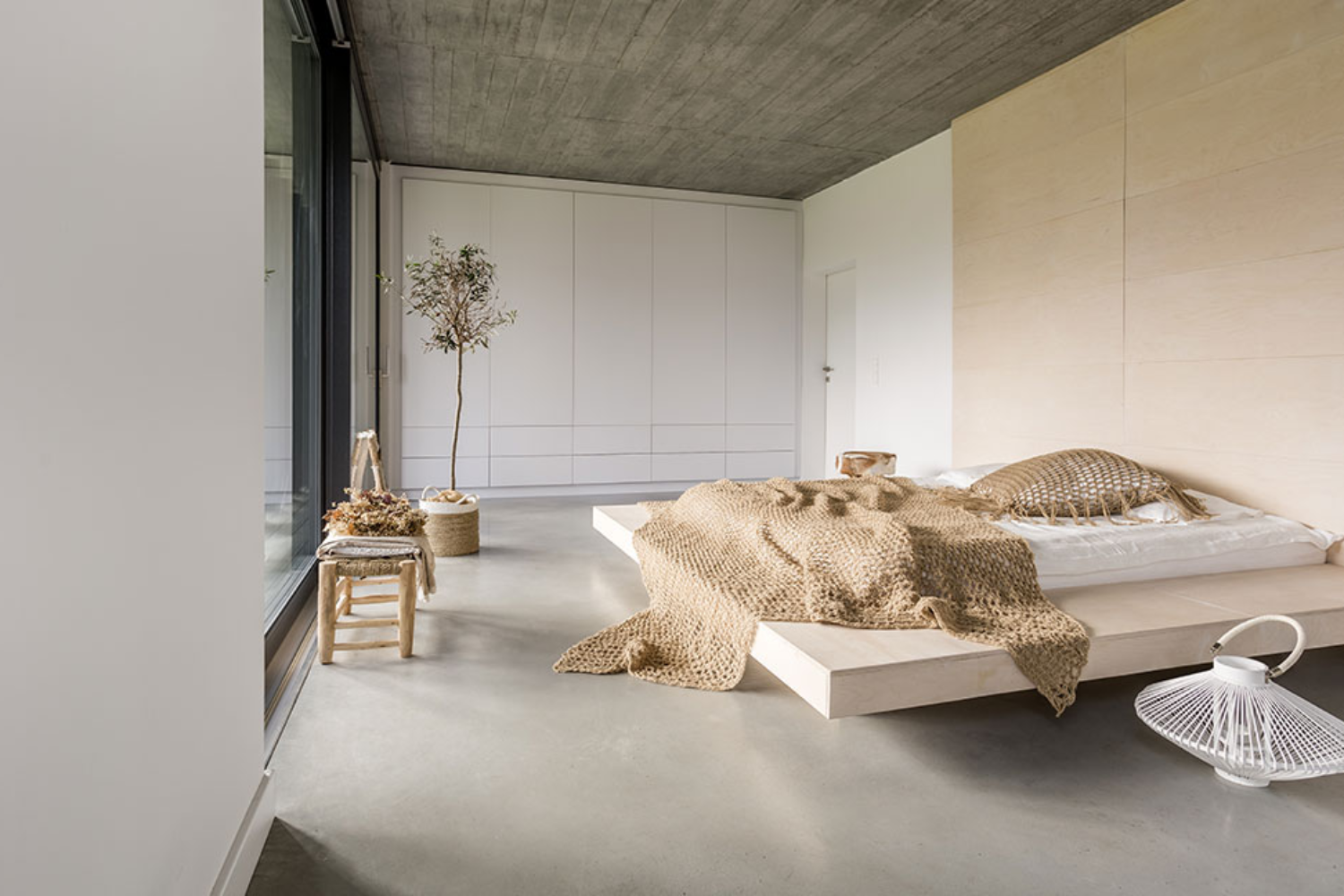
In bedrooms, a continuous floor can work well when a very restrained surface is desired, particularly in interiors where timber, fabrics and furniture provide most of the character.
Entrance halls and corridors, by contrast, are areas where abrasion, dirt and traffic become more important. Finishes that are less visually sensitive to marks should therefore be considered, together with verified wear resistance. A very dark, highly polished floor can be dramatic, but it also requires greater acceptance of everyday signs of use.
Is resin flooring compatible with underfloor heating?
Radiant underfloor heating does not automatically rule out resin flooring.
There are systems specifically declared compatible with heated substrates. Kerakoll certifies this compatibility for Cementoresina according to EN 1903, while other dedicated products are designed specifically to work over heated floors.
The presence of underfloor heating must, however, be communicated before installation. Substrate temperature, heating and cooling cycles and point loads should all be managed according to the system instructions. For certain finishes, Sika explicitly requires the heating to be switched off during application because an excessively warm surface accelerates drying and may cause defects.
Colours and finishes: matt, satin or gloss?
A perfectly smooth, monochromatic resin floor produces a very different effect from a trowelled surface.
A matt finish tends to create a softer, more material appearance. Satin retains a subtle degree of reflection. Gloss makes the floor more responsive to light, but it can also make small marks, undulations or scratches more visible.
The finish should therefore be selected together with the colour. A clouded, matt mid-grey may visually accommodate everyday wear very differently from a uniform high-gloss black.
How to clean and maintain resin flooring
Routine maintenance should be straightforward and regular.
Mapei recommends removing liquids and contaminants quickly, using cleaning methods compatible with the coating and periodically checking the condition of both the flooring and expansion joints. Sika describes certain polyurethane finishes as easy to clean and, in some systems, directly renewable through the application of a new topcoat.
Using felt pads beneath chair and furniture legs and removing abrasive particles before washing can also help reduce superficial micro-scratches.
How much does resin flooring cost in 2026?
Here it is important to distinguish between a technical specification price and the real cost of decorative residential resin flooring.
The 2026 price schedule for post-earthquake reconstruction issued by the Italian Extraordinary Commissioner lists, as a public-works reference, €46.70/m² for a 3 mm self-levelling epoxy floor, including the preparation specified in the relevant item. This is a technical benchmark, not a price list for private homes, and it does not automatically include the aesthetic complexity of a bespoke decorative system.
For residential projects, 2026 quotations published by Italian contractors indicate higher figures. One guide referring to the Turin market suggests approximately €80–150/m² for decorative resin flooring, including material and installation, while noting that substrate preparation, floor area, number of coats and type of finish can substantially affect the total. Another industry guide from 2025 broadly places resin flooring at around €50 to over €120/m². These figures should be understood as indicative ranges rather than national rates.
Small areas also often have a higher cost per square metre because primer, preparation, sanding, successive application stages and technical curing times are still required even over a limited surface.
Common resin flooring problems: cracks, bubbles, scratches and yellowing
When a resin floor develops problems, the cause may lie in the material itself, the substrate or the application process.
Reflective cracking can result from an existing crack or movement within the substrate that has not been properly assessed. Delamination and bubbles may be linked to inadequate preparation, contamination or moisture problems. Scratches and loss of gloss, by contrast, affect the finishing layer and increase according to traffic levels and patterns of use.
Yellowing should be assessed primarily in relation to formulation and UV exposure: where exposure is significant, a system specifically declared UV-resistant should be selected rather than simply choosing a resin described as “decorative”.
When should resin flooring be avoided?
Resin is generally a poor choice when the substrate has significant movement, rising damp or cracking that cannot be resolved without major remedial work.
It should also be considered carefully when the expectation is for a surface that remains visually identical for years without showing any signs of use. A continuous floor makes the material highly visible, and small abrasions can gradually become part of its visual ageing.
For outdoor use, the same system used in a living room should not simply be extended outside. Formulations specifically designed for UV radiation, weather exposure and thermal changes are required. Sika, for example, distinguishes dedicated UV- and weather-resistant polyurethane coatings for balconies and terraces.
Resin flooring therefore works best when it is chosen as a complete technical system rather than simply as a way to obtain a “seamless look”. When substrate, joints, resin, finish and intended use are compatible with one another, it can become a highly effective surface for contemporary interiors. When these elements are ignored, the continuity that makes resin flooring so appealing can instead become its main weakness.