Joe Colombo transformed furniture into a tool for imagining how domestic life could change. Between the 1960s and the beginning of the 1970s, he designed enveloping armchairs, modular seating, mobile kitchens, storage units on wheels and complete living systems capable of adapting to the user's changing needs. Elda, Minikitchen, Universale, Tube Chair, Boby and Total …
Joe Colombo transformed furniture into a tool for imagining how domestic life could change. Between the 1960s and the beginning of the 1970s, he designed enveloping armchairs, modular seating, mobile kitchens, storage units on wheels and complete living systems capable of adapting to the user’s changing needs. Elda, Minikitchen, Universale, Tube Chair, Boby and Total Furnishing Unit express the same idea at different scales: the home not as a fixed collection of rooms and furniture, but as a flexible, programmable environment increasingly independent from traditional architecture. More than pop forms and bright colours, this is where the genuinely futuristic dimension of his design can be found.
Joe Colombo: a brief biography of a designer focused on the future
Cesare Colombo, known as Joe Colombo, was born in Milan on 30 July 1930 and died in the same city on 30 July 1971, at just 41 years old. His education crossed art and architecture: he attended the Brera Academy of Fine Arts and the Politecnico di Milano and, before devoting himself primarily to design, took part in Milan’s artistic avant-garde and the Nuclear Movement. The Historical Archive of Fondazione Fiera Milano documents his activity across painting, exhibition design and later industrial design, while the British Museum records him as a painter, architect and designer.
His transition towards product design took place within just a few years. From the early 1960s, Colombo increasingly focused his research on furniture, production technologies, plastics and ergonomics, developing objects intended for serial production but often conceived as parts of larger systems. His body of work includes seating, lighting, kitchens, storage units and complete living environments; MoMA currently holds fifteen works attributed to the designer in its online collection, from the Acrilica lamp and Minikitchen to Tube Chair and Boby.
The brevity of his career makes the speed of his research even more striking. In less than a decade, Colombo moved from the autonomous object towards the question that would define the final phase of his work: could domestic behaviour itself be designed, rather than simply designing individual pieces of furniture?
The 1960s and the idea of a home that could change
Joe Colombo’s innovation did not simply lie in giving furniture a “space-age” appearance. At the heart of his work was a deeper transformation: making furniture independent from walls and capable of changing over time.
The 1963 Minikitchen already makes this position clear. In MoMA documentation, Colombo argues that modern furniture should become interchangeable and programmable, capable of adapting to present and future spatial situations. Boffi similarly describes his research as focused on multifunctional, convertible objects independent from the architectural shell.
This idea challenged a traditional domestic organisation in which each room had a predetermined function and every piece of furniture occupied an almost permanent position.
For Colombo, by contrast, functions could move.
A kitchen could be placed on wheels. An armchair could be disassembled. A storage system could move with its user. A single volume could incorporate several different activities.
This research became especially evident in 1969, when the designer created the experimental Visiona 1 project for Bayer, recorded by the Italian archival system SIUSA as a proposal for a futuristic habitat. A few years later, this line of research would reach the scale of the complete domestic environment with the Total Furnishing Unit.
Plastic, fibreglass and modularity: materials become tools for behaviour
Plastic interested Colombo not simply because it made curved forms possible.
Above all, it enabled industrial production, lightness, modularity and new relationships between object and body.
Elda uses a large fibreglass structure instead of the traditional timber construction of an upholstered armchair. Universale pushes experimentation towards a moulded plastic seat. Tube Chair uses interchangeable hollow cylinders. Boby exploits injection-moulded ABS to create stackable drawers and compartments.
The futuristic appearance is therefore the visible consequence of a transformation in production.
What matters is that the furniture can behave differently: rotate, stack, move, open, combine or reduce its footprint.
Elda: an armchair conceived as an individual space
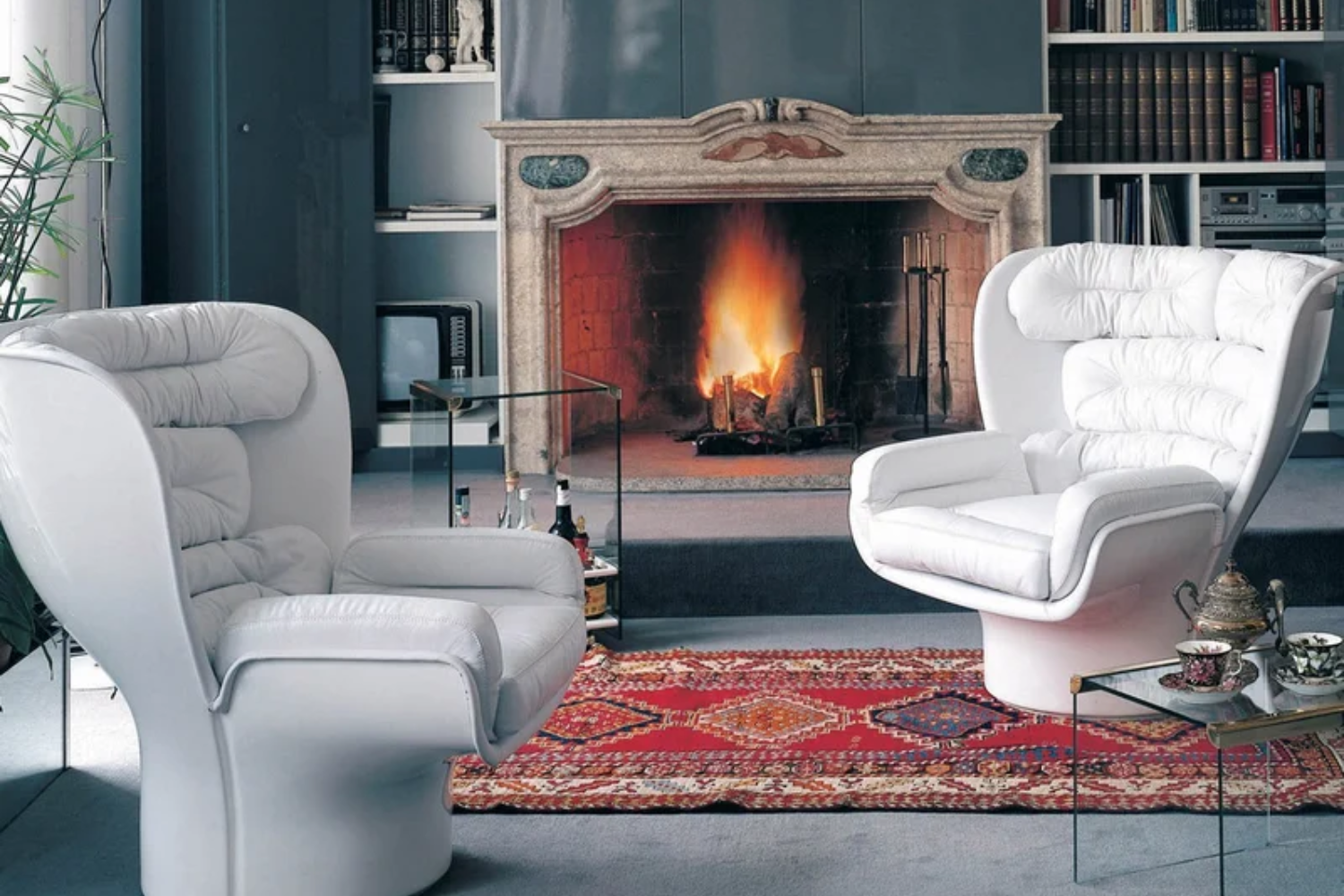
The Elda armchair was designed in 1963 and named after Joe Colombo’s wife. The Vitra Design Museum dates the project to 1963, while Longhi, which still produces the chair today, specifies that production began in 1965.
The structure uses fibreglass-reinforced polyester, while the interior is formed by a sequence of upholstered cushions. The large curved shell rotates on a circular base and envelops the body far more than a conventional armchair.
It is precisely this relationship between shell and individual that makes Elda so significant.
The furniture does more than support the body. It creates a kind of domestic micro-environment around the user, physically establishing a degree of separation from the rest of the room through its high back and enveloping structure.
In this sense, it anticipates a theme that Colombo would develop much further in his later habitats: instead of necessarily building a new wall, the furniture itself can define a space.
Minikitchen: condensing an entire room into a piece of furniture
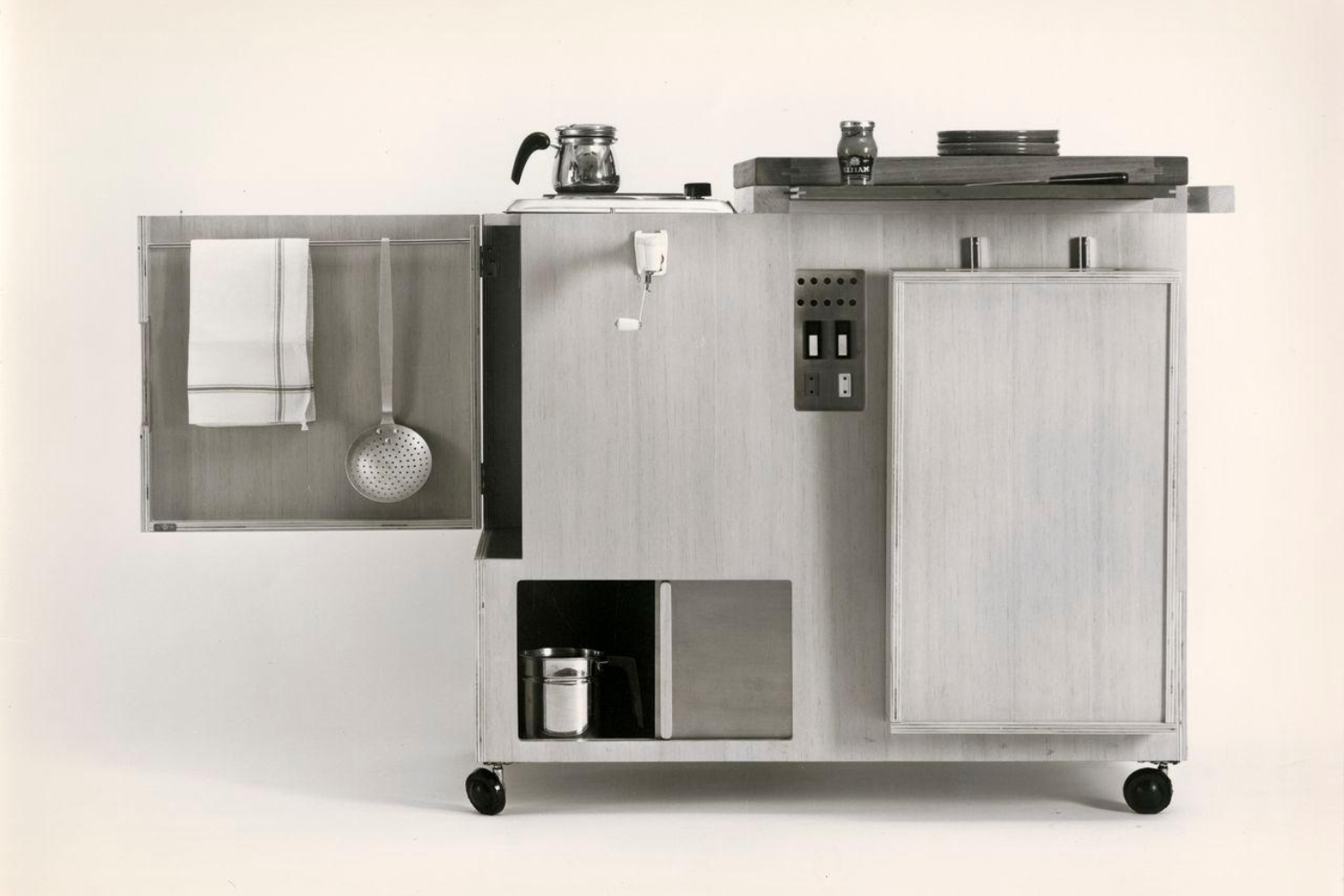
In 1963 Joe Colombo designed the Minikitchen for Boffi, probably one of the clearest projects for understanding his idea of flexible living.
It is a mobile kitchen on wheels that integrates a hob, refrigerator, storage, drawers, pull-out worktop, electrical sockets and other functions required for food preparation within a single volume. MoMA holds a 1963 Minikitchen in its collection; Boffi continues to produce the design and has also developed a contemporary version for covered outdoor environments.
Here, the concept matters more than compactness.
Colombo does not simply design a small kitchen: he separates the kitchen function from the kitchen room.
The unit can be moved and, when not in use, closed. A domestic function therefore becomes a mobile, self-contained piece of equipment.
It is entirely consistent with the kind of home Colombo was imagining: less dependent on specialised rooms and more reliant on systems that could be reconfigured.
Minikitchen received a silver medal at the XIII Triennale di Milano in 1964 and was later exhibited in MoMA’s 1972 exhibition Italy: The New Domestic Landscape. In 2022, ADI also awarded it the Compasso d’Oro Product Career Award.
Universale: designing a chair through industrial production
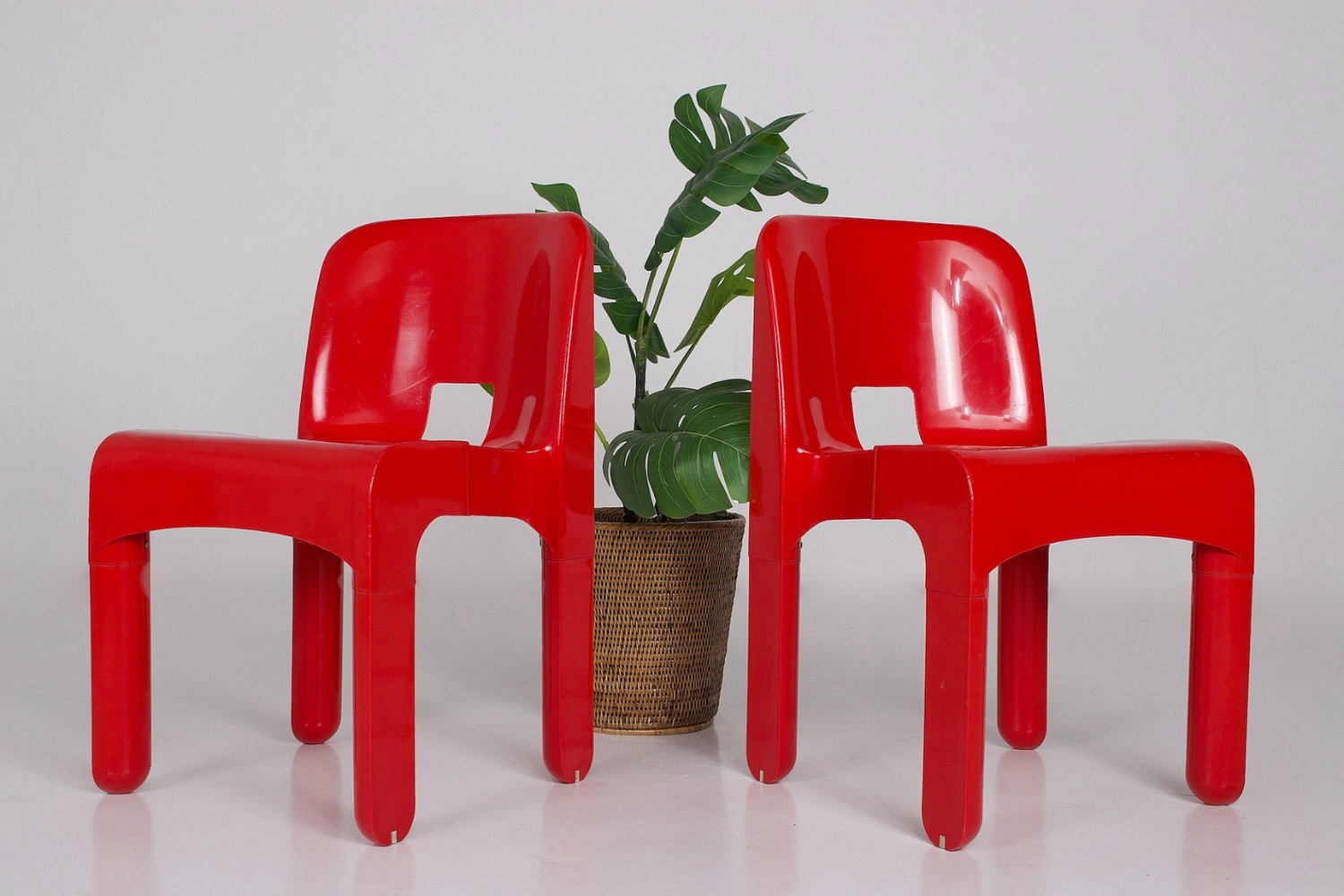
Between 1965 and 1967, Colombo developed the Universale chair for Kartell, also identified as model 4867.
The Design Museum in London describes it as a stackable chair in injection-moulded ABS plastic, emerging from Colombo’s research into the possibility of producing a seat through a highly integrated industrial process. The Vitra Design Museum records Universale as a 1965 design.
Here, the research differs from Elda.
Elda creates a space around the body through a large enveloping shell; Universale instead focuses on repeatability, stackability and serial production.
The design demonstrates how central industrial technologies were to Colombo’s work. Plastic does not imitate wood or attempt to reproduce the language of earlier materials: it is used to create an object consistent with its own production possibilities.
Tube Chair: when an armchair no longer has a fixed form
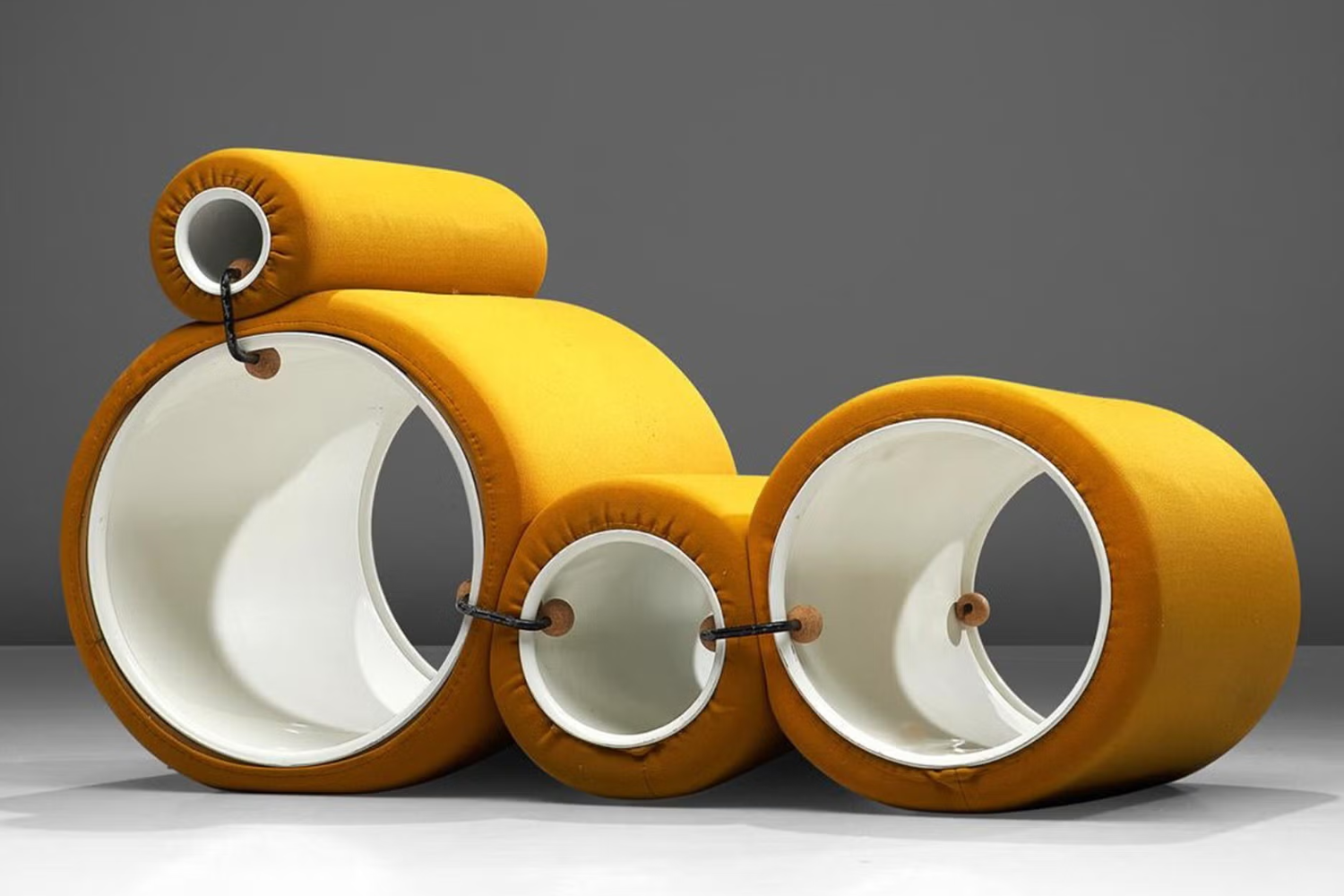
The Tube Chair, designed in 1969, brings modularity directly into the structure of the seat.
Cappellini, which now produces the re-edition, describes it as a system composed of four hollow cylinders of different sizes, interchangeable and connectable through metal hooks. The elements can be assembled in different configurations or nested inside one another to reduce their footprint. MoMA dates its example to 1969–1970 and documents materials including PVC plastic, polyurethane foam and fabric.
Few objects represent Colombo’s thinking more clearly.
A traditional armchair is designed to assume a defined configuration and retain it. Tube Chair introduces a variable instead: the configuration can be determined by the user.
The final form no longer belongs entirely to the designer.
This shift is fundamental because it moves part of the design towards behaviour. The furniture does not simply prescribe how to sit; it provides a framework within which the way it is used can be modified.
Boby: when storage becomes mobile and accessible from multiple sides
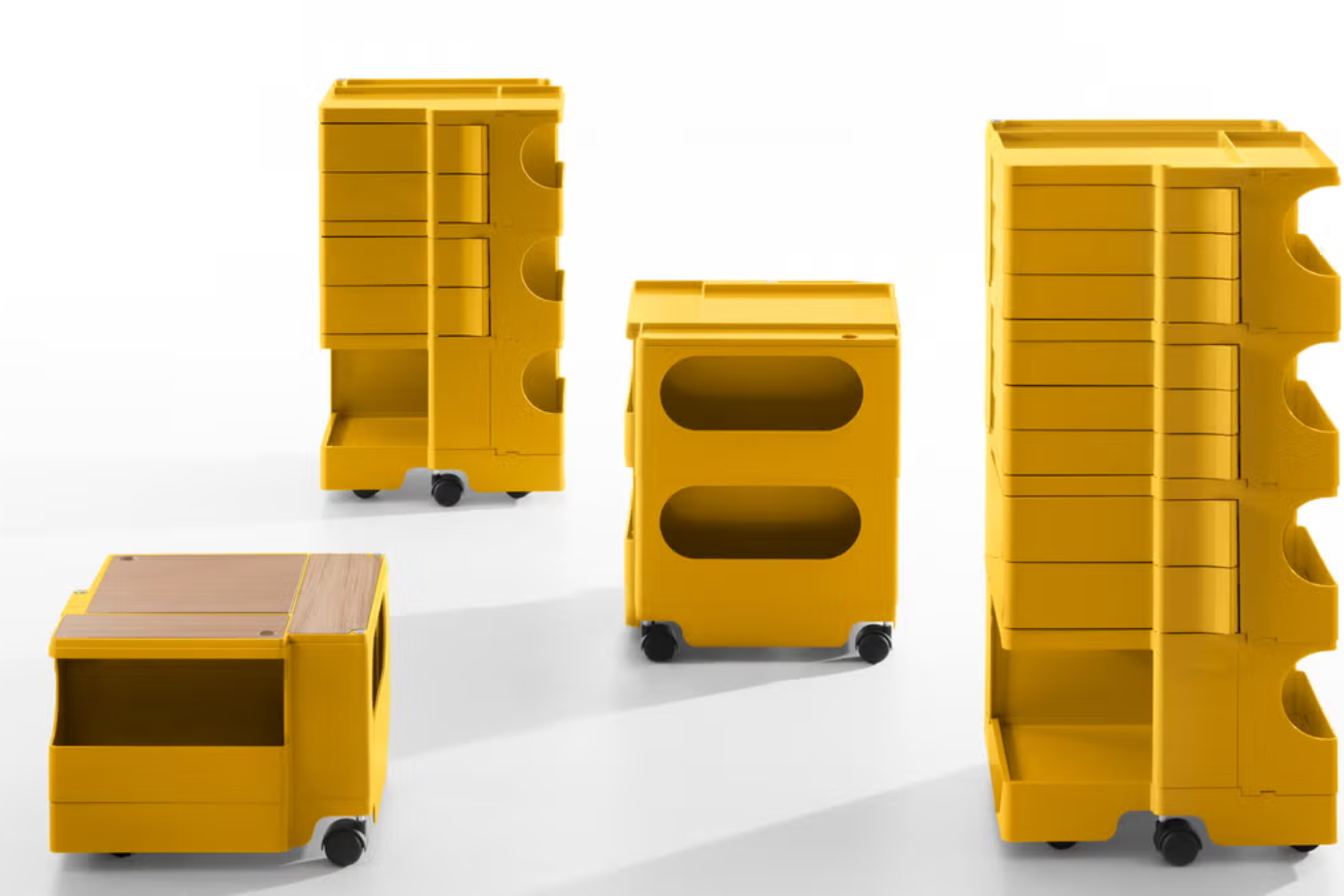
A similar principle appears in Boby, the storage trolley that B-Line dates to 1970 and continues to produce in 2026. MoMA holds a Boby 3 dated 1969, indicating the development phase immediately before the commercial production documented by the current manufacturer.
Boby is built around injection-moulded ABS drawers and compartments, arranged vertically, and uses polypropylene castors to allow movement. B-Line still emphasises its versatility across creative, healthcare and domestic environments.
It may appear much less futuristic than Tube Chair, yet it is perhaps even more directly connected with contemporary life.
Storage no longer necessarily belongs against the wall. It follows the activity.
It can sit beside a desk, move next to a table, enter a studio or be used in a healthcare environment. Mobility becomes part of the function itself.
From furniture to the home of the future: Visiona 1 and living systems
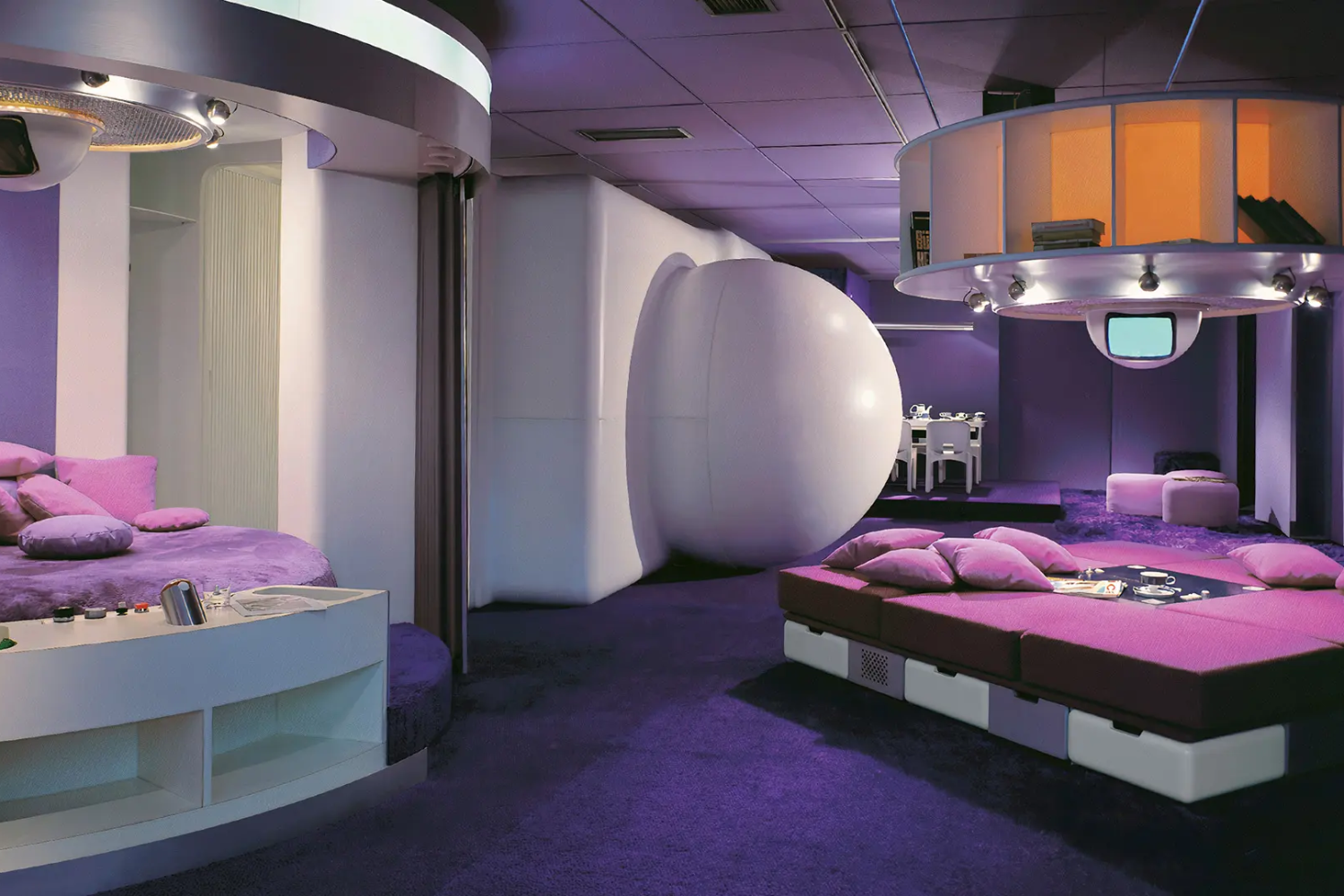
By the end of the 1960s, Colombo was moving increasingly clearly from product design towards what he defined as the total domestic environment.
In 1969 he presented Visiona 1 for Bayer, an experimental habitat in which the subject was no longer the individual chair but the overall organisation of everyday life. The SIUSA archive records Visiona 1 as a proposal for a futuristic habitat and connects this phase with the later Total Furnishing Unit.
At the same time, he developed systems such as Rotoliving and other equipped units designed to concentrate several functions within autonomous elements.
The objective becomes clear: reducing the dependence of domestic life on a permanent architectural floor plan.
Instead of imagining a house divided rigidly into living room, bedroom, study and kitchen, Colombo conceived elements capable of activating different functions within a freer space.
Total Furnishing Unit: when furniture becomes domestic infrastructure
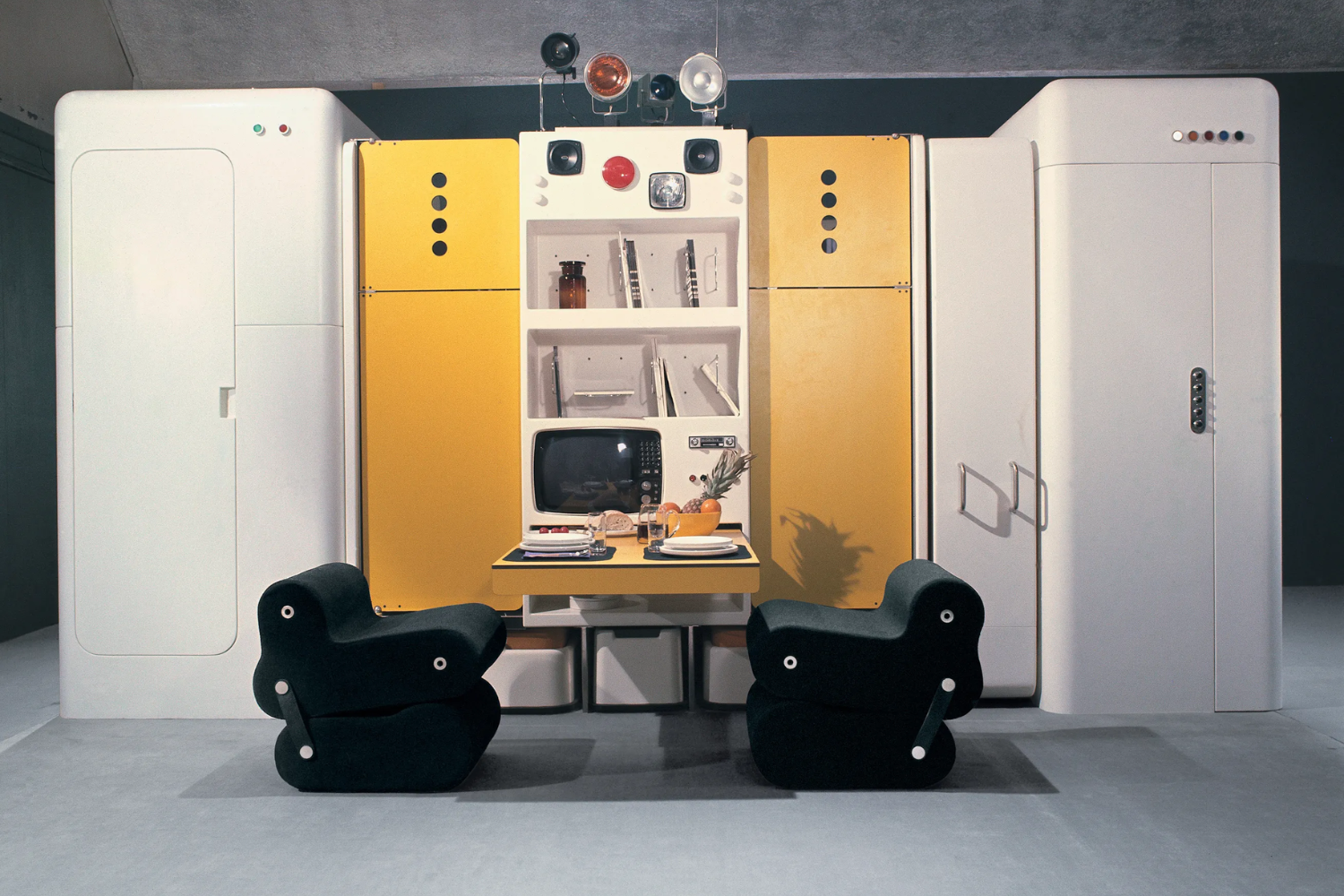
The research reaches its most radical point with the Total Furnishing Unit, designed by Joe Colombo with the collaboration of architect Ignazia Favata and presented posthumously at the Museum of Modern Art in 1972 for the exhibition Italy: The New Domestic Landscape, curated by Emilio Ambasz. Colombo had died the previous year.
The original MoMA documentation describes four independent volumes.
The central unit incorporates two beds and a table on wheels beneath a raised floor, while containing two small private spaces above. The other elements consist of a mobile wardrobe, a kitchen unit and a bathroom unit. The components can be arranged in different ways within spaces of varying shapes.
At this point, furniture has almost ceased to be furniture in the traditional sense.
It has become infrastructure for living.
Sleeping, working, storage, cooking and bathing are organised through equipped cores, while the surrounding space remains relatively free.
The principle that allowed the four cylinders of Tube Chair to change position is therefore expanded to the scale of the home: the form of the environment can adapt to its functions instead of being permanently established in advance.
Technology and behaviour: why Joe Colombo was genuinely futuristic
It is easy to associate Joe Colombo’s idea of the future with white plastic, rounded forms and Space Age aesthetics.
These elements are real, but they represent only the surface of the issue.
His most radical insight concerned the relationship between technology and domestic behaviour.
Minikitchen assumes that a function can move. Tube Chair assumes that the user can modify the seat. Boby assumes that storage can accompany an activity instead of remaining against a wall. Total Furnishing Unit assumes that even the main functions of a home can be organised through autonomous cores.
MoMA summarises this research through the expressions progressive living solutions and “total domestic environment”, terms that explain Colombo’s project more effectively than the generic label of futurism.
For him, the future meant above all flexibility.
Why Joe Colombo is still relevant in 2026
In 2026, several of his major designs exist well beyond museum collections.
Elda is still produced by Longhi, Tube Chair by Cappellini, Boby by B-Line and Minikitchen by Boffi. The manufacturers’ current product pages keep these designs in contemporary production, while MoMA, Vitra Design Museum and other museums preserve examples in their collections.
Their continued relevance is significant because many of the questions Colombo addressed have become ordinary concerns: open-plan interiors, overlapping functions, working from home, mobile or reconfigurable furniture, compact kitchens and the need to support more activities within a limited surface area.
This does not mean attributing to him a literal prediction of every transformation that followed.
It means recognising that he identified remarkably early a tension that would remain central: architecture changes slowly, while the way we live can change much more quickly.
In his research, furniture serves precisely to bridge this gap.
Joe Colombo and the home as an open system
Viewed separately, Elda, Universale, Boby and Tube Chair might appear above all as icons of 1960s Italian design.
Read together with Minikitchen, Visiona 1 and Total Furnishing Unit, they take on a more precise meaning.
Joe Colombo was progressively shifting design from the object towards the relationship between objects, space and people.
Elda’s shell creates privacy. Minikitchen condenses a room into a mobile volume. Universale uses industrial production to make seating serial and stackable. Tube Chair gives part of the configuration to the user. Boby frees storage from the wall. Total Furnishing Unit turns the main functions of the home into autonomous infrastructures.
The most radical aspect of his work therefore lies less in the science-fiction image of his interiors and more in this idea: a home should be able to change together with the people who live in it.
This is precisely where Joe Colombo continues to speak to contemporary interiors. Not because homes in 2026 necessarily resemble his experimental habitats of the 1960s, but because flexibility, transformability and the intelligent use of space remain open questions in domestic design.