Mid-Century Modern style today refers to a range of design languages developed around the middle of the twentieth century, with particular strength in post-war American design: clean forms, furniture raised from the floor, experimentation with moulded plywood, plastic, metal and glass, and a freer relationship between furniture and space. But reducing it to a formula …
Mid-Century Modern style today refers to a range of design languages developed around the middle of the twentieth century, with particular strength in post-war American design: clean forms, furniture raised from the floor, experimentation with moulded plywood, plastic, metal and glass, and a freer relationship between furniture and space. But reducing it to a formula of walnut, mustard yellow, tapered legs and Sputnik lamps means losing precisely what made that period so interesting. Decorating in a Mid-Century Modern style today means recovering its proportions, lightness, materials and capacity for innovation, introducing a small number of historic pieces or authorised reissues into a contemporary home rather than recreating a 1958 living room.
What Mid-Century Modern really means and which years it covers
The chronological boundaries of Mid-Century Modern are not absolute. The Getty Art & Architecture Thesaurus uses the term to describe trends in architecture, interior design and product design developed approximately between the 1930s and the mid-1960s. In current usage, however, its most immediately recognisable core is associated above all with post-war design culture, from the late 1940s through the 1960s.
The expression we now use to identify that period is itself largely retrospective. The best-known historiographical reference is Cara Greenberg’s book Mid-Century Modern: Furniture of the 1950s, published in the 1980s, which helped establish the category within the language of design. Speaking about Mid-Century Modern as though Charles and Ray Eames, Eero Saarinen, Hans J. Wegner and the Castiglioni brothers consciously belonged to a single “style” therefore risks flattening very different design cultures and experiences.
In the United States, a fundamental part of this research emerged from the encounter between industry, new manufacturing processes and post-war domestic life. The Organic Design in Home Furnishings competition, organised by MoMA in 1940 and presented as an exhibition in 1941, awarded Charles Eames and Eero Saarinen for experiments that sought to integrate structure, material, function and form. After the war, Charles and Ray Eames continued this research through moulded plywood, fibreglass, metal and systems intended for industrial production.
Mid-Century Modern, Scandinavian Modern and vintage are not synonyms
A home furnished with pieces from the 1950s is not automatically Mid-Century Modern, just as a teak cabinet bought at a flea market does not become “Danish Modern” simply because it has slender legs.
Scandinavian Modernism has its own independent history. The Metropolitan Museum notes that as early as the 1930s, Nordic designers were softening the severity of some forms of International Modernism through natural materials, organic forms and greater attention to the human body. Alvar Aalto experimented with bent wood well before the rise of post-war American design; during the 1950s, the Danish tradition further developed the relationship between craftsmanship, ergonomics and modern production.
The CH24 Wishbone Chair by Hans J. Wegner, designed in 1949 and produced by Carl Hansen & Søn since 1950, is a perfect example. Today it frequently appears in interiors described as Mid-Century Modern, but historically it is first and foremost a landmark of Danish Modern: its timber frame, Y-shaped backrest and paper-cord seat emerge from research deeply rooted in Danish furniture culture.
“Vintage”, meanwhile, simply describes a relationship with an earlier period and does not identify a specific design philosophy. An anonymous sideboard made in 1962 can be genuinely vintage without necessarily representing an important example of mid-century modernism.
The characteristics of Mid-Century Modern style that still work today
Rather than copying a series of objects, it is more useful to recognise a number of recurring principles.
The first is visual lightness. Many pieces are raised from the floor and use slender structures or bases that reduce their perceived bulk. The result allows the eye to move freely through the room and makes each piece legible as an object within space.
The second is the meeting of geometry and organic forms. The period is not dominated exclusively by strict rectangles: enveloping shells, biomorphic tops, curves and sculptural bases coexist with orthogonal structures.
The third is an interest in industrial materials treated as design tools, rather than merely as inexpensive substitutes. The Eameses experimented with plywood, fibreglass and aluminium; Saarinen explored the possibility of achieving continuous forms; Noguchi transferred a sculptural sensibility into furniture. The Met highlights how new materials and manufacturing processes generated new aesthetics in post-war design.
Timber, colours and materials: why Mid-Century Modern is not all walnut and mustard
Timber remains fundamental, but there is no single species required to create a coherent interior.
Walnut, teak, oak, rosewood in historic production, ash and different veneers can appear alongside metal, glass, plastic and stone. The real characteristic is often the legibility of the material and its construction.
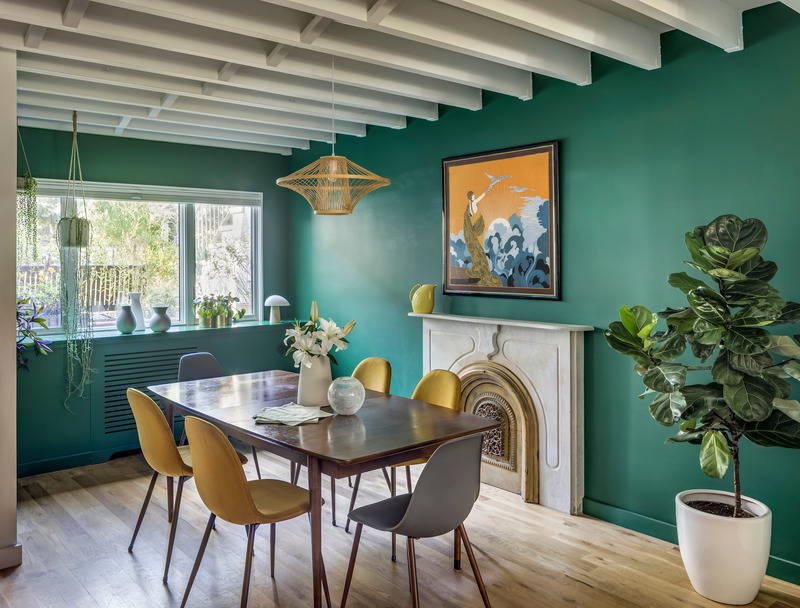
The same applies to colour. Reducing Mid-Century Modern to a combination of mustard yellow, olive green and burnt orange is a contemporary reinterpretation far more rigid than the historical reality.
The textiles designed by Alexander Girard for Herman Miller from the 1950s onwards demonstrate precisely the opposite: intense colours, geometry, graphic patterns and references to folk art coexisted with extremely pared-back modernist furniture. The Metropolitan Museum holds hundreds of samples documenting this broad chromatic range.
For a contemporary home, a neutral base with a single red or blue element can work just as well as earth tones, greens, yellows or more graphic combinations. The palette should belong to the architecture of the home, not to a stereotyped image of the 1960s.
Five pieces that explain Mid-Century Modern better than a retro moodboard
A selection of key designs makes it easier to understand how different the period’s directions of research actually were.
| Design | Designer | Year | Why it matters |
|---|---|---|---|
| Noguchi Coffee Table | Isamu Noguchi | 1944 | Transforms a biomorphic and sculptural language into a table with a timber base and glass top. |
| Eames Plastic Chairs | Charles & Ray Eames | 1950 | Extend research into single-shell seating and new materials towards an industrial chair adaptable to different bases. |
| CH24 Wishbone Chair | Hans J. Wegner | 1949–1950 | Represents Danish Modern and demonstrates the meeting of woodworking, comfort and essential form. |
| Eames Lounge Chair & Ottoman | Charles & Ray Eames | 1956 | Reinterprets the traditional club chair through moulded timber shells and upholstered cushions. |
| Tulip Chair | Eero Saarinen | 1957 | Reduces the chair structure to a single pedestal and addresses the visual clutter of multiple legs beneath a table. |
None of these objects requires the entire room to belong to the same period.
In fact, a single historic piece often becomes more powerful when it is not surrounded by ten other design classics.
From America to Europe: why not all 1960s design is Mid-Century Modern
The category becomes even more problematic when it is applied indiscriminately across Europe.
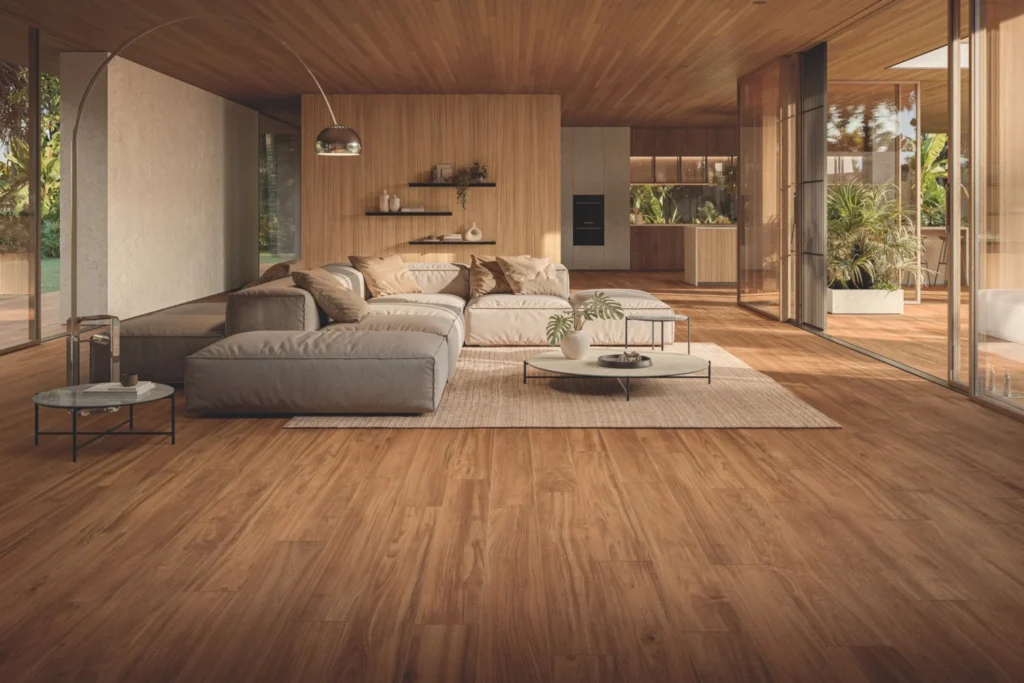
The Arco lamp, designed in 1962 by Achille and Pier Giacomo Castiglioni for Flos, belongs chronologically to the same period but emerged from the specific culture of Italian industrial design. Its Carrara marble base, telescopic steel stem and large arch allow light to be positioned over a table without requiring a ceiling connection. According to Flos documentation, the design developed from observing street lighting.
Placing Arco in a contemporary Mid-Century interior can work perfectly well. Historically, however, it is more accurate to recognise the meeting of different modernisms from the same period rather than turning every object produced between 1945 and 1965 into Mid-Century Modern.
Vintage original or authorised reissue: what is the difference?
Many major designs from the period are still in production or have been reissued by manufacturers working with archives and foundations.
The Eames Lounge Chair & Ottoman has been produced by Herman Miller since 1956. The CH24 has remained in continuous production with Carl Hansen & Søn since 1950. Knoll continues to produce Saarinen’s Tulip Collection, dating from 1957. Since 2002, Vitra has produced reissues of Isamu Noguchi designs in collaboration with the Isamu Noguchi Foundation and today also offers the 1944 Coffee Table.
An authorised reissue is therefore not a second-rate copy: it can be the most coherent way to acquire a historic design with production, materials and documentation controlled by the current manufacturer.
With vintage pieces, however, provenance, maker’s marks, labels, alterations and condition all become important. Before buying a piece attributed to a major designer, it is worth verifying the manufacturer associated with that specific edition, because the same design may have different production histories across markets and periods.
How to introduce Mid-Century Modern into a contemporary home
The most effective approach is to start with the home you already have.
A historic apartment with parquet flooring and mouldings can accommodate a 1950s lounge chair without removing earlier architectural elements. A minimalist interior can gain depth through a timber sideboard and sculptural lamp. A recently built home can use a Saarinen table as a contrast to a highly linear contemporary kitchen.
Paradoxically, one of the best antidotes to the revival effect comes from the Eames House, completed in 1949 as Case Study House #8.
The interior inhabited by Charles and Ray Eames was not a sterile showroom filled exclusively with their own furniture. The house contained books, textiles, plants, modern art, folk objects and artefacts from different cultures. The Eames Foundation still preserves this layering, while documentation of the Herman Miller showroom designed by the Eames Office in 1950 demonstrates a similar approach: modern furniture coexisted with kites, shells, plants, sculptures and collected objects.
Authentic Mid-Century interiors were therefore far less “coordinated” than many contemporary imitations suggest.
Mid-Century Modern room by room
In the living room
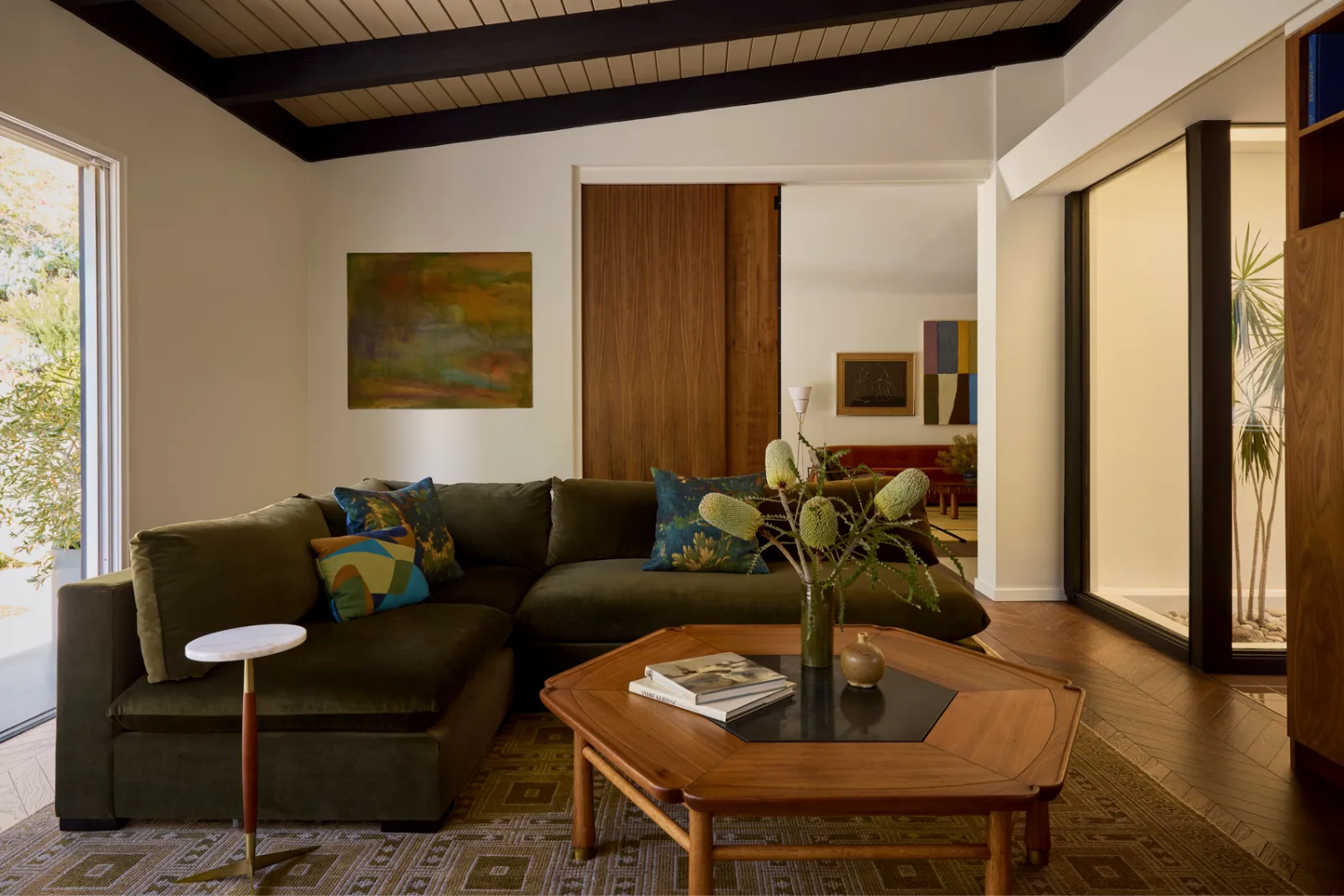
This is the room where the language is easiest to use, but also where it is easiest to overdo it.
One important lounge chair, a sculptural coffee table or a low sideboard can be enough. The sofa does not necessarily need to be vintage: a restrained contemporary model can create a more convincing contrast than an entire composition bought to look period-correct.
In the dining room
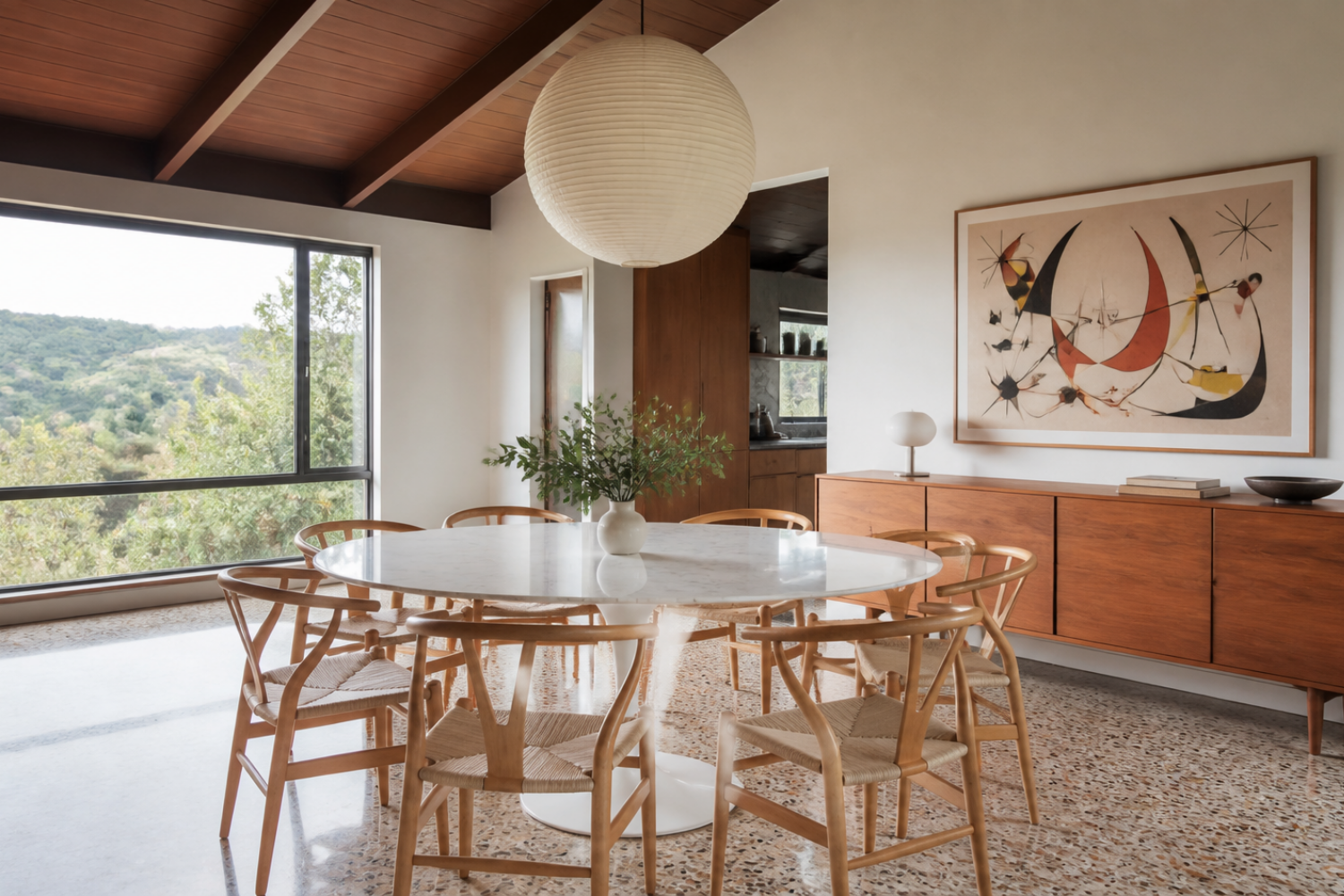
Here, it is particularly useful to work on the relationship between table and chairs.
A Saarinen-inspired pedestal table can visually lighten the dining area, while timber chairs connected to the Danish tradition introduce a more tactile quality. The table and chairs do not need to belong to the same designer or even the same decade.
In the bedroom
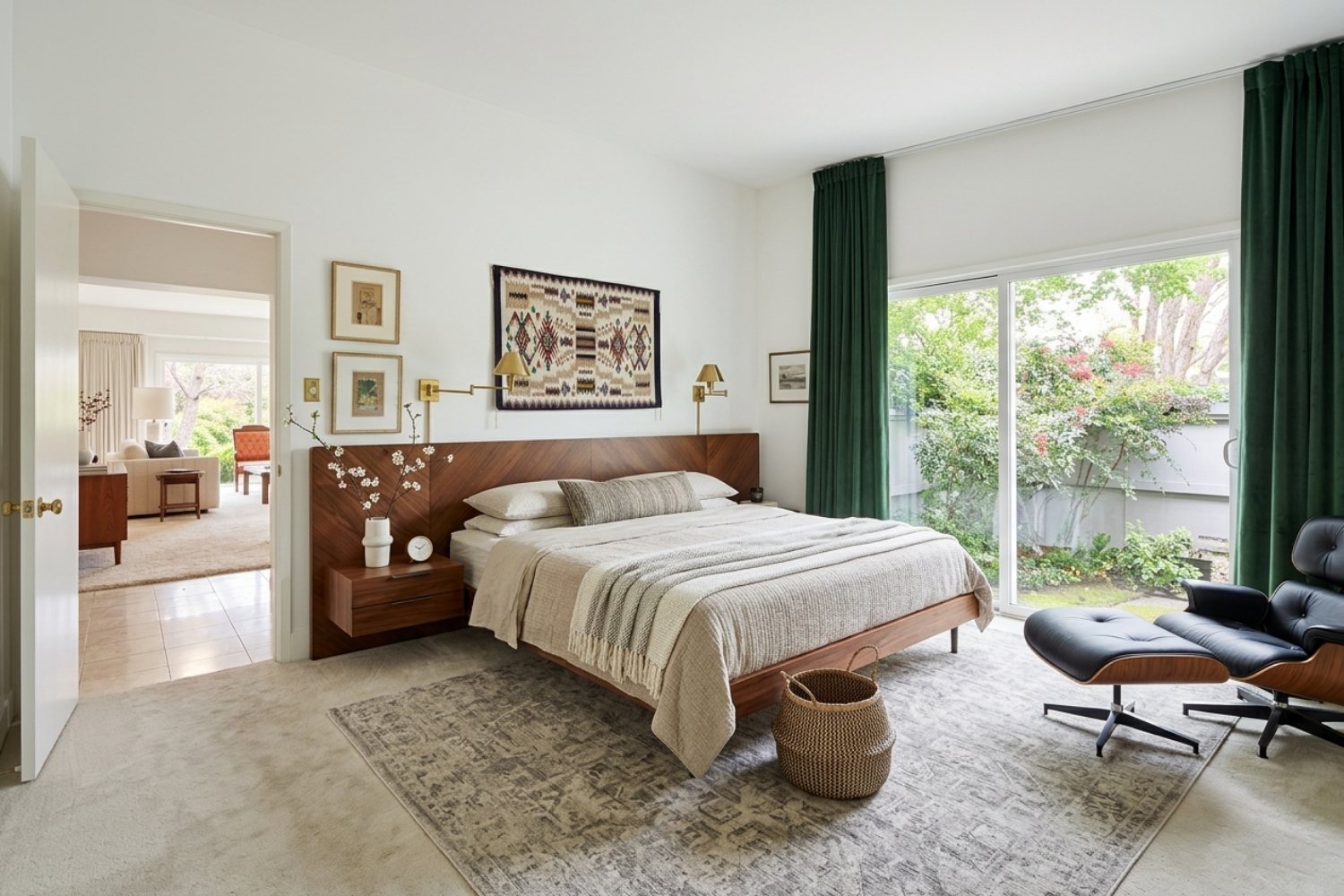
It is better to keep the references restrained.
A low timber chest of drawers, two geometric lamps or a small armchair can evoke the period without turning the room into a retro hotel. Contemporary textiles and simple walls help keep the contrast clear.
In the kitchen
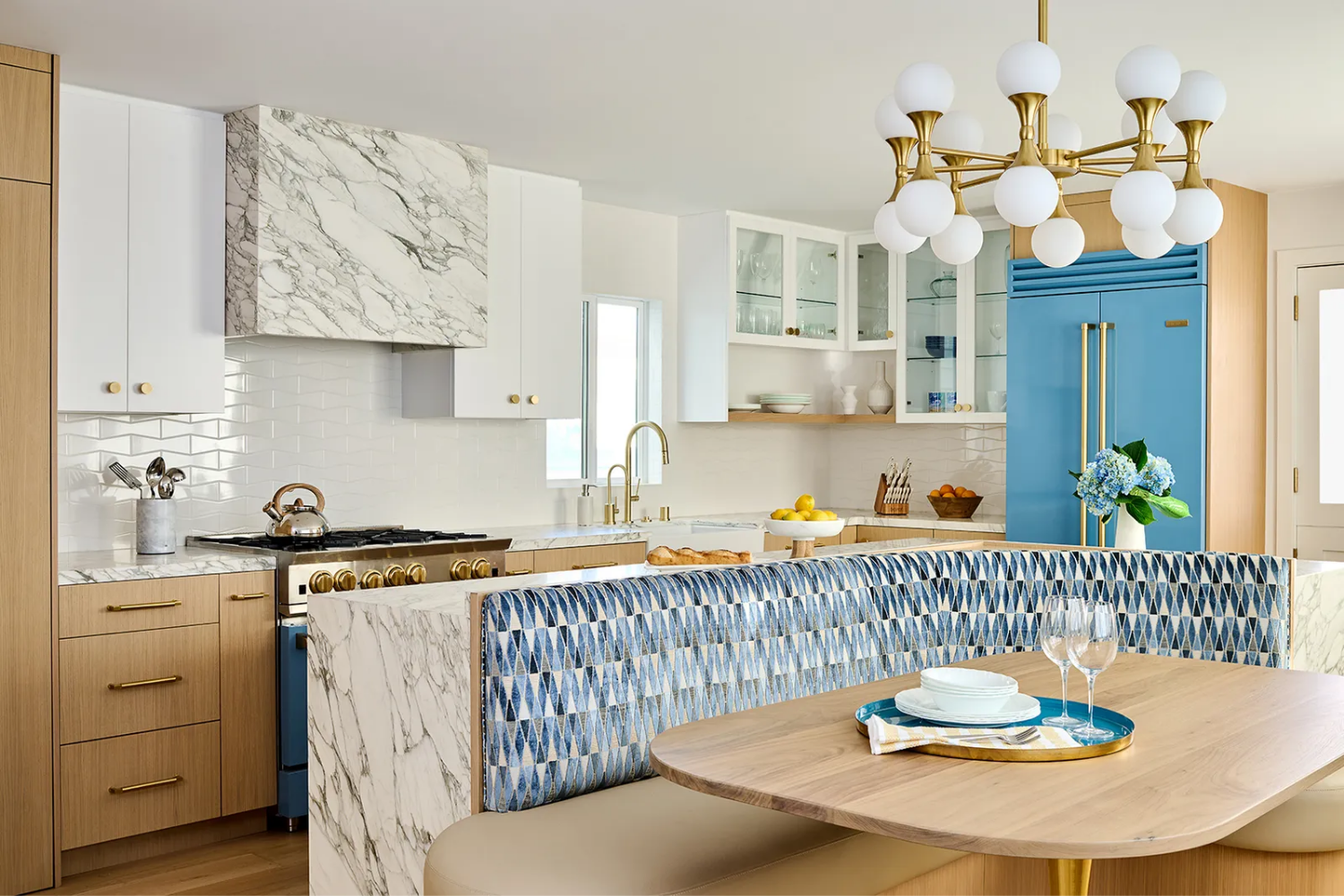
An entirely “1950s-style” kitchen is probably the quickest route to a theatrical revival effect.
It is more interesting to introduce stools, lighting, handles or a historic table into a contemporary design while retaining current technology and ergonomics.
Mistakes that turn Mid-Century Modern into a retro set
The first is buying every piece of furniture with tapered, angled legs. A construction detail becomes a caricature when repeated obsessively.
The second is using walnut, orange, olive green, mustard yellow and geometric patterns all at once simply because they are associated with the 1960s.
The third is filling the home with design icons. Five classics grouped in the same corner can look more like a showroom than a lived-in interior.
The fourth is calling every vintage piece produced in the 1950s or 1960s Mid-Century Modern, erasing distinctions between American design, Danish Modern, Italian Modernism and anonymous production.
The fifth is prioritising aesthetics over scale. Many historic chairs and sideboards have very specific proportions: checking their dimensions, comfort and relationship with the room is more important than remaining faithful to a moodboard.
The sixth is forgetting what made that period interesting in the first place: the determination to design for its own present.
Mid-Century Modern style still works when approached with the same freedom that the best designers of the period brought to materials, industry and domestic life. An Eames Lounge Chair can coexist with contemporary art; a CH24 with a recently designed table; Arco with a sofa created sixty years later.
The result becomes more convincing when the 1950s and 1960s represent one layer of the home rather than the script for the entire interior. This is perhaps the most coherent way to use that heritage today: not by imitating the past, but by allowing some of its designs to continue doing what they were created to do — live in the present.