From 21 November 2026 to 6 January 2027, the Marché Vert Noël in Piazza Chanoux: dates, hours, Aosta Valley woodcraft and a route through the Roman theatre, the Porta Praetoria and the cloister of Sant’Orso.
Aosta is the only Alpine Christmas market town built on a Roman plan you can still read: the Marché Vert Noël is shopped among the chalets of Piazza Chanoux, but it is understood by walking on to the façade of the Roman theatre and the cloister of Sant’Orso, where the stone is two thousand years old and woodwork is still a trade.
The Aosta Christmas market, the Marché Vert Noël, opens on Saturday 21 November 2026 and runs until Wednesday 6 January 2027, daily from 10am to 8pm, in Piazza Chanoux at the heart of the historic centre. The opening ceremony is on Friday 20 November at 6pm. It is organised by the Comune di Aosta, which has gathered the market into a single Alpine village of wooden chalets in the city’s main square.
Our editors see Aosta as a lesson in urban planning. The orthogonal grid of Augusta Praetoria, founded in 25 BC, still shapes the streets of the centre, and every walk between the stalls ends up crossing a gate, an arch or a stretch of wall. Few Christmas markets in Europe take place inside a perimeter laid out by Roman engineers.
When does the Aosta Christmas market open in 2026?
The 2026 Marché Vert Noël opens to the public on Saturday 21 November, after the inauguration on Friday 20 November at 6pm, and closes on Wednesday 6 January 2027. It opens every day, Christmas Day and New Year’s Day included, with shorter hours on those two dates.
| Information | 2026/27 edition |
|---|---|
| Dates | 21 November 2026 to 6 January 2027 |
| Inauguration | Friday 20 November 2026, 6pm |
| Opening hours | Daily, 10am to 8pm |
| Exceptions | 25 December 3pm to 8pm; 1 January 11am to 8pm |
| Where | Piazza Chanoux, Aosta historic centre |
| Getting there | By train: Aosta station is a few minutes’ walk from Piazza Chanoux; free entry |
Where is the market and how is it laid out?
The market turns Piazza Chanoux into an Alpine village of timber chalets, each roughly three metres by two metres forty, split between artisans and producers, sellers of gifts, food stalls and places to eat and drink. The council’s call for exhibitors draws a clear line between the three categories, and it shows: the food area does not spill into the crafts, and the square stays legible.
Concentrating everything in a single space is an interesting urban choice. Piazza Chanoux is the city’s civic square, overlooked by the town hall, and with the chalets in place it becomes a kind of winter courtyard. The rest of the centre, Roman monuments included, stays clear and is a few minutes away on foot, which makes it easy to alternate shopping and sightseeing.
What makes the Aosta Christmas market different?
Here woodwork is not a seasonal ornament but a tradition documented for centuries. Every year on 30 and 31 January Aosta hosts the Fiera di Sant’Orso, born in the Middle Ages around the collegiate church and now spread across the entire centre, with around a thousand exhibitors from the Aosta Valley: wood sculpture and inlay, soapstone, wrought iron, leather, drap woven on old wooden looms, lace, wicker, ladders and casks. In 2027 the fair returns on the same dates, 30 and 31 January, with the Veillà, the festive night that keeps the streets lit and busy until dawn.
The December market is, in a sense, a preview of that fair. Among the chalets you will find Aosta Valley woodcarvers giving demonstrations, alongside local food and wine, vintage pieces and decorations. Design lovers can read here the continuity between an artisan know how and a culture of materials that contemporary design has rediscovered.
Which architecture should you see in Aosta during the market?
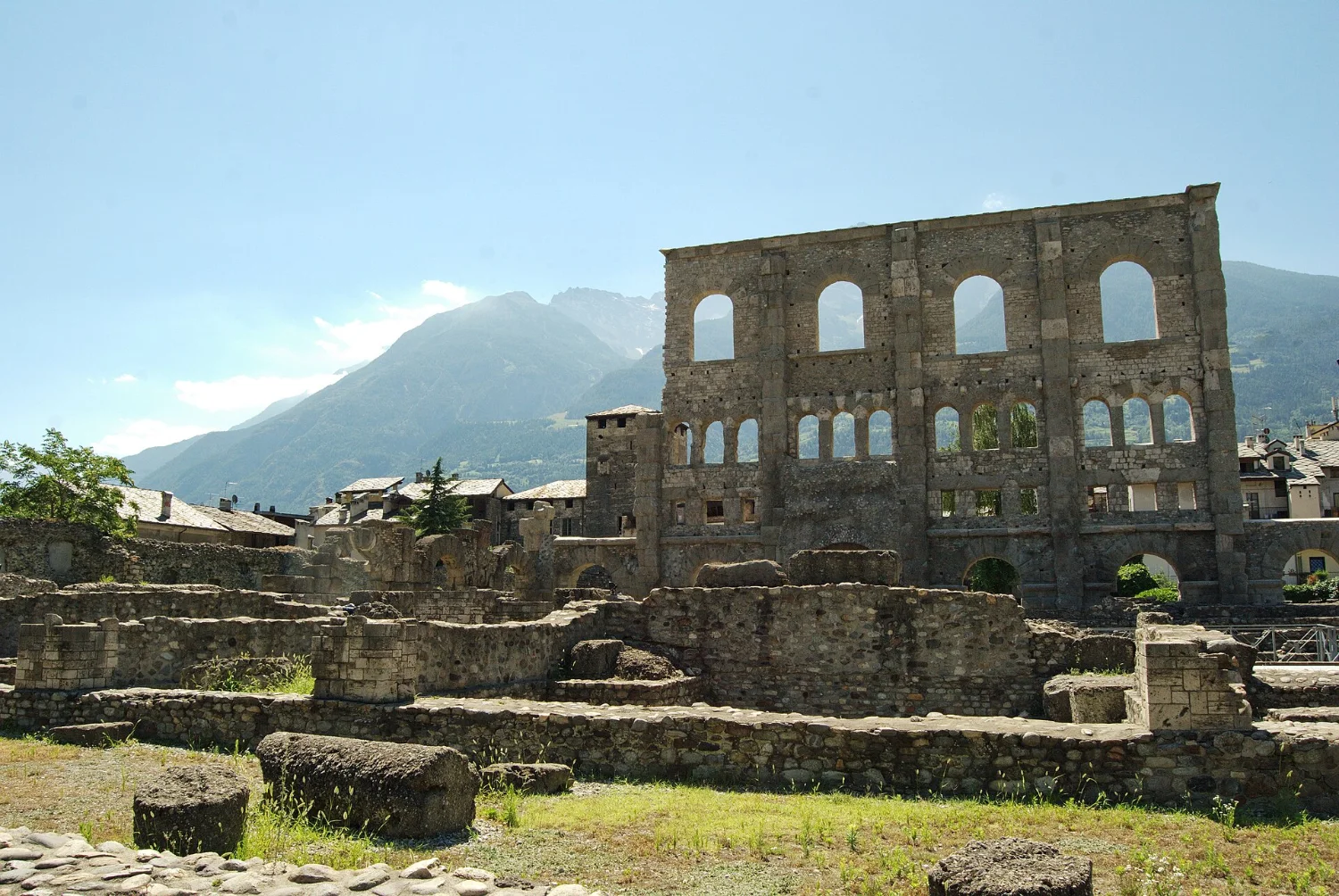
The first stop is the Roman theatre, whose 22 metre façade, punctuated by tiers of superimposed arches, remains one of the most striking ancient frontages in the Alps. Seen in winter, in the raking light of late afternoon, it is a lesson in structure and rhythm: a load bearing wall that is also a composition. Our advice is to walk there from Piazza Chanoux and let the Roman city reveal itself street by street.
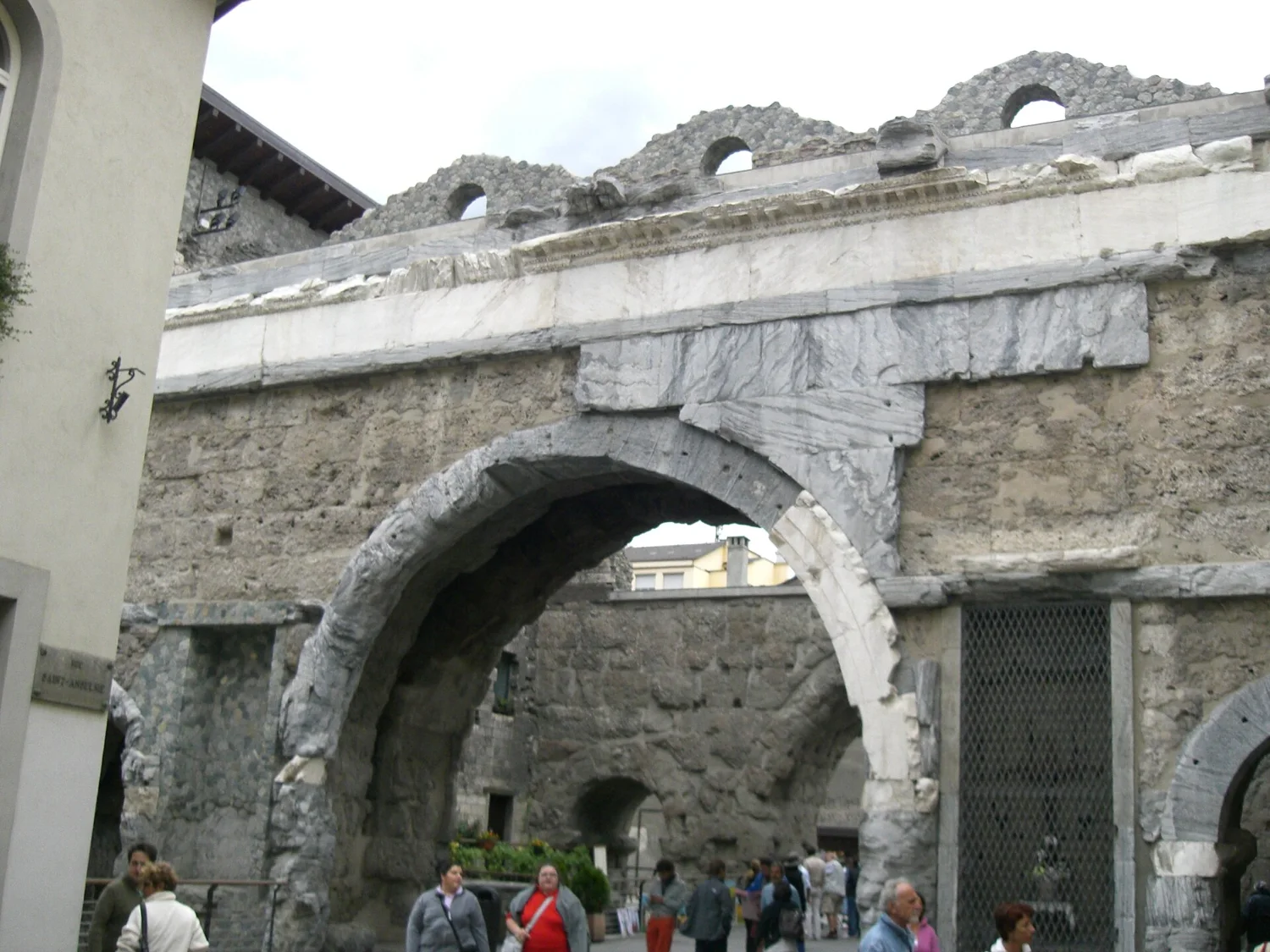
A little further east stands the Porta Praetoria, the main entrance to the ancient city on the eastern side of the walls, and beyond the Buthier stream the Arch of Augustus, dedicated to the emperor. The walls traced a rectangle of 727 by 574 metres, faced on the outside with travertine blocks. Next to the cathedral, the forum cryptoporticus, an Augustan underground gallery of powerful arches, completes the picture; its purpose is still debated, though it probably helped contain and level the sloping ground.
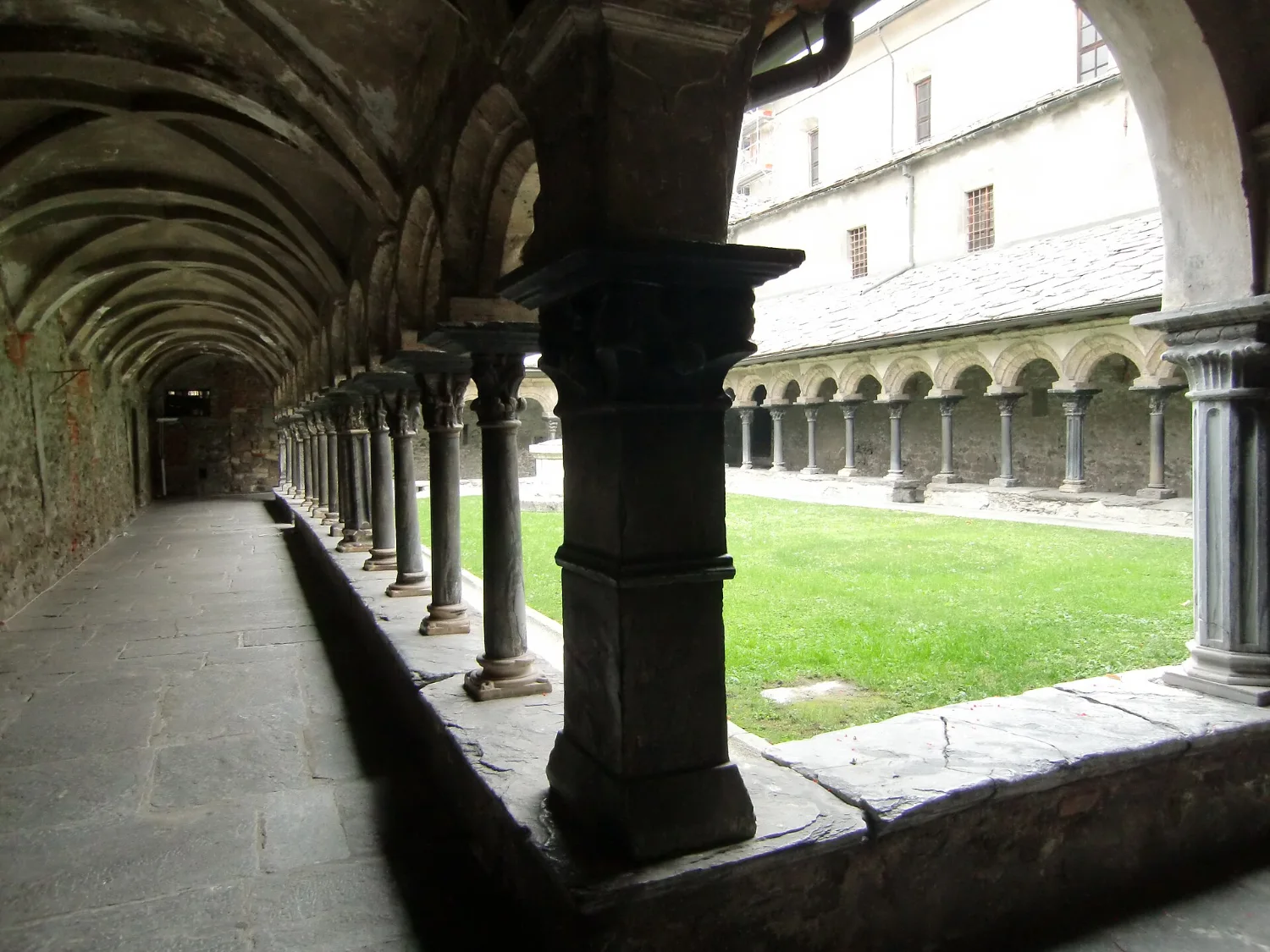
The medieval chapter is the Collegiate Church of Sant’Orso. Its Romanesque bell tower, 44 metres high and dated to 1131, was partly built with large blocks salvaged from the Roman walls, an early example of what we would now call circular construction. The cloister, begun in 1133, keeps 40 of its original 52 capitals in Aymavilles marble, while a fragmentary cycle of early eleventh century frescoes survives in the church’s roof space. This is where the Fiera di Sant’Orso began, and it neatly closes a route that runs from ancient stone to present day timber.
What should you buy at the Aosta Christmas market?
Wood is the highlight: sculptures, carved and turned pieces, stylised toys, household utensils. Alongside them you will find Aosta Valley food and wine, vintage objects, Nordic style goods and Christmas decorations. Our editors suggest stopping to watch the carvers at work, since seeing an object take shape is the quickest way to tell craftsmanship from souvenirs.
The test is a designer’s one: honest material, a recognisable wood, visible making, a form that holds up away from the festive setting. A carved bowl, a pair of wooden sabots or a length of drap all pass. Mass produced souvenirs, even wooden ones, rarely do. If you want to invest in a signed piece, come back at the end of January for the Fiera di Sant’Orso.
Where should design lovers stay in Aosta?
On the hillside above the city, at Località Porossan Roppoz 15, Hotel Milleluci was created in 1961 by converting the family farm. Stone and timber, period furniture and rural details define the interiors, and the spa has an outdoor pool shaped like an Alpine lake; the name comes from the sea of city lights visible at night, with Monte Emilius behind. The historic centre is a few minutes away.
For similar experiences elsewhere, our edit of design hotels immersed in nature and our selection of Italian country houses offer plenty of alternatives. For a contrast between Alpine and urban Christmas, our guide to the Milan Christmas markets describes the exact opposite of Aosta, while the Bruneck and Sterzing markets are its closest relatives in scale.
Frequently asked questions about the Aosta Christmas market
When does the Aosta Christmas market open in 2026?
The Marché Vert Noël opens on Saturday 21 November 2026, after the inauguration on Friday 20 November at 6pm, and stays open until 6 January 2027.
What are the Marché Vert Noël opening hours?
Daily from 10am to 8pm. On 25 December it opens at 3pm and on 1 January at 11am.
Is the market open on and after Christmas Day?
Yes. It opens on 25 December from 3pm to 8pm and continues through to Epiphany with no closing days.
Where is the Aosta Christmas market?
In Piazza Chanoux, the main square of the historic centre, within walking distance of the railway station. The Roman theatre, the Porta Praetoria and Sant’Orso are a few minutes away.
How many days do you need for Aosta at Christmas?
One day covers the market and the main Roman monuments. Add the Collegiate Church of Sant’Orso and the cryptoporticus and we recommend a weekend.
Official information is published on the regional tourism portal, Lovevda, which also covers the Fiera di Sant’Orso, and on the website of the Comune di Aosta, which organises the market.