Founded by Caline Chagoury-Moudaber, the new Lagos studio combines two venues, production and curation. Its debut show, The Design Institute, puts manufacturing, materials and the circulation of West African design at its center.
Founded by Caline Chagoury-Moudaber, the new studio brings together two venues, production and curation. The Design Institute puts manufacturing, materials and the circulation of West African design front and center.
Casa Mouda has opened in Lagos, Nigeria: a creative studio spread across two locations that sets out to close a gap often invisible at the big international design shows—the distance between the quality of an idea and the conditions needed to produce it, tell its story and get it into circulation. The news here is not the announcement of the project, released on September 9, but its actual debut, documented on November 9 by Wallpaper*. The distinction matters, because it means we can now look not just at a program on paper, but at spaces, objects and relationships that have already been put to the test.
Founded by art and design entrepreneur Caline Chagoury-Moudaber, Casa Mouda grows out of Art Twenty One, the space she opened in 2013, and takes on a broader form. It is not a traditional gallery but a platform with the stated aim of producing, promoting and supporting contemporary design. Its opening show, The Design Institute, brings together West African designers, makers from the diaspora and practices spanning furniture, lighting, glass, weaving and applied art.
Two venues, two ways of encountering design
Casa Mouda is split between AiMe Gallery, inside the Eko Hotel, and AiMe Concept, overlooking the Eko Atlantic Marina. The first space was reworked with input from architect Papa Omotayo of MOE+AA; the second was developed in collaboration with Gemma Sfeir and Nifemi Marcus-Bello. The two are not interchangeable. AiMe Gallery offers a tighter exhibition sequence, while AiMe Concept is conceived as a hybrid venue for events, experimentation and outdoor installations.
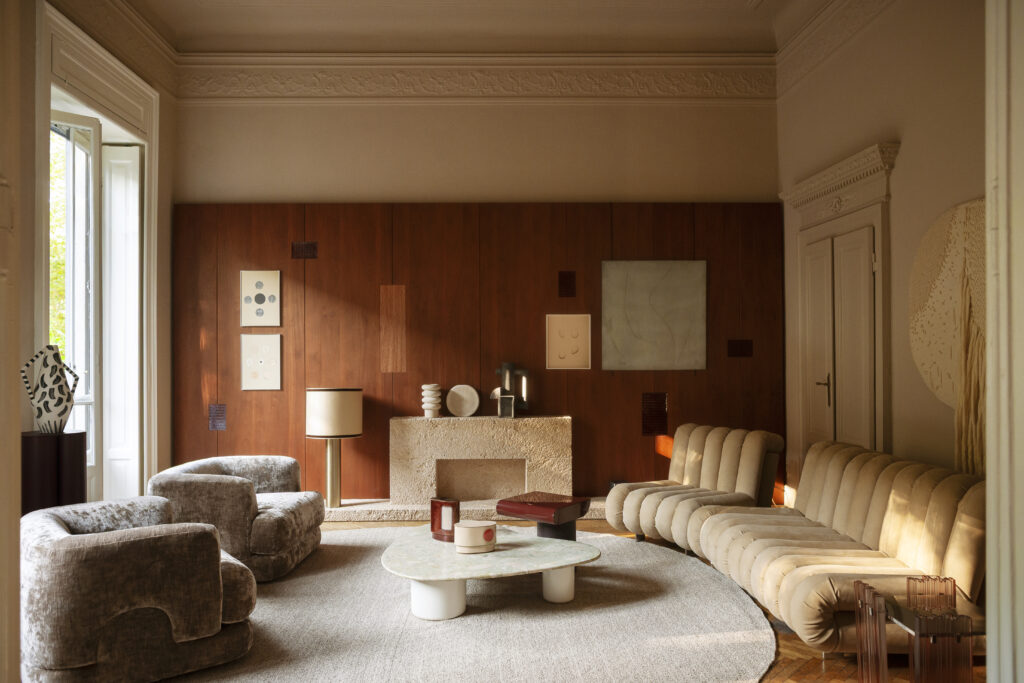
The difference also shows in the display. Objects are not isolated as self-contained pieces but arranged into domestic scenes: bookcases, seating, sculptures, lamps and surfaces interact and hint at a possible everyday life. It is a commercial choice—it makes it easier to picture a set of pieces you could buy—but also a curatorial one. Rather than asking visitors to already speak the language of collectible design, the space shows how proportions, materials and functions can coexist.
The sensory dimension continues with the KoFi café, present at both venues, with walls in a sandy finish that recalls the coastal landscape, and with a soundscape composed by Malloy James. These devices extend the time visitors spend inside and narrow the gap between exhibition and use. For interior designers, the takeaway is concrete: a culture of product is not built with a well-lit showcase alone, but through thresholds, rhythms, sound and opportunities to meet.
From telling the story of materials to making production possible
The most significant core of The Design Institute, however, is manufacturing. The launch press release presents Casa Mouda as a tool to remove obstacles to the production, exhibition and export of design made in West Africa. The opening shows how that ambition is being put into practice. For some works by Jean Servais Somian and Germane Barnes, Chagoury-Moudaber set up a collaboration with UFI, a furniture company linked to her family, providing production capacity and locally sourced iroko wood.
This is not an organizational footnote. In the world of designer and collectible pieces, international visibility tends to focus on the finished object, leaving prototyping, access to machinery, quality control and reliable supply in the background. Casa Mouda shifts attention to this intermediate stage. Supporting a designer also means making a series possible, however limited, and building a supply chain that doesn’t force every project to look elsewhere for the skills it needs.
The initial selection brings together bookcases by Nifemi Marcus-Bello, seating and storage by Germane Barnes, light sculptures by Marie-Paule Tano, wearable glass by Bubu Ogisi, work by the Hall Haus collective and basketry by Baba Tree, alongside pieces by People of the Sun and Midegbeyanevesho Ojisua. The show is deliberately fluid: objects will rotate in and out of the arrangement, changing how it can be read. Rather than fixing a canon, the project seems intent on making a network visible.
Why Casa Mouda matters for African design now
Casa Mouda arrives a few weeks after a Lagos Design Week devoted to the move “from material to market.” The timing clarifies the problem: an abundance of materials and know-how does not automatically produce an industry capable of sustaining them. What is needed are places where curation meets prototyping, where production talks to communication, and where the local audience is not treated as a secondary stop after London, Milan or New York.
In Europe, an exhibition like Nue: Black Aesthetic Reimagined at London’s Design Museum showed how necessary it is to free Black design from monolithic readings. Casa Mouda adds another layer: representation is stronger when it comes with the tools of production and a venue rooted in its own context. Compared with the fair circuit, recently covered through Collectible New York, the new Lagos space points in a complementary direction: not only bringing objects to market, but strengthening the ecosystem they come from.
For designers and companies, the lesson is simple but demanding. A cultural or retail interior can become infrastructure when it connects exhibition, manufacturing, hospitality and learning—and when giving credit to designers does not replace the work on the conditions that allow them to produce. Over time, Casa Mouda will have to prove the continuity of its program, its financial sustainability and its genuine openness to a plurality of practices. For now, its debut gives African design something more valuable than a showcase: a place to decide how it is made, presented and preserved.