When a home takes shape from art: a project where collecting, architecture and design become a single vision A private residence in Rome conceived around a contemporary art collection, where artworks, furnishings and architecture create a cohesive experience that can be purchased in its entirety. OPENING 20 November 2026, 3:00 pm Via di Campo Marzio …
When a home takes shape from art: a project where collecting, architecture and design become a single vision
A private residence in Rome conceived around a contemporary art collection, where artworks, furnishings and architecture create a cohesive experience that can be purchased in its entirety.
OPENING
20 November 2026, 3:00 pm
Via di Campo Marzio 43, Rome
There is a different way of thinking about the relationship between art and domestic space. A way in which the home is not a container for a collection, but instead takes shape from the collection itself.
Casa Aemilia takes shape from this intuition, a project conceived by Emilio Pennacchio, a young Roman collector accustomed to moving between different fields, from law to museums and culture, who proposes a radical reversal of the traditional relationship between contemporary art and interior design.
While artworks are normally adapted to domestic spaces, the exact opposite happens at Casa Aemilia: architecture is transformed to accommodate the collection. The space becomes art-specific. Every room, every material and every design detail emerges from a dialogue with the artworks, which cease to be decorative elements and become the generative principle of the entire project.
More than an apartment, Casa Aemilia is a curatorial approach to living, where architecture, art and design share a single creative process.
“From the very beginning, I imagined Casa Aemilia as a place where art, interior design and design engage in dialogue under a unified creative direction. A comprehensive curatorial approach to domestic space, where the paradigm of site-specific art is reversed in favour of a place that becomes art-specific. Living thus becomes a way of experiencing a new balance between all the elements that bring to life that project, that idea, which we call home.” Emilio Pennacchio.
The project comes to life in an apartment on the piano nobile of a historic building on Via di Campo Marzio, in the heart of Rome’s historic centre, and represents the first chapter of a format designed to bring together the worlds of contemporary art, design and interior architecture.
Materia Intima: the curatorial theme
The curatorial theme of this first edition is Intimacy, explored through its many manifestations: introspection, consciousness, the body, sensuality, the realm of dreams, domesticity, family memory, spirituality and eroticism.
The English word interior shares the same Latin root as intimus: intimacy becomes the lens through which every room in the home is interpreted.
The contemporary art collection at Casa Aemilia
The art collection provides the starting point and engages with the spaces through an approach that is both curatorial and architectural: the artworks are not simply placed within the rooms, but establish relationships with materials, light, colours, textures and furnishings, transforming every room into a narrative experience.
Lucia Longhi, curator of the collection, has selected a group of emerging, mid-career and internationally established artists, creating a balance between different artistic languages, generations and media.
Matteo Attruia, Silvia Giambrone, Ismaele Nones, Barbara Prenka, Adelisa Selimbašić, Flaminia Veronesi and Shafei Xia are the artists featured in this first edition of Casa Aemilia.
Visitors encounter different interpretations of the theme of intimacy.
The living area houses Ecforia by Barbara Prenka, a large reassembled textile work reflecting on memory, care and the reconstruction of family bonds. Alongside it, the work of Ismaele Nones transforms the living room into a contemplative space dedicated to introspection. The mirror Mirror n.40 by Silvia Giambrone, meanwhile, stages an encounter with one’s own vulnerability, replacing the reflective surface with acacia thorns that transform an everyday object into a metaphor for inner resilience.
The bedroom brings together different forms of bodily intimacy, expressed through the playful irony of Shafei Xia, whose diptych Parker introduces the themes of romantic relationships and desire.
The experience continues with the delicate eroticism of Sparkling Water by Adelisa Selimbašić, the dreamlike universe of Flaminia Veronesi and her Sirena con mosche, and a reflection on contemporary spirituality expressed through the neon work Poco Dio by Matteo Attruia.
Each artwork contributes to a narrative in which the architectural project, designed by Manuela Tognoli, becomes an emotional experience and interprets the founding principle of Casa Aemilia: the space does not merely accommodate art, but becomes an art-specific place in its own right, shaped by the artworks.
The interior design project by Manuela Tognoli
The design intervention stems from a close observation of the textures, colours and material qualities of the collection, creating a direct dialogue between art, architecture and design. Divided into three conceptual areas, the home interprets three dimensions of intimacy — introspective, relational and convivial — in which materials, surfaces, light and furnishings contribute to the creation of a single narrative.
A neutral palette centred around wax white runs throughout the interiors, taking on different forms and textures. The continuous light-coloured concrete flooring in the entrance, living area and bathroom is paired with textured plaster walls featuring vibrant, irregular surfaces. Metallic finishes, glass, glazed stone and textiles complement this foundation, creating a system of correspondences that gives each room its own identity while maintaining visual and sensory continuity.
Introspective intimacy
The entrance and bathroom, conceived as a single space, introduce visitors to an introspective dimension in which light and reflective surfaces alter the perception of volumes, suggesting a more intimate relationship with one’s own body and image.
In the entrance, the illuminated ceiling lights up the front wall, clad in cellulose fibre panels with a copper-coloured metallic finish by Paper Factor, incorporating mirrors designed by Millim Studio. Alongside it, a vertical opening made of solid glass bricks allows light from the bathroom to filter through, establishing an indirect visual connection between the two spaces.
The metallic surfaces echo the tones and finishes of several artworks in the collection, including Ecforìa by Barbara Prenka, while light becomes a connecting element with the luminous and conceptual dimension of Matteo Attruia’s work.
In the bathroom, the light-coloured concrete floor extends the visual continuity of the entrance, while the shower is clad in handcrafted glazed porcelain with a bronze finish by De Marchi Verona. The freestanding washbasin, designed by Manuela Tognoli and produced by Ninefifty in pomegranate-coloured glazed terracotta, introduces an intense chromatic accent echoed in one of the tones of Flaminia Veronesi’s textile artwork in the adjacent bedroom.
The taps from the Venezia by Venini collection by Fantini, crafted in Murano glass, multiply reflections and chromatic variations, while the Becoming Mirrors mirror by Millim Studio and the Azucena wall lamp, designed by Luigi Caccia Dominioni in 1960 and supplied by Galleria Incanto, complete the space. Through their luminosity and interplay of reflections, the glazed shower surfaces also contribute to developing the theme of reflection that runs through this first room.
Relational intimacy
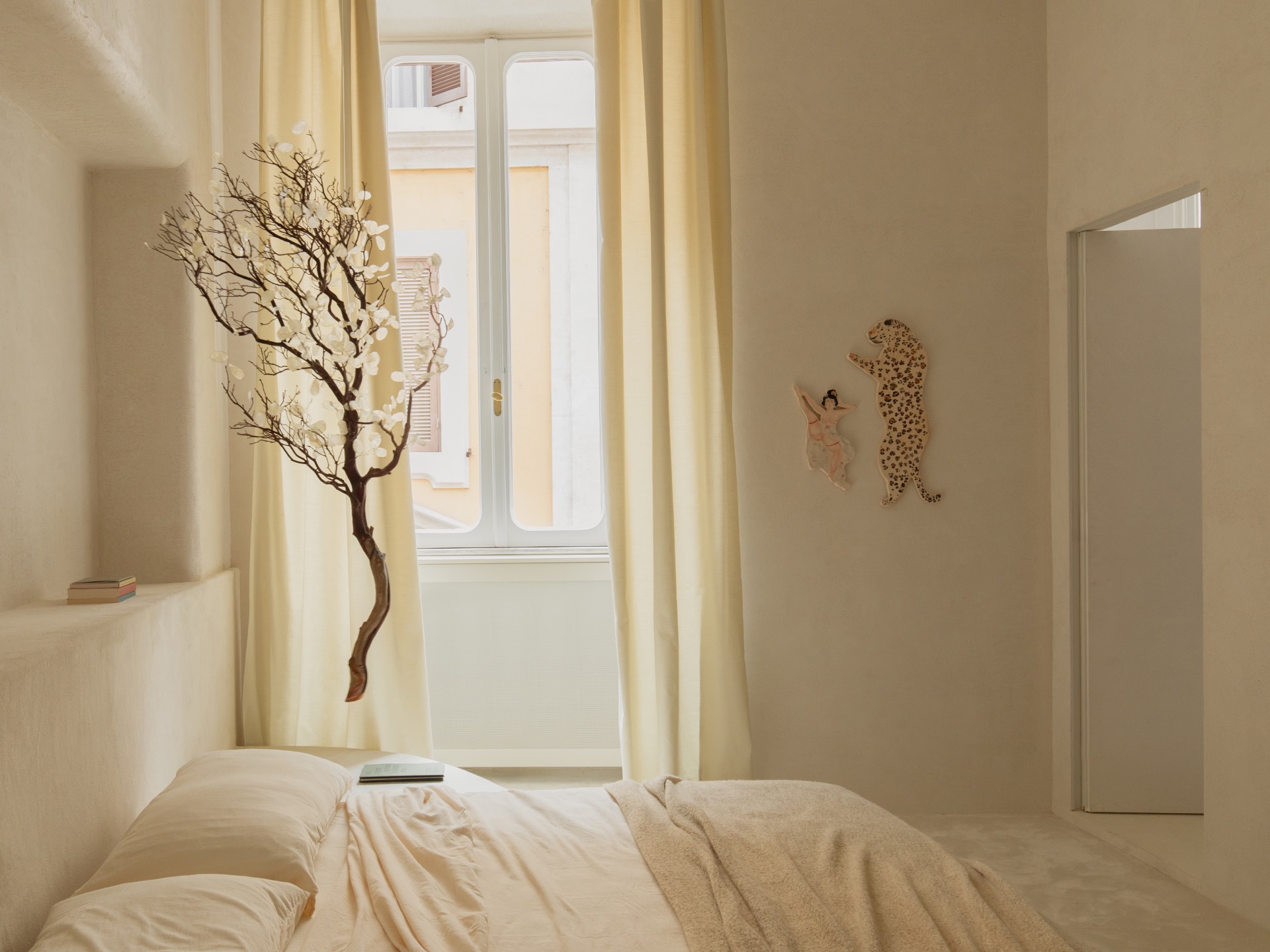
The bedroom introduces a more enclosed and protective dimension, conveyed through the softness of its materials. Concrete gives way to wax-white carpeting that covers the floor, extends onto the bed platform and continues vertically along part of the room, enveloping surfaces and furnishings in a continuous tactile experience.
The soft, enveloping quality of the fabric engages with the works of Flaminia Veronesi. The textile is not merely a surface, but a presence capable of suggesting closeness, protection and intimacy.
The second wardrobe, mirroring the one in the living area, is covered with Ray, a metallic gauze wallcovering designed by Daniela Pinotti specifically for Casa Aemilia, drawing on research from the Aura collection. The design interprets the way light passes across a surface, alternating luminous areas with delicate shadows.
Near the wardrobe, the Dudotta armchair by MARTASALA ÉDITIONS and the marble shelf by Ilaria Bianchi accommodate Adelisa Selimbašić’s work on paper.
Close to the window, FLOVVER presents Komorebi di lunaria: the pearlescent membranes of the plant, also known as the Pope’s money, filter and reflect light, inviting contemplation and suggesting a possible experience of transcendence through the beauty of small things, in delicate counterpoint to Matteo Attruia’s admonition.
Beside the bed, the Sidra floor lamp by LIT Studio, featuring two pink blown Murano glass elements and a satin-finished stainless steel base, anticipates the reflections and chromatic variations of the glass that also characterise the bathroom, while the Facetas 04 lamp by Berto reinterprets traditional leaded stained glass, transforming its “facets” into a volume permeated by light.
Convivial intimacy
The living area represents the convivial dimension of the home, where architecture becomes more essential and textured and metallic surfaces amplify natural light, accompanying the presence of the artworks.
The storage cabinet covered with Ray by Daniela Pinotti transforms a functional element into an architectural surface, establishing a connection with the bedroom wardrobe. The metallic finish of the wallcovering echoes the surfaces found in Barbara Prenka’s work, contributing to a material continuity between art and design.
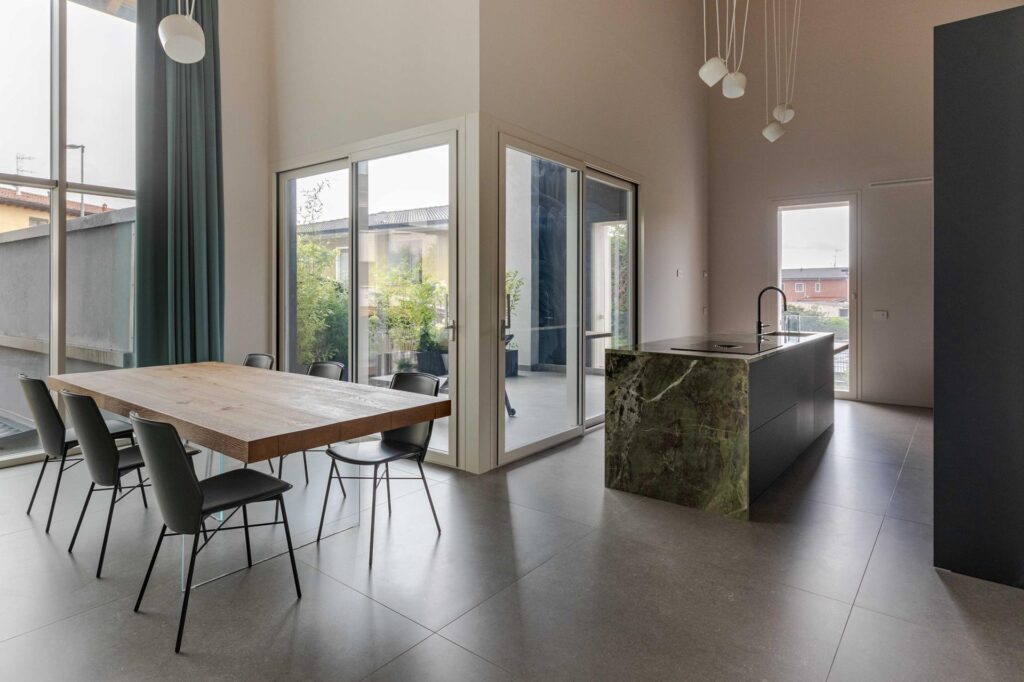
The kitchen, set within a niche, features base units produced by Elmar Cucine and is completed by a shaped glazed lava stone worktop that extends into the wall cladding and shelf. All were produced by Ninefifty according to a bespoke design. The glossy stone surface echoes the palette of the home while introducing a different depth of material expression.
Opposite, the table by Dante Negro, featuring a transparent fused glass top and a champagne-coloured forged iron frame, is accompanied by matching chairs and illuminated from above by the aluminium Inro lamp by Atelier Nuanda. Ceramic accessories by Arianna De Luca and Traga glassware complete the composition.
The sofa area is built around a dialogue between furnishings, architecture and art. The original 1970s Camaleonda sofa, supplied by Galleria Incanto, is paired with wall panelling featuring an integrated shelf, clad in neutral-coloured cellulose fibre panels by Paper Factor. The texture of Paper Factor and the colours of the glazed lava stone in the kitchen echo the wax surface of Silvia Giambrone’s artwork.
On the wall panelling, the Flare 40 candleholders by Studio Douze Degrés transform the flame into a sculptural presence: through an optical lens, the candlelight is captured, amplified and projected into a vibrant beam of light.
Materials, light and continuity between spaces
Continuity between the rooms is also achieved through curtain fabrics by Kvadrat, which envelop the home in an intimate and warm atmosphere. All bespoke joinery is produced by Teknocoop Wood Design Solution. Technical lighting and lighting design are overseen by Luce e Design.
Throughout the project, a small number of elements recur, taking on a different meaning each time: wax white moves from concrete to lava stone and carpeting; metallic surfaces appear in the wallcoverings, the stainless steel of the furnishings and the artworks; glass runs throughout the space, from the entrance bricks to the furnishings and lighting.
The artworks are also integrated according to these material and chromatic correspondences, so that art, architecture and design do not constitute separate layers, but parts of a single narrative. At Casa Aemilia, materials thus transcend their role as finishes and become a means of creating atmospheres, relationships and experiences of living.
Casa Aemilia’s design partners
The curation of the design partnerships is entrusted to Jacopo Manganiello, who, together with ATLANTE Design, Main Design Partner of this first edition of Casa Aemilia, has supported Manuela Tognoli’s research in selecting companies, designers and manufacturers who share the project’s vision, helping to translate the concept of Intimacy into a dialogue between materials, furnishings, objects and domestic space. The partners involved include: Arianna De Luca, Atelier Nuanda, Berto Sánchez, cc-tapis, Daniela Pinotti, Dante Negro, De Marchi Verona, Douze Degrés, Elmar Cucine, Fantini Rubinetti, Galleria Incanto, Ilaria Bianchi, Kvadrat, LIT Studio, Luce e Design, MARTASALA ÉDITIONS, Millim Studio, Ninefifty, Paper Factor, Teknocoop Wood Design Solution and Traga. The experience of the home is completed by the botanical installation by FLOVVER and the editorial selection curated by Santedicola.
Casa Aemilia: a design and cultural platform
Casa Aemilia was founded with the ambition of becoming a design platform for dialogue between collecting, architecture and design, capable of being replicated in future editions.
Alongside its residential dimension, the project will introduce a cultural programme of meetings, visits, talks and events, offering new ways of experiencing art within a domestic setting.
Project (Bath) Room
Completing this vision, Project (Bath) Room, a project room located within the apartment’s bathroom, will host temporary exhibitions dedicated to emerging artists or artists working independently of the institutional gallery circuit, invited to engage with the language of interior design and the most intimate space of the home.
The first exhibition will bring into dialogue the works of Krizia Galfo, Giorgia Prandin and Guendalina Urbani, who will occupy every dimension of the small exhibition space: ceiling, wall and floor.
Casa Aemilia thus positions itself as a laboratory for experimentation in which cultural, design and economic value coexist, envisioning a new model of engagement with the real estate market by developing domestic spaces to be presented as collectible objects. An investment proposal that synergistically brings together the contemporary art, design and real estate markets.
OPENING
20 November 2026, 3:00 pm
Via di Campo Marzio 43, Rome
Press Office
Elena Di Marco | elenadimarco.pr@gmail.com
Silvia Beretta | silviaberetta.pr@gmail.com

Casa Aemilia Art Collection
Adelisa Selimbašić
Adelisa Selimbašić (Karlsruhe, Germany, 1996) lives and works in New York. Of Italian-Bosnian heritage, she studied painting at the Academy of Fine Arts in Venice. At the centre of her painting is the body, particularly the female body, often depicted in details that evoke the aesthetics of social media, exploring identity, intimacy and desire through a gaze free from judgement and stereotypes. Her solo exhibitions include: “When we become each other”, Lubov Gallery, New York (2026); “The Dancefloor”, z2o Sara Zanin Gallery, Rome (2026); “The space in between”, Tommaso Calabro Gallery, Milan (2025); “Dust Bunny”, z2o Sara Zanin Gallery, Rome (2024). Group exhibitions include: “More Than This”, curated by Daniele Capra, Pinacoteca Nazionale, Bologna (2026); “Soft Focus”, Bradley Ertaskiran Gallery, Montréal (2024); “Embraced – A Lived Experience”, Rhodes Contemporary Art, London (2024). She won the Fountainhead Residency Prize with Untitled Art Fair Miami Beach (2023). Her works are held in the collections of the Fondazione Sandretto Re Rebaudengo, the Maramotti – Max Mara Collection and Soho House Rome.
Barbara Prenka
Barbara Prenka (Gjakova, Kosovo, 1990) lives and works between Venice, Bolzano and Berlin. She studied painting at the Academy of Fine Arts in Venice. Working with textiles, embroidery and painting, she transforms materials into vehicles for personal and collective memory, in which sewing becomes an act of care and reconstruction. Her solo exhibitions include: “What time is it between my fingers?”, A plus A Gallery, Venice (2025); “What Lies Behind the Boundaries of a Shadow?”, Lottozero, Prato (2025–2026); “Covers”, Gallery of the Ministry of Culture, Prishtina (2024). She has exhibited at the National Gallery of Kosovo, Kunstquartier Bethanien in Berlin, Galerie Italienne in Paris and Biennale Gherdëina 8. She won the Euromobil Under 30 Prize at ArteFiera Bologna (2015), the Emerging Art Prize at the Francesco Fabbri Prize (2014) and the Combat Prize, Painting category (2014).
Flaminia Veronesi
Flaminia Veronesi (Milan, 1986) lives and works in Milan. Her research draws on dreams, mythology and wonder, using imagination as a means of gaining knowledge: not an escape from reality, but a resource for human evolution and a way of creating relationships. Patterned textiles, ceramics, plasticine, drawings and murals populate dreamlike landscapes inhabited by mermaids, dragons and hybrid figures. Her solo exhibitions include: “Il bar sotto il mare”, Red Lab Gallery, Milan (2025–2026); “Popplay”, Galleria Tommaso Calabro, Milan (2024); “The Hermitcrab’s Wundershell”, Marni Flagship Store, Milan (2023); “Erbario e Bestiario del Meraviglioso”, Botanical Garden of Palermo (2023). She participated in “Pittura Italiana oggi”, Triennale Milano (2023); “Embryonic Journey”, Richard Saltoun Gallery, Rome (2024); and “MoonKillers”, Tommaso Calabro, Venice (2025). A finalist for the 2024 Cairo Prize, in 2025 she designed one of the works forming the Bee Awards for the 24th International Exhibition at Triennale Milano.
Ismaele Nones
Ismaele Nones (Trento, 1992) lives and works in Turin. The son of an icon painter, he draws on historical techniques and iconographies, from Byzantine art to Arte Povera, to explore introspection, alienation and the desire for connection. His hieratic figures often inhabit ambiguous and suspended spaces, conveying a tension that sometimes dissolves into a sense of peace. In 2026, he was selected by the Municipality of Siena to create the Drappellone for the Palio of 2 July, dedicated to the Madonna di Provenzano. His solo exhibitions include: “What we hold, what we lose”, Tommaso Calabro, Venice (2026); “A chi parlo quando parlo”, MAC Lissone (2025); “Chiara confusione”, Galleria d’Arte Niccoli, Parma (2024). He participated in “Biennale del Mosaico Contemporaneo IX”, Ravenna (2025); “Io sono una forza del passato”, Gallerie d’Italia, Miart (2024); and “Pittura Italiana Oggi”, Triennale Milano (2023). He won the Casarini Due Torri Prize at ArtVerona (2021) and was a finalist for the Cairo Prize (2023). His works are held in the collections of MAC Lissone and Gallerie d’Italia.
Matteo Attruia
Matteo Attruia (Sacile, 1973) is based in Pordenone. Using neon, writing, photography, video and installation, he deconstructs language and questions the meaning of words, objects and signs, employing irony and paradox to create a sense of estrangement. His works function as open-ended devices that initiate a dialogue with the viewer. His solo exhibitions include: “Stato di confine”, Gorizia, a project for Nova Gorica – Gorizia European Capital of Culture 2025 (2026); “All I Need Is”, Italian Cultural Institute, Prague (2024); “Not Yet”, MLZ Gallery, Trieste (2024); “Inedito”, Marina Bastianello Gallery, Mestre (2021). In 2026, he presented the two-person exhibition “Lei è meglio di me” with Noemi Durighello at SMdot Contemporary Art, Udine. Group exhibitions include: “Logos Infinito”, Museo Villa Colloredo Mels, Recanati (2022); “Together We Stand”, Galleria Michela Rizzo, Venice (2020). In 2018, he designed an espresso cup for the Illy collection.
Shafei Xia
Shafei Xia (Shaoxing, China, 1989) lives and works in Italy. She works with painting on sandalwood paper and ceramics, reinterpreting Eastern figurative and erotic traditions, from nineteenth-century Chinese painting to Japanese shunga. With a tone that is both ironic and melancholic, she portrays desire and intimacy as part of human relationships, through playful and surreal scenes inhabited by animals, dancers, lovers and acrobats. She has exhibited at prestigious institutions: “Looking at Her”, Murray Edwards College, Cambridge (2025); “I Licked It, It’s Mine”, Museum of Sex, New York (2024); “The Infinite Woman”, Fondation Carmignac, Hyères (2024); “Italia 70 – I nuovi mostri”, Fondazione Trussardi, Milan (2024); “Fantastica”, 18th Art Quadriennale, Palazzo delle Esposizioni, Rome (2025). Her works form part of the collections of GAMeC Bergamo, the Museum of Sex in New York, the Women’s Art Collection at the University of Cambridge and ILHAM, Kuala Lumpur.
Silvia Giambrone
Silvia Giambrone (Agrigento, 1981) lives and works between Rome and London. Moving between performance, installation, sculpture, video and sound, she investigates the politics of the body and the power dynamics embedded within domestic spaces, altering familiar objects such as mirrors, beds and lace to address vulnerability and violence. Her solo exhibitions include: “I Lie”, Richard Saltoun, Rome (2026); “Sub Rosa”, Appartamenti Segreti di Palazzo Doria Pamphilj, Rome (2025–2026); “Sexually Explicit Content”, PAC, Milan (2023); “Hall of Shadows”, in collaboration with Dior, Palace of Versailles (2021); “Nobody’s Room. Anzi, parla”, Museo del Novecento, Milan (2020). In 2026, she won the BPER Prize at Arte Fiera with “Mirror n.18”, which will enter the collection of La Galleria BPER; in 2019, she won the VAF Prize. A work from the “Mirrors” series is held in the University of Padua’s collection dedicated to artistic production by women.
Bath Room Project
Krizia Galfo
Krizia Galfo (Ragusa, 1987) lives and works in Rome. Having graduated in Modern Literature in Catania, she discovered painting in London at Chelsea College of Arts and Central Saint Martins, before refining her technique in Rome. She paints in oils on linen, creating images derived from photography and cinematic close-ups that focus on the marginal details of everyday gestures and reveal their fragility, through paintings characterised by cool colours and a suspended gaze. Her solo exhibitions include: “Timid Socks”, Reintegra, Rome (2026); “We need to talk”, Curva Pura, Rome (2023). Her work “Caterina” was presented at the Galleria d’Arte Moderna in Rome in the exhibition “Materia Nova. Ultime generazioni a confronto”, curated by Massimo Mininni.
Guendalina Urbani
Guendalina Urbani (Rome, 1992) lives and works in Rome. Her research is rooted in contradictions and moves between semiotics and sculpture, grace and danger, conveying a sense of insecurity and existential tension. She works with rigid and fragile materials that reverse the protective function of objects, as in the series “Bolle d’aria” (since 2021) or the installation “Un mare di vetro”, composed of fragments that appear sharp but yield underfoot. Her solo exhibitions include: “Neanche un graffio”, curated by Valentina Muzi, Galleria Nuvole Arte Contemporanea, Montesarchio (2025).
Giorgia Prandin
Giorgia Prandin (Santa Giustina in Colle, 2000) lives in Padua. She studied metal design and goldsmithing at Liceo Artistico Selvatico in Padua, followed by Sculpture at the Academy of Fine Arts in Venice. She works with glass, including through body casts, to reflect on memory, fragility and human interaction: the fracture that runs through every individual. She exhibited in “MNEME”, curated by Angela Bertolo, Centro Universitario, Padua (2024), and participated in “Artefici del nostro tempo”, Venice (2022). In 2026, she was selected through an open call for The Venice Glass Week HUB Under35 in Venice.
Main Design Partner
Atlante Design
Atlante Design was founded in 2021 within the cultural ecosystem of EDIT Napoli, an international fair dedicated to independent and authorial design. This context helped shape its vision and consolidate its commitment to supporting a new generation of designers and artisans characterised by a recognisable identity and a deep connection with craftsmanship. Today, Atlante Design operates as an independent consultancy, collaborating with creatives, manufacturers, architects, interior designers, retailers and galleries. It promotes contemporary and authorial design, celebrating the expertise of artisans capable of combining knowledge of materials, excellence in execution and a distinctive creative vision.
Design Partners
Arianna De Luca
Arianna De Luca creates collectible ceramic objects that combine Mediterranean heritage with a contemporary, bold and recognisable aesthetic. Each piece celebrates craftsmanship, colour and cultural storytelling, creating objects designed for interiors where design becomes an expression of a way of life. Handmade in Italy, her creations transcend their functional dimension to become narrative fragments, everyday rituals and small contemporary classics.
Atelier Nuanda
Atelier Nuanda was founded in 2022 by textile designer and artist Cecilia Rinaldi together with her husband. Driven by a deep passion for craftsmanship, Cecilia experiments with innovative leatherworking techniques, creating distinctive pieces characterised by interwoven textile structures. In her Bologna studio, she transforms leather into textile surfaces, accessories and unique furnishing elements, reinterpreting traditional techniques through experimentation and a contemporary design sensibility.
Berto
Berto is the collectible design project of Spanish designer Alberto Sánchez. Established as a space for personal and experimental research, Berto explores the relationships between geometry, light and matter through unique and limited-edition objects created in collaboration with specialised artisans. Working primarily with glass and traditional techniques, the studio creates pieces suspended between functionality and sculpture. Its research celebrates the expressive qualities of materials, the value of handmade craftsmanship and the enduring appeal of objects designed to transcend time.
cc-tapis
cc-tapis was founded by Nelcya Chamszadeh and Fabrizio Cantoni, who began producing hand-knotted rugs in Nepal more than twenty years ago. Since relocating to Milan in 2011, the company has developed an innovative approach to traditional craftsmanship under the creative direction of Daniele Lora. Through collaborations with international designers and artists, cc-tapis continually explores new aesthetics, materials and production techniques.
For this project, cc-tapis presents a creation by Duccio Maria Gambi, whose multidisciplinary practice combines influences from Radical Design, architecture and material experimentation. From his studio in Florence, Gambi approaches each project as part of an ongoing investigation into structures, processes and the expressive potential of materials, combining research and storytelling in objects that transcend conventional boundaries between art and design.
Daniela Pinotti
Daniela Pinotti is a textile and surface designer whose work spans the worlds of interior design and fashion. In 2026, she founded Et al., a Rome-based studio dedicated to visual research, art direction and material experimentation. Drawing on extensive international experience and collaborations with brands such as H&M Group, Manifattura Tessile Di Nole and l’Opificio, she develops textiles, wallcoverings and bespoke objects for interiors and installations, combining a sophisticated visual language with a research-driven design approach.
De Marchi Verona
De Marchi Verona transforms porcelain into an expressive architectural material, combining more than twenty years of experience rooted in the tradition of the German school of porcelain with ongoing technological research. Each surface is individually decorated by specialised artisans, creating unique finishes that combine manual expertise, aesthetic research and technical performance. From architectural façades and outdoor spaces to the most sophisticated interiors, its porcelain surfaces give walls and environments a distinctive material identity, combining lasting beauty with excellent resistance to thermal shock.
Dante Negro
Dante Negro brings together more than sixty years of Italian metalworking tradition with contemporary design, craftsmanship and technological innovation. Founded in 1964 and now under the creative direction of Margherita Rui, the company explores the expressive potential of metal through experimental finishes, refined textures and unexpected combinations with marble, wood and glass. From sculptural furniture and decorative objects to bespoke interiors and architectural installations, Dante Negro reinterprets traditional forging techniques through distinctive contemporary creations, offering designers and architects tailored solutions that combine material experimentation, technical expertise and artistic expression.
Douze Degrés
Douze Degrés is a Paris-based design studio operating at the intersection of object design and scenography. Drawing inspiration from contemporary scientific and technological themes, the studio creates objects and immersive environments that explore the relationships between form, experience and storytelling. Its research translates complex ideas into tangible and engaging creations, conceived as stories to be experienced and shared.
Elmar
Elmar is an Italian company specialising in kitchens, with more than forty-five years of experience combining technical expertise, refined materials and continuous innovation. Rooted in a longstanding manufacturing tradition, the company has developed a contemporary vision of living spaces through collaborations with leading architects and designers, including C+S Architects and Ludovica+Roberto Palomba. Its collections explore new relationships between ergonomics, movement and functionality, transforming kitchens and bathrooms into flexible and carefully designed environments where aesthetics and everyday life meet.
Fantini
Fantini is a family-run Italian company that has been designing and manufacturing innovative bathroom and kitchen taps since 1947. Founded by brothers Giovanni and Ersilio Fantini in Pella, on the shores of Lake Orta, the company is rooted in an area with a longstanding metalworking tradition. Water is the central element of Fantini’s design philosophy and inspires collections that combine technological excellence, architectural simplicity and aesthetic refinement. Its deep connection with the surrounding landscape and local craftsmanship continues to define its distinctive approach to contemporary design.
FLOVVER
FLOVVER is a botanical design studio founded in Rome by Barbara Mattei, whose minimalist and conceptual aesthetic research is influenced by her background in contemporary art. Moving beyond a purely decorative dimension, the studio explores the boundary between design and art through essential, material-focused botanical installations characterised by single-species compositions, rigorous lines and surreal elements. Its research favours local and wild materials, with particular attention to the territory and sustainability.
Incanto Gallery
Incanto Gallery is dedicated to rediscovering and celebrating the timeless relevance of the great masters of design. Through a carefully curated selection of historical and contemporary pieces, the gallery explores the enduring beauty of objects capable of transcending trends and generations. Its approach seeks to reveal the contemporary relevance of iconic works and lesser-known creations, placing them in new contexts and establishing unexpected connections between design history, collecting and contemporary living.
Ilaria Bianchi
Ilaria Bianchi is a multidisciplinary designer based in Milan, whose practice ranges from unique objects and limited editions to installations and industrial design. After studying Industrial Design at the Polytechnic University of Turin and completing a Master’s degree in Ceramic, Furniture and Jewellery Design at Central Saint Martins in London, she established her independent practice in 2015. Combining craftsmanship, analytical research and material experimentation, her work investigates new relationships between design, sustainability and contemporary production, challenging conventional approaches to form and functionality.
Kvadrat
Kvadrat is a Danish company founded in 1968, deeply rooted in the Scandinavian design tradition and internationally recognised for innovation in the textile industry. Through continuous research into materials, colours and technologies, it develops upholstery fabrics, rugs, curtains and acoustic solutions for residential spaces and contemporary architecture. Collaborations with internationally renowned designers, architects and artists, including Patricia Urquiola, Ronan and Erwan Bouroullec and Olafur Eliasson, fuel research that explores the expressive and functional potential of textiles. From tactile surfaces to elements that modulate light and sound, Kvadrat interprets textiles as an integral part of architecture, combining quality, innovation and a commitment to sustainability.
Lit Studio
Lit Studio is an interdisciplinary architecture and design studio founded by Rudy Faissal and Riccardo Boccia, born from the intersection of Middle Eastern and Italian cultural identities. Based in Milan, it operates across different scales, from product design to retail spaces, interior design and large-scale architectural projects. Rooted in an ongoing dialogue between tradition and innovation, Lit Studio develops projects characterised by a refined aesthetic, a particular sensitivity to materials and a strong conceptual approach.
Luce e Design
Luce e Design creates distinctive lighting solutions that combine aesthetics, functionality and spatial experience. Through a carefully considered dialogue between light, lines and materials, the company transforms interiors into spaces with unique atmospheres and identities. Precision, attention to detail and continuous support throughout the design and implementation stages ensure carefully considered solutions in which technical performance and visual expression achieve a harmonious balance.
Martasala Éditions
Martasala Éditions is an Italian brand founded in 2015 by Marta Sala, dedicated to contemporary furniture with a strong architectural identity. Entering its second decade of activity with an increasingly established international presence, the company continues to develop collections that combine design research, craftsmanship and cultural depth. Its collaboration with Herzog & de Meuron, presented in 2025 at the Museo Bagatti Valsecchi in Milan, represents a significant moment in the brand’s evolution, expressing the dialogue between independent production and contemporary architecture.
Millim Studio
Millim Studio is a Rome-based design studio founded by Chiara Pellicano and Edoardo Giammarioli, dedicated to conceptual research, material experimentation and contemporary craftsmanship. Working across objects, installations and interiors, the studio investigates the relationships between form, meaning and production processes. Its approach celebrates experimentation, sustainability and the expressive potential of materials, creating distinctive works capable of establishing connections between art, design, culture and communication.
Ninefifty
Ninefifty is an Italian brand dedicated to research into lava stone and terracotta surfaces and cladding. Rooted in the ceramic tradition of Caltagirone, Sicily, the brand combines ancient techniques and contemporary experimentation to create distinctive handcrafted pieces. Founders Nicolò and Fausto grew up in the ceramic workshops of their father, Rosario Parrinello, founder of Made a Mano, developing an extensive knowledge of materials, pigments and production processes. Each surface emerges from meticulous manual work, with freehand decorations and brush-applied colours that celebrate the expressive qualities of natural materials and the uniqueness of artisanal production.
Paper Factor
Paper Factor is an Italian company specialising in material research and the creation of bespoke interiors, furnishings and architectural surfaces. Operating at the intersection of design, architecture, art and production experimentation, it explores the extraordinary potential of cellulose fibre, transforming natural and recycled materials into lightweight, durable and highly versatile surfaces. Through an innovative approach to material research, Paper Factor develops sculptural forms, textures and customised solutions that transcend conventional perceptions of paper, opening up new possibilities for sustainable design.
Santedicola
Santedicola is an urban and cultural regeneration project that reinvents the role of the traditional newsstand, transforming it into a meeting place for design, art, publishing and communication. Established with the aim of breathing new life into urban locations of historical interest, Santedicola proposes a hybrid and inclusive format capable of combining the original function of the newsstand with new cultural and creative experiences, while maintaining a strong focus on independent and niche publications. Through exhibitions, pop-ups, workshops and collaborations with artists and brands, the project promotes dialogue between contemporary creativity, businesses and the local community, shaping a new model of accessible and constantly evolving cultural space.
Teknocoop Wood Design Solution
Teknocoop Wood Design Solution is an Italian company specialising in bespoke furniture and interior design solutions, combining craftsmanship, technological innovation and a refined approach to contemporary design. Working closely with architects, designers and international brands, the company transforms creative visions into distinctive and personalised spaces, with meticulous attention to materials, functionality and detail. From private residences to boutique hotels, restaurants and retail spaces, Teknocoop combines technical expertise and creative sensibility to shape interiors where craftsmanship, aesthetics and architectural identity meet.
Traga
Traga is a Milan-based design brand that reinterprets objects for the contemporary table. Specialising in glassmaking, Traga creates versatile objects that combine brutalist aesthetics with a highly functional approach, suggesting new rituals associated with drinking, conviviality and everyday life. The brand’s name derives from a Slavic word meaning “to leave a trace”, evoking a playful exploration of gestures, interactions and the small marks that make shared moments memorable.