Choose indoor plants around real light, temperature and care needs. Compare positions, pots and plant size before creating a green interior.
Indoor plants should be chosen for the light, temperature and care available in their actual position. A plant that suits a photograph may not suit the corner beside your sofa. Start with the room conditions, then select the shape and scale that complete the interior.
Foliage gives a room a living rhythm, but it is not a maintenance-free accessory. Windows, seasonal changes and heating affect the growing environment. An attractive container should support the plant, not conceal problems with drainage.
Map the light in the exact position
Look at the window orientation, distance from glass and shading by nearby buildings or curtains. The light immediately beside a window can differ considerably from the light several metres into the room.
Observe changes over the day and across seasons. Low-light tolerant does not mean able to live indefinitely without adequate light. Choose a species with requirements compatible with the measured position.
| Position | Question to ask | Design consequence |
|---|---|---|
| Near a bright window | Does the species tolerate that exposure? | Leave room for foliage and curtains |
| Deeper in the room | Is light adequate for healthy growth? | Do not use plants to fill every dark corner |
| Beside heating | Will heat and dry air affect it? | Move it away when needed |
| Busy passage | Will leaves or the pot obstruct movement? | Choose a smaller footprint |
Choose the plant before the decorative pot
A nursery container and decorative outer pot can work together when drainage and inspection remain possible. Check for accumulated water rather than assuming the outer pot is harmless.
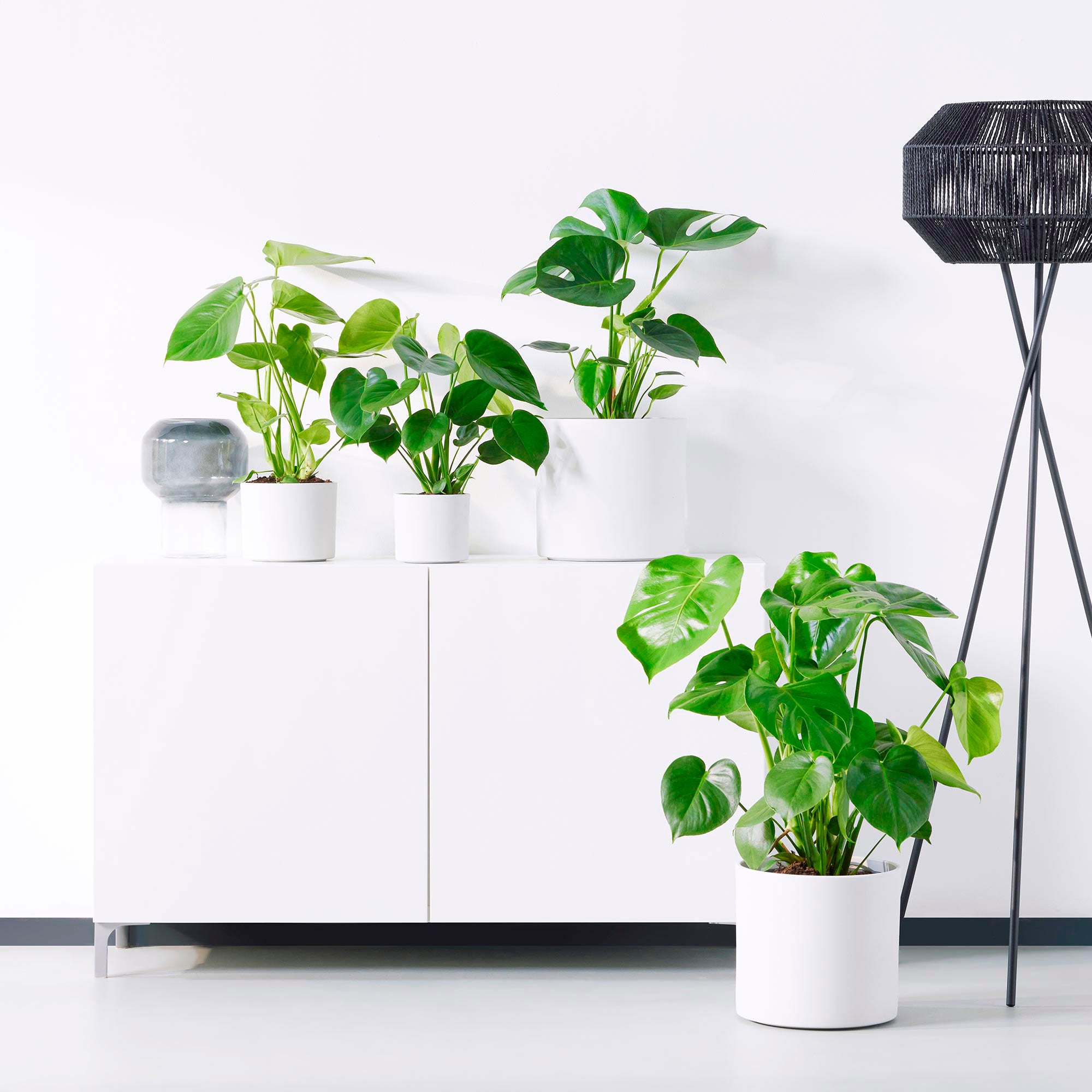
The plant should be accessible for watering, cleaning and checking for pests. A heavy pot placed behind furniture can make a simple care routine needlessly difficult.
Scale: one clear form can be enough
A taller specimen can establish a vertical element near low furniture. Smaller plants work where their leaves can be seen and cared for. Avoid a scattered collection bought only to occupy empty surfaces.
Consider the likely mature size and growth habit. A climbing plant needs a suitable support; a spreading one needs space around the pot. Leave room for movement and for the plant itself.
Water by observation, not decoration
Species, growing medium, container and room conditions determine the useful watering routine. Check the plant-specific guidance and the root environment. A fixed weekly schedule can be inappropriate in changing conditions.
The Royal Horticultural Society houseplant resources are a useful institutional starting point. They do not remove the need to identify the actual species and observe it.
Children and animals: check the exact species
Some popular houseplants can be harmful if ingested or cause irritation. Verify the botanical name and suitable safety information before placing a plant where children or animals may reach it.
This guide does not label an unidentified decorative plant as safe. If ingestion is suspected, seek appropriate urgent professional advice. Styling should never replace species identification.
Bring foliage into the material palette
A restrained pot can let foliage remain the focus. Timber, metal and painted surfaces give green different visual contexts, but the best-looking position still has to suit growing needs.
The modern Mediterranean interior approach offers a way to connect natural textures. Use it as a compositional reference, not as permission to put a sun-loving plant in a shaded room.
For the wider project, explore furnishing a new home, bougainvillea in pots.
Frequently asked questions
Can an indoor plant live in a dark corner?
Do not assume so. Check the actual light and the species requirements; low-light tolerance is not absence-of-light tolerance.
Should indoor plants be watered once a week?
Not as a universal rule. Species, temperature, light and the growing medium affect water needs.
Are all decorative plants safe for animals?
No. Check the exact botanical species and reliable safety information before placing it within reach.
Opening image: Bakker.