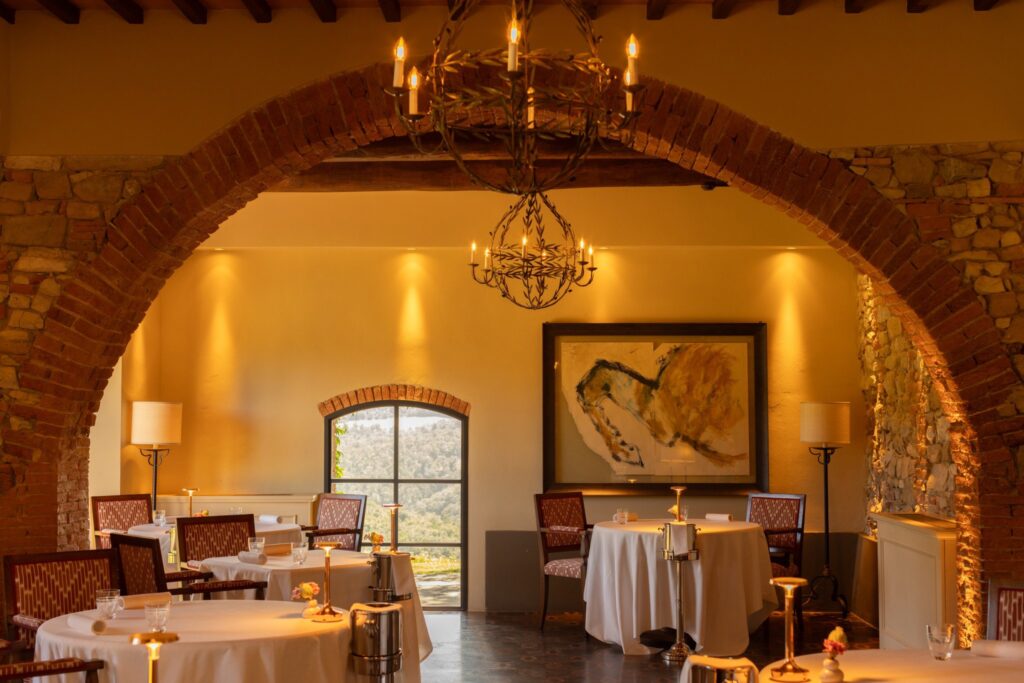
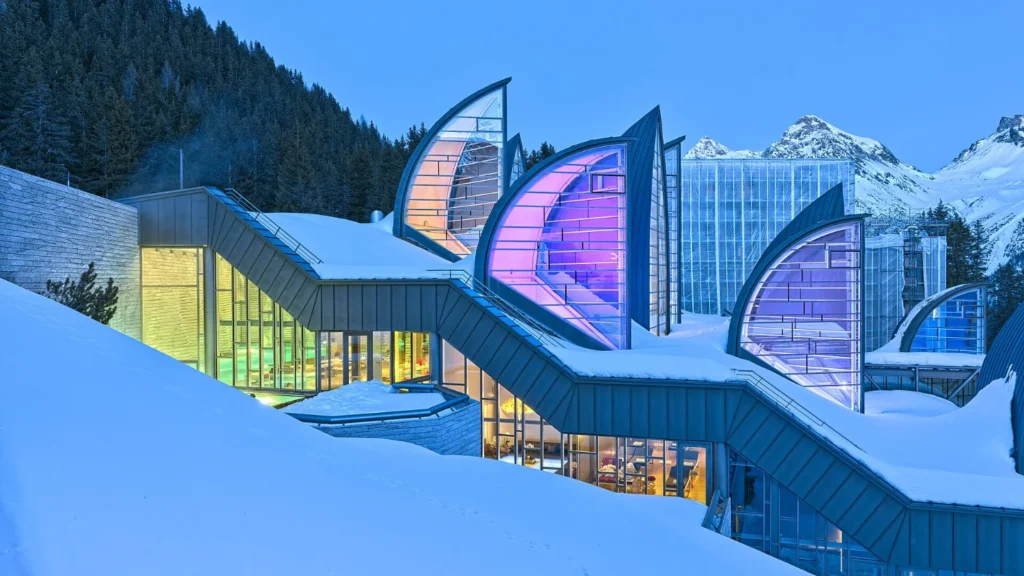
Italian hospitality design is in an interesting place right now: moving away from the decorative idea of the “pretty” hotel and ever closer to in-depth work on place, existing buildings, landscape, materials and identity. From the Alps to Sicily, by way of historic palazzos, former monasteries, masserie (Apulian fortified farmhouses), rural homes and new buildings …
Italian hospitality design is in an interesting place right now: moving away from the decorative idea of the “pretty” hotel and ever closer to in-depth work on place, existing buildings, landscape, materials and identity.
From the Alps to Sicily, by way of historic palazzos, former monasteries, masserie (Apulian fortified farmhouses), rural homes and new buildings set in nature, many contemporary hotels point in a clear direction: design is no longer just about image, but about building an experience. A guest room, a spa, a facade, a breakfast room or a garden become part of a broader story, in which design interprets the territory without turning it into a stage set.
In this selection we have gathered 15 Italian design hotels by Italian studios, not necessarily tied to the predictable circuit of starchitects, but each capable of leaving a recognizable mark on contemporary hospitality. The projects differ in scale, language and geography, yet share one idea: the hotel as a designed place, not simply a furnished one.
Italian Design Hotels: Boutique Hotels, Resorts and Contemporary Retreats by Italian Architects and Interior Designers
The new design-led hospitality is not defined solely by a famous name or spectacular interiors. The most interesting projects are often those that work with restraint: they restore historic buildings, read the landscape, choose materials that suit the place, and create atmospheres that linger in the memory without imposing themselves.
In Italy, and beyond its borders, many architecture and interior design studios are pursuing sophisticated research into the hotel as a cultural, domestic and sensory space. Boutique hotels, mountain resorts, rural retreats, city palazzos and properties immersed in nature thus become concrete examples of a different way of designing hospitality: more thoughtful, more rooted, less predictable.
1. Hotel Bühelwirt, Valle Aurina — Pedevilla Architects

In Valle Aurina (Ahrntal), in South Tyrol, Hotel Bühelwirt presents a vision of the mountains far removed from any decorative cliché. The extension by Pedevilla Architects focuses on the relationship between the existing building, the slope and the Alpine landscape, adding a compact new volume linked to the original structure by a narrow passage. The result is pared-back, almost austere architecture whose strength comes from restraint: an asymmetrical roof, a dark facade, deep openings and an ongoing dialogue with the light, climate and topography of the site.
The Bühelwirt is a precise example of contemporary Alpine hospitality: it does not chase scenic effect, but builds a clear identity through proportion, materials and silence. The new structure houses guest rooms, a spa and an expanded restaurant, confirming a vision of the hotel as an architectural organism able to grow without losing its relationship with its setting.
2. Monastero Arx Vivendi, Arco — noa* network of architecture

In Arco, near Lake Garda in Trentino, Monastero Arx Vivendi is the result of transforming a monastic complex from the second half of the 17th century. The project by noa* network of architecture treats the memory of the place with great care: part of the monastery, including the church and cloister, has been left intact, while the hospitality spaces were created through restoration and conversion carried out in dialogue with the cultural heritage authorities.
The new hotel retains the monastery’s architectural grammar: corridors, vaults, internal routes and rigorous proportions. Guest rooms are spread across the first floor and the attic, while the communal areas occupy the ground floor. In the garden, a new wellness area introduces a light contemporary presence, conceived as an extension of the surrounding farmland. The project’s value lies precisely in this controlled tension between historic architecture, hospitality and well-being.
3. Hotel Milla Montis, Maranza — Peter Pichler Architecture

In Maranza (Meransen), South Tyrol, Hotel Milla Montis interprets Alpine architecture through a crisp, contemporary language. Designed by Peter Pichler Architecture, the building consists of four staggered volumes intended to reduce its scale and set it more naturally into the landscape. Its form draws on traditional hay barns and local farming culture, translating them into a sculpted, distinctive timber facade.
The design avoids literal nostalgia in favor of a more precise reading of the place: large windows facing the mountains, minimal interiors, ash wood, green loden fabrics and strong continuity between architecture and nature. Milla Montis works because it does not use the mountains as a backdrop, but as a compositional principle. It is a hotel where design grows out of a reinterpretation of the Alpine landscape, not its decoration.
4. Casa di Langa, Cerretto Langhe — GaS Studio with Parisotto + Formenton Architetti

In the heart of the Langhe wine region in Piedmont, Casa di Langa takes the luxury resort into more interesting territory: sustainability, landscape, Piedmontese rural tradition and attention to the guest experience. The project is by GaS Studio in collaboration with Parisotto + Formenton Architetti and stems from the restoration and transformation of existing structures, reinterpreted through a contemporary language inspired by local rural architecture.
Here, design works through subtraction and continuity. The building engages with vineyards, hazelnut groves and hills, seeking a balance between comfort, authenticity and respect for the land. Casa di Langa’s strength lies in its ability to turn the concept of the eco-luxury resort into something tangible: materials, proportions, views, routes and details all contribute to a rooted form of hospitality, closer to the culture of the place than to the generic idea of a charming hotel.
5. Vocabolo Moscatelli, Umbria — Archiloop / Jacopo Venerosi Pesciolini

In Umbria, Vocabolo Moscatelli occupies a 12th-century monastery converted into a boutique hotel. The restoration, entrusted to architect Jacopo Venerosi Pesciolini of studio Archiloop, preserves the material presence of the original building while introducing a more open, luminous and contemporary language: airy spaces, fresh colors, custom furniture and references to Italian mid-century design.
The result is a retreat that neither erases the past nor stages it nostalgically. Beams, stone, fireplaces, floors and handcrafted details coexist with a more domestic, cultured, almost private sensibility. Vocabolo Moscatelli is interesting because it embodies a form of contemporary rural hospitality that remains intimate: a small world designed around silence, materials and the relationship with the Umbrian hills.
6. Vista Ostuni, Ostuni — RMA Roberto Murgia Architetto
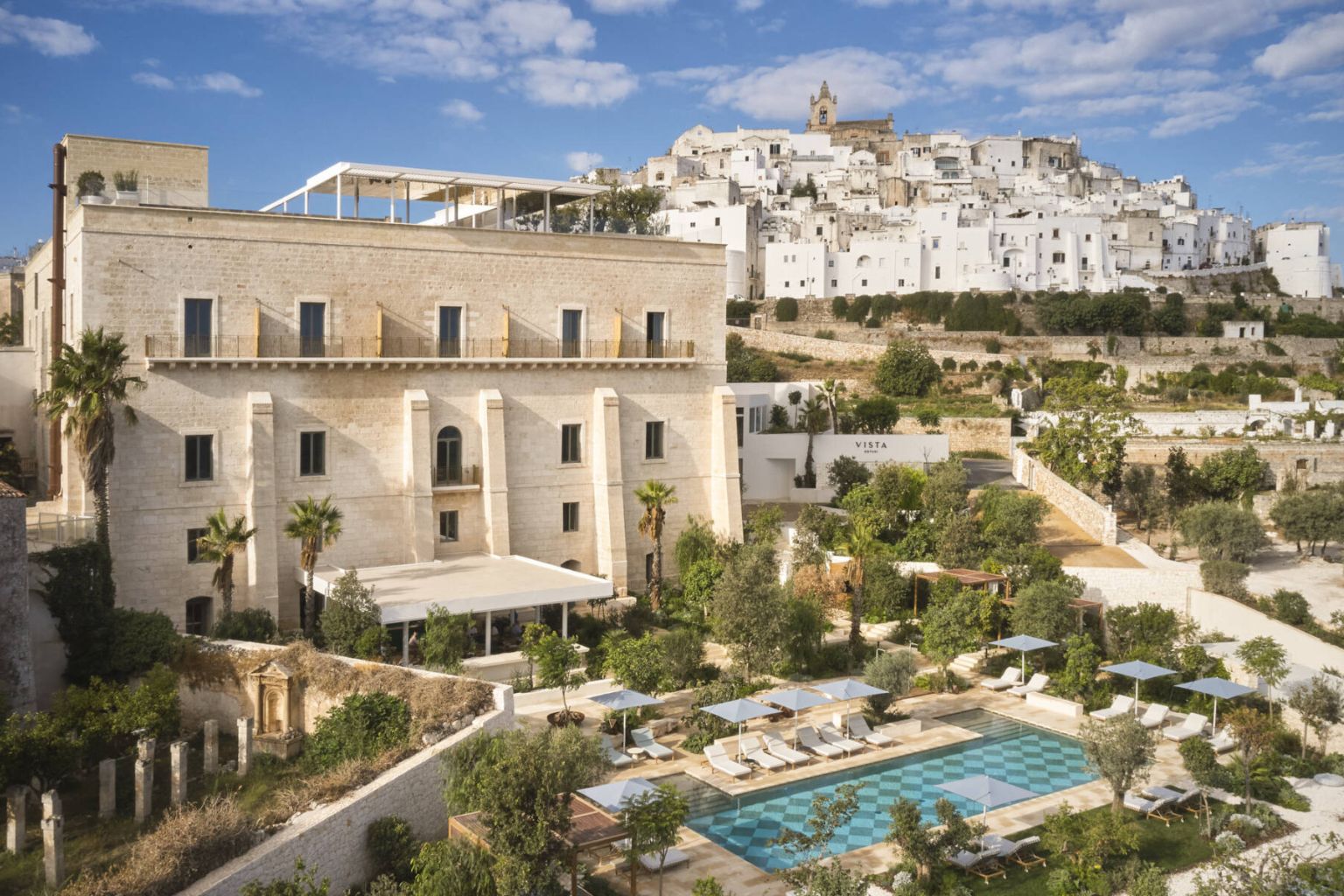
In Ostuni, Apulia, Vista Ostuni gives the town back a complex, layered building that had long stood apart from its original use. The project by RMA Roberto Murgia Architetto turns the former Manifattura Tabacchi (tobacco factory) into a five-star hotel, striking a delicate balance between restoration, new function and Mediterranean identity. The building’s historic fabric is not neutralized but reinterpreted through bright spaces, glimpses of the “white city,” textured surfaces and a sequence of rooms that hold together urban memory and contemporary hospitality.
The project’s value lies in avoiding a predictable take on Apulia. Vista Ostuni does not build a simplified tourist image, but works on a more nuanced idea of Mediterranean luxury: craftsmanship, proportion, light, landscape and decorative details come together without tipping into folklore. It is a hotel born of urban regeneration that uses design as a tool to bring a place back to the center of town life.
7. Zash Country Boutique Hotel, Riposto — Antonio Iraci / Studio Archline
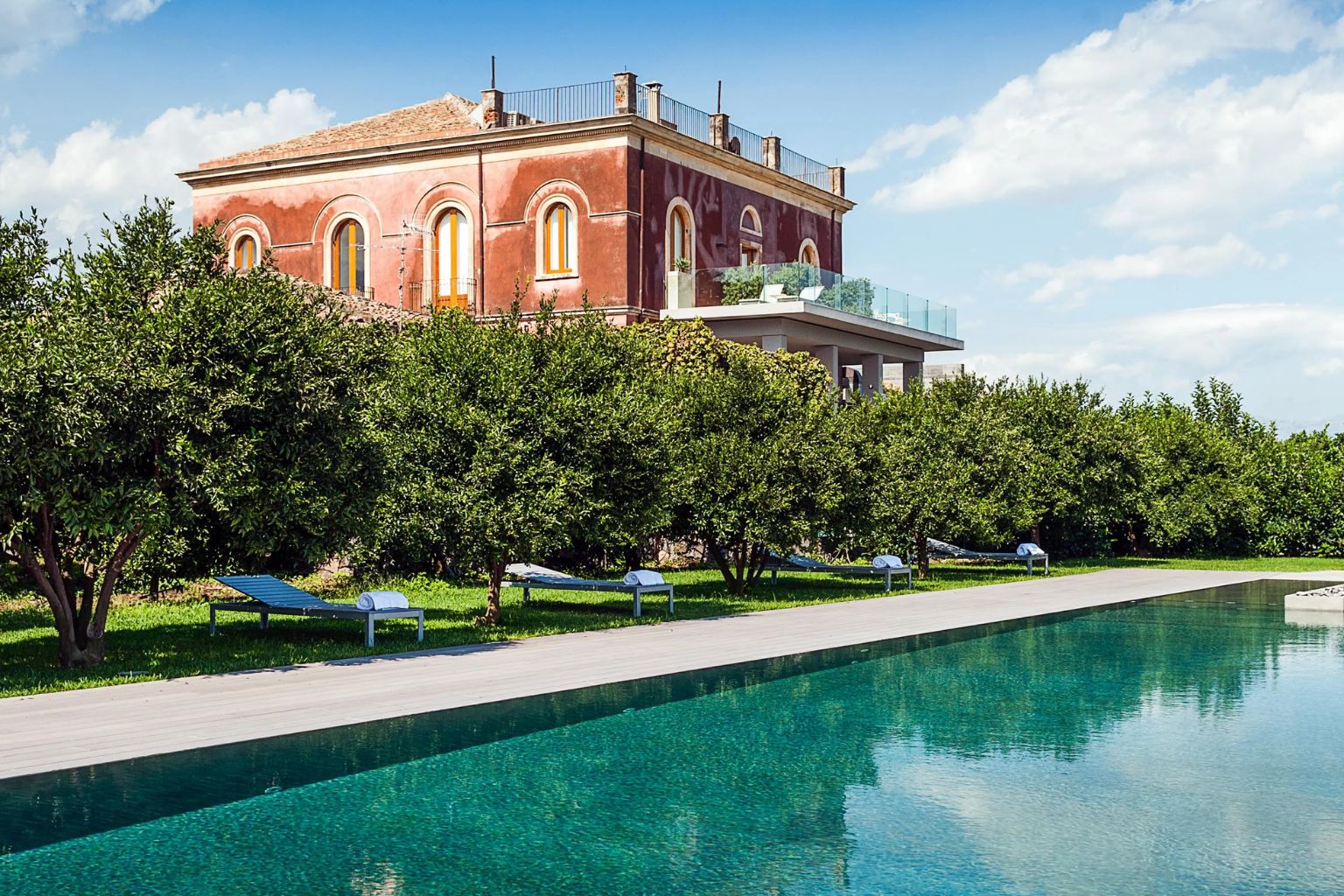
On the slopes of Mount Etna, Zash Country Boutique Hotel sits in a farming landscape of citrus groves, vineyards, lava stone and Sicilian rural buildings. The project is by architect Antonio Iraci, founder of Studio Archline, and works on a very precise tension: preserving the historic fragments of the original building while inserting a contemporary, spare, almost silent language.
The hotel is interesting because it does not force the contrast between old and new. Stone, arches, existing masonry and transparent surfaces create a measured dialogue, in which nature enters the project without being treated as a mere backdrop. Zash expresses a form of contemporary Sicilian hospitality in which design does not erase rural character but makes it easier to read: few gestures, lots of material, and a constant relationship with the volcano and the landscape.
8. Monaci delle Terre Nere, Zafferana Etnea — Pekstudio / Giuseppe Merendino

Also on Etna, Monaci delle Terre Nere embraces a scattered, intimate idea of hospitality deeply tied to the land. The boutique hotel’s rooms are spread between the main building and several rural structures across the estate; the renovation, associated with Pekstudio and Giuseppe Merendino, set out to preserve the historic and local identity of the original buildings.
Here the design does not seek glossy perfection. Monaci delle Terre Nere draws its strength from the coexistence of agricultural elements, 19th-century memory, contemporary furniture, artworks and natural materials. It is a hotel that deliberately keeps a discreet, almost domestic scale, where luxury lies more in the quality of the experience than in ostentation. Its identity rests on this balance between volcanic landscape, rural architecture and a Mediterranean culture of living.
9. Palazzo Daniele, Gagliano del Capo — Palomba Serafini Associati
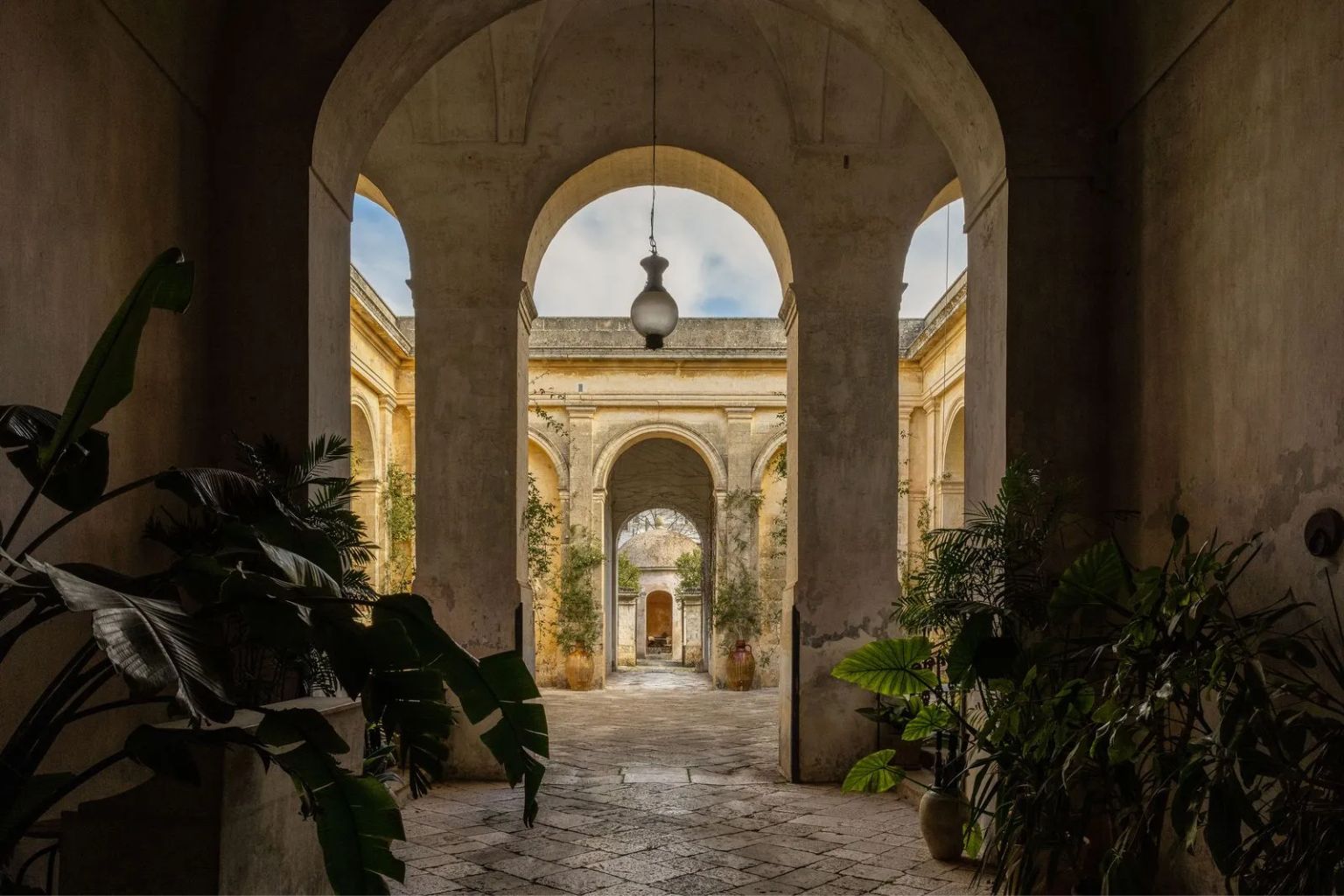
In the heart of Salento, at the southern tip of Apulia, Palazzo Daniele is one of the most refined transformations in contemporary Apulian hospitality. The project by Palomba Serafini Associati tackles a historic palazzo in Gagliano del Capo with a radical yet controlled gesture: emptying, lightening and letting frescoes, mosaics, proportions and architectural traces take center stage.
The result is a pared-back, almost monastic residence, punctuated by contemporary art, carefully selected furniture and generous voids. Palazzo Daniele does not treat the historic palazzo as a container to be filled, but as a space to be listened to. The design choice is subtle: taking away rather than adding, creating atmosphere through absence, and turning the hotel into a kind of artist’s house. It is a very clear example of cultured Mediterranean minimalism, where design works through subtraction and the power of memory.
10. Hotel Maalot, Rome — RPM Proget

A few steps from the Trevi Fountain, Hotel Maalot brings Roman hospitality into a more theatrical, contemporary register. The project is by RPM Proget, a Rome-based studio with solid experience in hospitality and restaurant spaces, and occupies a 19th-century historic building in the city center. The interiors create an intense atmosphere of color, pattern, decorative detail and dramatic rooms, without sacrificing the functional structure of a five-star hotel.
One of its most recognizable features is the relationship between hotel and restaurant, with Don Pasquale as the convivial heart of the project. Maalot is interesting because it rejects the international neutrality often associated with urban luxury, preferring a more narrative, dense Rome that feels almost like a private salon. Here design becomes a tool for character, turning a hotel into a distinctive address where hospitality, dining and the image of the city come together.
11. Lasserhaus Art Hotel, Bressanone — Vudafieri-Saverino Partners

In the historic center of Bressanone (Brixen), South Tyrol, Lasserhaus Art Hotel is the result of transforming a 15th-century aristocratic residence into an intimate four-star superior hotel. The project by Vudafieri-Saverino Partners plays on the dialogue between history and the present, respecting the building’s monumental character while introducing a new idea of hospitality that is intimate, cultured and almost domestic. The nine rooms, including suites, doubles and a single, create a sophisticated atmosphere in which the owning family’s painting collection meets works by contemporary artists.
The project’s value lies in turning a historic palazzo into a living place rather than a museum. Lasserhaus does not use art as mere decoration, but as part of the hotel’s identity: an element that ties together private memory, openness to the city and the building’s new hospitality role. It is a measured example of the contemporary art hotel, where restoration does not become nostalgia and design does not force the presence of the new.
12. Schgaguler Hotel, Castelrotto — Peter Pichler Architecture

In Castelrotto (Kastelruth), Schgaguler Hotel translates the imagery of the Dolomites into white, pared-back, luminous architecture. The project by Peter Pichler Architecture stems from the rebuilding of the existing hotel and adopts a controlled language based on pure volumes, large openings and a constant relationship with the landscape. The mountains are referenced not through decorative motifs but through proportion, light, views and materials.
The result is an Alpine hotel of great formal clarity, where every space seems built around the view of the Dolomites. Guest rooms, common areas and wellness spaces share a single idea of living: quiet, clear, almost suspended. Schgaguler is interesting because it shows how mountain hospitality can be contemporary without losing familiarity, and rigorous without turning cold.
13. Apfelhotel Torgglerhof, Val Passiria — noa* network of architecture

In Val Passiria (Passeier Valley), Apfelhotel Torgglerhof starts from a clear agricultural identity: the apple, the maso (the traditional South Tyrolean farmstead) and the cultivated landscape. The project by noa* network of architecture works with this imagery without turning it into a decorative theme. The extensions and wellness spaces engage with the terrain, the orchards and the family history of the property, creating a hotel that seems to grow out of the landscape rather than sit on top of it.
The most successful aspect of the project is precisely this continuity between architecture, nature and storytelling. The new rooms, common areas and wellness facilities do not seek isolated spectacle, but a slow form of immersion: greenery flows into the spaces, materials stay close to the rural world, and the design interprets South Tyrol’s farming culture with a contemporary eye. Apfelhotel is a powerful example of evolved rural hospitality, where design does not erase the productive origins of the place but turns them into an experience.
14. Palazzo Talìa, Rome — studiolucaguadagnino, Mia Home Design Gallery and Laura Feroldi Studio

In Rome, Palazzo Talìa occupies a historic building in the city center and brings a strongly authorial language to hospitality. The common areas are by studiolucaguadagnino, the design studio of film director Luca Guadagnino, while the rooms, suites and corridors are designed by Mia Home Design Gallery and Laura Feroldi Studio. The result is a hotel where the palazzo’s monumental character meets color, craftsmanship, textiles, custom furniture and an almost cinematic idea of space.
Palazzo Talìa is less interesting as a “luxury hotel” than as an exercise in atmosphere. Every room seems to follow a precise direction: the past is not left neutral but reinterpreted through tightly controlled textures, geometries, colors and details. The project shows how contemporary Italian interior design can work within history without constraining it, turning the palazzo into a layered, theatrical place that is never generic.
15. Casa Fantini Lake Time, Lake Orta — Lissoni Architettura

On the shores of Lake Orta, in Piedmont, Casa Fantini Lake Time was born from an idea by Daniela Fantini and designed by Lissoni Architettura. The hotel is conceived as an intimate eleven-room oasis, balancing contemporary architecture, nature, water and local culture. Piero Lissoni chose natural materials such as wood and stone, creating restrained, essential interiors that leave room for the light and the slow rhythm of the lake.
The project works because it does not try to compete with the landscape. Casa Fantini is all about proximity: the lake, the island of San Giulio, silence, materials and precise detailing. It is a small hotel with a strong design identity, where the design seems to spring from the same industrial and craft culture as the surrounding area. In this selection, it represents a form of quiet lakeside luxury, closer to contemplation than to display.