During Milan Design Week, the city seems to transform into a dimension made of luxury, flawless images and a constant search for beauty: perfect shop windows, glittering showrooms, installations curated down to the smallest detail. And yet, if we look more closely at what happens during Fuorisalone, a fascinating paradox emerges: crowds rarely gather only …
During Milan Design Week, the city seems to transform into a dimension made of luxury, flawless images and a constant search for beauty: perfect shop windows, glittering showrooms, installations curated down to the smallest detail.
And yet, if we look more closely at what happens during Fuorisalone, a fascinating paradox emerges: crowds rarely gather only in the most polished spaces of the historic centre or in the perfectly finished stands of the fair. More and more often, they move toward the edges of the city, into places that Milan itself seemed to have forgotten.
During the days of Milan Design Week, thousands of people queue to enter spaces removed from urban memory, places to which someone has chosen to restore dignity. Former slaughterhouses on the outskirts, underground tunnels and abandoned buildings come back to life, giving shape to an ecosystem that interprets the meaning of “Be the Project” in a concrete way.
In the contemporary world, people seem to have lost interest in exhibitions that look only like three-dimensional catalogues. Instead, there is a growing need to experience places, relationships and spaces able to respond to an increasingly evident social urgency.
This is precisely where one of the most current qualities of Italian design and contemporary Made in Italy emerges: the ability to place, alongside its historic industrial excellence, the capacity to become a social infrastructure, responding to the silent demand for aggregation that comes from the city.
This need has not been shaped only by the most traditional institutions. In recent years, independent projects and platforms have emerged with the aim of recovering disused urban areas and returning them to the city with a more authentic identity, creating true ecosystems.
Projects such as Alcova and Dropcity are making a significant contribution to the rediscovery and regeneration of Milan.
The essence of this transformation is clearly visible in the approach of Alcova Milano, the itinerant platform dedicated to independent and research-based design, founded in 2018 from an intuition by Valentina Ciuffi and Joseph Grima.
Far from the idea of serial production or a traditional fair, Alcova presents itself as a radical alternative to the prefabricated stand. Its goal is not to cover or neutralize spaces, but to preserve them in their real state, including all those imperfections that tell their story.
The result is a powerful dialogue between highly contemporary works and decaying architecture. In these settings, peeling plaster, dust and traces of time coexist with experimental installations and future technologies.
Over the years, Alcova has “unlocked” parts of the city that had previously been inaccessible, temporarily returning them to the community. A former slaughterhouse in Porta Vittoria was transformed into an industrial citadel crossed by new energies, while the former military hospital in Baggio became a surreal garden where the concept of exhibition took on the character of an almost archaeological exploration.
And yet, however revolutionary, Alcova’s magic remains ephemeral. Its projects last for the duration of Design Week and then disappear.
But what happens when this need for aggregation is no longer satisfied with just one week a year?
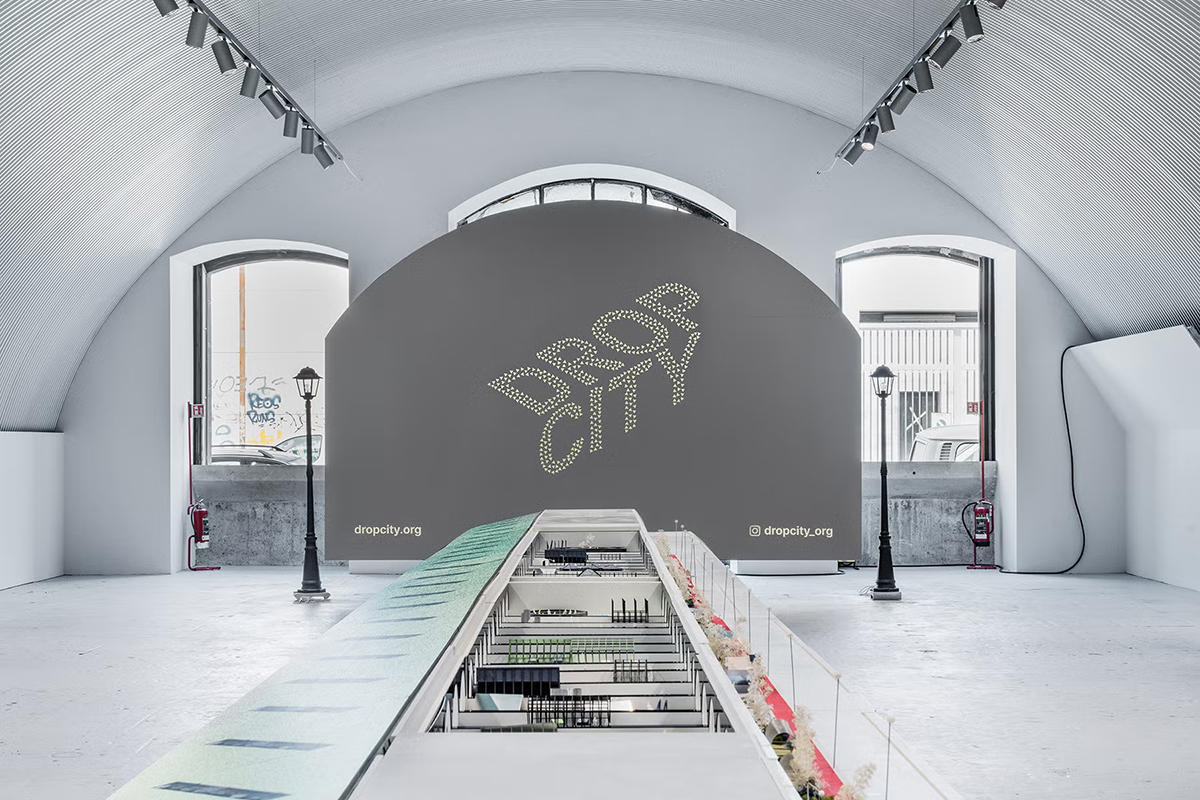
Dropcity tries to answer this question. Born from an idea by architect Andrea Caputo, the project aims to become a new centre for architecture and design in Milan.
The chosen location is emblematic: beneath the tracks of Milan Central Station stretches a system of monumental tunnels that, for decades, remained a dark and forgotten area of the city, often associated only with degradation and marginality.
During Fuorisalone, these spaces open up to debates, presentations and exhibitions. But the real specificity of Dropcity lies in its refusal of the idea of a simple temporary exhibition gallery.
The project was conceived as a true design district, where alongside exhibition spaces there are above all shared infrastructures: robotic fabrication laboratories, 3D printing areas, a material library, offices and classrooms dedicated to public debate.
In this case, industry does not enter only to show the best of itself, but to make tools available to the community. This is where design stops standing on a pedestal and becomes a space in which the city can rethink itself.
The platforms described here directly testify to the change currently taking place in the world of contemporary design. It is now an irreversible metamorphosis.
In today’s Made in Italy, the goal is no longer only to display finished forms and aesthetic perfection, but to build common ground, open a dialogue with society, and activate new possibilities for use and encounter.
Ultimately, this seems to be the most current meaning of “Be the Project”: a simple slogan that becomes the manifesto of a new nature of Italian design.
Today, Made in Italy no longer wants only to be looked at. It wants to be inhabited.
Italy’s historic manufacturing excellence thus becomes a means to return places of sociality, relation and participation to the community.
This contribution was selected among the 5 winners of the “Be the Project” contest, promoted by Archi&Interiors together with Hdemy Group, NAD – Nuova Accademia del Design and Accademia Cappiello.