Sforza Castle, known in Italian as Castello Sforzesco, is one of the most recognizable places in Milan. It is not just a fortress, nor simply a historic monument: it is a great urban machine whose history, over the centuries, has spanned ducal power, foreign rule, military transformations, restorations, museums and public life. Located in the …
Sforza Castle, known in Italian as Castello Sforzesco, is one of the most recognizable places in Milan. It is not just a fortress, nor simply a historic monument: it is a great urban machine whose history, over the centuries, has spanned ducal power, foreign rule, military transformations, restorations, museums and public life.
Located in the heart of the city, between the historic center and Parco Sempione, Milan’s largest central park, the Castle tells the story of a different Milan from the vertical, financial, contemporary one. This is the Milan of Renaissance courts, military defenses and the great families who shaped the city’s history, but also the Milan of accessible culture, civic museums and open spaces crossed every day by residents and visitors.
Today Sforza Castle is one of the most important symbols of Milan’s heritage. Its strength lies not only in its imposing architecture but in its ability to remain a living place: a monument, a museum, an urban thoroughfare, a cultural venue and a gateway to one of the city’s best-loved green spaces.
The origins of Sforza Castle
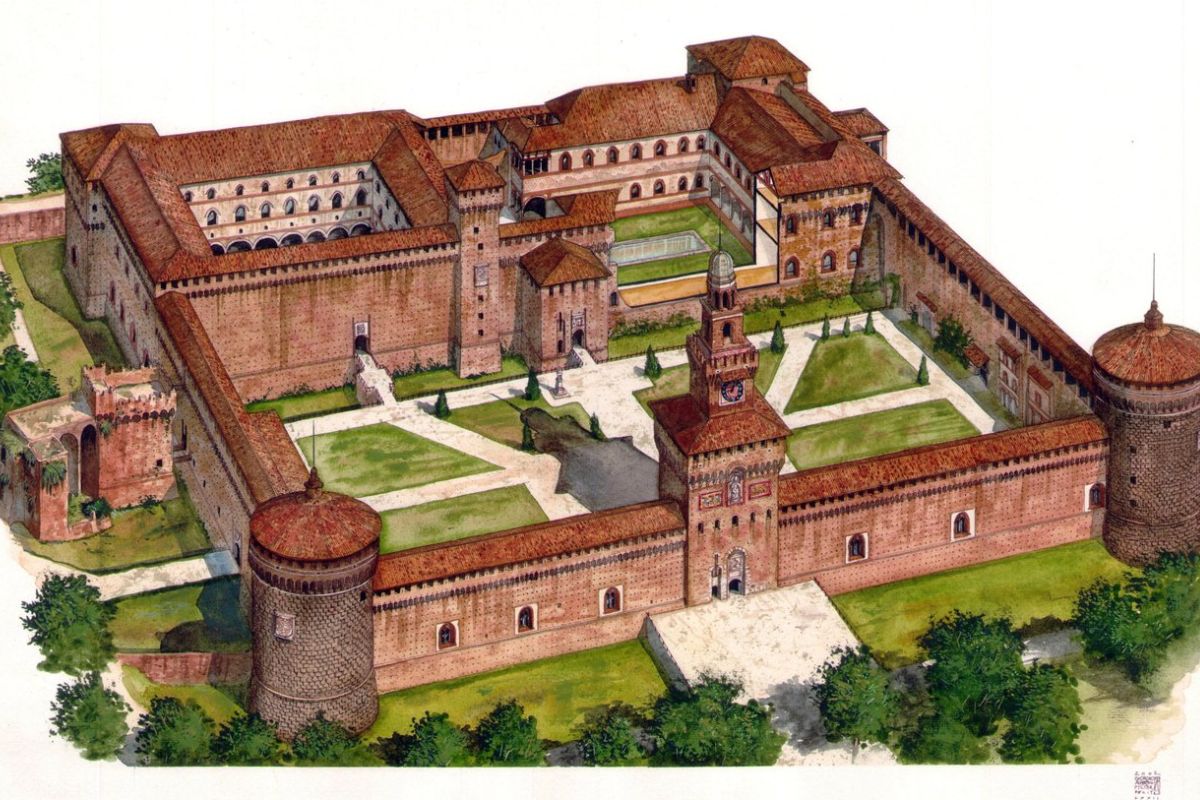
The history of Sforza Castle goes back to the 14th century, when Galeazzo II Visconti decided to build a stronghold in the Porta Giovia area of Milan. The Castle was therefore born as a defensive structure and as a sign of political control over the city.
Its location was no accident. Set at a strategic point in Milan, the complex had a military function but also a symbolic one: it represented the power of the ruling Visconti family and the often complicated relationship between the government and the city.
Over time the stronghold was altered, demolished and rebuilt. After the short-lived Ambrosian Republic, the Castle was rebuilt by Francesco Sforza, the new lord of Milan, who transformed the old Visconti structure into a fortified residence that would become one of the centers of Milanese power.
Francesco Sforza and the rebirth of the fortress
It was under Francesco Sforza that the Castle took on the name and identity by which we still know it today. The fortress was rebuilt and strengthened as a ducal residence, but also as a tangible image of the new dynasty ruling Milan.
Sforza Castle was not just a place to live in or defend. It was a political statement. Its towers, inner courtyards, walls and monumental spaces were meant to convey strength, continuity and prestige.
The Sforza family made the Castle one of the focal points of court life. From a military structure, the complex thus began to become a place of state ceremony, culture and artistic patronage as well.
The Castle in the age of Ludovico il Moro
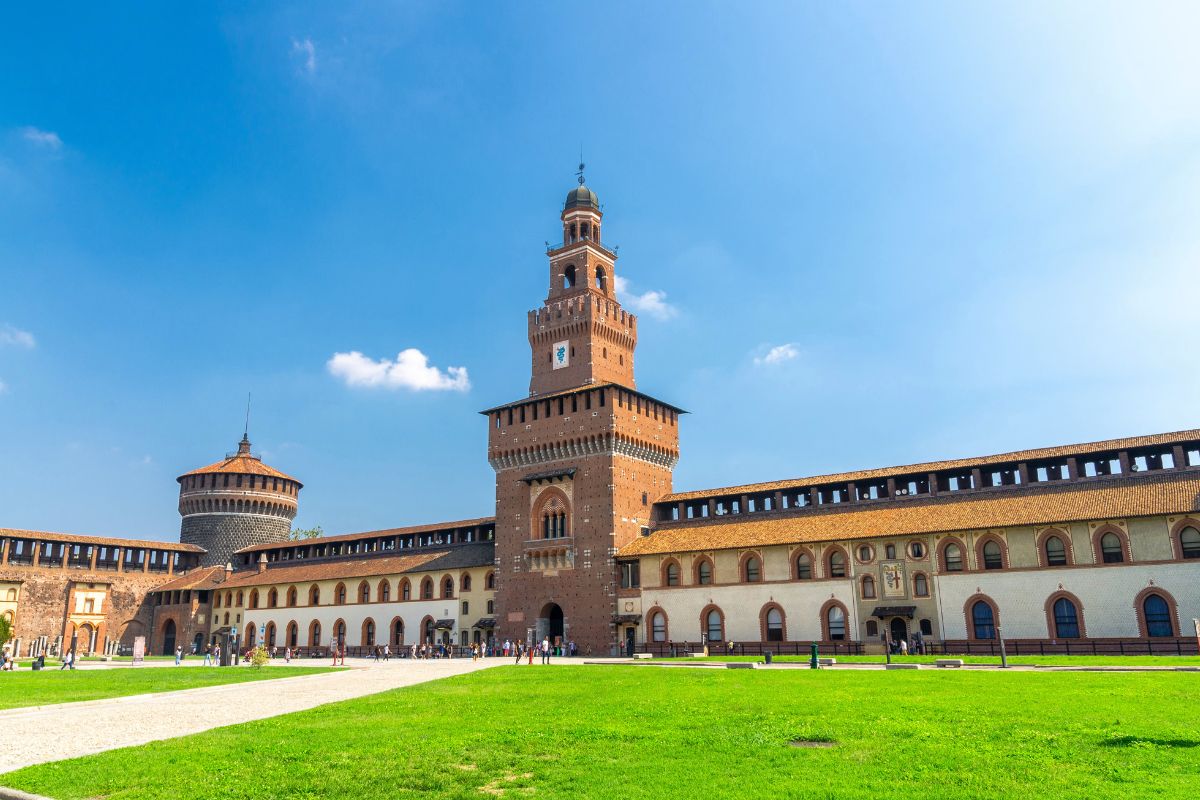
One of the most important chapters in the history of Sforza Castle coincides with the era of Ludovico Sforza, known as Ludovico il Moro. Milan became one of the most refined courts of the European Renaissance, and the Castle turned into a place frequented by artists, architects and intellectuals.
It was during this period that figures such as Leonardo da Vinci and Bramante entered the history of the Castle and the city. The Sforza court was not only a political center but also a cultural laboratory, where art, architecture, engineering and the representation of power were intertwined.
Among the best-known legacies of this period is the Sala delle Asse, linked to Leonardo da Vinci’s work. Its decoration, with interlacing trees and an illusionistic construction of space, reflects a Renaissance Milan that was cultured, ambitious and deeply connected to the visual culture of its time.
From ducal residence to military barracks
With the end of the Sforza era, the Castle gradually lost its role as a noble residence. Over the following centuries, under foreign rule, it was used mainly as a military structure and barracks.
The Spanish, Austrians and French changed the relationship between the Castle and the city. Once the seat of ducal power, the complex became a presence often perceived as distant, associated with military control and the political upheavals of the Duchy of Milan.
This long phase helped change the Castle’s image. No longer a Renaissance court, but a great defensive machine. No longer only a symbol of the city, but also a reminder of the foreign powers that ruled Milan from the early modern period onward.
Luca Beltrami and the restoration of the Castle
The great turning point came at the end of the 19th century, when Sforza Castle was restored and given back to the city thanks to Luca Beltrami. An architect, historian and driving force behind the monument’s recovery, Beltrami helped transform the Castle from a former military site into a major civic symbol.
The restoration was not just an architectural undertaking. It was also a cultural and urban project. Milan, by then part of a unified Italy, needed places in which it could recognize its own identity. The Castle thus became part of a new civic narrative: no longer a fortress cut off from the city, but a public monument, a cultural space and a site of collective memory.
It was in this phase that the Castle began to take on the role it still holds today: a place where history is not locked away in the past, but woven into the daily life of Milan.
Sforza Castle today: museums, collections and culture
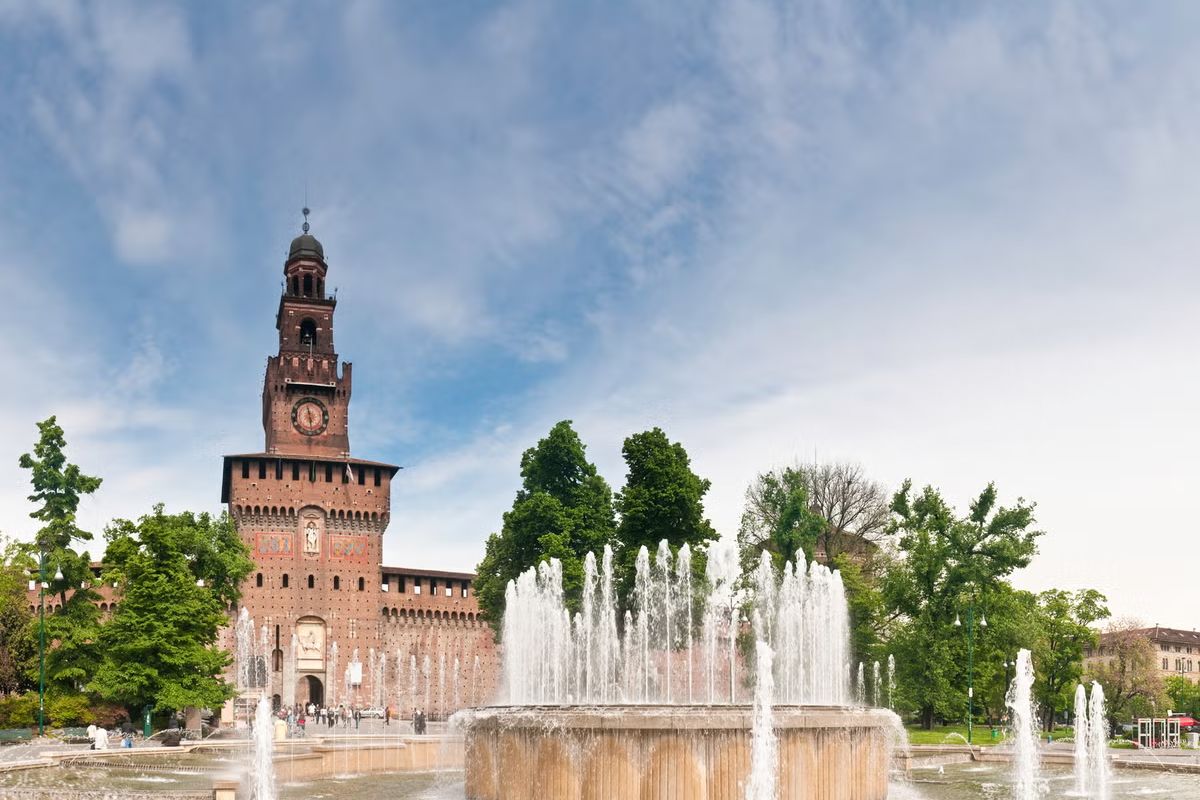
Today Sforza Castle houses museums and cultural institutions that make it one of Milan’s most important cultural hubs. Its collections span centuries of art, history and material culture: from sculpture to painting, from musical instruments to decorative arts, from archaeology to Michelangelo’s celebrated Rondanini Pietà.
This layering makes the Castle a special case in Italy. It is not a single museum but a complex cultural system, where historic architecture becomes the container for many different kinds of heritage.
Visiting the Castle therefore means moving through several layers of Milan: the medieval and Renaissance city, the city under foreign rule, the 19th-century city of restoration, and the contemporary city that uses culture as a space for public life.
The Rondanini Pietà and the symbolic value of the collections
Among the most important works held at Sforza Castle is Michelangelo’s Rondanini Pietà, one of the most intense and debated masterpieces of the artist’s final years.
The presence of this work gives the Castle added significance. It is not only a matter of preserving a masterpiece, but of placing it in a setting that itself speaks of the relationship between power, memory, fragility and transformation.
The Rondanini Pietà, with its unfinished, spiritual form, resonates powerfully with the Castle’s own history: a story of construction, collapse, restoration, changing uses and constant rebirth.
The Sala delle Asse and Leonardo da Vinci
Another key element in the Castle’s story is the Sala delle Asse, linked to Leonardo da Vinci. Located in the Corte Ducale (Ducal Court), the room preserves one of the most fascinating traces of Leonardo’s relationship with Milan.
The decoration Leonardo conceived transforms the space into a natural and symbolic setting, where branches, leaves, interlacing and perspective illusions create a kind of monumental arbor. It is a significant example of the Renaissance ability to merge art, nature, science and the representation of power.
The Sala delle Asse is still the subject of restoration work and research today, confirming that the Castle remains a place of study as well as a destination for visitors.
The relationship with Parco Sempione
One of the most interesting aspects of Sforza Castle is its relationship with Parco Sempione. Exiting through the back of the Castle, the monument opens onto one of Milan’s great green spaces, creating continuity between historic architecture, urban landscape and everyday life.
This relationship makes the Castle a place people pass through, not just visit. Its courtyards, gateways and pathways are part of the urban experience of Milan. Some come for the museums, some cross it on their way to the park, some photograph it, and some use it as a meeting point.
In this sense, Sforza Castle is not an isolated monument but a true cultural and urban infrastructure.
Why Sforza Castle is still a symbol of Milan
Sforza Castle remains one of the strongest symbols of Milan because it holds together many different identities. It is a fortress and a museum, a medieval memory and a Renaissance culture, military architecture and public space, a historic monument and an everyday place.
Its history is not linear. It is made up of power, destruction, reconstruction, foreign rule, restoration and new functions. That is exactly why it represents Milan so well: a city that is constantly changing, yet preserves in its architecture the traces of the transformations it has lived through.
Today, at the heart of an increasingly international metropolis, Sforza Castle remains a fixed point. Not only because it tells the story of the past, but because it continues to build connections between residents, visitors, art, architecture and urban space.
Architecture firms in Milan: 30 studios to know