At the Galleria Nazionale d’Arte Moderna e Contemporanea, design enters the scene as an architecture of experience. Through iconic seating, luminous atmospheres, and new strategies of cultural branding, art becomes an environment, while the visitor becomes the protagonist of a contemporary aesthetic way of inhabiting space. Design as an infrastructure of vision At the Galleria …
At the Galleria Nazionale d’Arte Moderna e Contemporanea, design enters the scene as an architecture of experience. Through iconic seating, luminous atmospheres, and new strategies of cultural branding, art becomes an environment, while the visitor becomes the protagonist of a contemporary aesthetic way of inhabiting space.
Design as an infrastructure of vision
At the Galleria Nazionale d’Arte Moderna e Contemporanea in Rome, the new exhibition layout does not simply introduce design into the museum space. It redefines its language, its attitude, and even its symbolic temperature. This is not a simple furniture update, nor a cosmetic operation designed to make the galleries more welcoming. Here, design enters as a critical discipline, as an infrastructure of vision, and as a tool able to transform the relationship between artwork, architecture, and the visitor’s body.
Created in collaboration with some of the most authoritative companies in the Italian and international design scene — from Agapecasa to Armani/Casa, from Cassina to Cappellini, from Flexform to Molteni&C, from Poltrona Frau to Zanotta, alongside Kartell, Porro, Rubelli, Slamp, Davide Groppi, and other leading names — the project treats design not as an accessory to art, but as one of its most mature and conscious expressions.
After all, especially in Italy, design has never been only industry applied to form. It has been design thinking, the ability to transform technique into culture, serial production into language, and function into vision. It is a discipline that has absorbed the pressures of modernity — globalization, innovation, competition, and changing patterns of consumption — translating them into a system of objects where beauty is never separated from constructive intelligence.
A more inhabitable museum: space, body, perception
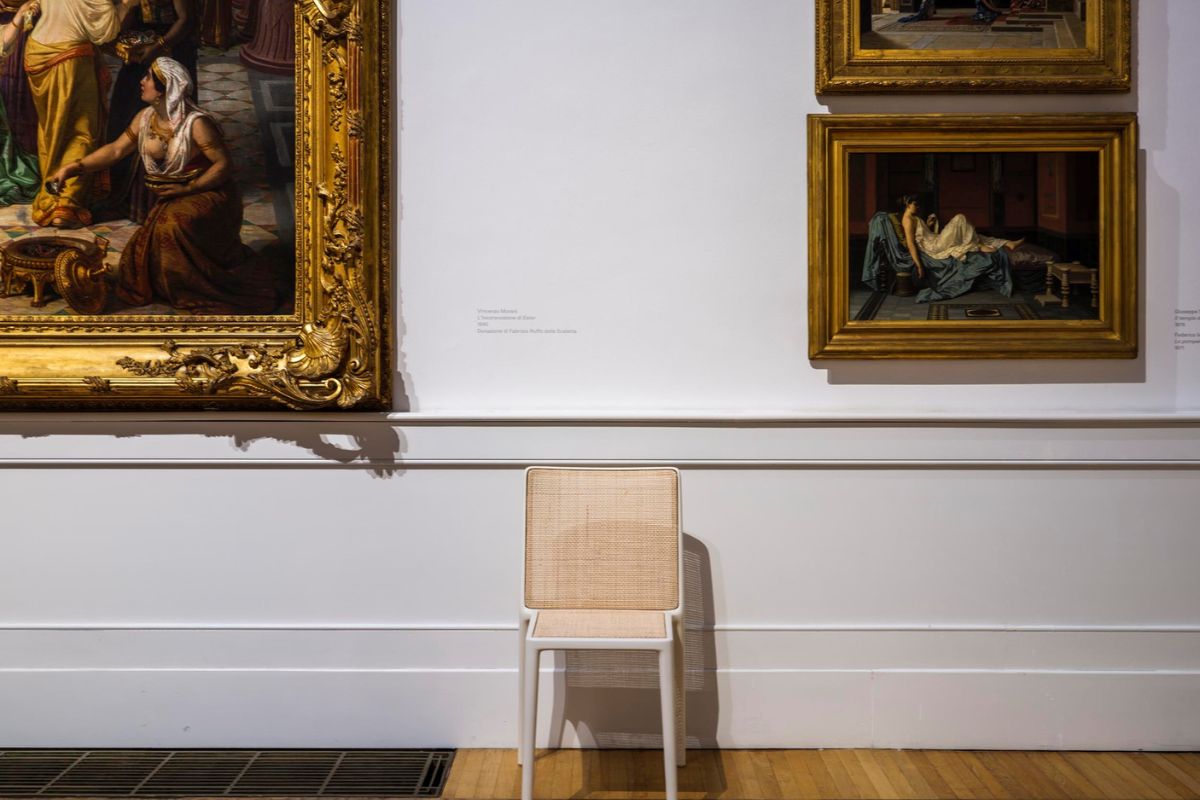
In this sense, the choice made by the GNAMC is especially meaningful. Placing iconic seating, lighting elements, fabrics, wall coverings, furniture objects, and environmental presences along the exhibition route means removing the museum from the abstraction of pure contemplation and returning it to an inhabitable dimension. The museum stops being only an optical machine and becomes, once again, a space of permanence. Visitors no longer move through the galleries like disciplined pilgrims, forced into a frontal and progressive experience. Instead, they are invited to pause, change rhythm, and measure their own body within the architecture. And it is precisely at this subtle threshold that the deepest transformation takes place.
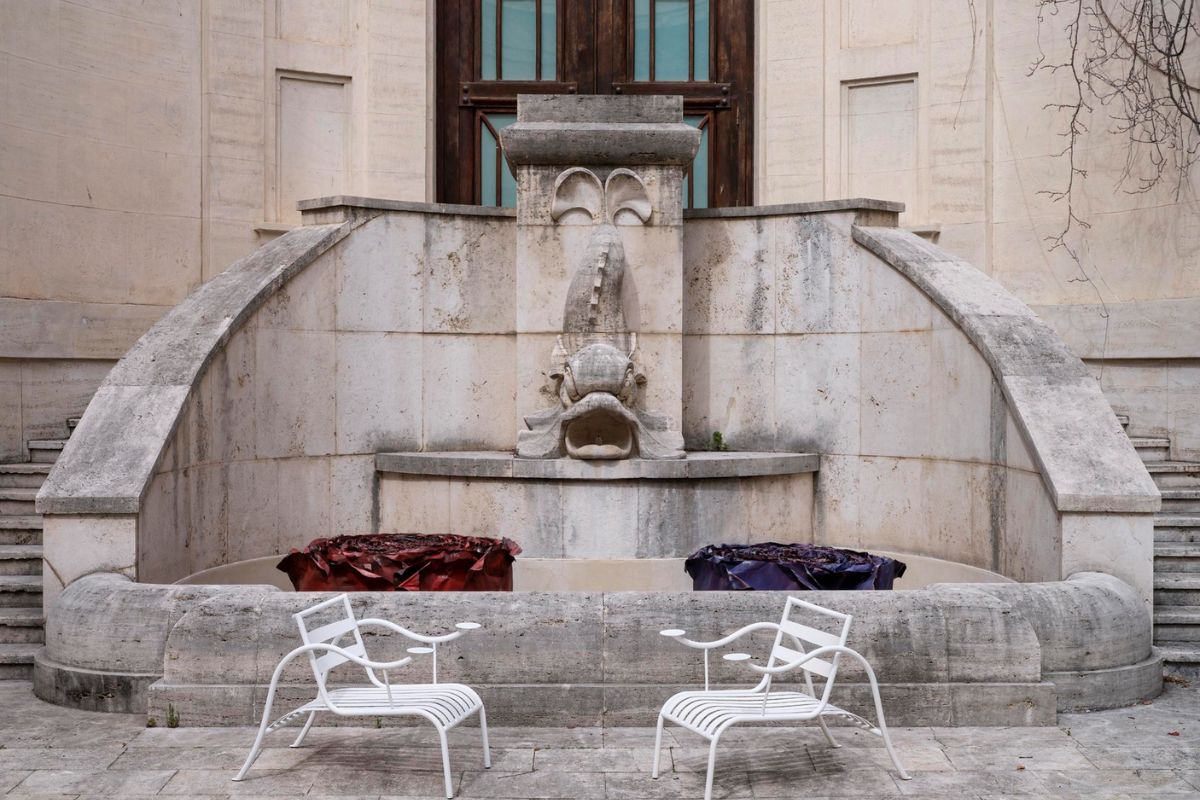
The seats placed throughout the museum route are not simple tributes to the history of Italian design, nor precious decorative insertions. They are spatial tools. They act on the time of vision. They impose a different choreography on the visitor. To sit means to slow down. To slow down means to look differently. A museum that allows the body to rest changes the perceptual regime of the artworks it contains. Art, from an isolated and almost sacred event, enters into a more complex relationship with the environment around it. It may lose part of its distance, but it gains a new relational intensity. It coexists with other objects, other functions, and other registers of living.
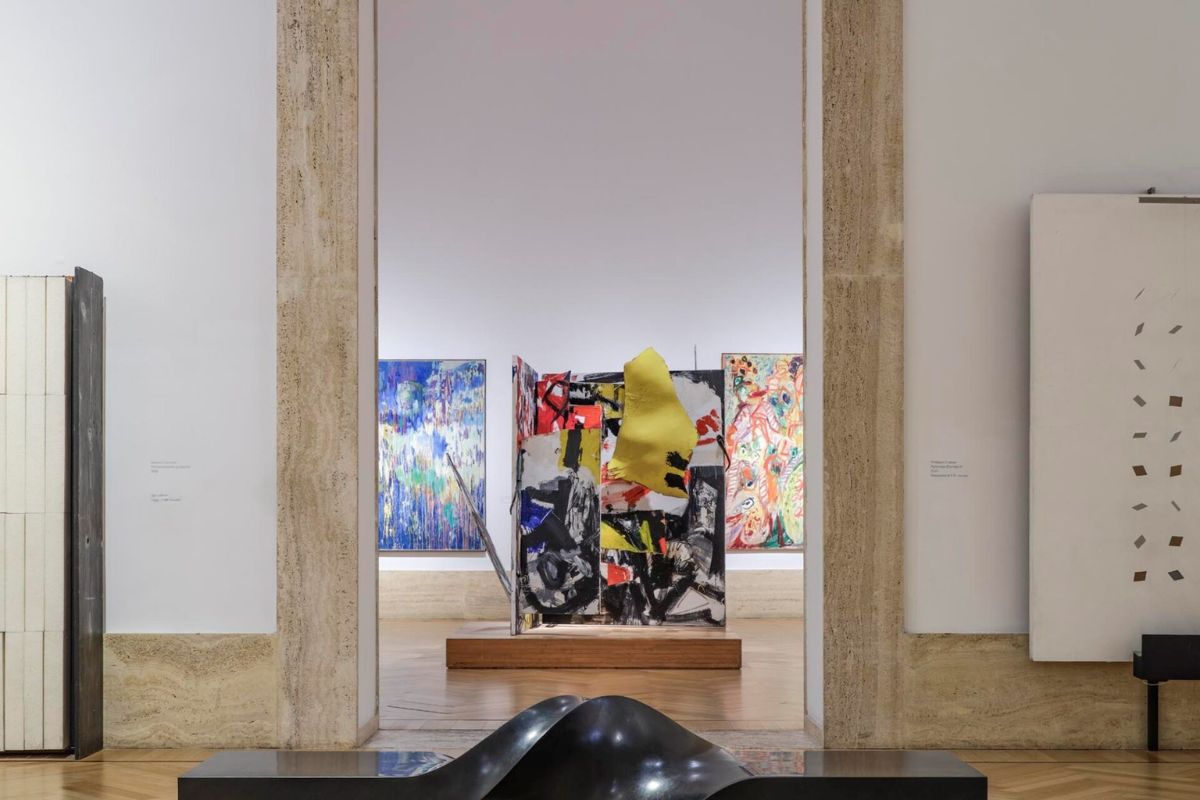
This is where the dialogue between visual arts and design becomes truly interesting, because it does not simply overlap languages. It builds a field of tension. On one side, the artwork preserves its irreducibility, its symbolic opacity, and its resistance to use. On the other, design introduces into the museum space the logic of function, comfort, and everyday proximity.
This coexistence is neither peaceful nor neutral. It creates friction. And friction is precisely its most fertile quality. The museum is not made more domestic in a banal or merely welcoming sense. It becomes more complex, more ambiguous, and more contemporary. It asks us not only to look, but to question what it means today to inhabit culture.
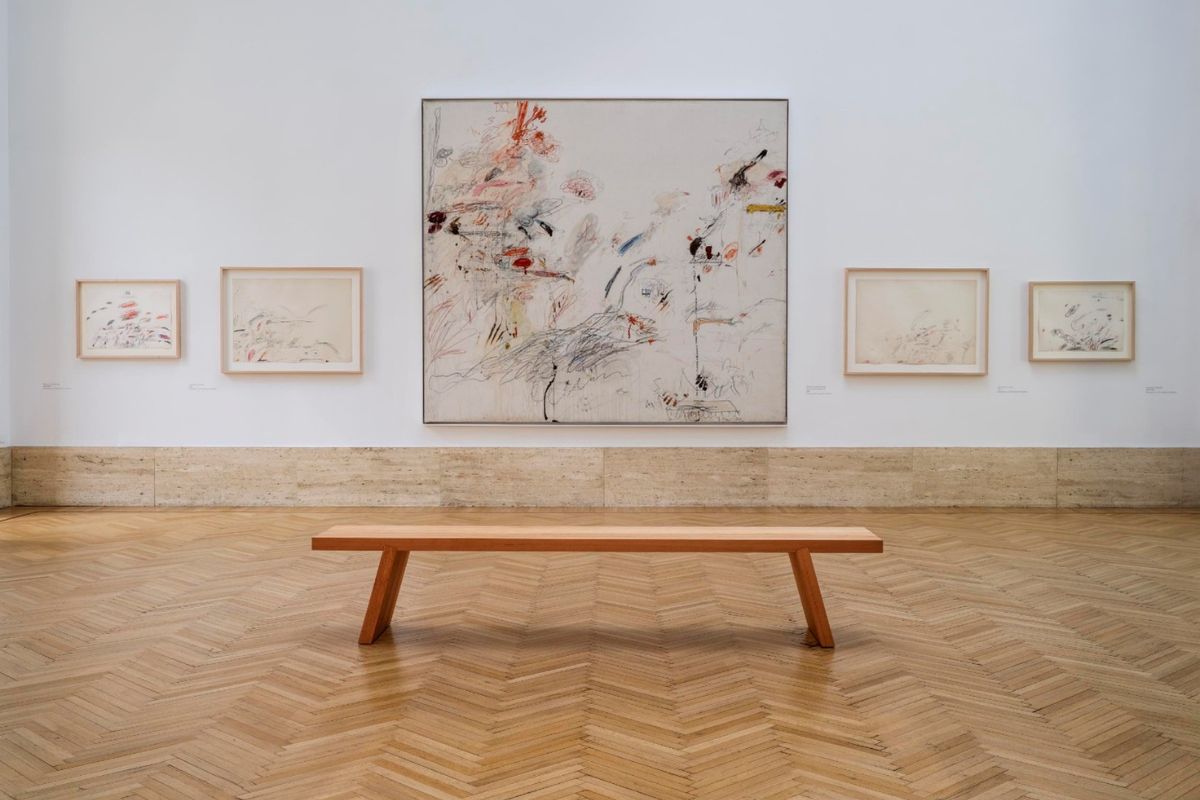
Light also plays a decisive role in this operation. It is no longer only the invisible medium that makes the artwork readable, but a true interpretive material. Lighting installations accompany, emphasize, and sometimes contradict. In an exhibition layout of this kind, light does not simply show. It builds hierarchies, guides emotion, and articulates spatial depth.
In the same way, fabrics, surfaces, colors, and curtains are not secondary elements. They are sensitive membranes that redefine the atmosphere of the galleries. Design, then, appears not only as an object, but as an environment. It does not simply stand beside art. It surrounds it, mediates it, and rewrites it through a different perceptual grammar.
All of this fits coherently within Italian cultural history, where design has always occupied a distinctive position: that of an art form able to think through reproducibility without betraying quality, and to delegate execution to engineering while keeping the poetic ambition of the project intact.
This, in the end, is the great lesson of Italian design: it has shown that a functional object can carry high symbolic value, and that technique does not weaken imagination. On the contrary, it can make it more widespread, more democratic, and more connected to the world.
The bookshop as the final exhibition room
The GNAMC extends this principle to the bookshop as well, and perhaps this is where the project makes its most radical gesture. The new merchandising line, conceived as a true curatorial extension, does not treat the museum shop as a residual space or a simple place of consumption, but as the “final exhibition room.”
This definition deserves attention. It means affirming that the museum narrative does not stop at the checkout counter, but continues through objects that reinterpret the poetics of the collection and transfer them into everyday life.
The cultural branding project, developed through calls for expressions of interest addressed to producers and designers, aims to create GNAMC-branded products that do not trivialize masterpieces, but translate them into new relationships of use, new forms of domestic and symbolic proximity.
The start of the collaboration with Guzzini, through a line of tableware objects, is emblematic. The table is one of the oldest places of sociability and the representation of taste. Bringing the echo of the museum collection there, even indirectly, means allowing art to leave its institutional frame and enter the most common gestures of daily life.
Of course, an operation of this kind involves a transformation. The uniqueness of the artwork gives way to the serial nature of the object. Contemplative distance becomes familiarity. The masterpiece, instead of imposing itself as unrepeatable, is disseminated through reproducible forms.
But this is not necessarily a loss. It can be, instead, a conscious mutation: the passage from the museum as a place of preservation to the museum as a cultural platform able to produce connections, symbolic economy, and circulation.
From the museum to Salone del Mobile 2026
From this perspective, the participation of the Galleria at Salone del Mobile 2026, inside the Ministry of Culture Pavilion and within the Made in MiC project, becomes easier to understand. This is not an accessory presence, nor a simple promotional operation. It is a statement of positioning.
The museum recognizes that its heritage does not live only through preservation, but also through the ability to be translated, shared, and relaunched within contemporary circuits. Here, Made in Italy is not evoked as an exhausted identity formula, but as an intersection of history, creativity, manufacturing knowledge, and economic intelligence. In other words, as a culture of design.
What does a museum gain — and what does it risk — when it becomes an environment?
Yet one critical question remains, and it is the most interesting one. When a museum becomes more comfortable, more inhabitable, and closer to the language of use and the market, what does it gain, and what does it risk losing?
On one hand, it certainly gains accessibility, porosity, and the ability to enter people’s real lives. On the other, it risks weakening the distance that once made the museum an “elsewhere”: a separate space, able to interrupt the flow of everyday life.
The challenge, then, is not simply the meeting between art and design, but the possibility of preserving the tension between these two dimensions: between contemplation and use, aura and function, exception and familiarity.
With this exhibition layout, the Galleria Nazionale does not offer a definitive answer — and rightly so. Truly contemporary projects do not close questions. They open them.
Here, the boundary between artwork and object becomes thinner, but it does not disappear. A continuity is established between museum and domestic environment, but so is a friction. It is in this ambiguity that the project finds its strength.
Because it reminds us that design, when it is thought and not ornament, does not simply make spaces more beautiful. It changes their ethics, their use, and the quality of experience. It also reminds us that the interior architecture of a museum is not made only of walls and artworks, but of thresholds, pauses, postures, lights, materials, and relationships.
From the exhibition galleries to the bookshop, the GNAMC therefore stages a substantial transformation: not simply a museum that welcomes design, but a museum that chooses to think of itself as a designed organism, a sensitive space where comfort, market, culture, and vision coexist in a balance that is still unstable, and precisely for this reason alive.
It is a courageous operation, because it accepts the risk of contamination. And every true contamination, when guided by strong thinking, does not impoverish. It complicates, enriches, and forces us to look more carefully.