Modern Mediterranean style interprets light, materiality and the relationship with the outdoors without turning the home into a holiday-house set. There is no single “Mediterranean interior”: Mallorca, the Cyclades, Sicily, the Levant and North Africa have different building traditions and material cultures. Yet the most convincing contemporary projects share several principles: mineral surfaces, stone and …
Modern Mediterranean style interprets light, materiality and the relationship with the outdoors without turning the home into a holiday-house set. There is no single “Mediterranean interior”: Mallorca, the Cyclades, Sicily, the Levant and North Africa have different building traditions and material cultures. Yet the most convincing contemporary projects share several principles: mineral surfaces, stone and timber, colours drawn from the landscape, carefully designed shade, transitional spaces and furniture that allows the architecture to breathe. In 2026, projects such as OHLAB’s Casa Óculo in Palma show how contemporary Mediterranean architecture can be restrained and technologically aware without losing tactility or its relationship with place.
What modern Mediterranean style means today
Talking about modern Mediterranean style is useful only when the term is understood as a contemporary design category, rather than a codified historical movement or a catalogue of compulsory elements.
The Mediterranean home promoted by commercial imagery is often reduced to white walls, linen, terracotta, blue ceramics and a few arches. Built architecture reveals something more interesting: design often emerges from the relationship between climate, light, shade, materiality and the ways outdoor spaces are inhabited.
Casa Óculo, completed by OHLAB in Palma, is a particularly clear example. The studio identifies light, materiality and climate as the main tools of the project. A large roof creates protected areas around the house, while orientation and openings regulate daylight and ventilation; stone, timber joinery, natural brass and lime mortar define the character of the interiors. In January 2026, Wallpaper described the project as an expression of contemporary Mediterranean living.
The lesson can also be applied to an apartment far from the coast: before decoration come light, proportions, materials and the quality of transitional spaces.
Light and indoor-outdoor living come before the colour palette
The most convincing feature of many contemporary Mediterranean projects is not the colour white, but the way light is controlled.
In climates characterised by intense solar exposure, openings, pergolas, walls, courtyards and roofs become architectural devices. The aim is not necessarily to bring in as much light as possible, but to filter it, frame it and create shade.
At Villa Mandra, designed by K-Studio in Mykonos, two rendered volumes and a third volume built from stone excavated on site are arranged around a large central outdoor area. A chestnut pergola protects the space and allows it to be used throughout the day. K-Studio describes the project as a reinterpretation of Cycladic tradition through contemporary materials and techniques, explicitly avoiding nostalgic architecture.
Casa Óculo takes a different approach. Its large roof creates perimeter porticoes and incorporates an oculus designed in relation to the seasonal path of the sun: light reaches the interior during the cooler months, while in summer it is more strongly contained within the terrace.
In an ordinary residential interior, the same principle can be translated without replicating these buildings: sheer curtains, shutters, screening devices, deep reveals and indirect artificial lighting are often more relevant than simply applying a “Mediterranean” colour palette.
Lime, stone, terracotta and timber: Mediterranean materials, but not universal ones
Certain materials appear frequently in architecture across the Mediterranean region, but this does not mean they belong to every area in the same way.
Lime and mineral surfaces
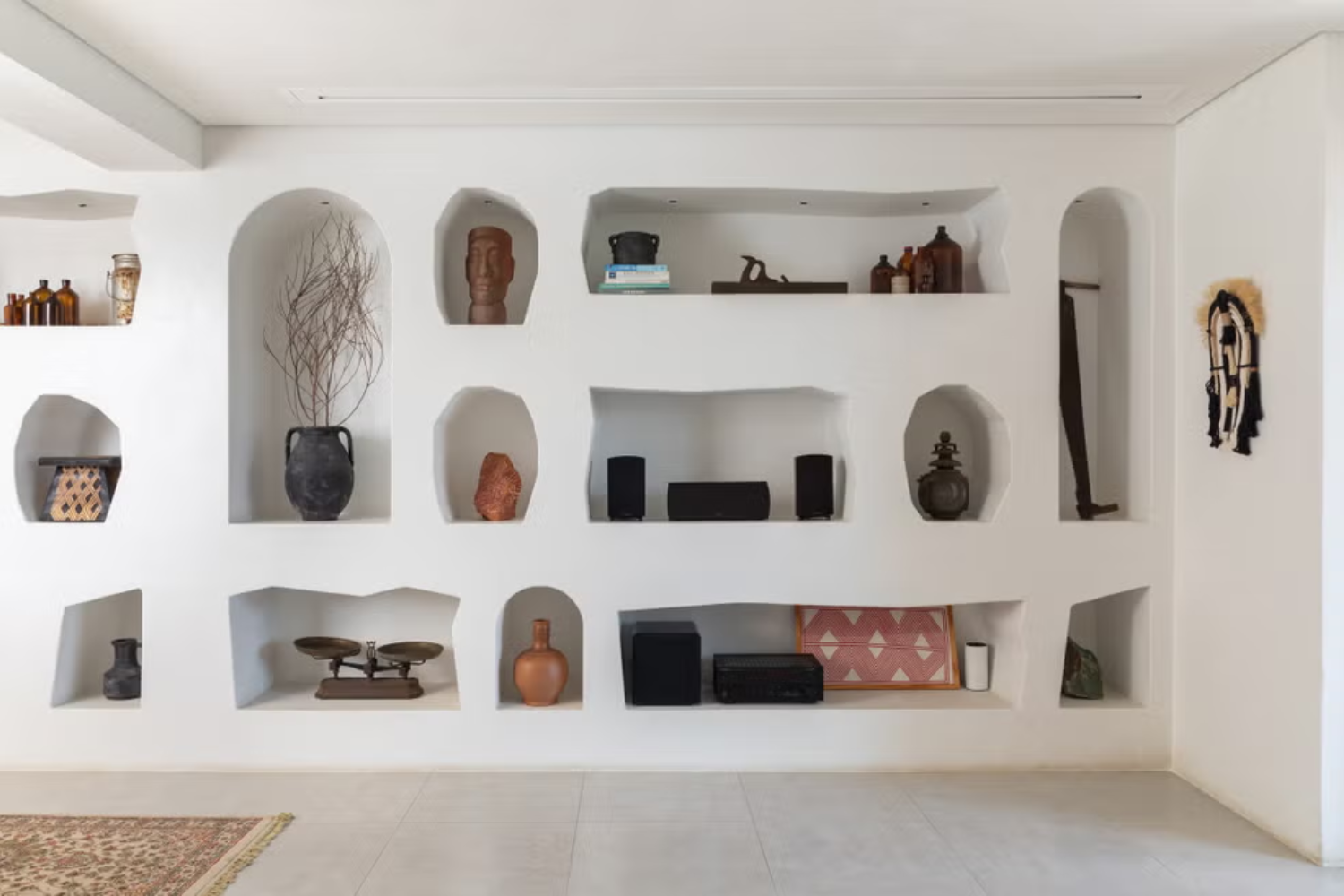
Lime-based finishes are particularly effective in contemporary interiors because they introduce a surface that is less uniform than perfectly smooth paint.
At Casa Óculo, the walls are finished in lime mortar; OHLAB highlights the ability of the material used in the project to develop a patina over time and contribute to the tactile quality of the building.
At Villa Mandra, by contrast, limewash is explicitly connected to Cycladic building language and is combined with stone and chestnut timber.
The point is therefore not to specify generic “Mediterranean white walls”, but to choose a surface with depth, responsiveness to light and coherence with the architecture.
Stone: better connected to place than chosen as an effect
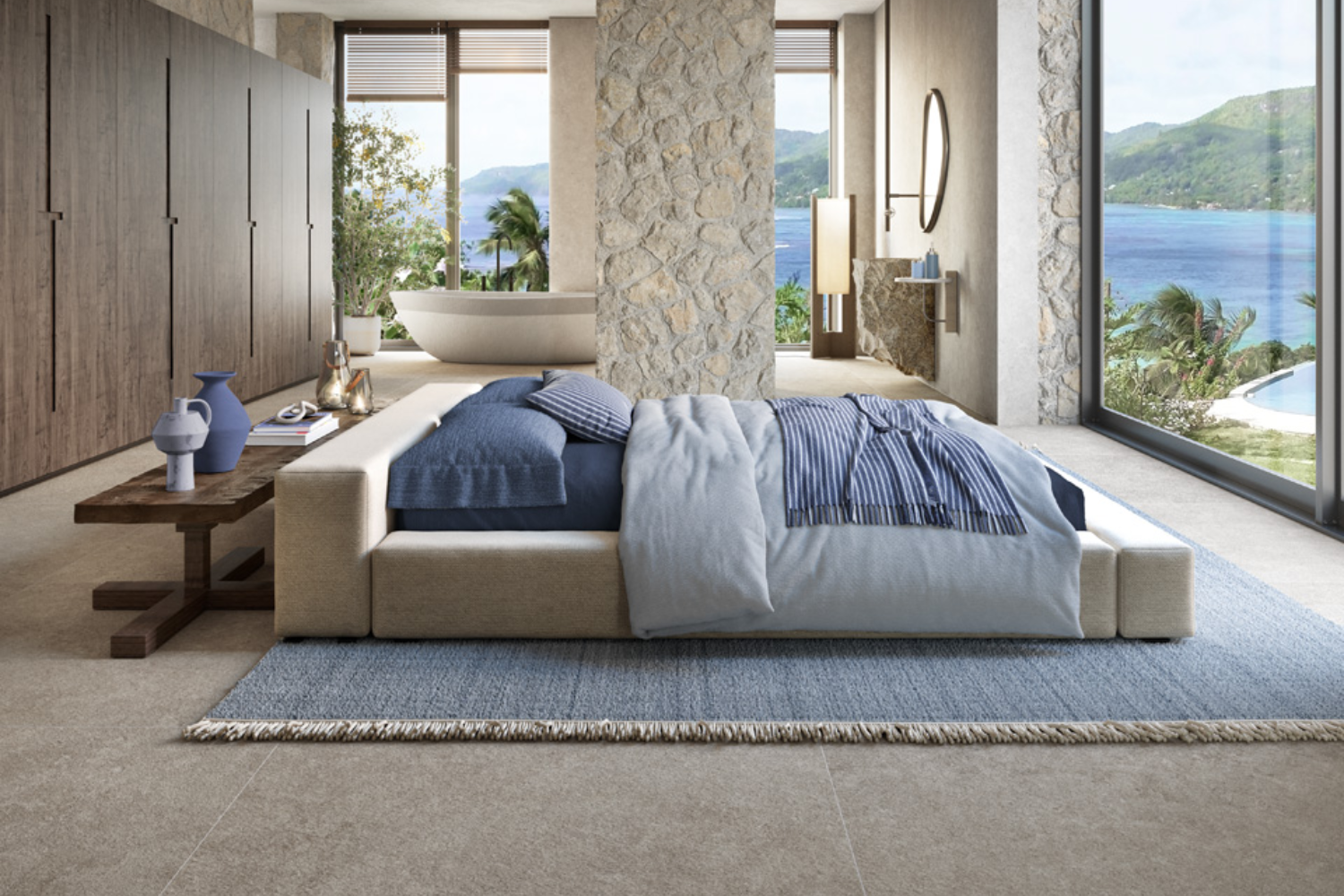
Stone is perhaps the material that most clearly reveals the diversity of Mediterranean architecture.
In Mallorca, OHLAB also uses local marés stone in the outdoor areas of Casa Óculo. In the Lebanese mountains, Villa A by Carl Gerges Architects develops a completely different language: the stone used for the building envelope reappears in hand-cut elements, mosaics, paving and gravel, combined with concrete and warm timber. The work is carried out with regional craftspeople, creating a direct material relationship with the mountain landscape.
This comparison shows why speaking generically of “Mediterranean stone” is imprecise. Colour, cut, texture and installation technique belong to specific contexts.
Terracotta and cocciopesto do not have to look rustic
Terracotta, ceramics and cocciopesto-based surfaces can be incorporated into highly disciplined contemporary interiors.
Villa Modda, the restoration of a rural complex in the Val di Noto by depaolidefranceschibaldan architetti, works with natural materials and techniques linked to local construction. In the project, the new extension uses pigmented cocciopesto, while floors and surfaces establish chromatic continuity with the surrounding stone and soil.
This is very different from treating terracotta as a decorative accessory. The material becomes part of the architecture and the colour palette, rather than a symbol inserted simply to announce “Mediterranean”.
Modern Mediterranean colours go far beyond white and blue
The combination of white and blue clearly relates to certain island architectures, particularly within the visual identity of the Cyclades, but turning it into a universal rule erases much of the Mediterranean’s chromatic diversity.
A contemporary palette can begin with:
lime white, ivory, sand, stone, clay, ochre, terracotta, tobacco, olive, botanical greens, timber browns and darker mineral tones.
Villa A in Lebanon works mainly with stone, concrete and timber, allowing landscape and light to generate the chromatic variations.
At Villa Modda, by contrast, colours derive from the land around Noto: the cocciopesto used in the extension incorporates pigments that echo the soil and agricultural landscape.
A modern Mediterranean home can therefore be light or dark, almost monochromatic or more colourful. What matters is that the palette appears to emerge from materials and light rather than from a pre-packaged thematic image.
Contemporary forms: arches are not compulsory
Another cliché is the idea that a Mediterranean interior must necessarily include arches, rounded niches and curved masonry.
These elements genuinely belong to many architectural traditions across the region, but they do not form a universal grammar. They can be retained or reinterpreted when they derive from the building itself; systematically adding them to a contemporary apartment risks producing a theatrical effect.
Casa Óculo uses large horizontal planes and linear load-bearing walls. Villa A works with modernist lines, stone and concrete. Villa Mandra combines simple white volumes, stone walls and a lightweight pergola structure. They are three very different expressions, yet all retain a recognisable relationship with their own Mediterranean context.
In interiors, a more convincing strategy is to balance clean lines with a small number of softer elements: an oval table, an enveloping chair, a sculptural lamp or a gently curved wall when the architecture justifies it.
How to choose furniture without creating a holiday-home look
Furniture should avoid becoming a collection of recognisable Mediterranean signals.
Rattan, rope, linen, ceramics, rustic timber, woven lamps and white sofas can all work individually. Used together, they can quickly become a formula.
A more sophisticated interior instead creates a dialogue between contemporary pieces, handcrafted furniture and a limited number of recurring materials. A monolithic kitchen can coexist with a solid timber table; a modernist armchair with a handmade ceramic piece; a mineral surface with stainless steel or a highly technical light fitting.
Villa A also demonstrates this approach: its interiors combine stone and concrete with warm timber while maintaining a disciplined rather than rustic composition.
Craftsmanship gains value when it is specific and legible, rather than used as generic scenery.
Coastal and urban Mediterranean interiors require different approaches
Modern Mediterranean style does not need to be confined to villas overlooking the sea.
A coastal house can organise much of domestic life around terraces, pergolas and gardens. Villa Mandra, for example, develops its social centre beneath a large pergola opening towards the Aegean landscape.
An urban home, by contrast, must respond to privacy, neighbouring buildings, noise and different levels of daylight. Here, Mediterranean character can emerge through a courtyard, loggia, continuous flooring, the depth of openings or the materiality of the walls, without attempting to imitate a seaside villa.
Existing buildings also provide useful examples. In the historic centre of Artà, Mallorca, the refurbishment of a former printing press published by ArchDaily in 2026 preserves the memory of the building while redefining its relationship with light and contemporary domestic life.
In Lebanon, Beihouse in Beirut combines historic buildings, local craftsmanship and new elements in Corten steel and glass, showing how an architectural language rooted in the eastern Mediterranean can remain deeply urban.
Authenticity begins with place, not with imitating an image
Perhaps the most interesting quality of the contemporary Mediterranean is precisely what makes it impossible to reduce it to a rigid style.
K-Studio refers to Cycladic tradition at Villa Mandra because the project is in Mykonos and responds to that landscape and those building techniques. OHLAB uses marés stone and interprets Mallorca’s climate. Villa Modda grows out of agricultural ruins and the materials of the Val di Noto. Carl Gerges Architects works with stone and regional craftsmanship within Lebanon’s mountain landscape.
They are not variations of the same house.
What they share instead is a method: reading the context and transforming some of its qualities into contemporary space.
For this reason, even a project far from the sea can develop a credible Mediterranean attitude when it responds to local light, appropriate materials, continuity between indoors and outdoors and a certain economy of elements.
Mistakes that turn Mediterranean style into a decorative theme
The first mistake is using white and blue as an automatic formula. It may be appropriate in a particular context, but it does not represent the Mediterranean as a whole.
The second is adding arches where the architecture does not require them. A curve without a purpose often remains little more than a stylistic gesture.
The third is accumulating “natural” materials: travertine, terracotta, rattan, timber, linen, jute and ceramics all in the same room can create exactly the thematic effect the design was trying to avoid.
The fourth is ignoring the city. An apartment in Milan, Marseille or Beirut does not need to pretend it is a house in Formentera. It can instead work with its own relationship to light, courtyards, terraces and materiality.
The fifth is confusing rusticity with authenticity. A rough surface is no more authentic than a precise geometry. Villa Mandra provides a particularly effective example: hand-built stone walls coexist with extremely crisp rendered volumes and a traditional pergola reinterpreted through its structure.
The sixth is designing the interior independently from the exterior. In the strongest contemporary examples, vegetation, terraces, courtyards, sky and light are as much a part of the composition as the sofa and dining table.
Modern Mediterranean style becomes convincing precisely when it stops searching for a universal Mediterranean image. A house in Noto may grow from cocciopesto and rural stone; in Mykonos, from lime, site-sourced stone and the shade of a pergola; in Mallorca, from marés stone and careful control of sunlight; in Lebanon, from stone, concrete, timber and regional craftsmanship. Materials and forms change, while the same attention remains towards climate, materiality, light, landscape and the quality of life between indoors and outdoors. It is on these principles, rather than decorative clichés, that a genuinely contemporary Mediterranean interior can be built.