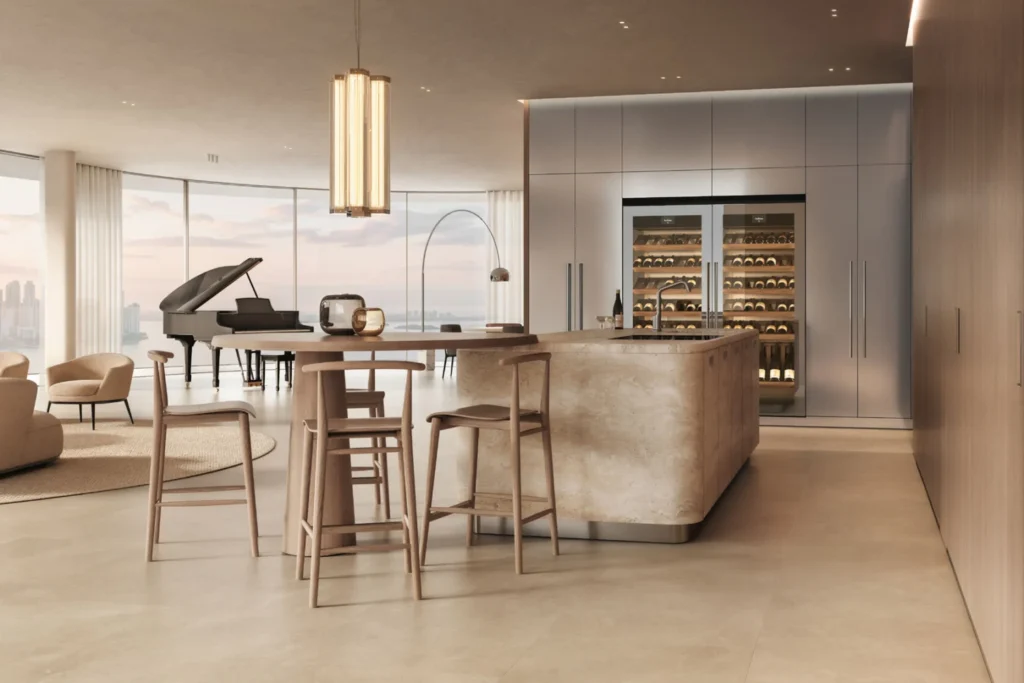
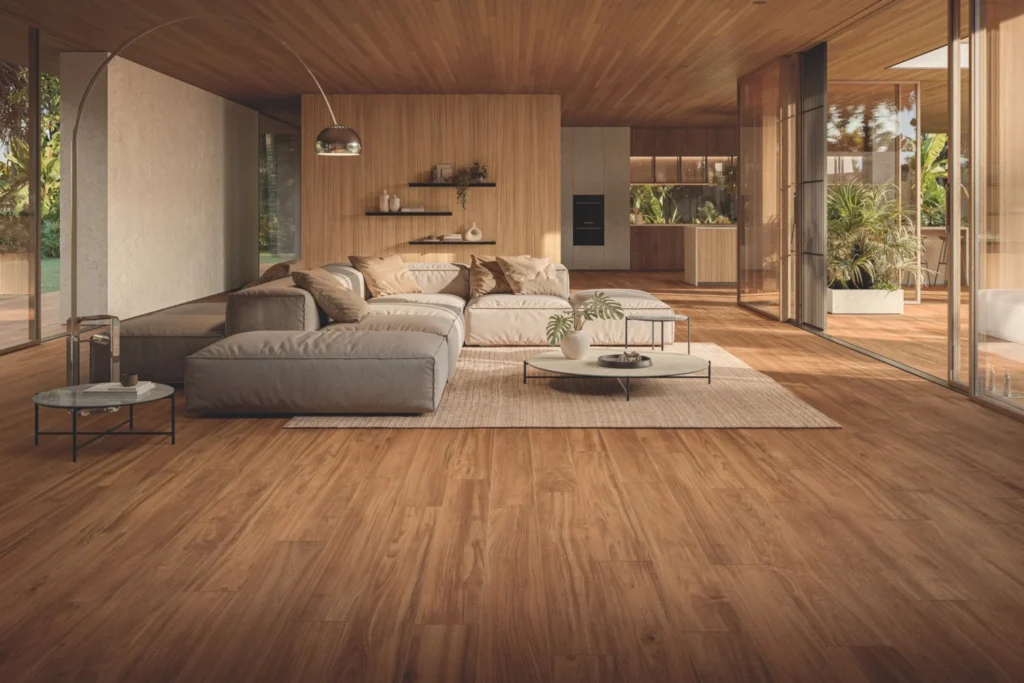
Lime paint is a mineral finish that uses lime as a binder and creates matt, deep and chromatically irregular walls. In its traditional form, limewash consists essentially of slaked lime, water and, where required, compatible pigments; contemporary formulations can instead be more complex ready-to-use products. Its most interesting quality in interiors is its ability to …
Lime paint is a mineral finish that uses lime as a binder and creates matt, deep and chromatically irregular walls. In its traditional form, limewash consists essentially of slaked lime, water and, where required, compatible pigments; contemporary formulations can instead be more complex ready-to-use products. Its most interesting quality in interiors is its ability to respond to light without creating a perfectly uniform surface. It should, however, be distinguished from lime putty, lime plaster, marmorino and conventional paints that merely imitate the effect: material, substrate and application system determine both the appearance and the vapour permeability of the wall.
What is lime paint?
The simplest definition begins with traditional limewash. The Society for the Protection of Ancient Buildings describes it as a matt paint made from lime and water, to which pigments resistant to an alkaline environment and, historically, certain additives may be added. During curing, calcium hydroxide gradually reacts with carbon dioxide to form calcium carbonate again: this is the carbonation process of lime.
In the contemporary Italian market, “lime paint” can also refer to ready-made formulations based on lime putty and pigments. Kerakoll, for example, classifies Biocalce Tinteggio as a wall paint based on pure CL 90-S lime putty and coloured earth pigments. This makes it clear why lime paint should not be treated as a single universal recipe: composition and performance should always be checked in the technical data sheet of the chosen product.
Lime paint, limewash, lime putty and lime plaster are not the same
The terminology is often mixed together, especially when the aim is to create a generic “textured wall”. The differences, however, are substantial.
| Material | What it is | What it does to the wall |
|---|---|---|
| Limewash | A liquid finish traditionally based on slaked lime and water | Adds colour without creating a thick layer and allows the behaviour of the substrate to remain visible |
| Lime paint | A broader category of paints formulated with a lime-based binder | Creates a matt mineral finish; composition and application vary by product |
| Lime putty | A matured paste of hydrated lime | Acts as a raw material or binder for paints, stuccoes, marmorino and mortars |
| Lime plaster | A coating applied in thickness, made from a binder and aggregates | Builds up or physically levels the wall surface |
| Marmorino / fine lime render | A mineral finish applied in a thin layer, often with mineral fillers | Creates a more compact and materially structured surface than paint |
Fassa Bortolo defines lime putty as a hydrated lime paste that can be used as a binder or to create stuccoes, marmorino and smooth finishes. A fine lime render, by contrast, also contains aggregates or mineral fillers and is applied in thickness: Kerakoll’s version, for example, is available in different grain sizes and contains lime putty, coloured earth pigments and marble.
The difference becomes clear when looking at a wall: paint mainly changes colour and response to light; plaster or marmorino can also alter grain, flatness and the physical consistency of the surface.
Why lime paint looks so different from a uniform wall paint
A highly opaque synthetic paint tends to create a visually homogeneous field of colour. With lime, by contrast, the absorption of the substrate, the amount of material and the movement of the brush can remain visible.
This is what creates the characteristic washed, clouded or gently mottled effect, with areas that respond differently to light. Portola Paints notes that the finish is applied by brush using overlapping strokes and that darker colours generally tend to show more variation than lighter shades. Bauwerk likewise recommends thin coats and continuous application to avoid overly sharp lines.
This irregularity should not be confused with three-dimensional texture. A lime-painted wall can feel almost smooth to the touch while still appearing highly tactile because the depth is primarily optical.
Lime paint colours go far beyond white
The association between lime and white comes from a long building tradition, but lime paint can be pigmented.
Earth pigments and oxides compatible with lime have historically been used to create different shades, while contemporary collections extend the palette even further.
For contemporary interiors, particularly effective choices include:
ivory, lime white, sand, mineral beige, taupe and greige when a restrained surface is desired; clay, terracotta, ochre and dusty pink for greater warmth; olive green, sage and mineral tones when the colour needs to work with timber and stone; and blues, browns and very deep shades when the aim is to make tonal variation more visible.
There is, however, no perfect correspondence between a colour sample and the finished wall. Absorption, natural light and application technique all affect the final appearance; manufacturers therefore recommend preliminary tests on the actual substrate or on samples prepared in the same way.
Which walls can lime paint be applied to?
The ideal substrate for traditional limewash is mineral, porous and absorbent.
Lime plaster, certain mineral renders, brick and compatible stone allow the finish to penetrate the substrate without requiring a surface film. SPAB lists lime plaster, render, earth walls and limestone among traditionally compatible backgrounds.
The situation changes with contemporary wall constructions.
Plasterboard and gypsum plaster
This does not mean that lime finishes cannot be used on plasterboard. It means that a specific preparation system is required.
For new or repaired plasterboard, Bauwerk specifies a preparation method designed to equalise absorption and joints before applying its limewash finish. Portola similarly requires a primer and its own undercoat on new drywall.
Previously painted walls
Existing paint can also be covered with some contemporary systems, but lime should not simply be applied over any glossy or impermeable surface.
Manufacturers use specific primers or bridge coats to create a suitable base. It is also important to remember that when a less permeable layer sits beneath a permeable finish, the overall performance of the wall build-up no longer automatically corresponds to that of the lime paint alone. In historic buildings, compatibility across the entire system is therefore more important than appearance alone.
Breathability: a real advantage, but one that needs correct interpretation
One of the most relevant technical characteristics of traditional lime finishes is their vapour permeability.
SPAB and Historic England recommend permeable finishes such as limewash in many traditional buildings because they allow lime-based wall systems to continue managing the passage of water vapour without being sealed beneath impermeable coatings. Historic England also documents cases in which non-permeable paints applied to historic structures can contribute to moisture becoming trapped within the wall.
This does not justify turning “breathable” into a generic health claim.
Permeability concerns the hygrothermal behaviour of the surface and the wall build-up. It does not automatically mean that a paint makes an interior healthier, eliminates damp problems or resolves mould caused by water ingress, thermal bridging or insufficient ventilation.
Where to use lime paint in interiors
In living rooms and bedrooms, it is relatively easy to take advantage of the aesthetic qualities of lime paint because walls are generally less exposed to grease, water and cleaning products.
A contemporary approach is to extend it across all walls and the ceiling, allowing changes in light to replace the traditional contrast between coloured walls and a white ceiling. Alternatively, it can be used on a single surface when depth is desired without introducing a physically textured finish.
A Mexico City apartment published by Architectural Digest, for example, uses pale yellow limewash in the bedroom and a terracotta tone along the staircase, combining it with timber, clay, fibres and contemporary pieces. The example is useful because it shows how the finish can work in a recent interior without imitating a historic setting.
Lime paint in bathrooms
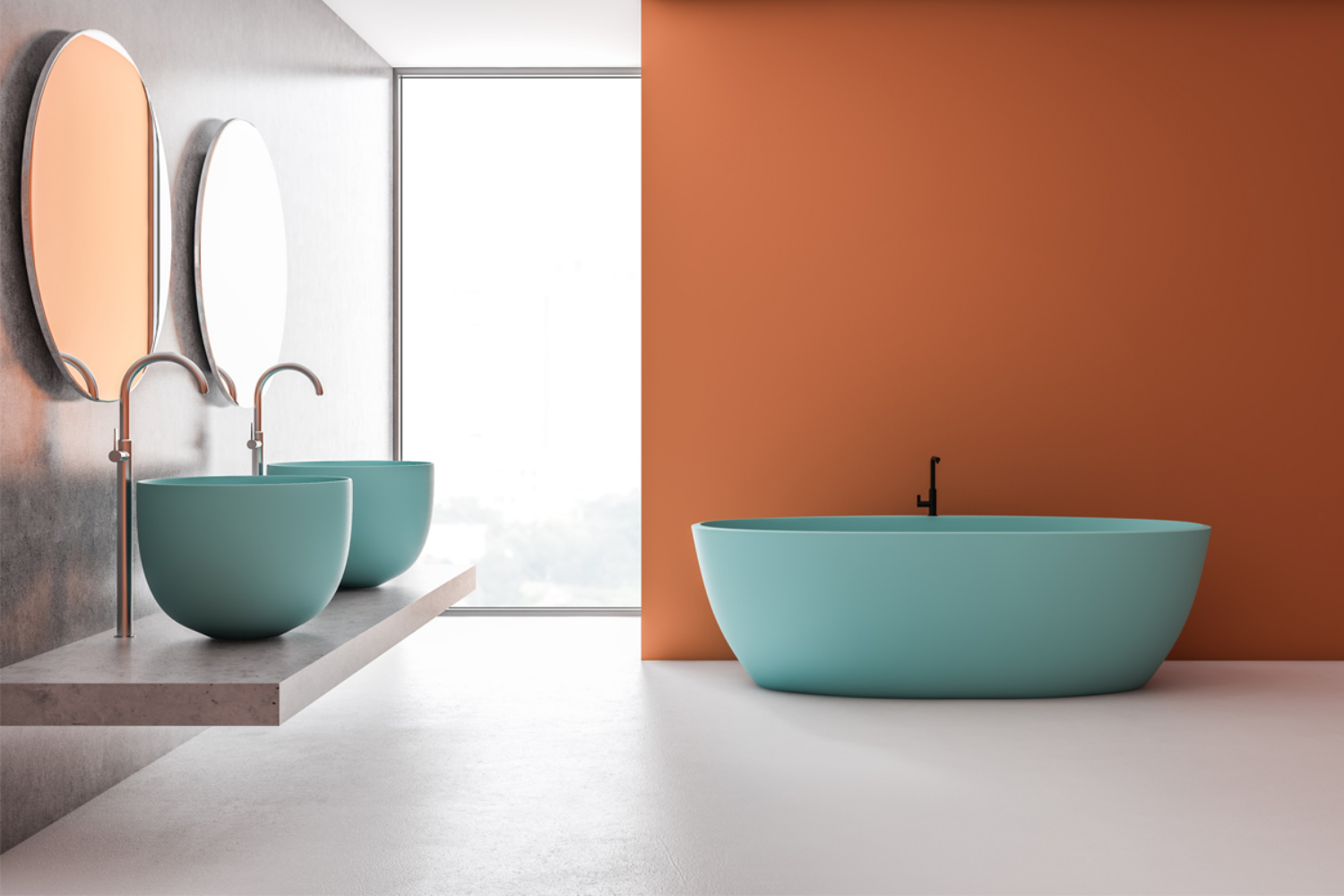
It can be used in various areas of a bathroom, but it should not automatically be treated as a waterproof finish.
Bauwerk, for example, advises against using its limewash inside showers and immediately around baths, recommending water-resistant materials in areas exposed to splashes.
Lime paint in kitchens
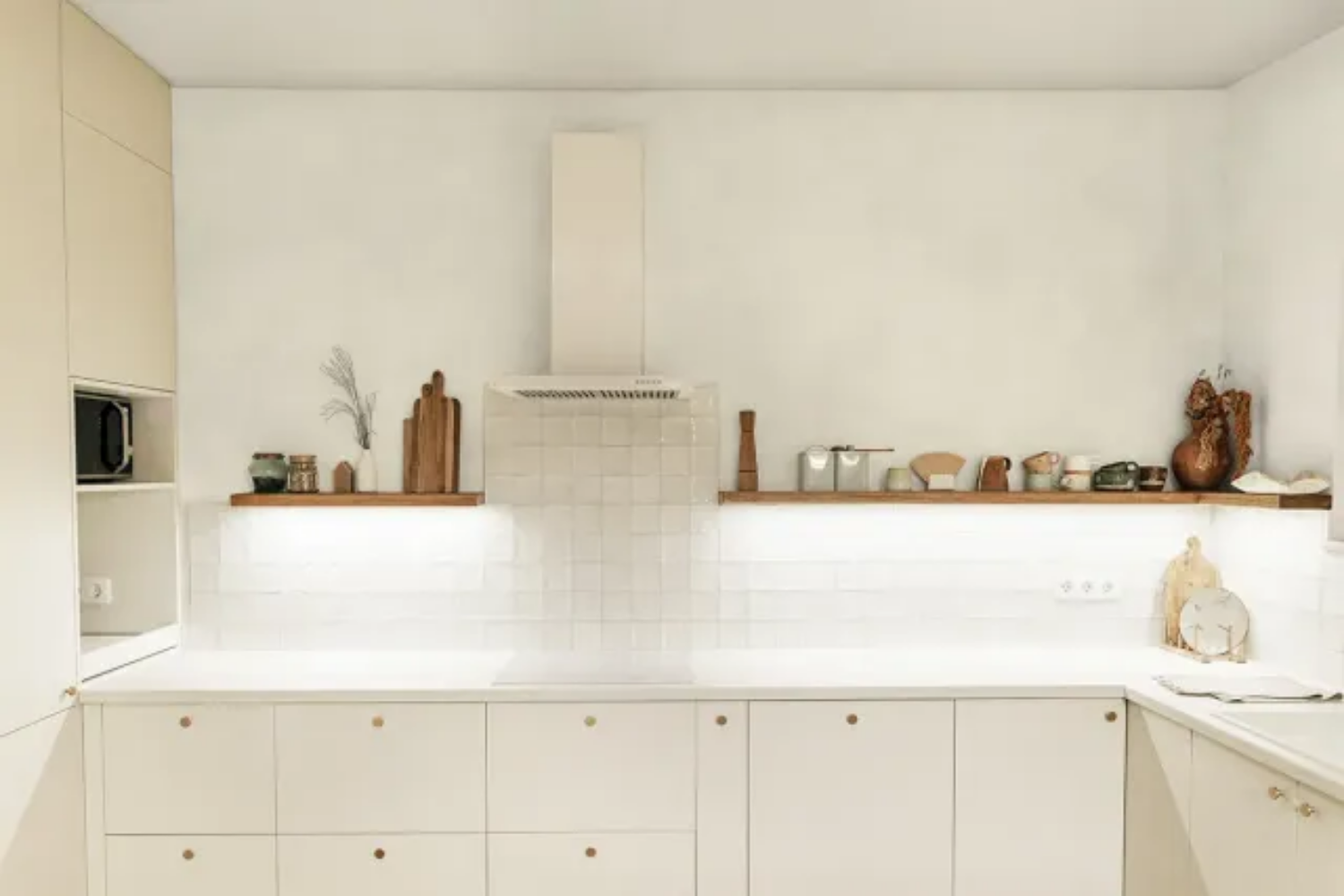
The same principle applies in the kitchen.
Walls and ceilings can be finished with lime, while behind the hob and in areas constantly exposed to grease or splashes it is more practical to use stone, tiles, glass or another washable splashback material. The absorbent nature of the finish can otherwise make stains difficult to remove.
The limitations to understand before choosing lime paint
The main trade-off is generally lower washability than paints specifically formulated to withstand scrubbing and detergents.
For its own product, Bauwerk recommends very light cleaning with a damp cloth, without scrubbing or soap; oil, grease and ink can instead require more extensive repairs.
Protective sealers also need to be assessed case by case. There is no universal rule: Bauwerk prefers not to seal its system in order to preserve permeability and ease of repair, while Portola offers a specific matt sealer designed to make the surface easier to clean, while making clear that it does not make the finish waterproof or necessarily prevent oils and grease from staining it and that it can alter the appearance of more intense colours.
How to pair lime paint without creating a faux-rustic interior
Lime does not require exposed beams, distressed furniture or “Mediterranean” décor to work effectively.
With natural timber, the matt surface visually softens part of the contrast and allows the grain to stand out. With travertine, limestone and less polished marbles, it creates a mineral continuity that can be interrupted by metals or technical elements.
Pairing it with stainless steel, aluminium, glass and highly geometric furniture is often even more interesting because it prevents the wall from being read exclusively through a vernacular lens. A minimalist kitchen, a technical light fitting or a lacquered piece of furniture can sit comfortably alongside an intentionally irregular surface.
With linen, wool, timber and ceramics, however, it is worth avoiding excess: when every element is matt, rough and “natural”, materiality can quickly become a decorative formula.
Maintenance and touch-ups require a different approach from standard paint
A lime-painted wall tends to show the passage of time more visibly than a perfectly washable surface.
Small marks can become part of the patina; when intervention is necessary, the procedure depends on colour and product. Bauwerk notes that very light colours can be easier to touch up locally, while for mid-tone and dark shades it is often preferable to repaint from one natural boundary of the wall to another, keeping a wet edge to avoid visible overlaps.
Initial application matters as well. A coat that is too thick can create whitish patches and powdering during curing; the manufacturer therefore recommends thin coats rather than trying to achieve greater coverage by overloading the brush.
The most common mistakes with lime paint
The first is choosing it from a photograph alone. Real light conditions and the substrate can radically change the result.
The second is confusing paint with plaster. If a genuinely granular, carved or trowelled surface is required, a fine lime render or marmorino may be necessary rather than additional coats of limewash.
The third is ignoring the substrate. Plasterboard, gypsum plaster, old paint and mineral masonry do not require the same preparation.
The fourth is trying to create an exaggerated clouded effect by applying too much product. Variation should come from the material and the application gesture, not from random build-up.
The fifth is using it without suitable protection behind basins, hobs and other areas highly exposed to staining.
The sixth is applying a lime finish over an impermeable build-up and continuing to describe the entire wall as “breathable”.
An ancient finish can create highly contemporary interiors
Lime paint works in contemporary interiors when it is treated as a material rather than as a nostalgic effect.
Its strength lies in the combination of mattness, chromatic variation and interaction with light. It can cover an almost monochromatic room, extend onto the ceiling, create a mineral backdrop for artworks or provide contrast with steel, glass and rigorously modern furniture.
Choosing the right system, however, requires distinguishing aesthetics from technology. Traditional limewash, lime-putty-based paint, lime plaster and marmorino belong to the same material culture of lime, but they are not interchangeable. Above all, the result depends on the complete system: substrate, preparation, product, pigment, application and the everyday use of the room.
It is precisely this absence of absolute uniformity that makes lime so interesting: a wall that does not try to look perfectly printed, but changes with the light and retains something of the way it was made.