Sintered stone is an industrial mineral surface produced by compacting raw materials and consolidating them at high temperature to create dense slabs with very low porosity. It is used for kitchen worktops, tables, bathrooms, wall cladding, furniture and, where the specific product is declared suitable, outdoor applications. Its performance can be high in terms of …
Sintered stone is an industrial mineral surface produced by compacting raw materials and consolidating them at high temperature to create dense slabs with very low porosity. It is used for kitchen worktops, tables, bathrooms, wall cladding, furniture and, where the specific product is declared suitable, outdoor applications. Its performance can be high in terms of stain, heat and UV resistance, but there is no universal technical specification that applies to every sintered stone. Composition, thickness, finish and manufacturing process vary between producers. It is also important not to confuse it automatically with large-format porcelain stoneware or quartz composite: materials that may look similar can have different structures, technical standards and limitations of use.
What is sintered stone really?
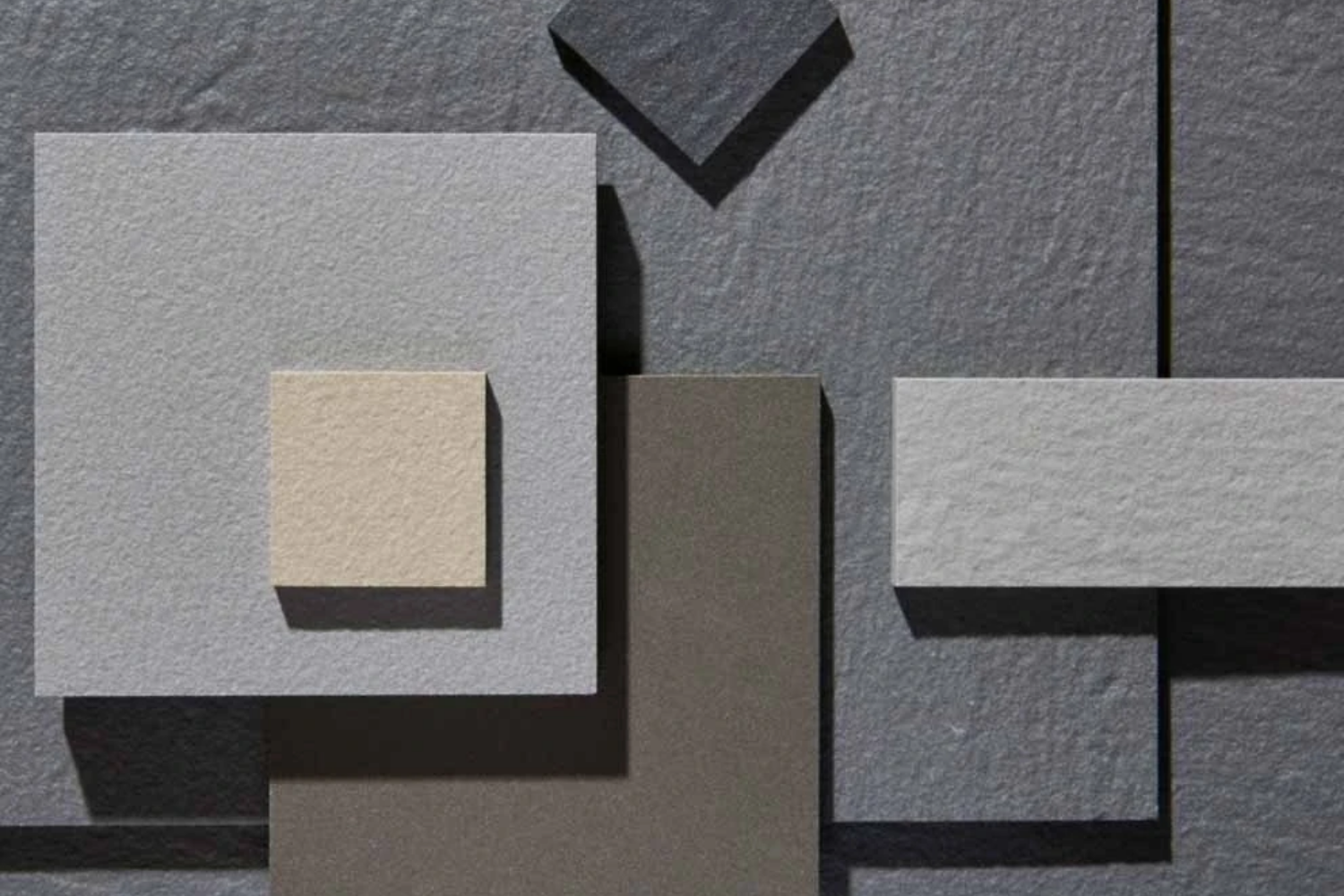
The term describes a family of surfaces produced through compaction followed by the sintering of mineral materials. Lapitec, for example, defines its sintered stone as an industrial product made from a wet mixture of natural minerals, without resin or cement, formed through vacuum vibro-compression and subsequently consolidated through sintering. Neolith states that its composition is based on clays, feldspars, oxides and other natural minerals, without added resins or plastics.
Cosentino, meanwhile, describes Dekton as an ultracompact surface made from a mixture of minerals subjected to intense compaction and a sintering process reaching approximately 1200–1250 °C.
These examples already show why the term should be used precisely. “Sintered stone” does not identify a single recipe: it is more accurate to consider it a technological category within which each manufacturer develops its own formulation, process, formats and characteristics.
The word “stone” can also be misleading if interpreted literally. It is not a slab extracted from a quarry, like marble, granite or quartzite. It is an industrial material manufactured from mineral raw materials.
How sintered stone is made: pressure, heat and sintering
The principle of sintering consists of consolidating mineral particles through pressure and temperature, changing their structure until a compact body is formed.
In the Dekton process documented by Cosentino, the material is first heavily compacted and then passes through a kiln where it reaches temperatures of around 1200–1250 °C. Lapitec similarly describes an initial forming stage using vacuum vibro-compression followed by a thermal sintering phase.
The result can be a very dense, low-absorption slab available in large formats and relatively thin thicknesses.
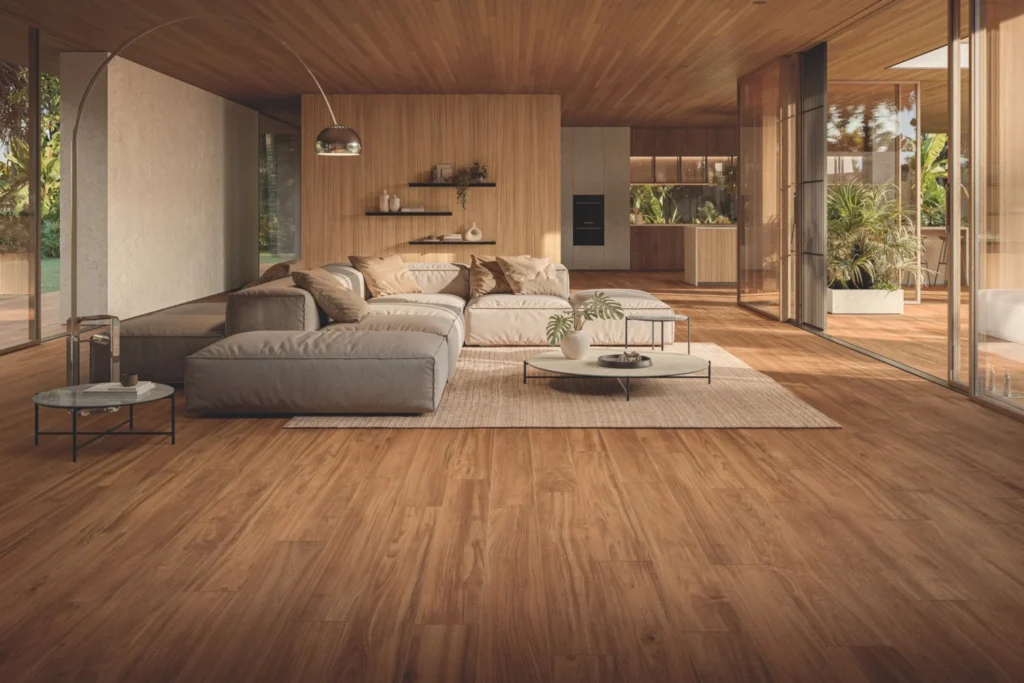
This industrial production also makes it possible to control colour and graphics far more predictably than with natural stone. Marble, concrete, travertine, quartzite, metal and even timber can be visually reproduced on the surface, but it is important to remember that a graphic that imitates stone does not turn the material into that stone.
Sintered stone, porcelain stoneware and quartz composite: what are the differences?
This is one of the areas where commercial terminology creates the most confusion.
Porcelain stoneware is a ceramic material classified according to precise standards. Confindustria Ceramica describes a typical composition based mainly on clay, feldspar and quartz, which are mixed, spray-dried, pressed and fired at around 1200 °C. Under EN 14411 and ISO 13006, ceramics with water absorption not exceeding 0.5% can be classified as porcelain stoneware.
The process therefore has clear similarities with some sintered surfaces: mineral raw materials, pressure and high temperatures. The distinction cannot be reduced to saying that “one is ceramic and the other is stone”, nor can it be established simply by looking at a slab.
Sintered stone is instead marketed through specific proprietary technologies and may have a composition, through-body structure and technical documentation that differ from porcelain stoneware. For professional specification, it is more useful to check the declaration of performance, applicable standards and technical data sheet of the specific product rather than relying on the commercial name alone.
Quartz composite, or more accurately composite mineral surfaces within this family, differs above all in its binding system. Traditional quartz surfaces combine mineral aggregates with polymers and pigments; contemporary formulations such as Silestone HybriQ have progressively changed their composition by reducing crystalline silica and introducing other minerals and recycled materials.
The presence of a polymer matrix also explains some practical differences: Cosentino, for example, recommends using trivets with Silestone and does not advise outdoor use because UV exposure can alter the surface.
The advantages of sintered stone in interiors
One of its main strengths is low porosity. In technically advanced products, this translates into low liquid absorption and good resistance to common household stains. Dekton declares porosity below 0.05%; Neolith similarly describes its surfaces as having almost zero porosity.
A second quality is stability when exposed to heat. Dekton and Neolith both declare resistance to high temperatures and thermal shock within their respective technical specifications. This is a clear advantage in kitchens, but it does not mean that the same values can automatically be applied to every product sold as sintered stone.
UV resistance is also documented for several surfaces in this category, including Dekton and Neolith, enabling outdoor applications where the complete system is designed for that use.
Other advantages include large slab dimensions and the availability of different thicknesses. These make it possible to move from a kitchen worktop to vertical cladding using the same surface while reducing the number of joints.
The disadvantages: edges, fabrication and installation are the real critical points
A very hard slab is not necessarily indestructible.
Edges, and especially fabricated areas around sinks, hobs and cut-outs, require correct design. The Dekton manual, for example, specifies minimum radii for internal corners of cut-outs and advises against placing joints in the most critical areas around openings. Lapitec likewise recommends minimum internal radii to avoid stress concentrations.
This highlights one of the main disadvantages of sintered stone: the quality of the final result depends heavily on fabrication and installation.
A slab can be extremely resistant across its surface yet still chip if the edge is poorly fabricated, if the cabinetry is not perfectly level or if openings and overhangs are designed without following the manufacturer’s specifications.
Repair after a significant chip is also generally less invisible than simply cleaning a stain.
Kitchen worktops: where sintered stone makes the most sense
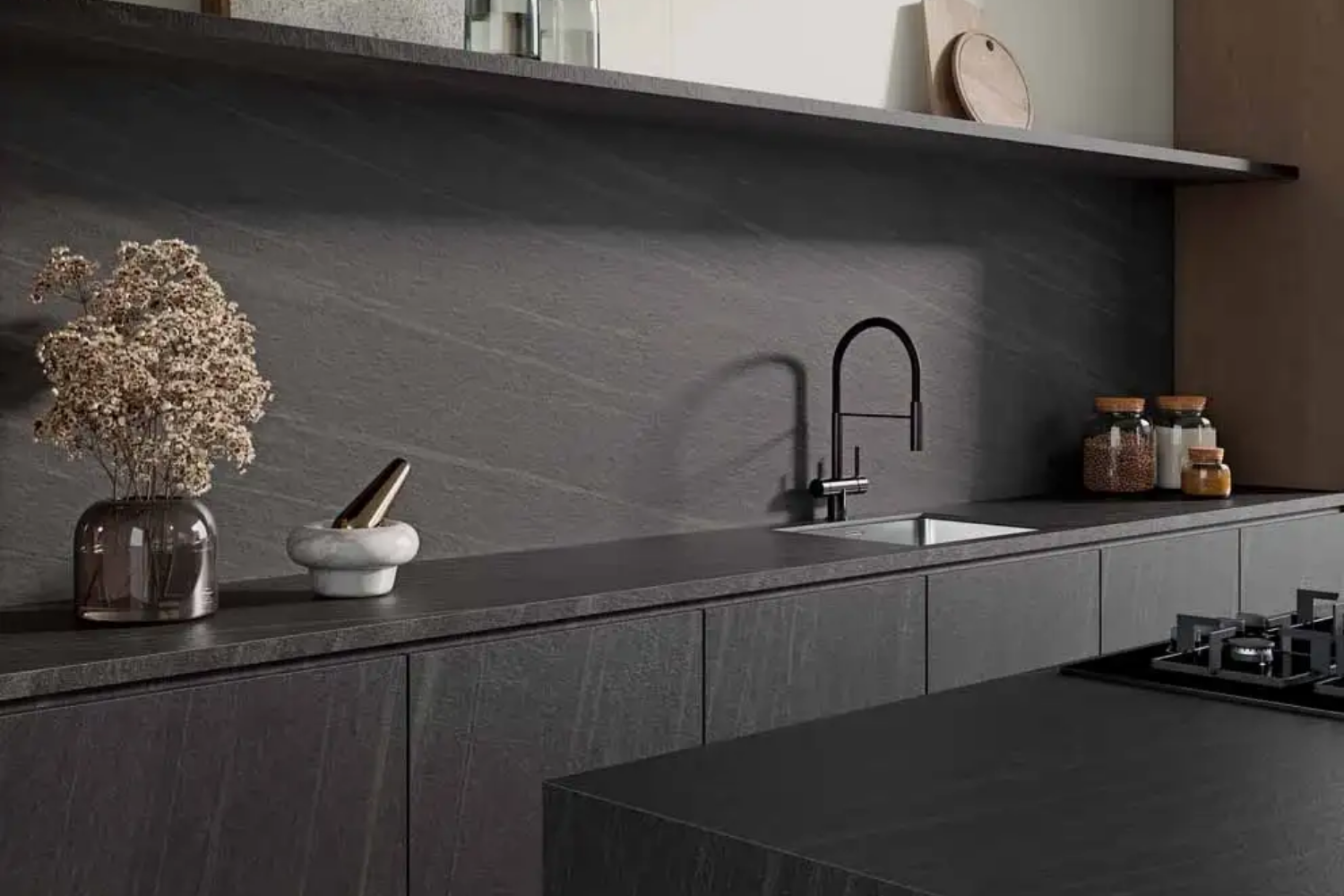
This is probably the application where the material’s characteristics come together most convincingly.
Low porosity, stain resistance, thermal stability and ease of cleaning are all useful qualities for a work surface exposed every day to water, food and temperature changes.
Neolith recommends 12 and 20 mm thicknesses for its kitchen worktops; Cosentino offers Dekton worktops in several thicknesses, including 8, 12 and 20 mm depending on the application.
Visible thickness, however, can be deceptive. A worktop that appears to be 40 or 60 mm thick may be created using a thinner slab with a 45° mitred edge and applied apron, producing a visually substantial volume without using a slab of the same thickness throughout.
The effect works particularly well with marble-inspired graphics, but it requires careful attention to vein continuity and the quality of the joint.
Tables and furniture: a thin slab does not mean no structure is required
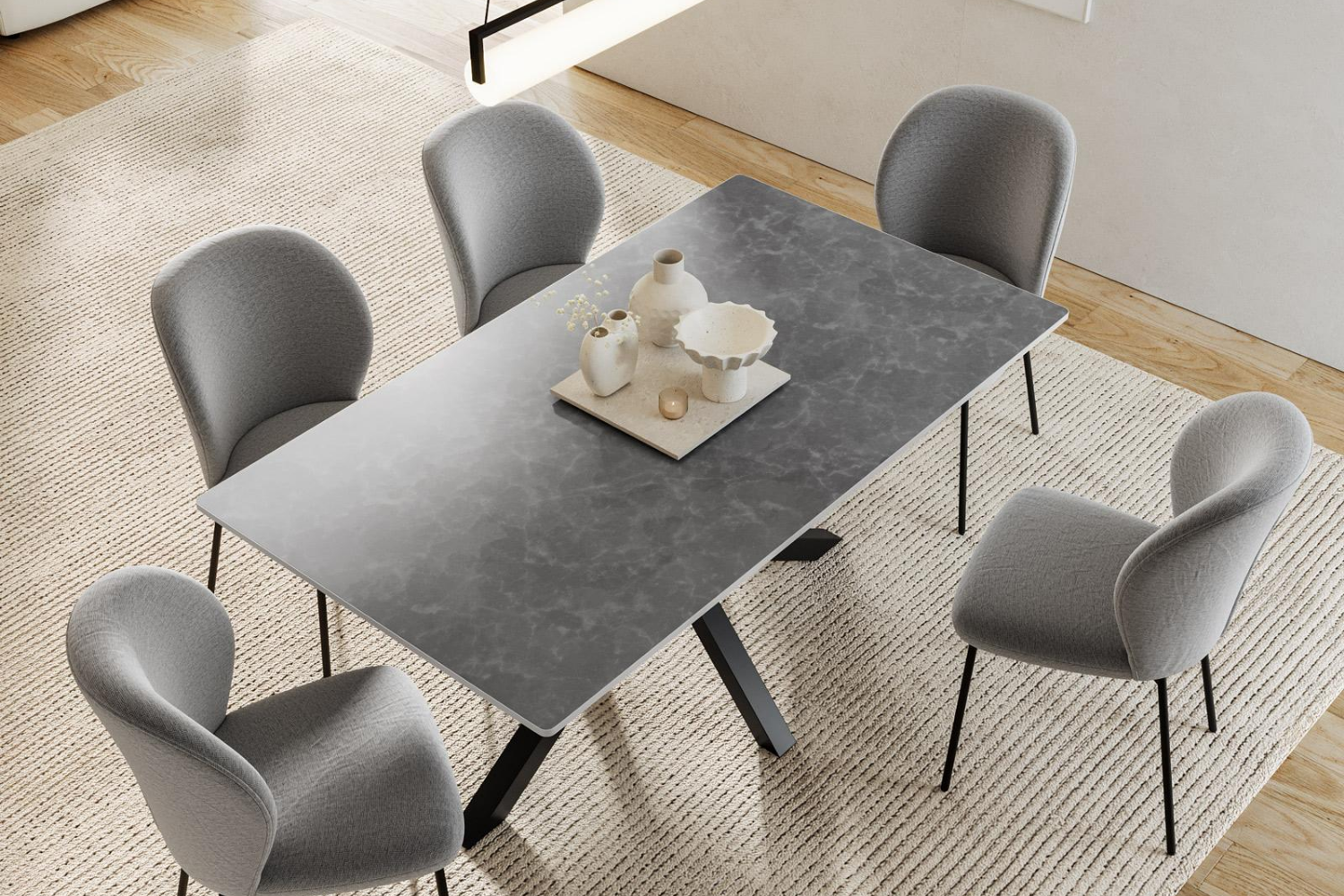
Sintered stone is also used for dining tables, coffee tables, consoles, cabinet fronts and furniture cladding.
The advantage is the ability to create large mineral-looking surfaces while keeping thickness relatively low. Depending on the collection, Neolith uses slabs of 6, 12 and 20 mm, while Dekton also includes very thin formats intended for cladding and furniture fronts.
A thin slab, however, should not automatically be interpreted as a self-supporting element. Frame, substructure, overhang dimension and distribution of supports are all part of the furniture design.
The Dekton technical manual, for example, specifies maximum distances between supports and particular reinforcement requirements in the most vulnerable areas of worktops.
Bathrooms and wall cladding: large surfaces with fewer joints
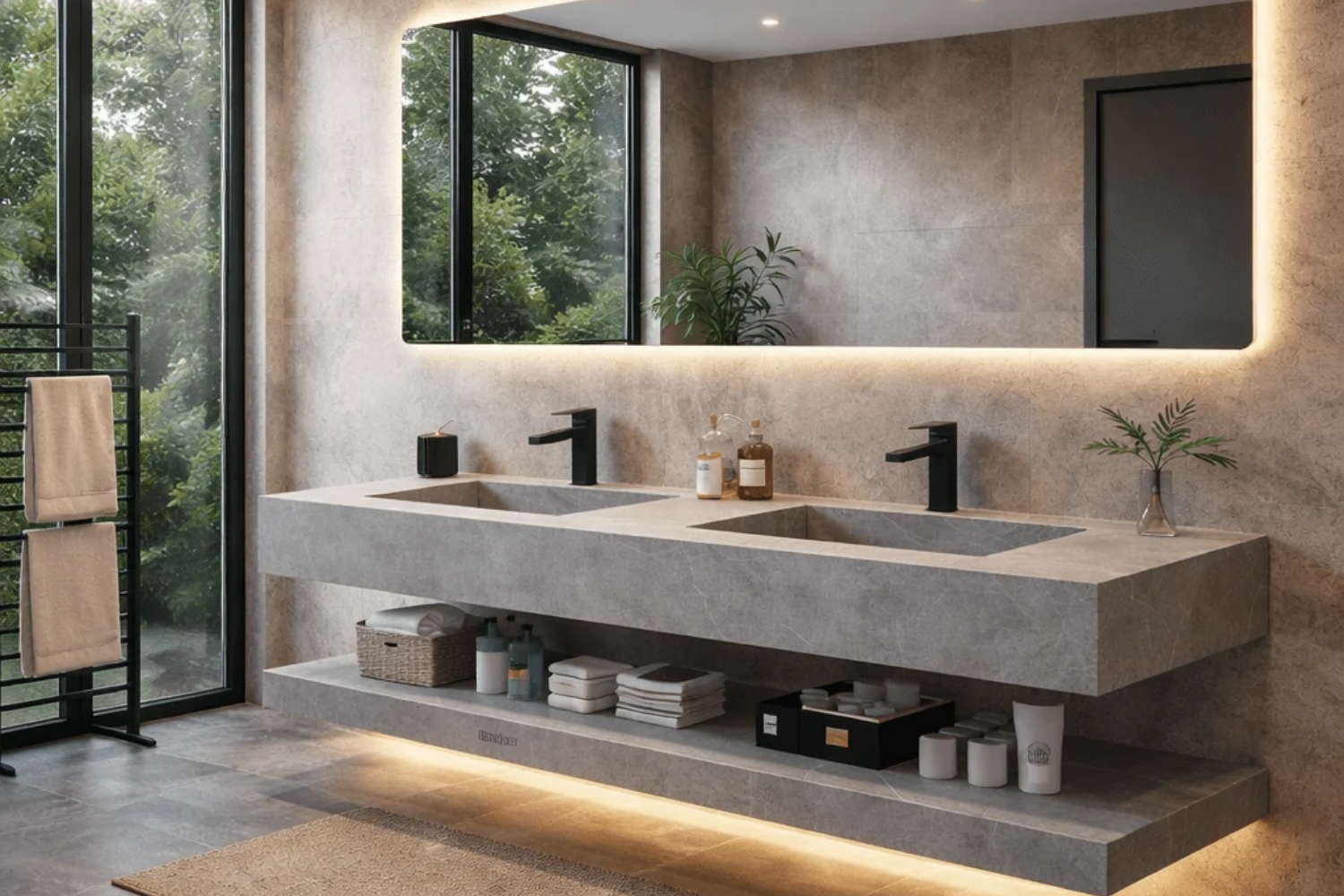
In bathrooms, sintered stone can be used to create coordinated vanity tops and large wall coverings.
The low porosity of products such as Dekton and Neolith is particularly suitable for surfaces exposed to water, while reduced thicknesses allow walls to be clad with large-format panels.
The visual advantage is clear: a continuous graphic can run across walls, washbasins and furniture, reducing visual fragmentation.
This does not mean that every joint can technically be eliminated. Installation joints, movement joints, junctions and sealants remain necessary according to format, substrate and installation system.
Outdoor applications: UV resistance is not the only parameter to check
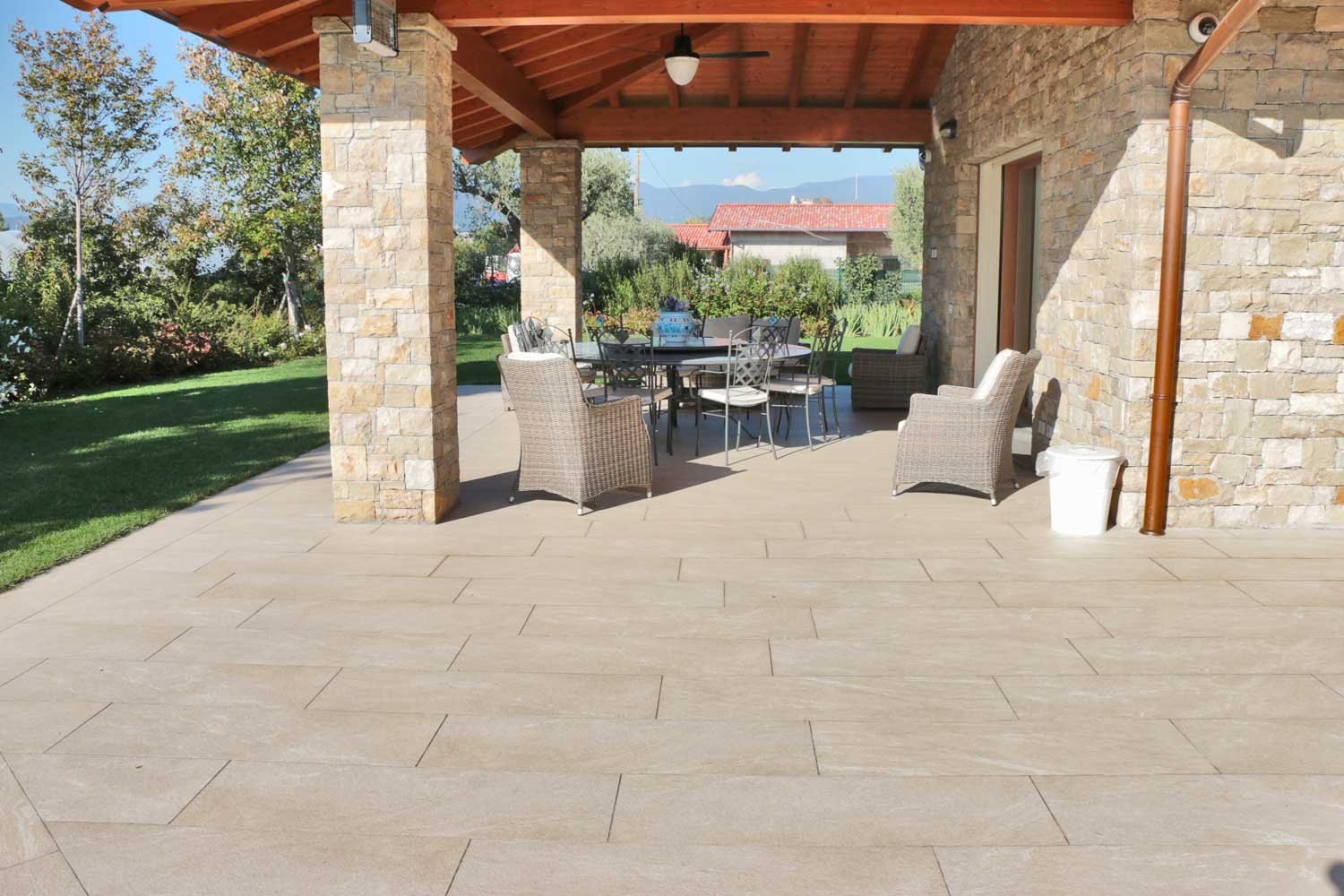
One of the most interesting differences compared with many composite surfaces is that some sintered stones can also be used outdoors.
Dekton documents UV resistance and facade applications; Neolith likewise offers products intended for exterior cladding and dedicated systems for ventilated facades.
But “UV-resistant” does not automatically mean “suitable for every outdoor application”.
For floors, pool surrounds and terraces, frost resistance, slip resistance, installation system, drainage and surface finish must also be checked. For facades, fixings, wind loads and substructure become central considerations.
Outdoor suitability should therefore always be assessed against the specific application certified or declared by the manufacturer.
Finishes and stone effects: remember to look at the edge
Contemporary sintered surfaces can reproduce marble, travertine, granite, concrete, oxidised metals and solid colours.
Neolith’s 2026 collections, for example, include surfaces inspired by travertine, stone and even timber, offered in finishes such as Matt, Riverwashed and Wood.
When selecting a strongly veined design, however, it is also important to look at how the thickness of the slab appears.
Not every product carries decoration through the full body in the same way. Cosentino explicitly distinguishes between colours with design integrated into the material and other patterns where layout, edge treatment and vein alignment require greater attention.
This difference may be almost invisible on a front-facing sample, but becomes obvious on a thick edge, shelf or heavily fabricated worktop.
Edges, joints and cut-outs: the details that determine the quality of the project
The edge is often where a technically advanced surface can appear refined or artificial.
Straight, bevelled, rounded and 45° mitred edges are possible with various sintered stones, but not every geometry is recommended for every thickness. Neolith and Dekton both publish specific guidance for their respective systems.
Cosentino also specifies continuous, level support for the worktop and a minimum perimeter gap where the surface meets walls.
A large-format slab therefore does not eliminate the need to design joints: it simply allows their number to be reduced and their position to be controlled more carefully.
How to clean sintered stone
For everyday use, maintenance is generally straightforward.
Cosentino recommends neutral soap and a microfibre cloth for Dekton, using specific products when more difficult residues are present. Neolith likewise generally recommends a damp cloth and notes the resistance of its products to most common cleaning chemicals.
It is still incorrect to assume that any cleaning product can be used without consequences. Polished finishes, particular treatments and specific products may have different maintenance instructions.
The same simple rule applies here: the maintenance sheet for the selected product matters more than properties attributed generically to the category.
How much does sintered stone cost in 2026?
Price is difficult to summarise because the raw slab represents only one part of the final cost.
For a bespoke kitchen worktop, the price depends on brand, colour, thickness, depth, quantity of material, sink and hob cut-outs, edge fabrication, transport and installation.
On the Italian market in 2026, estimates for Dekton worktops are typically in the region of approximately €350–1,000 or more per linear metre at standard kitchen depth, depending on the configuration. One current retail reference lists certain bespoke Dekton versions at around €666/m² in 20 mm thickness and €777/m² in 30 mm thickness. These prices cannot be generalised across the entire category, but they illustrate the order of magnitude for a finished, fabricated product.
An island with a built-up edge, undermount sink, veins that need aligning and large cut-outs can cost considerably more than a simple linear section.
For this reason, the most meaningful comparison is not between raw slab prices, but between complete quotations for the same project specification.
When to choose sintered stone and when to consider alternatives
Sintered stone makes particular sense when a project requires large surfaces, very low absorption, relatively low maintenance and visual continuity across different applications. It is effective for kitchen worktops, tables, bathrooms and wall cladding and, with products specifically declared suitable, can continue outdoors as well.
It is not necessarily the best choice when the goal is the unique variation of natural stone, when the budget is limited or when the design requires fabrication that makes the project unnecessarily complex.
Large-format porcelain stoneware can provide very similar performance and visual languages in many applications; a composite mineral surface may suit a predominantly indoor project; marble and quartzite, by contrast, retain material characteristics that no industrial print can reproduce exactly.
The most useful decision is therefore to move beyond labels. Composition, technical data sheet, thickness, edge, support and installation reveal far more than the commercial name of the material. This technical reading is what allows sintered stone to be used for what it actually is: a high-performance industrial surface, not by definition an improved version of natural stone.