Onyx in interior design is chosen above all for a quality that is relatively rare among natural stones used indoors: its ability to allow part of the light to pass through. Walls, counters, furniture and architectural details can therefore change dramatically when backlit, revealing veins and layers that are usually less visible. This scenographic quality, …
Onyx in interior design is chosen above all for a quality that is relatively rare among natural stones used indoors: its ability to allow part of the light to pass through. Walls, counters, furniture and architectural details can therefore change dramatically when backlit, revealing veins and layers that are usually less visible. This scenographic quality, however, requires restraint. Architectural onyx is a calcareous material that is delicate and sensitive to acids and abrasion; porosity and performance also vary from one variety to another. Backlighting makes sense when it is designed together with the slab, supporting structure and lighting system, rather than added later as a purely decorative effect.
What is the onyx really used in interior design?
The name creates an initial ambiguity. In gemmology, onyx belongs to the chalcedony family and is therefore a form of microcrystalline quartz, traditionally characterised by parallel bands of colour. This is the material referred to, for example, by the Gemological Institute of America when discussing onyx used in jewellery.
In the architectural stone sector, however, the term commonly identifies what has historically also been called onyx marble: a translucent carbonate stone composed predominantly of calcite. Antolini describes it as an evaporitic sedimentary rock formed by the precipitation of calcium carbonate, while the Natural Stone Institute links the formation of many commercial varieties to deposits developed within cavities and systems of stalactites and stalagmites.
It is therefore important not to confuse the material used for large backlit surfaces with the black onyx found in jewellery. In interior design, when referring to slabs of white, honey, green or pink onyx, the material generally consists of translucent calcareous stone processed into slabs.
This composition explains both the material’s appeal and its delicacy.
Onyx colours and veining: from white to green, pink and honey tones
The original colour of calcite can be very pale and translucent, while different elements present during mineral formation create bands, clouds and chromatic variations. Antolini documents a particularly broad commercial range, including white, ivory, honey, pink, green, grey and multicoloured onyx varieties. Margraf likewise offers materials ranging from Onice Bianco to orange, red, green, brown and grey Velluto onyx.
This variety makes it difficult to describe onyx as a material with a single chromatic identity.
White or ivory onyx can create a relatively even, diffused luminosity, while honey and caramel varieties introduce warmer tones. Green onyx often has more graphic veining, whereas pink, red and multicoloured versions can become strongly defining features within an interior.
The choice should always begin with the actual slab, rather than a small sample. In a natural surface, vein distribution, more transparent areas and colour variations can change significantly even within the same block.
When a project includes bookmatching or large consecutive panels, the slab layout should therefore be planned before cutting.
Why onyx is translucent
Translucency derives from the mineral structure of the stone, which allows part of the light to penetrate the material rather than simply being reflected from the surface. The Natural Stone Institute considers this one of the defining qualities of architectural onyx, while Antolini identifies it as the main reason the material can be backlit.
Translucent does not mean transparent. You cannot see through onyx as you would through glass: light is filtered by the different densities, bands and crystallisations within the stone.
For this reason, a slab illuminated from behind can look very different from the same surface when lit from the front. Areas that appear relatively uniform can suddenly reveal deep veining, while denser sections remain darker and create the overall graphic pattern.
It is precisely this contrast that makes backlighting effective.
Backlit onyx: when it really makes sense
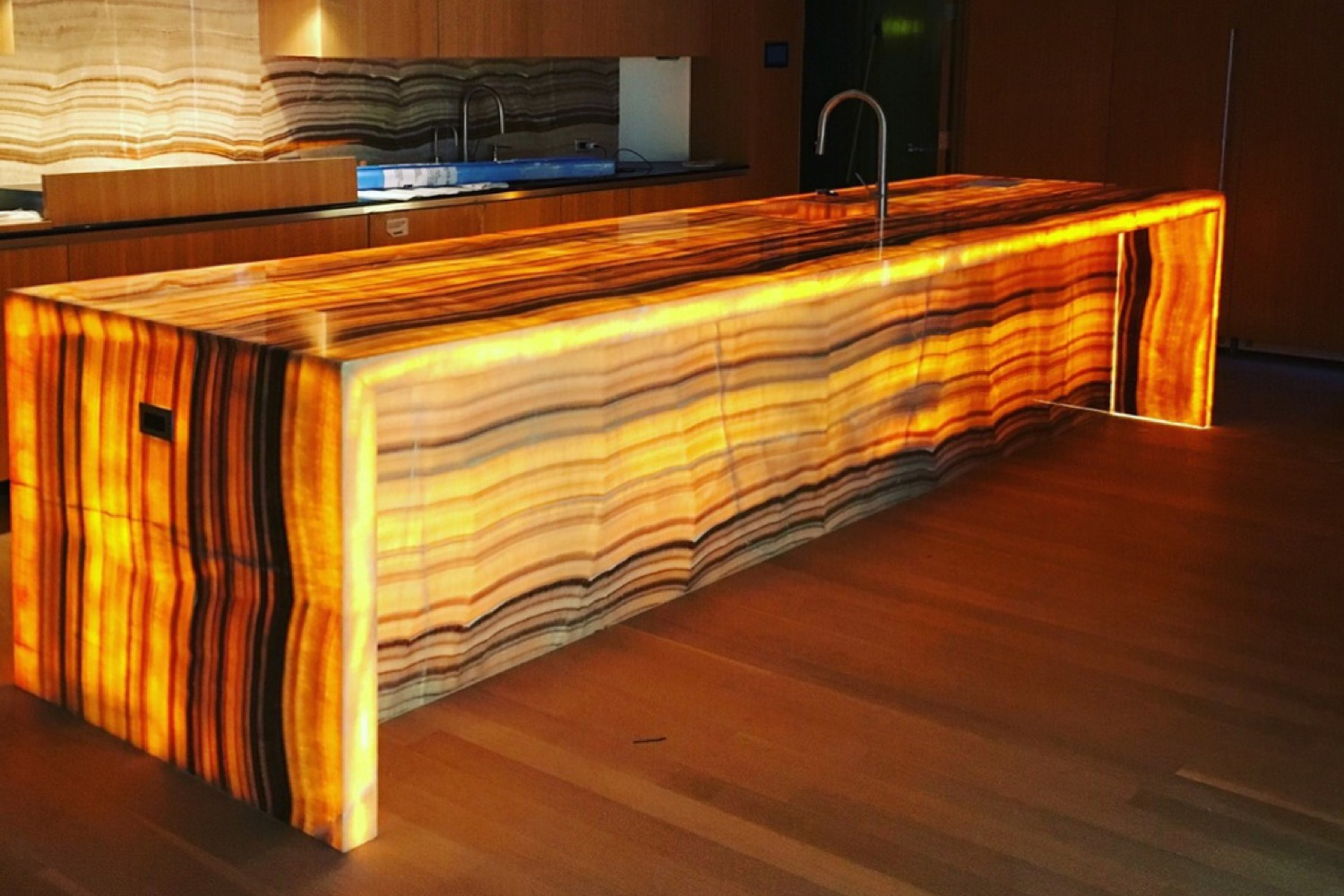
Backlighting every onyx surface risks reducing the material to a special effect.
The solution is more convincing when light transforms a specific architectural surface: the wall behind a reception desk, the front of a bar, a screen in the living room, a backdrop for the dining area or a panel installed within a niche.
In Ms. Elliot at Hock Bee, designed by JUJURWORK, the reception counter uses old onyx tiles recovered from storage. A metal structure supports the stone elements, while a series of LED modules installed behind them creates the backlighting. Here, stone, structure and lighting are designed as a single element rather than as independent layers.
At the South Villa by ARRCC, meanwhile, a backlit slab of Verde Fume Onice becomes the connecting element between oak, brass inserts and dark surfaces in the private entrance. The material is concentrated in one precise location and works precisely because the rest of the space does not compete with its luminosity.
The light must be uniform
A backlit installation should always be tested in real conditions.
The distance between the light source and the stone, LED layout, any diffuser and variations in translucency within the slab can produce hotspots, shadowed areas or excessively visible variations. Professional backlighting systems therefore use panels or modules designed to distribute the light output more evenly.
The stone should be tested both switched off and illuminated before final installation. A bookmatched composition that appears perfect in natural light can behave differently when artificial light passes through it.
It is also advisable to provide access to the lighting system: drivers and LED components will have a different technical lifespan from the stone slab and should remain accessible for inspection or replacement.
Onyx walls and counters: the most effective applications
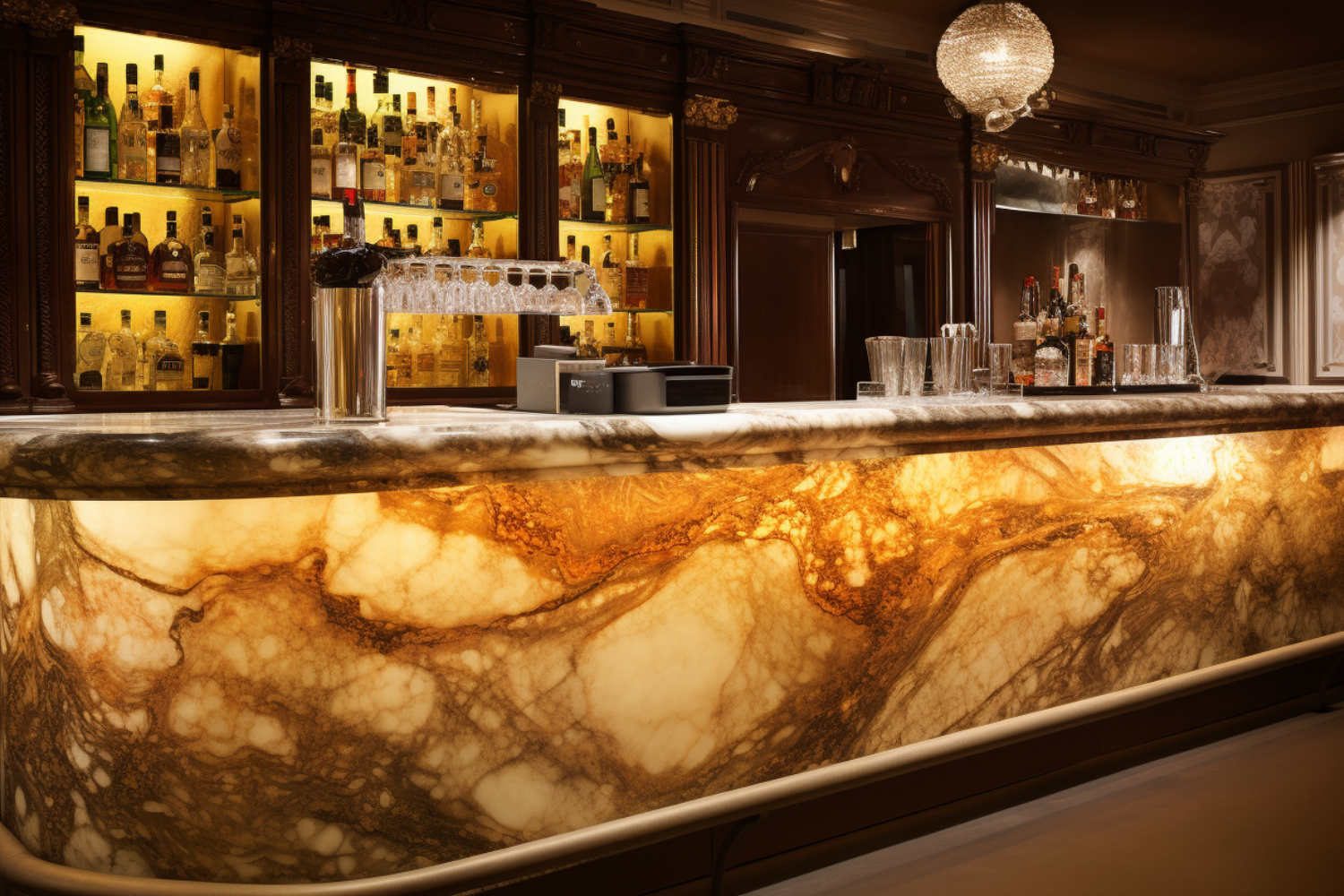
Large vertical surfaces are probably the most natural application for the material.
On a wall, onyx is less exposed to impact and to the substances that make worktops more problematic. Surface continuity also makes it possible to emphasise the movement of the veins, especially when several slabs are bookmatched.
In retail, hospitality and residential entrance areas, an onyx wall can therefore replace the traditional logic of artwork or applied decoration: the material itself becomes the focal point.
Counters are another recurring application. Nobu Dubai by Rockwell Group uses a backlit onyx bar front, while more recent projects continue to demonstrate how effectively onyx can work at the intersection of natural stone and bespoke furniture.
In a residential interior, however, there is no need to reproduce the scale of a hotel. A panel behind a home bar or an island used only on the vertical front can achieve the same depth with a far more controlled presence.
Onyx in bathrooms: better on less exposed surfaces
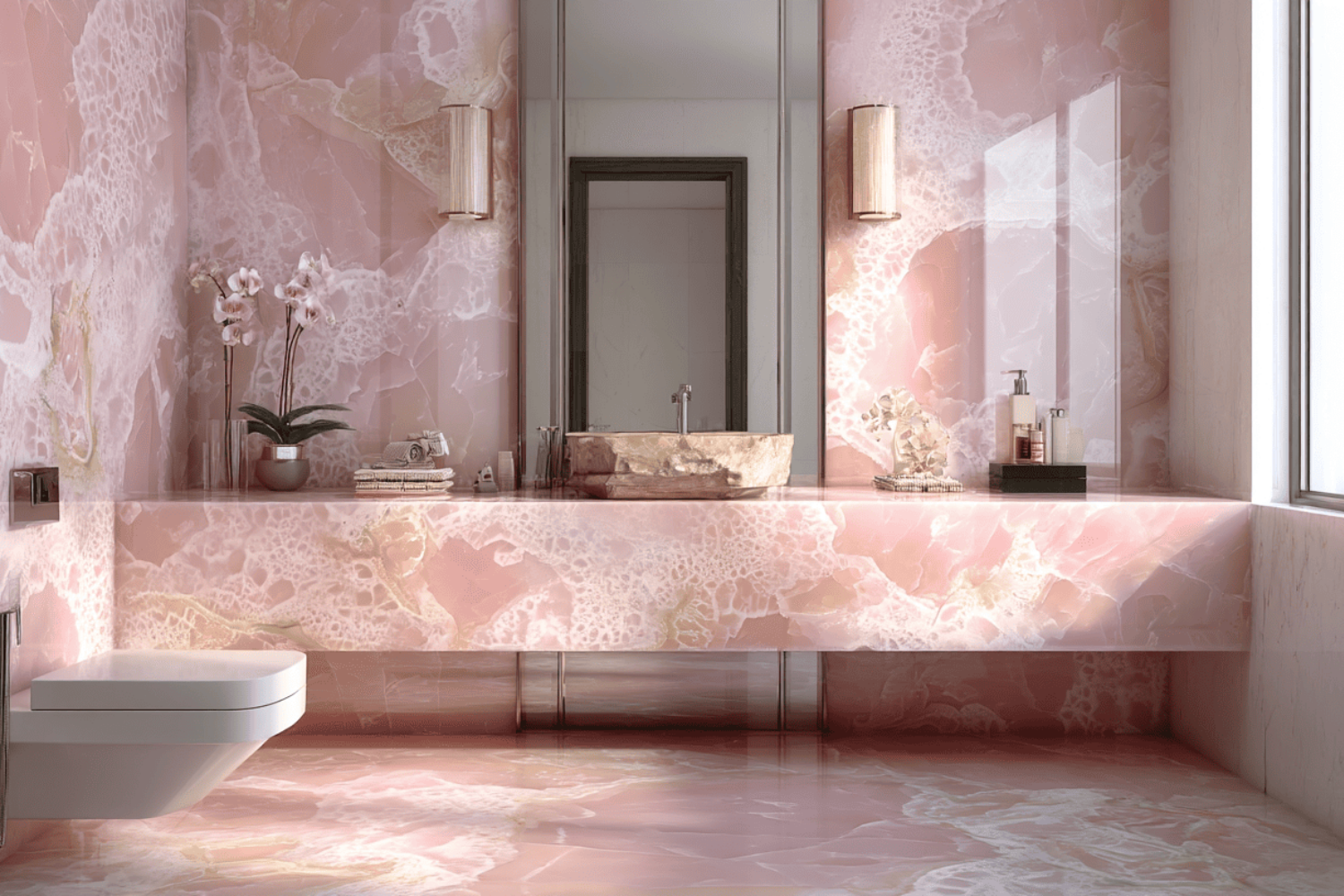
The bathroom may seem like a natural place for this stone, particularly on walls, vanity units and decorative panels. Its composition and maintenance requirements, however, need careful consideration.
Because architectural onyx is based on calcium carbonate, it is sensitive to acidic substances. The Natural Stone Institute recommends neutral cleaners for calcareous stone and warns that products containing lemon, vinegar or other acids can dull or chemically etch the surface.
In wet areas, an impregnating treatment may also be required depending on the specific stone. An impregnator does not make the slab waterproof or completely stain-proof: it increases resistance to liquid penetration and must be selected according to the actual material being used.
For this reason, walls, vanity fronts and vertical details are often less demanding applications than surfaces exposed to continuous use.
More complex examples do exist. Among its Pinnacle Awards projects, the Natural Stone Institute has documented a residential bathroom featuring a large backlit onyx shower wall. In that project, waterproofing, support and installation were addressed as part of a specific technical system.
The precedent demonstrates that such an application is possible, not that every variety of onyx can be installed in a shower in the same way.
Tables, consoles and small details: using onyx without backlighting
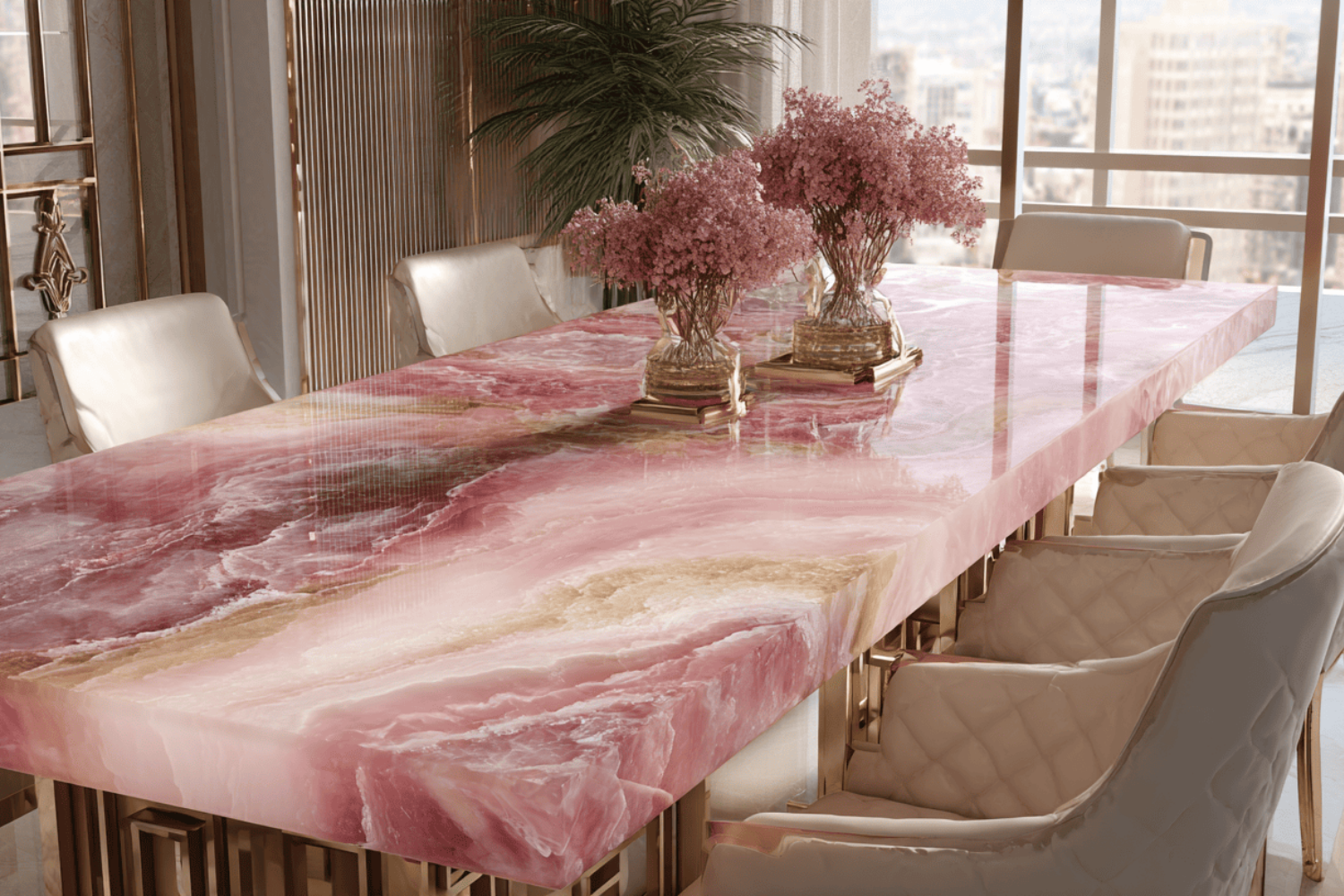
Translucency remains interesting even when the material is illuminated only by natural light.
An onyx coffee table or tabletop changes throughout the day because its edges and thinner areas respond to light differently. The NUDO collection developed by Kelly Wearstler with ARCA used onyx for sculptural pieces, including a ping-pong table that can be transformed into a dining table; the designer highlighted the relationship between translucency, natural light, banding and colour variation within the material.
At the Brera Design Apartment presented during Milan Design Week 2025, Zanellato/Bortotto instead introduced an onyx coffee table within a much broader material composition.
These examples suggest another approach: onyx can be valuable even when it is not illuminated from within.
A tray, shelf, console top or small table allows the material to be introduced without turning lighting into the dominant element of the room.
How to combine onyx without creating an overly opulent interior
Onyx already carries a high level of visual information. For this reason, it tends to work best alongside quieter materials.
Natural timber, burnished metal, steel, mineral plaster, monochromatic surfaces and matt textiles can absorb some of its visual brilliance. Honey onyx paired with dark oak creates a very different effect from the same stone combined with polished brass and velvet.
Green onyx can also feel distinctly contemporary when separated from its traditional associations with classical interiors. At the forte_forte store in Rome, large surfaces of green onyx were finished with a matt treatment and combined with brass within a highly controlled spatial composition.
For a contemporary result, it is therefore more effective to work through material contrast than to accumulate other overtly luxurious materials.
The limitations of onyx: a delicate stone requires careful placement
The Natural Stone Institute notes that onyx generally has lower resistance to chemical and abrasive attack than many marbles. Some varieties can also contain fragile areas, open veins or structural differences that make fabrication, transport and installation particularly delicate.
The kitchen is the most controversial application.
Onyx can certainly be fabricated into a worktop, but it is not the most forgiving choice for a heavily used kitchen surface. Lemon, wine, vinegar and other acidic foods can etch the calcitic surface, while sand, abrasive objects and intensive use can alter the polish. The Natural Stone Institute has historically advised against using onyx for islands and kitchen worktops subject to heavy use precisely because of its vulnerability to acid etching.
Anyone choosing an onyx worktop should therefore accept maintenance and the possible development of patina, or restrict the material to less heavily used areas.
How to clean and maintain natural onyx
Maintenance should be simple and cautious.
For calcareous stone, the Natural Stone Institute recommends pH-neutral cleaners, stone soaps or mild detergents, followed by rinsing and drying with a soft cloth. Acidic products and abrasive powders should be avoided.
Spills should be blotted quickly rather than rubbed across the surface.
Any impregnating treatment should be defined with the supplier or installer after identifying the specific stone variety and finish. Sealing does not make onyx stain-proof: an impregnator can slow absorption, but it cannot prevent the chemical attack caused by an acidic substance.
Deep scratches, etching and significant loss of polish will normally require intervention by a professional capable of restoring the surface.
Natural onyx or onyx-effect porcelain stoneware?
The difference is first and foremost material.
Onyx-effect porcelain stoneware is porcelain stoneware decorated to reproduce the colours and veining of natural onyx. Marazzi, for example, offers Onice Avorio, Onice Giada, Onice Blu and Onice Perla surfaces within its porcelain stoneware collections, including large-format slabs in 6 or 12 mm thicknesses.
This alternative can make sense when a more durable ceramic surface, coordinated formats, easier maintenance or continuity between flooring and wall cladding are required.
However, standard onyx-effect porcelain stoneware does not automatically reproduce the translucency of natural onyx. It recreates the visual appearance of the material, not necessarily the way it behaves with light. If backlighting is central to the project, the alternative product must be specifically designed to transmit light.
This is perhaps the most important distinction.
With onyx in interior design, veining is only one part of the project. What truly distinguishes the natural material from a surface that imitates it is the relationship between mineral mass and light. Using it well means understanding when to exploit that translucency and when simply to allow it to respond to natural light.
A backlit wall can be extraordinary precisely because it remains the only luminous surface in the room. A small table may be enough without any LEDs. A bathroom can use onyx on a single wall while leaving more resistant materials to handle everyday wear.
Onyx can therefore retain its scenographic quality without becoming excessive decoration: natural stone, light and design remain legible as three distinct elements working together.