Eighteen enduring table lamps, from Gio Ponti’s Bilia to Barber and Osgerby’s Bellhop: discover their designers, history, light effects and the spaces they suit.
From Gio Ponti’s glass sphere to Barber and Osgerby’s rechargeable light: eighteen table-lamp designs, chosen for the way they illuminate a desk, a bedside table or a corner of the living room.
In 1972, Richard Sapper wanted a light that would fall precisely on the sheet of paper in front of him. The result was Tizio: two counterbalanced arms, an electrical supply carried through the structure rather than a wire running along it, and a small head that could be positioned with a fingertip. Artemide still offers the design, including an LED version. It provides a useful starting point for understanding designer table lamps: their shapes do more than decorate a room. They solve particular problems of light, movement and space.
A table lamp is often the light we live closest to. We touch it each evening, turn it towards a book and take it with us when we move house. This selection brings together eighteen enduring designs, from Bilia in 1932 to the Bellhop family developed from a 2016 museum commission. The dates describe the original designs or families, not every later size, finish or LED edition. There are no prices or shop recommendations: the question is what makes each lamp significant, and where it works best.
How to choose a designer table lamp
Begin with its purpose. Reading light, bedside light, desk light and ambient light require different distributions of light. A reading lamp should illuminate the page without directing a bright source into your eyes. An ambient lamp creates a softer pool of light, helping a room feel inhabited without making every surface equally bright.
At a desk, adjustability and reach matter: how far can the head move from the base, and will it stay where you put it? Articulated designs such as Tizio and Tolomeo were conceived for this task. On a bedside table, a compact footprint and a shielded or diffusing shade may matter more, especially when another person is sleeping beside you. Eclisse’s adjustable inner shade offers one solution; opal glass and paper offer others. In the living room, a table lamp usually works as one layer alongside general lighting and floor lamps, as discussed in our guide to living-room lighting.
Consider visual weight as well as brightness. A marble base or large glass sphere makes a strong statement even when the light is off. A slender vertical form can suit a narrow console, while an articulated arm needs enough working space to extend. Measure the supporting surface, check the cable route and imagine the lamp at its full reach before choosing it for its silhouette alone.
Colour temperature, lux and colour rendering
Warm light is a common choice for domestic interiors. Around 2,700 K can suit a bedroom or relaxed living room; around 3,000 K is another useful starting point for a desk. These are choices, not universal legal requirements. The colour of the walls, other lamps in the room and your own visual preferences affect the result. A domestic lighting specification such as UNI/TS 11826 addresses a different setting from a workplace lighting standard.
For the amount of light, EN 12464-1 uses a maintained illuminance of 500 lux for office tasks such as reading, writing and data processing. That is a workplace reference, not a blanket rule for every home. It helps explain why a decorative diffuser may not provide adequate task lighting by itself. Lux measures light reaching a surface; it is not the same as the lamp’s output in lumens.
Colour rendering describes how faithfully colours appear under a light source. The functional requirements in EU Regulation 2019/2020 set CRI 80 as the baseline for light sources within their relevant scope, with specified exceptions. It is not an exception-free rule for every type of lighting. A higher CRI can be useful when assessing materials or printed images. For a historic lamp, also check the exact bulb or LED module, dimming compatibility and replacement arrangements: a familiar name does not identify one fixed technical specification.
Iconic table lamps designed before 1970
These early designs established several familiar archetypes: a sphere on a cone, a spring-balanced arm, a paper lantern and a light turned upside down. They remain compelling because their underlying ideas are so clear. Their history is also a reminder that a design icon is not necessarily the right lamp for every activity.
Bilia, Gio Ponti for FontanaArte (1932)
A luminous glass sphere rests on a metal cone, with little to distract from the relationship between the two forms. Bilia is the oldest design in this selection. FontanaArte continues to offer it alongside smaller interpretations, including Bilia Mini. Ponti approached the lamp almost as a small piece of architecture, using simple volumes rather than ornament. On a bedside table or bookshelf, its diffuse sphere becomes a quiet point of light. Check the dimensions and controls of the chosen version: the original and its smaller descendants do not occupy the same amount of space.
Anglepoise Original 1227, George Carwardine (1935)
George Carwardine was an engineer with experience in vehicle suspension. In 1932 he developed the spring-balancing idea that would allow a lamp to move easily and remain in position. He licensed the design to Herbert Terry & Sons in 1934; the three-spring Original 1227 followed in 1935, adapting the earlier industrial design for domestic use. It remains one of the defining articulated task lamps. Its practical character suits a working desk, but the springs and carefully balanced proportions also bring the atmosphere of an engineer’s studio to a contemporary room.
Akari 1A, Isamu Noguchi, distributed by Vitra (Akari family, 1951)
Washi paper made from mulberry bark, bamboo ribs and slender wire legs create a lamp that seems almost weightless. Noguchi began the Akari project in Gifu, Japan, in 1951, drawing on the town’s lantern-making tradition. The lights are handmade by Ozeki; Vitra distributes the collection in its markets. The compact 1A belongs to this much larger family of light sculptures. Paper softens the electrical light and gives it a particularly gentle presence on a bedside table or low shelf. Its delicacy is part of its appeal, but also worth considering in a busy household.
Taccia, Achille and Pier Giacomo Castiglioni for Flos (1962)
The Castiglioni brothers began with the unsettling idea of putting a ceiling light upside down on a pedestal. The ribbed aluminium base recalls a radiator because the original design had to deal with heat from its light source. Above it sits a glass bowl and reflector, producing a broad, reflected light rather than a narrow reading beam. Current LED editions retain this unusual architectural relationship. Taccia has a substantial presence on a console or low cabinet: it is a living-room light first, not a substitute for an adjustable desk lamp.
Eclisse, Vico Magistretti for Artemide (1965)
A small sphere inside another sphere gives Eclisse its character. Turn the inner shell and it progressively shields the source, changing the light from more exposed to more contained. The design won the Compasso d’Oro in 1967 and is represented in major design collections. Artemide offers painted and metallic finishes. The European version uses an E14 LED-retrofit bulb, rather than an integrated LED module; specifications differ by market. Its modest scale and adjustable shielding make it an especially convincing bedside option, where the direction of the light matters as much as the amount.
Pipistrello, Gae Aulenti for Martinelli Luce (1965)
Pipistrello breaks away from the severity often associated with 1960s design. Its rippling opal diffuser suggests outstretched wings, explaining the Italian name, which means bat. The large telescopic version adjusts from approximately 66 to 86 cm, making it much more substantial than an ordinary bedside lamp. The family also includes medium and smaller versions, with cordless options in selected editions. Its soft light and expressive outline work well on a living-room table or generous entrance console. Size is the important distinction: the original and Minipipistrello create very different relationships with a room.
Nesso, Giancarlo Mattioli and Gruppo Architetti Urbanisti Città Nuova for Artemide (1965)
Nesso emerged from a competition for a plastic lamp organised by Artemide and Domus in the mid-1960s. Mattioli developed the proposal with Gruppo Architetti Urbanisti Città Nuova. The mushroom-like dome conceals the sources beneath it and distributes light towards the supporting surface. Its rounded outline and confident use of plastic make it a particularly recognisable expression of the period. The smaller Nessino offers a related form with a different footprint. Nesso belongs in a room where a lamp can be an object in its own right, rather than an almost invisible piece of equipment.
Snoopy, Achille and Pier Giacomo Castiglioni for Flos (1967)
The name makes the reference unmistakable: the comic-strip beagle’s profile, with its nose inclined towards the table. An asymmetrical white Carrara marble base supports the broad enamelled reflector; a glass disc completes the relationship between the parts. Current versions include dimming controls. Snoopy combines the Castiglionis’ humour with a useful downward light, making it suitable for reading or a substantial desk. Its marble and generous head mean it remains a strong sculptural presence when switched off, so it needs a surface large enough to let its proportions breathe.
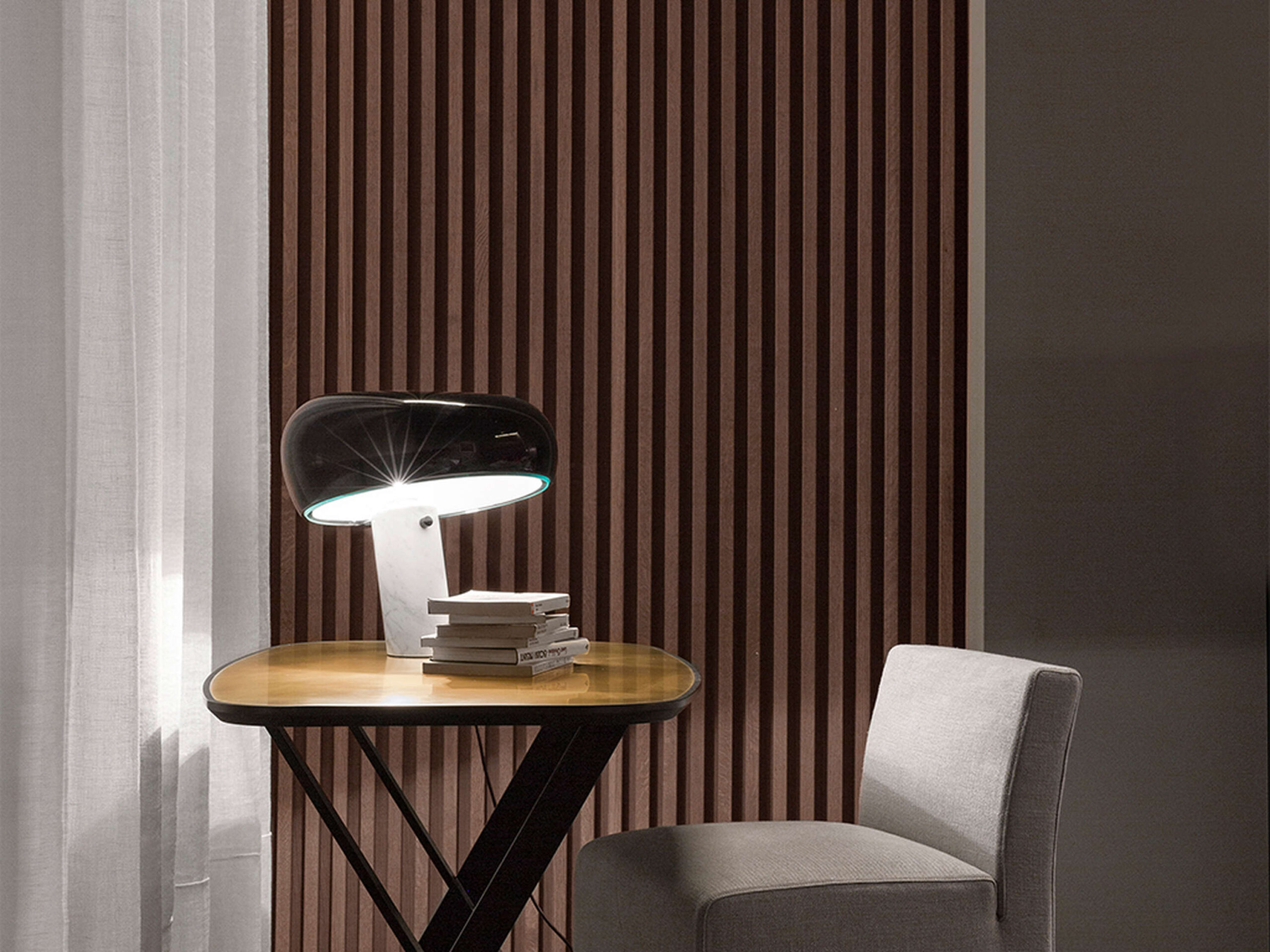
Table and desk lamps of the 1970s and 1980s
During these decades, the desk lamp became an increasingly precise tool: low-voltage sources, small heads, calibrated springs and arms that could be moved with a fingertip. Alongside these technical designs came ambient lamps built from remarkably simple geometric forms.
Panthella, Verner Panton for Louis Poulsen (1971)
A hemispherical shade sits above a stem that widens into a trumpet-shaped base. Both parts contribute to the way Panthella reflects and distributes light. Opal versions provide a particularly soft glow; opaque shades direct more of the light downwards, so finishes are not merely cosmetic. The current family includes the 320 table version and portable sizes such as 160 and 250. The original design dates to 1971, not each later portable edition. It offers an approachable way to bring Panton’s organic forms into a room without the stronger visual complexity of some of his other work.
Tizio, Richard Sapper for Artemide (1972)
Two slender arms balanced by counterweights and a tiny head make Tizio look more like an instrument than a conventional lampshade. Electricity travels through the structure, avoiding a cable running along the arms. Its original use of a small halogen source helped make the compact head possible; the family now includes an LED version as well as different sizes. The mechanism lets the light move towards the work rather than forcing the user to work underneath a fixed shade. For drawing, reading or detailed desk tasks, that reach is the design’s enduring advantage.
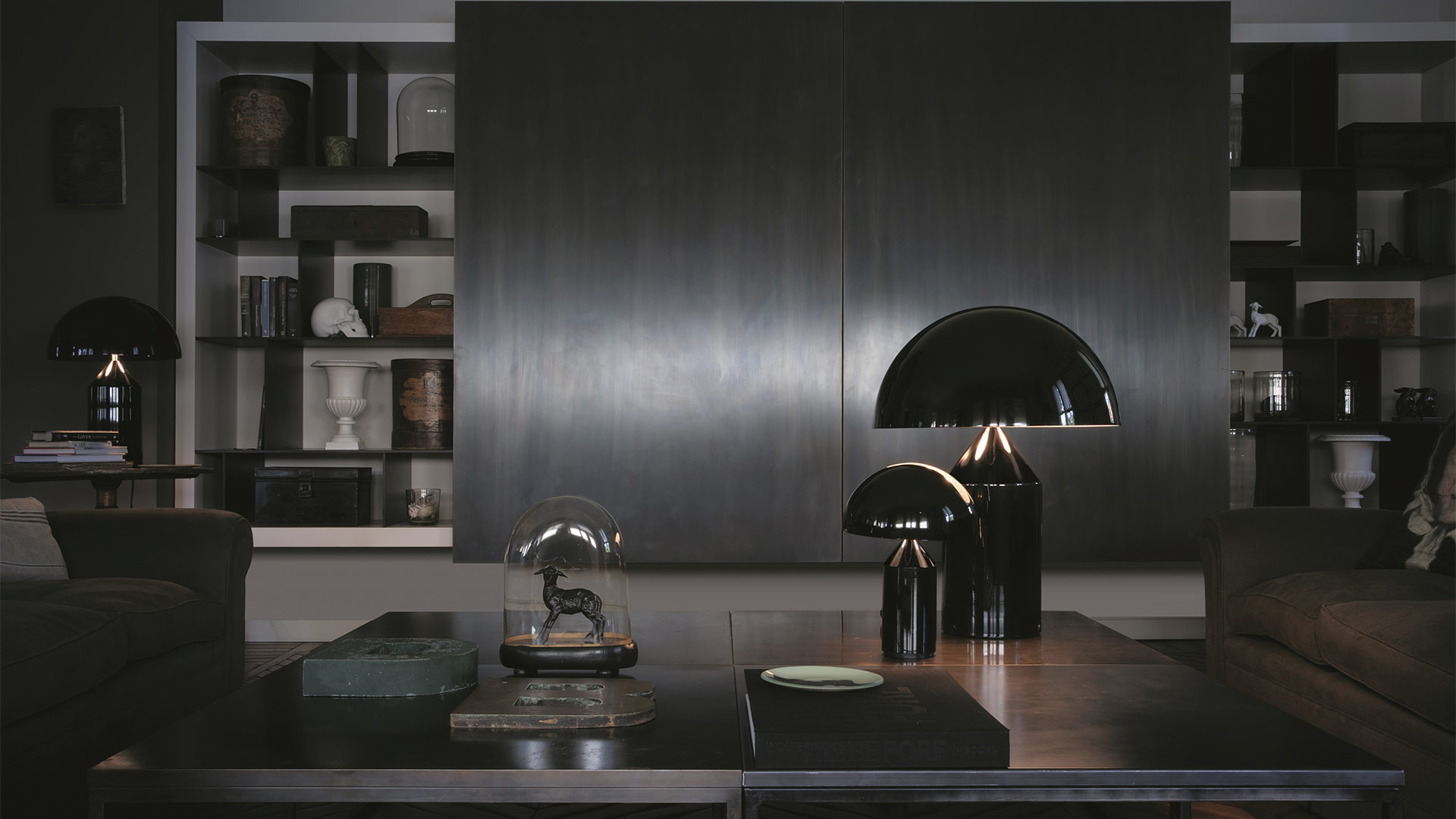
Atollo, Vico Magistretti for Oluce (1977)
A cylinder, cone and hemisphere reduce the conventional shaded lamp to three geometric forms. The dome seems to hover above the stem, while the light reveals the cone and gathers below the shade. Atollo won the Compasso d’Oro in 1979 and appears in major museum collections. Oluce produces it in several sizes and in metal and glass versions, with different light effects. It is particularly persuasive as an ambient living-room lamp: not because it disappears into the room, but because its familiar outline remains coherent across very different interiors.
Berenice, Alberto Meda and Paolo Rizzatto for Luceplan (1985)
Berenice balances technical precision with an unexpectedly delicate appearance. Slender articulated arms position a small head, while the coloured glass reflector gives the mechanism a distinctive accent. Steel, aluminium and engineered plastics belong to a structure designed around easy adjustment rather than a large decorative shade. It suits a desk where the light must move repeatedly between a drawing, a book and a keyboard. The broader family includes other mounting arrangements; the exact edition matters if desk space is limited.
Costanza, Paolo Rizzatto for Luceplan (1986)
Costanza revisits the most familiar image of a lamp: a slender stem beneath a conventional shade. Industrial materials change that image without making it unfamiliar. An aluminium structure supports an interchangeable polycarbonate shade, and selected versions have a telescopic stem. On the dimmable edition, a metal rod hanging beneath the shade controls the light. Different heights, colours and controls let the design move between bedside and living room. Its flexibility comes from these variants, not from one configuration being suitable for every home.
Tolomeo, Michele De Lucchi and Giancarlo Fassina for Artemide (1987)
Tolomeo takes the architect’s articulated task lamp and makes it lighter in appearance. Aluminium arms, a spring-balancing system and an adjustable conical reflector provide considerable freedom of movement. It won the Compasso d’Oro in 1989; the ADI Design Museum’s account of the Tolomeo series places that familiar image alongside its technical sophistication. The family has since expanded into many sizes and configurations. Bulb fittings, integrated LED sources and dimming arrangements vary, so check the selected model rather than assuming every Tolomeo shares the same equipment.
Contemporary designer table lamps
More recent table lamps explore three distinct directions: an ironic return to decorative tradition, the integration of electronic controls and portable light. Their usefulness often depends less on belonging to a particular room than on the way people move through the home.
Bourgie, Ferruccio Laviani for Kartell (2004)
Bourgie combines a pleated shade and a baroque, candelabrum-like stem with moulded polycarbonate. The contrast between historical ornament and an industrial material is the point of the design. Transparent editions multiply reflections, while other finishes change its visual weight. The adjustable-height arrangement and dimmable versions help it work on a console or beside a bed, but it is an intentionally decorative presence. A pair can establish a formal rhythm; a single lamp can introduce a playful note into a quieter setting.
Kelvin LED, Antonio Citterio with Toan Nguyen for Flos (2009)
Kelvin carries the articulated desk lamp into the LED era. A double pantograph arm and thin adjustable head provide directed light without a bulky shade. Electronic controls sit on the head; selected configurations offer Green Mode, which adjusts output in response to ambient light. The family includes several mounting options, so a base is not the only way to position it. Kelvin makes most sense at a home-working desk where control and repeatable adjustment matter more than a decorative pool of light beside a sofa.
IC Lights T1 High, Michael Anastassiades for Flos (2014)
An opal glass sphere appears to balance at the end of a metal rod. The IC family grew from Anastassiades’ observation of contact juggling, in which a ball seems to remain suspended against the performer’s body. T1 High translates that moment into a tall table-lamp composition, approximately 53 cm high, with dimming on the cable. The sphere diffuses light around the lamp instead of concentrating a task beam. It belongs on a surface where its balancing act can be seen clearly, whether beside a sofa or on a generous bedside table.
Bellhop, Edward Barber and Jay Osgerby for Flos (2016 commission; commercial edition 2018)
Bellhop began as a bespoke light for the Design Museum in London in 2016; Flos identifies the commercial portable edition as 2018. A compact polycarbonate dome and rechargeable base bring light closer to the idea of a contemporary candle. Its portability lets it move between a dining table, bedside and reading corner. However, cordless does not automatically mean weatherproof. The earlier Bellhop Unplugged edition has an IP20 rating for dry indoor use, while the newer IP54 version is specified for outdoor use. Check the exact edition and instructions before taking it outside.
The eighteen lamps compared
The table gives the original design or family date, designer, manufacturer or distributor and the use we consider especially appropriate. Later sizes and technical editions may have different launch dates. These are editorial suggestions, not a performance ranking.
| Lamp | Designer | Original date | Manufacturer or distributor | Suggested use |
|---|---|---|---|---|
| Bilia | Gio Ponti | 1932 | FontanaArte | Bedside table, shelf |
| Original 1227 | George Carwardine | 1935 | Anglepoise | Desk |
| Akari 1A | Isamu Noguchi | Akari family, 1951 | Made by Ozeki; distributed by Vitra | Bedside, ambient light |
| Taccia | Achille and Pier Giacomo Castiglioni | 1962 | Flos | Ambient light, console |
| Eclisse | Vico Magistretti | 1965 | Artemide | Bedside table |
| Pipistrello | Gae Aulenti | 1965 | Martinelli Luce | Living room, entrance hall |
| Nesso | Giancarlo Mattioli; Gruppo Architetti Urbanisti Città Nuova | 1965 | Artemide | Ambient light |
| Snoopy | Achille and Pier Giacomo Castiglioni | 1967 | Flos | Desk, reading |
| Panthella 320 | Verner Panton | Panthella family, 1971 | Louis Poulsen | Ambient light |
| Tizio | Richard Sapper | 1972 | Artemide | Desk |
| Atollo | Vico Magistretti | 1977 | Oluce | Living room, ambient light |
| Berenice | Alberto Meda; Paolo Rizzatto | 1985 | Luceplan | Desk |
| Costanza | Paolo Rizzatto | 1986 | Luceplan | Bedside, living room |
| Tolomeo Tavolo | Michele De Lucchi; Giancarlo Fassina | 1987 | Artemide | Desk, reading |
| Bourgie | Ferruccio Laviani | 2004 | Kartell | Bedside, console |
| Kelvin LED | Antonio Citterio with Toan Nguyen | 2009 | Flos | Desk |
| IC Lights T1 High | Michael Anastassiades | 2014 | Flos | Living room, bedside |
| Bellhop | Edward Barber; Jay Osgerby | 2016 commission; 2018 commercial edition | Flos | Portable light; indoor/outdoor suitability depends on edition |
Italian manufacturers account for fifteen of the eighteen entries: Artemide, Flos, Oluce, Luceplan, FontanaArte, Martinelli Luce and Kartell. Yet national origin is not a substitute for understanding the individual light. Magistretti’s Eclisse and Atollo alone show how differently two designs by the same author can approach the relationship between a shade, its source and the supporting surface.
Frequently asked questions about designer table lamps
What is the most famous designer table lamp?
There is no official league table. Tizio, Atollo, Tolomeo and Eclisse are among the designs repeatedly represented in design histories and museum collections. Atollo won the Compasso d’Oro in 1979, Tolomeo in 1989 and Eclisse in 1967. The most useful choice for your home depends on the activity and available space, not fame alone.
Which designer lamp works best on a bedside table?
Look for a compact footprint and light that does not shine into the eyes of someone sleeping beside you. Adjustable shielding, as on Eclisse, or a paper or opal diffuser, as on Akari 1A and Bilia, can help. Costanza is another option if the table can accommodate it. Warm light around 2,700 K is a useful starting point, but check glare from the actual position of the pillow.
Which desk lamp is best for working?
For detailed work, prioritise a controllable beam and enough reach to light the task without obstructing it. Tolomeo, Tizio, Berenice, Kelvin LED and Original 1227 approach this through articulated structures. The office reference of 500 lux for reading and writing concerns light at the work surface; it is not an automatic guarantee supplied by any particular lamp. Consider the whole workstation, reflections on screens and other light in the room.
What colour temperature should a table lamp have?
For a relaxed bedroom or living room, approximately 2,700 K is a common choice; 3,000 K can also work, including at a desk. These values are guidance rather than a universal domestic requirement. Check colour rendering as well as colour temperature: the EU ecodesign baseline of CRI 80 has a defined scope and exceptions, and higher colour fidelity may suit tasks involving materials or images.
Do historic designer lamps still use halogen bulbs?
Technical arrangements vary. Some families have integrated LED editions, while others use replaceable LED bulbs in conventional fittings. Tizio has an LED version; current Taccia editions use LED technology; the European Eclisse uses an E14 LED-retrofit bulb. Check the exact product code, the permitted source, dimmer compatibility and whether replacement is a user task or requires a professional. Do not infer these details from the lamp’s design date.