Compare six European plaster, render and dry-mix mortar brands, with guidance on substrates, quantities, material costs and where to buy.
A well-finished wall starts beneath the colour. Before choosing a matt paint or a textured mineral finish, there is a base coat that needs to suit the masonry, bond correctly and provide a sound surface. Choosing the best plaster, render and dry-mix mortar brands therefore starts with the building and the job, rather than the cheapest bag.
Fassa Bortolo, Kerakoll, Mapei, Weber, Baumit and RÖFIX make a useful European shortlist. We selected them for documented products covering different needs, from general base coats and natural lime systems to existing masonry and interior finishes. This is a buying guide, not a laboratory-tested ranking or an exhaustive worldwide list. Product names, formulations and distribution vary between countries; the examples below are drawn principally from Italian and European catalogues.
Plaster, render and dry-mix mortar: which do you need?
Plaster generally refers to internal wall and ceiling coatings, while render is commonly used for external wall coatings. Regional vocabulary varies, and lime products may be described as suitable for both plastering and rendering. Neither word alone tells you the binder, substrate compatibility or permitted thickness.
Dry-mix means that the powdered ingredients are proportioned at the factory and mixed with the specified water on site. It is different from a ready-to-use paste sold in a tub. Dry-mix materials can be base plasters, renders, masonry mortars or other products, so the description does not make them interchangeable.
A base coat levels the wall and builds up the specified thickness. A finishing coat or skim creates the finer surface appropriate to the next finish. A masonry mortar has a separate purpose, such as bedding bricks or repairing masonry as specified. Floor screeds and levelling compounds require a different selection again.
Read “lime-based” carefully. A product may contain air lime, natural hydraulic lime (NHL), cement or a combination of binders. The composition and technical data sheet matter more than the family name printed on the packaging.
Six plaster and mortar brands to compare
| Brand | Consider for | Example |
|---|---|---|
| Fassa Bortolo | Lime-based base coats and masonry work | KB 13; MB 60 |
| Kerakoll | NHL lime plasters and masonry mortars | Biocalce Intonaco; Biocalce Muratura |
| Mapei | New and existing masonry base coats | Mape-Antique NHL Eco Intonaco |
| Weber | Hand- or machine-applied lime render | webercalce into G |
| Baumit | Coordinated interior plaster finishes | KlimaUni; KlimaMPI |
| RÖFIX | Lime-cement base coats | 510 |
Fassa Bortolo: separate base coats from masonry mortar
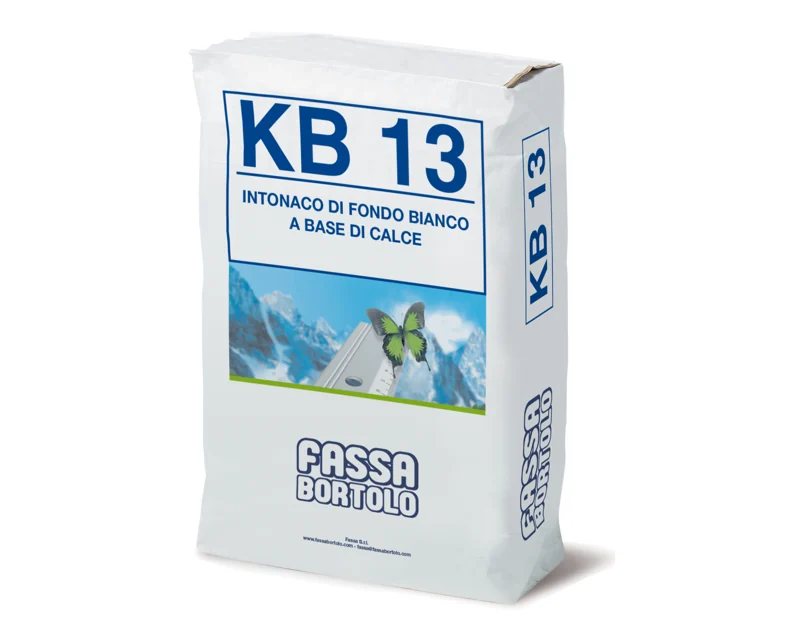
Two Fassa Bortolo products illustrate why it helps to describe the job precisely. KB 13 is a lime-based base plaster for internal and external use; its documentation identifies substrates including brickwork, concrete blocks and rough concrete. MB 60 is a white mortar for exposed masonry where a light colour and the absence of grey Portland cement are required.
Plastering a wall and laying exposed brickwork are different purchases, even when the bags come from the same manufacturer. For KB 13, smooth concrete needs the preparation specified by the manufacturer: knowing that a wall is “concrete” is not enough to establish adhesion. Bagged and silo supply also suit different site arrangements, and available formats should be checked locally.
Kerakoll: natural hydraulic lime plaster and mortar
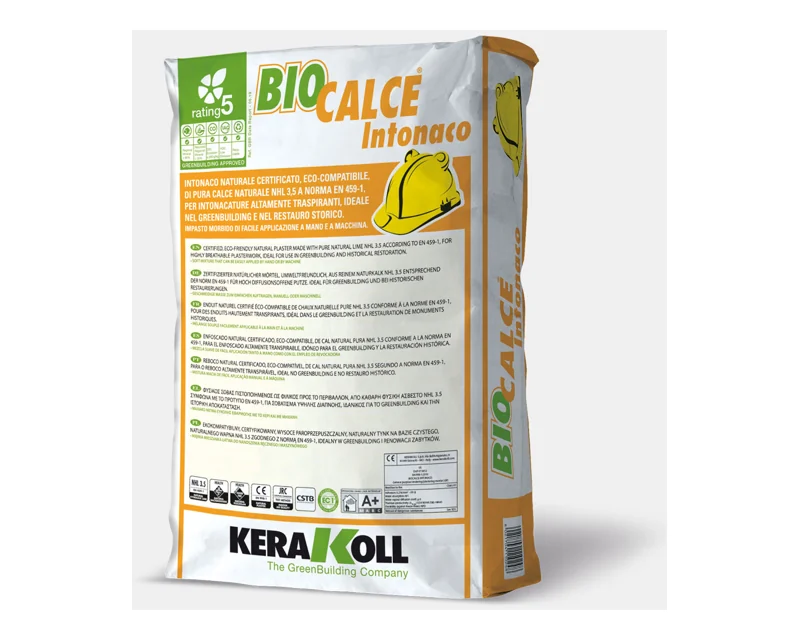
Biocalce Intonaco is an NHL 3.5 natural hydraulic lime plaster/render specified for internal and external masonry including brick, tuff, stone and mixed construction. Its 25 kg bag and approximate consumption of 13 kg/m² per centimetre provide a useful starting point for estimating quantities.
Biocalce Muratura, in the same family, is an M5 masonry mortar for its specified building and repair applications. Sharing a lime binder does not mean that the two products perform the same task. When renovating an existing house, discuss the base coat, finishing coat and paint together rather than looking for one material to do every layer.
Mapei: check the system when renovating existing walls
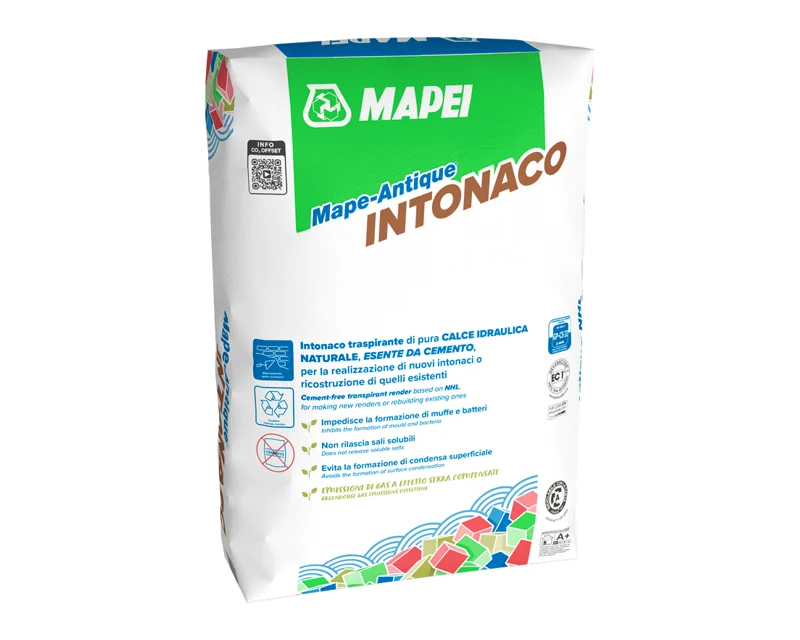
Mape-Antique NHL Eco Intonaco is a cement-free natural hydraulic lime base coat incorporating recycled materials, with applications that include existing masonry. Its documentation distinguishes it from the dedicated renovation products used for walls affected by rising damp and salts.
That distinction matters when renewing a ground-floor wall. Vapour permeability does not automatically make an ordinary plaster a damp-renovation system. Establish the condition of the masonry before ordering the coating. Follow the specified mixing method and thicknesses too: adding cement or another binder to change the consistency is not an approved shortcut.
Weber: NHL lime with a realistic working schedule
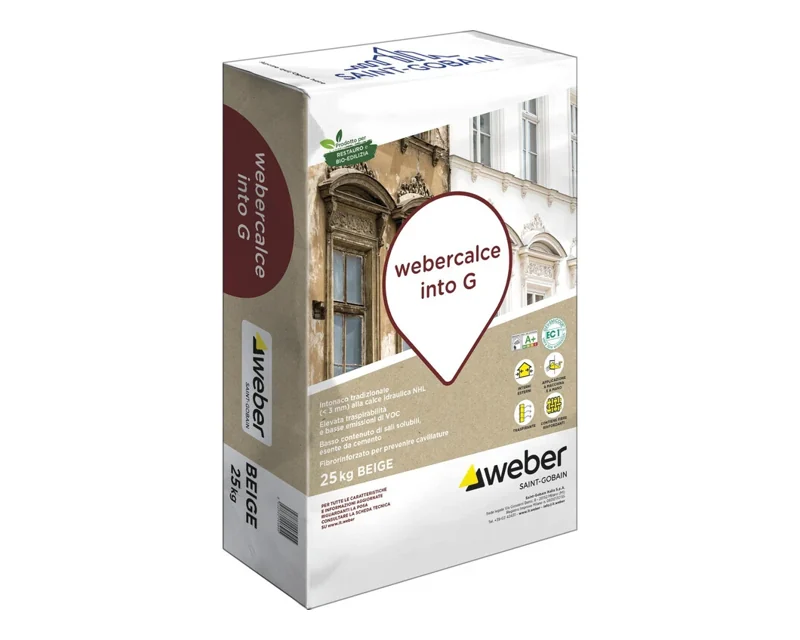
webercalce into G, an example from the Italian range, is a cement-free, fibre-reinforced natural hydraulic lime plaster/render for hand or machine application. It is worth comparing where that binder and application method suit the project.
The technical instructions also show why the schedule belongs in the buying discussion. Protection against rapid drying and waiting periods before subsequent finishing are part of the work, not optional extras once the wall looks dry. Agree the sequence with the contractor before booking decoration: a rushed programme can undermine an otherwise suitable material. Check the equivalent local Weber product rather than assuming the Italian name is stocked worldwide.
Baumit: plan the interior surface as a complete finish
Baumit’s interior systems provide examples such as KlimaUni for manual application and KlimaMPI for machine application, to be assessed alongside the corresponding finishing layers. Its interior guide connects the base plaster, surface finish and paint, which is useful when appearance matters as much as preparation.
A smooth wall and a more textured mineral surface involve different finishing work. Request a sample and agree what “ready for painting” means before accepting a quotation. The final surface depends on the sequence of compatible layers, not simply on choosing a bag labelled lime plaster.
RÖFIX: a lime-cement base coat for specified applications
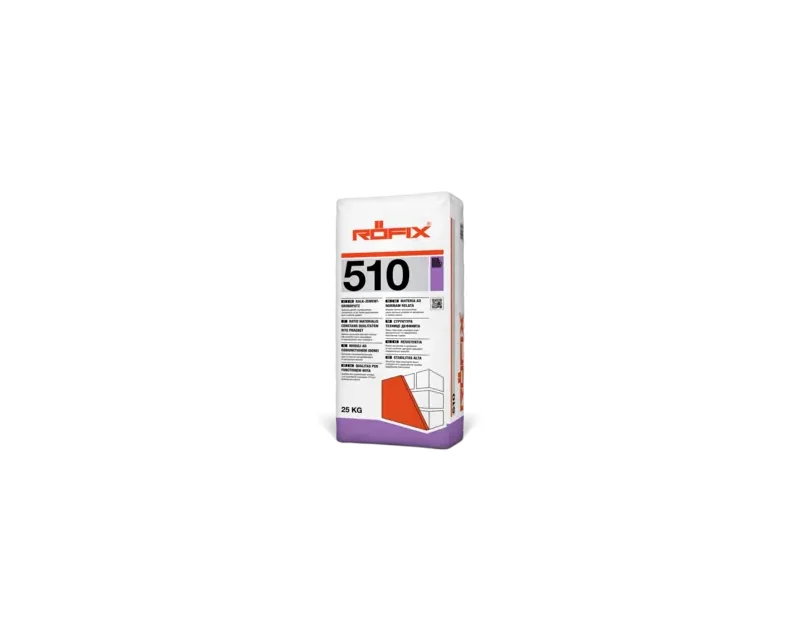
RÖFIX 510 is a lime-cement base coat for internal walls, ceilings and façades with low moisture exposure on the specified substrates. The Italian product page lists 25 kg bags and silo supply, with consumption of 1.3 kg/m² per millimetre.
It is an example to compare for general mineral base-coat work, subject to the wall and subsequent finish. A separate CAM version is also listed in Italy. If a project requires particular recycled-content documentation, identify the exact variant in the quotation: a general product-family name is not enough. Local availability and declarations should match the product actually supplied.
How to choose plaster or render for your home
Begin with the substrate: new brick, old stone, concrete, existing plaster or a painted surface? Then establish the location and exposure: internal room, façade, plinth or moisture-prone area. Loose paint, friable material and salt deposits need assessment before selecting the coating.
For old masonry, compatibility with the existing wall should guide the specification. For general renovation, also consider flatness, thickness, application method and the planned finish. Where tiles will follow, check the suitability of the backing and any necessary waterproofing system. A plaster does not become waterproof simply because it is installed in a bathroom.
Breathability is a property to consider in a wall assembly, rather than a promise that mould will disappear. Leaks, rising damp, condensation and thermal bridges have different causes. Likewise, an ordinary mineral plaster does not replace a designed insulation system.
Think about texture and daylight before the final coat. Our guide to lime paint for interiors explores the visual effect of that finish; tadelakt is a distinct decorative technique, rather than another name for standard base plaster.
How much does plaster cost, and how many bags do you need?
The useful comparison is material cost per square metre at the intended thickness. Equal bag weights do not guarantee equal coverage. Start with area × thickness × declared consumption, divide by bag weight and round up. Agree an allowance for uneven walls and site waste with the installer.
For example, 20 m² at 10 mm with a declared consumption of 13 kg/m²/cm theoretically needs 260 kg, or 11 bags of 25 kg before any additional allowance. At 20 mm, the theoretical quantity doubles. A low bag price is not the same as a low wall cost.
As an Italian retail reference checked in October 2026, one offer for a 25 kg bag of Biocalce Intonaco was €11.85 including Italian VAT, excluding delivery. At the stated consumption, that works out at about €6.16/m² for the dry material at 10 mm; buying 11 bags costs €130.35. This is a calculation using one offer, not a worldwide price range. UK, US and other markets have different products, taxes, transport costs and labour rates.
A quotation for the finished wall should identify removal, substrate preparation, base coat, any mesh and profiles, finishing coat, decoration, labour, transport and disposal. Comparing two square-metre rates without checking these inclusions can make an incomplete quotation appear cheaper.
Where to buy and what to ask
Consider builders’ merchants, specialist plaster or lime-material suppliers and renovation-material retailers. Online ordering may suit smaller quantities, while larger jobs may require pallet or silo delivery organised with the contractor. Confirm access, unloading and any equipment requirements before purchasing.
Bring photographs of the wall, its approximate area, the proposed thickness and the intended finish. Ask for the exact product name, current local technical data sheet, quantity calculation, complementary layers and waiting times. For bagged materials, check packaging condition, batch information and storage: dry powder must be protected from moisture before mixing as well as during site storage.
Buying mistakes that lead to rework
- Choosing the manufacturer without identifying the product. Different bags from one brand serve different purposes.
- Using a thin finish to correct deep unevenness. The permitted build-up must match the task.
- Covering damage without assessing it. A new coating does not automatically solve damp or poor adhesion.
- Changing the mix by eye. Water dosage, mixing and usable time come from the technical instructions.
- Decorating too soon. Moving-in dates need to account for the chosen coating system.
Frequently asked questions about plaster and dry-mix mortar
Which is the best plaster brand?
There is no single best brand for every wall. Fassa Bortolo, Kerakoll, Mapei, Weber, Baumit and RÖFIX offer options worth comparing, but substrate, moisture, thickness, binder and final finish determine the appropriate product.
Is lime plaster better than lime-cement render?
The answer depends on the masonry and required performance. NHL lime and lime-cement materials differ in composition and behaviour. For existing walls, assess compatibility before choosing on price or declared strength alone.
Does breathable plaster solve rising damp?
Not by itself. Establish the cause of moisture and specify a dedicated renovation system where appropriate. A vapour-permeable base coat is not automatically a damp-management product.
How much area does a 25 kg bag cover?
Coverage depends on the product and thickness. At 13 kg/m²/cm, a 25 kg bag theoretically covers about 1.92 m² at 10 mm, before waste. Use the consumption declared for the exact product being purchased.
When can new plaster be painted?
Once it meets the curing and substrate-condition requirements of the plaster, finishing coat and paint system. There is no universal waiting period: material, thickness, temperature and ventilation all affect the programme.