Naples’ nativity street seen through a designer’s eyes: artisan workshops, the church and cloister of San Gregorio Armeno, Napoli Sotterranea and the Presepe Cuciniello at the Certosa di San Martino.
San Gregorio Armeno is not a Christmas market: it is a few hundred metres of stage designers’ workshops, where the Neapolitan nativity scene is built like architecture in miniature, figure by figure and backdrop by backdrop.
San Gregorio Armeno is the nativity street of Naples, at the heart of a historic centre that has been a UNESCO World Heritage Site since 1995. The artisan workshops make and display their work all year round, but the busiest period runs from November to December, when Christmas in Naples turns the narrow street into one of the most visited places in Italy. The street links the lower and upper decumani and follows one of the cardines of the city’s Greco Roman grid.
Seen through a designer’s eyes, the San Gregorio Armeno nativity scenes are far more than souvenirs. They are scale models in which ruins, taverns, staircases and forced perspectives are built with the logic of a theatre set. Understanding them means reading Naples itself: a layered, vertical city where the sacred and the everyday share the same space. The editors suggest exploring it this way, starting on the street and then going, quite literally, beneath it.
When should you visit San Gregorio Armeno for Christmas 2026?
The best time is November, when the workshops have already put out their new pieces and the December crowds have not yet arrived. In December the street is at its most vibrant, but at weekends and on public holidays the crowds are such that the City often regulates pedestrian flow: our advice is to choose a weekday morning.
| Information | Christmas 2026 |
|---|---|
| When | Workshops open all year; busiest from November to December |
| Opening hours | Vary from workshop to workshop; weekday mornings are the quietest |
| Where | Via San Gregorio Armeno, between Via dei Tribunali and Via San Biagio dei Librai, historic centre |
| Nearby | Church and cloister of San Gregorio Armeno, Napoli Sotterranea, Cappella Sansevero |
| Eighteenth century crib | Presepe Cuciniello, Certosa e Museo di San Martino (closed on Tuesdays) |
| Getting there | Metro line 1 (Dante or Museo stations) or line 2 (Cavour), then on foot |
How is the nativity street organised?
It is an unbroken sequence of workshops and stalls on both sides, spilling onto walls and into doorways. On display are terracotta and fabric figures, complete settings, individual architectural pieces and tiny accessories: baskets of fruit, fish, tools, lanterns. Locally the street is also known as San Liguoro, an old Neapolitan name for the same saint.
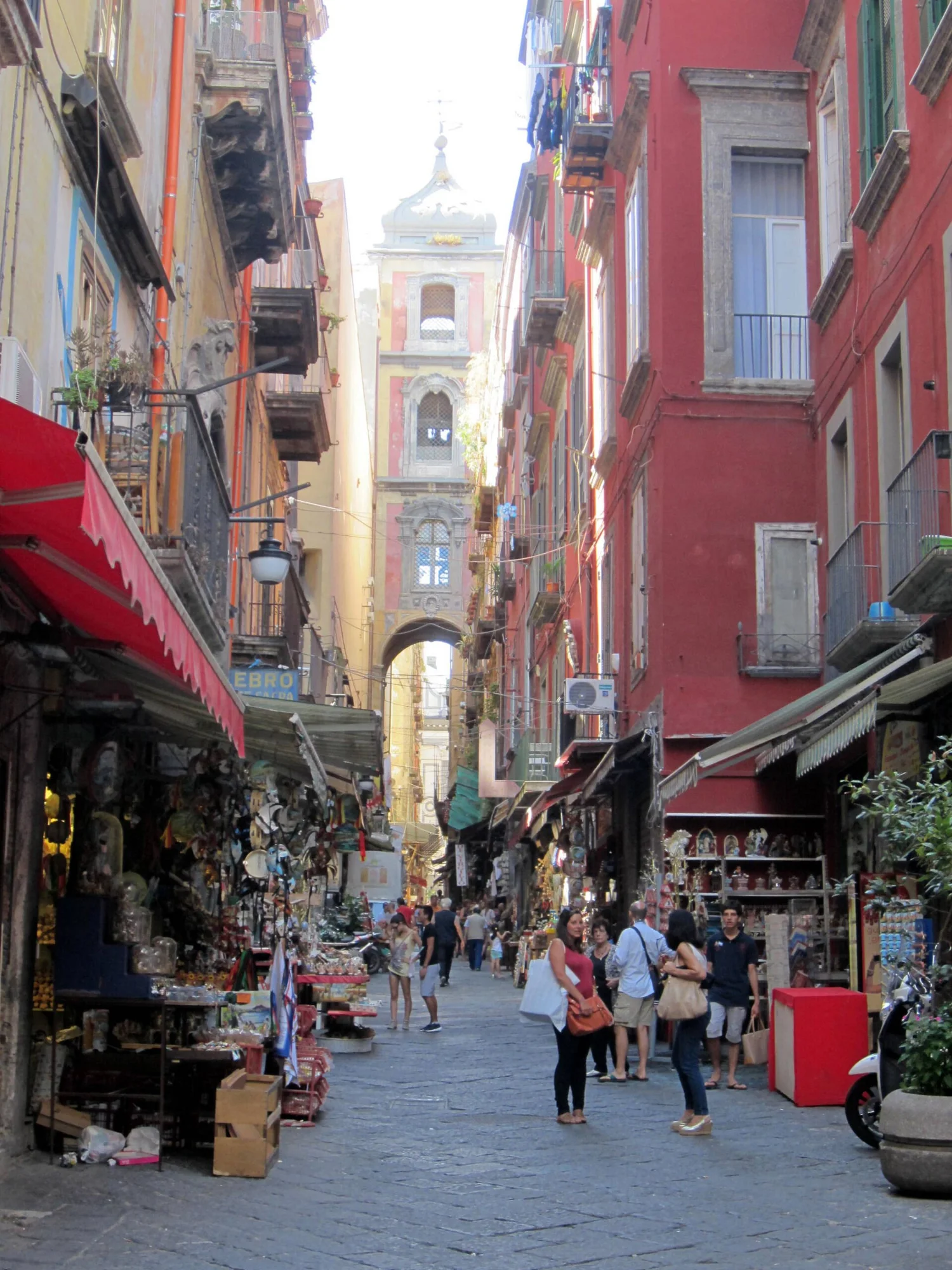
For many years the artisans have also made figurines of television, sporting and Neapolitan cultural icons, from Totò to Eduardo, from Pino Daniele to Massimo Troisi. It may look like kitsch, but it proves the tradition is alive: the Neapolitan crib has always been a portrait of the contemporary city, and in the eighteenth century the Nativity was surrounded by the street vendors and travellers of the day.
Why is the Neapolitan nativity scene a lesson in set design?
Because it builds a space, not just a scene. The Neapolitan crib combines three registers: the Nativity, often set among classical ruins, the annunciation to the shepherds and the tavern, which stands for secular life. The artisan works like a set designer, layering successive flats, stairs and levels to suggest a depth the model does not actually have. It is micro architecture in the most precise sense of the term.
So the way to judge a workshop is the way you would judge a project: the proportion between figures and setting, the quality of the modelling, the care taken over materials. Hand painted terracotta heads and hands, fabric clothes sewn onto the figure and accessories modelled one by one separate genuine craft from mass production.
Which architecture should you see around San Gregorio Armeno?
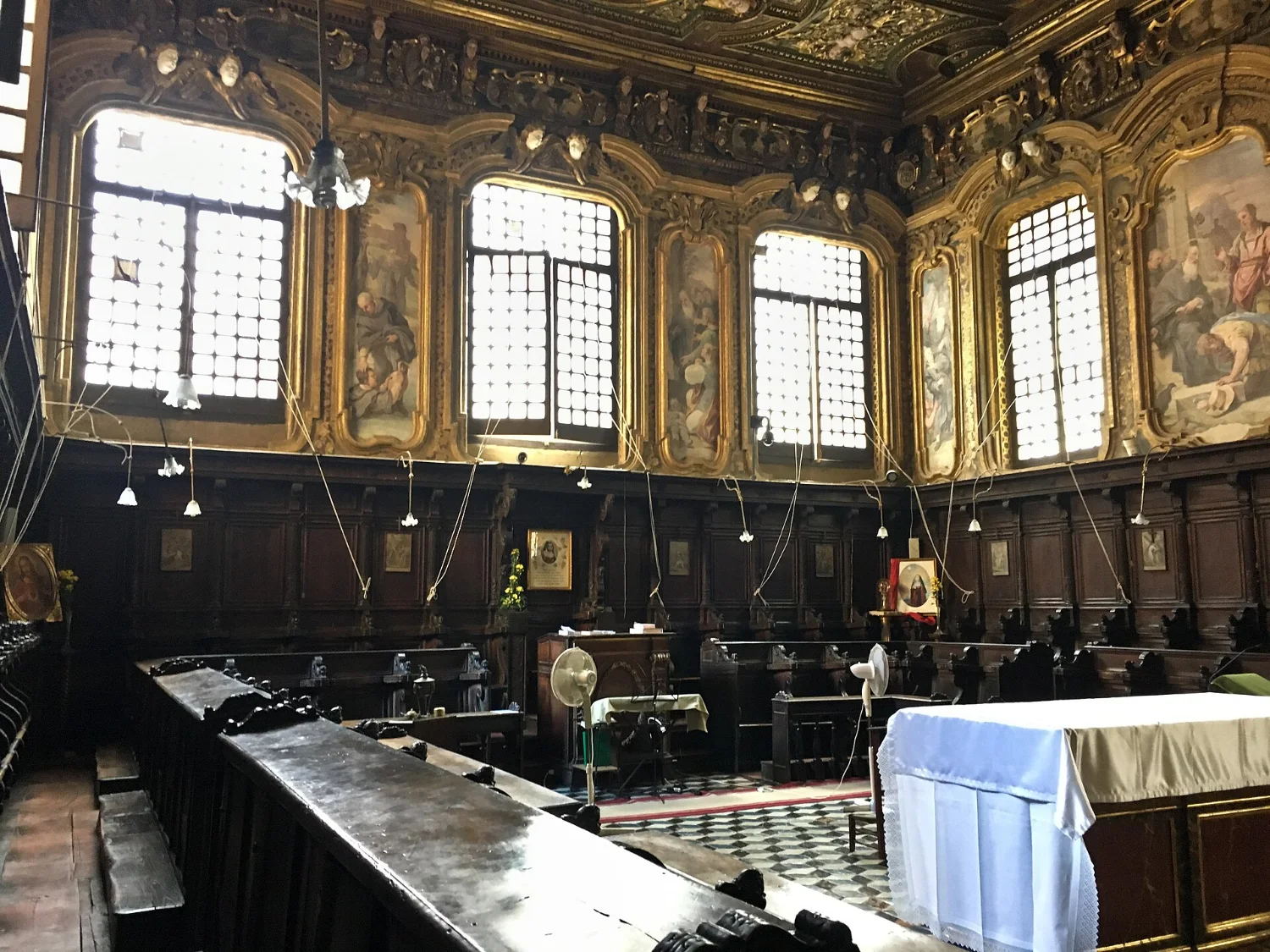
Halfway along, the bell tower bridging the street marks the church of San Gregorio Armeno and its monastery. Tradition links its founding to nuns who fled Byzantium during iconoclasm, carrying the relics of the Armenian saint; the complex was entirely rebuilt after the Council of Trent. The green and gold interior has a carved wooden ceiling painted from 1580 by Teodoro d’Errico and his workshop, and above the entrance the frescoes Luca Giordano painted in 1679 depict the nuns’ arrival in Naples.
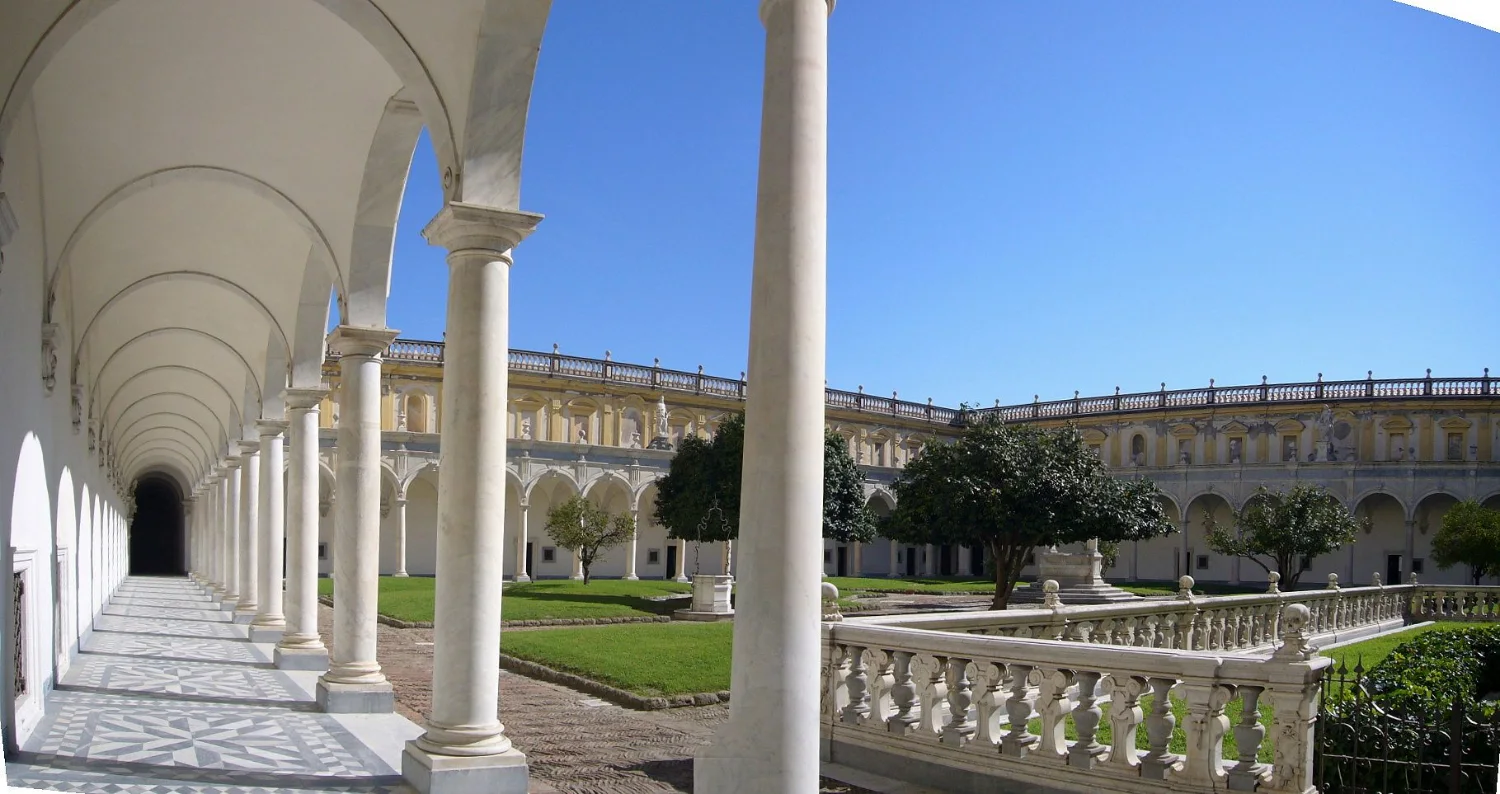
The cloister, with its own entrance, was begun in 1572 by Giovan Vincenzo della Monica and is one of the quietest spaces in the historic centre. At its centre stands a marble fountain with statues of Christ and the Samaritan Woman by Matteo Bottigliero, dating from 1733. After the bustle of the street, this is where the editors suggest you pause: the contrast between alley and cloister garden is the spatial essence of Naples.
A few steps away you can descend beneath the city. From Piazza San Gaetano, on Via dei Tribunali, the Napoli Sotterranea route goes down to about forty metres, through tunnels and cisterns of the ancient Greco Roman aqueduct and Second World War shelters. It is the most direct way to grasp why the historic centre, founded by Greek settlers as Neapolis, is a single organism built in layers.
Five minutes’ walk away, on Via Francesco De Sanctis, the Cappella Sansevero holds the Veiled Christ, the life size marble statue Giuseppe Sanmartino carved in 1753 for Raimondo di Sangro. It is the perfect counterpoint to the workshops: the same Neapolitan obsession with detail, pushed to the edge of virtuosity.
Where can you see an eighteenth century Neapolitan crib?
At the Certosa e Museo di San Martino, on the Vomero hill next to Castel Sant’Elmo. The nativity section, in what were once the monastery kitchens, holds the richest collection of eighteenth century figures. Its centrepiece is the Presepe Cuciniello, inaugurated in 1879 thanks to the collection Michele Cuciniello donated to the State: some eight hundred figures, animals and accessories set in an artificial grotto, with lighting that simulates dawn, day, sunset and night.
The Certosa is itself a lesson in architecture. Founded in 1325 at the wish of Charles of Calabria, it was transformed between 1623 and 1656 by Cosimo Fanzago, who replaced austere geometries with a Baroque of marble, foliage and scrolls. The museum, open to the public since 1867, is closed on Tuesdays; up to date information is on the Italian Ministry of Culture website.
What should you buy on San Gregorio Armeno?
Our advice is to buy little and buy well. A single hand modelled, hand painted figure dressed in fabric is worth more than an entire scene in resin. If you want to build your own crib, start with an architectural element, a ruin, a staircase or a fountain, and add figures over the years, as Neapolitan families always have.
It pays to ask the artisan how a piece is made: a serious maker is happy to explain materials and techniques. The miniature accessories, from fruit to baskets of fish, are small masterpieces of modelling and the smartest gift to take home: they take up little space and carry the whole tradition with them.
Where to stay in Naples if you love design?
The most fitting address is the Romeo, at Via Cristoforo Colombo 45, facing the port: its undulating glass façade bears the signature of Kenzo Tange, and the hotel pairs antique and contemporary art in an important collection. The historic centre is just a few minutes away. If you want to add a few days of rest, our selection of the most beautiful design spas in Italy has several ideas.
For a comparison between two opposite ways of celebrating Christmas, the editors have also covered the Bolzano Christmas market and the gallery of light that is Luci d’Artista in Turin.
Frequently asked questions about San Gregorio Armeno and Christmas in Naples
When are the San Gregorio Armeno workshops open?
The workshops are open all year round. The liveliest period runs from November to December, when new pieces appear and the street fills with visitors.
What is the best time to visit San Gregorio Armeno?
A weekday morning in November or early December. At weekends before Christmas the crowds are very large and pedestrian flow may be regulated.
Where can you see the most famous Neapolitan nativity scene?
At the Certosa e Museo di San Martino, home to the Presepe Cuciniello: around eight hundred eighteenth century pieces, on display since 1879. The museum is closed on Tuesdays.
How do you get to San Gregorio Armeno?
Take metro line 1 to Dante or Museo, or line 2 to Cavour, then walk through the historic centre towards Via dei Tribunali.
How many days do you need for Christmas in Naples?
Two full days: one for the historic centre, with San Gregorio Armeno, the cloister, Napoli Sotterranea and the Cappella Sansevero, and one for the Certosa di San Martino and the Vomero.