From Rockefeller Center to Gubbio, from Trafalgar Square to the Galeries Lafayette: the great public Christmas trees seen as temporary architecture, with their history and lessons for decorating at home.
A great public Christmas tree is not a decoration: it is a piece of urban stagecraft, with its own scale, its own direction of light and a precise relationship with the square around it.
Which is the most beautiful Christmas tree in the world? The question returns every December, and our answer is that it depends on how you look at it. Judge it as an object and the tallest or most brightly lit wins. Judge it as a design and other things matter: proportion in relation to the buildings, the quality of the light, the coherence of the staging, the story it tells. It is through this second lens that we have chosen our icons, from New York to Gubbio.
Our argument is that the most successful public trees work as temporary architecture. Rockefeller Center is a media ritual built on a sunken plaza, the spruce in Trafalgar Square is a diplomatic gesture of Nordic restraint, the tree at the Galeries Lafayette is an interior installation beneath a dome of 1912, while Gubbio draws a tree of light across an entire mountainside. Understanding why they work also helps you decorate your own home better.
What is the most beautiful Christmas tree in the world?
There is no official ranking, but three trees dominate the imagination for different reasons. The Rockefeller Center tree in New York is the most famous for its history and showmanship; Gubbio’s is the largest by extent, enough to earn a Guinness World Record in 1991; the tree in Cathedral Square in Vilnius is the most interesting for design lovers, because it changes concept every year and is discussed like an installation.
Our test is simple: a tree is beautiful when the square is better for it. The light should flatter the façades rather than smother them, the scale should converse with the space, and the whole should read clearly even in a night photograph. The trees that follow all pass that test, each in its own language.
Why is the Rockefeller Center tree the most famous?
Because it began as a spontaneous gesture and grew into the most powerful urban Christmas ritual in the world. In 1931, in the depths of the Depression, the workers building the complex decorated a balsam fir of about six metres with paper garlands, strings of cranberries and even a few tin cans. The first official lighting followed in 1933, and the tree has since become the centrepiece of a televised ceremony, usually held on the Wednesday after Thanksgiving.
In design terms the tree, usually a Norway spruce of more than twenty metres, works thanks to the sunken plaza with its ice rink and the vertical backdrop of 30 Rockefeller Plaza behind it: an almost theatrical composition. Since 2018 its tip has carried a Swarovski star designed by the architect Daniel Libeskind, with seventy spikes, three million crystals and a weight of around 400 kilograms. The lights number some fifty thousand multicoloured LEDs. There is also a detail we find exemplary: since 2007, once the season is over, the tree is milled into timber and donated to Habitat for Humanity to build homes. Season information is on the official Rockefeller Center website.
Which are the most beautiful Christmas trees in Europe?
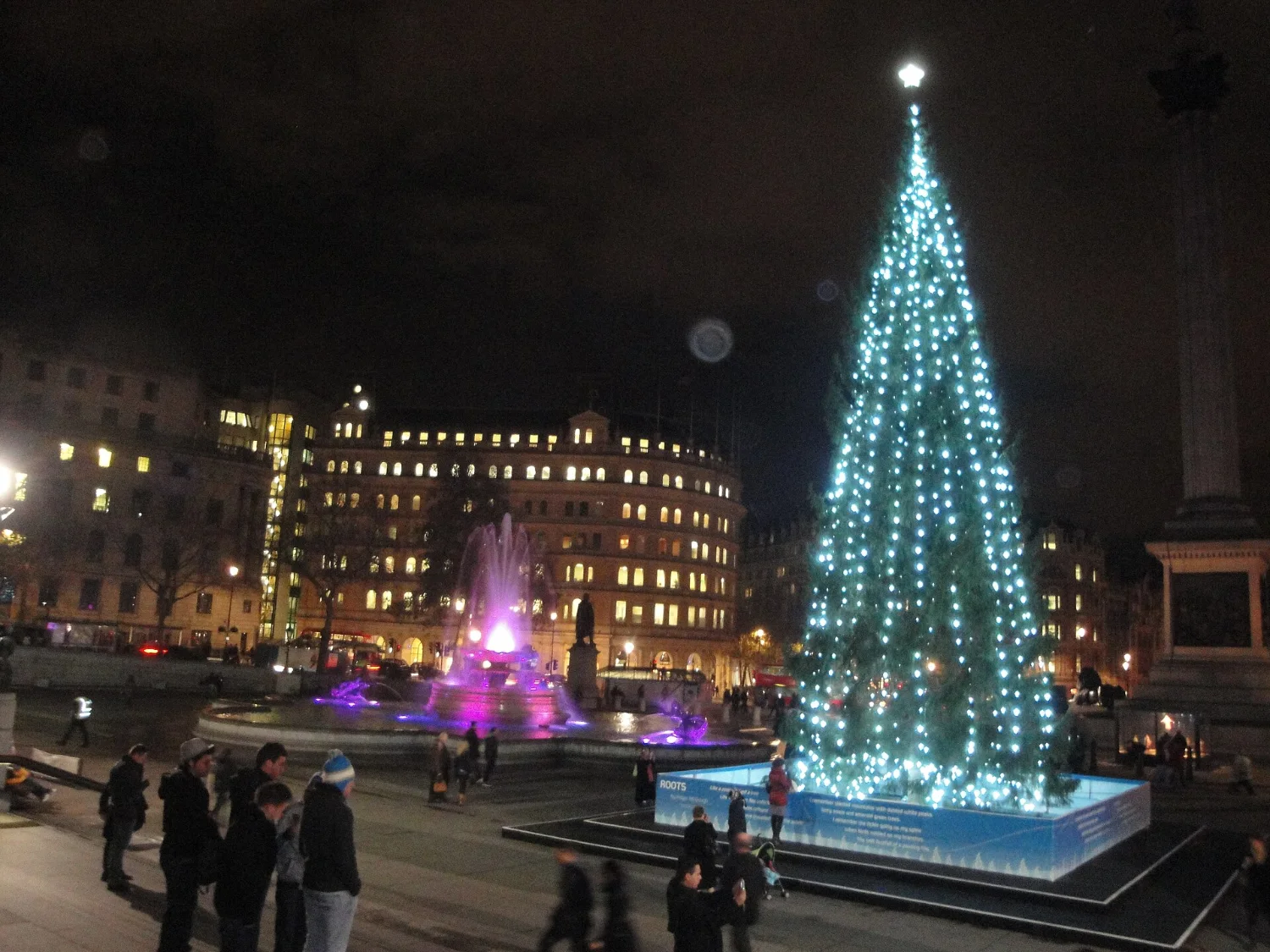
In London, the spruce in Trafalgar Square carries the most meaning. Since 1947 the city of Oslo has given it every year in gratitude for Britain’s support of Norway during the Second World War. It is a Norway spruce of fifty or sixty years, more than twenty metres tall, felled in November in a ceremony and dressed in the Norwegian manner, with white lights and no superfluous ornament. It is traditionally switched on on the first Thursday of December and stays until just before Twelfth Night. Its beauty lies entirely in its restraint: beside Nelson’s Column and the National Gallery, simplicity becomes elegance.
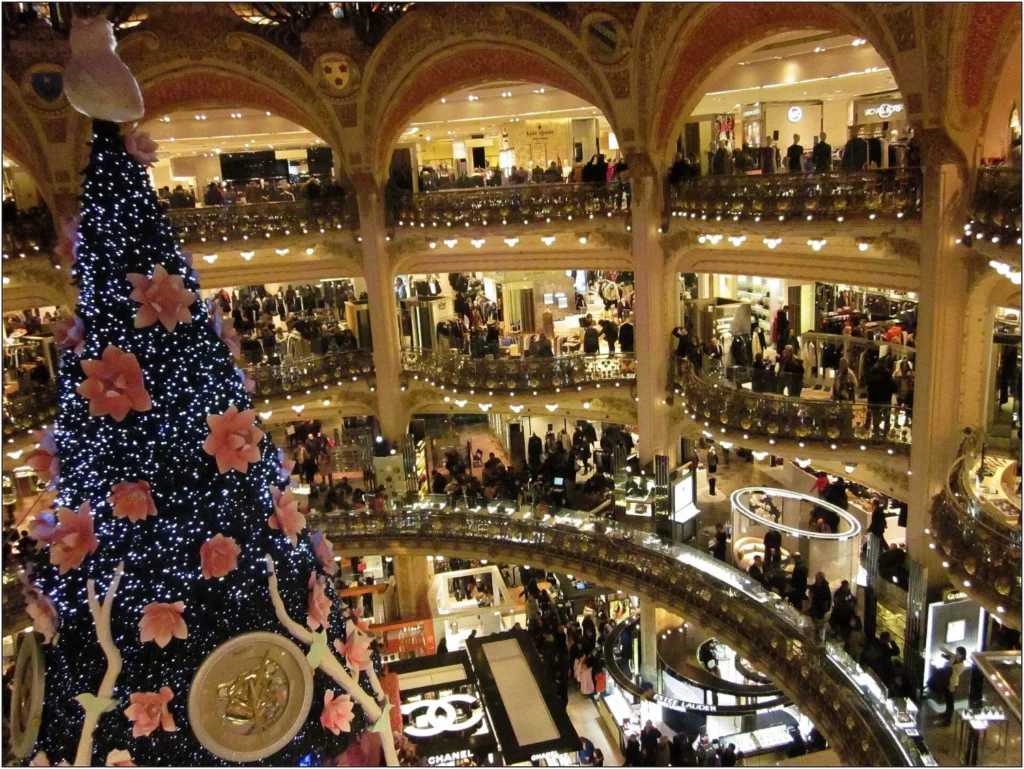
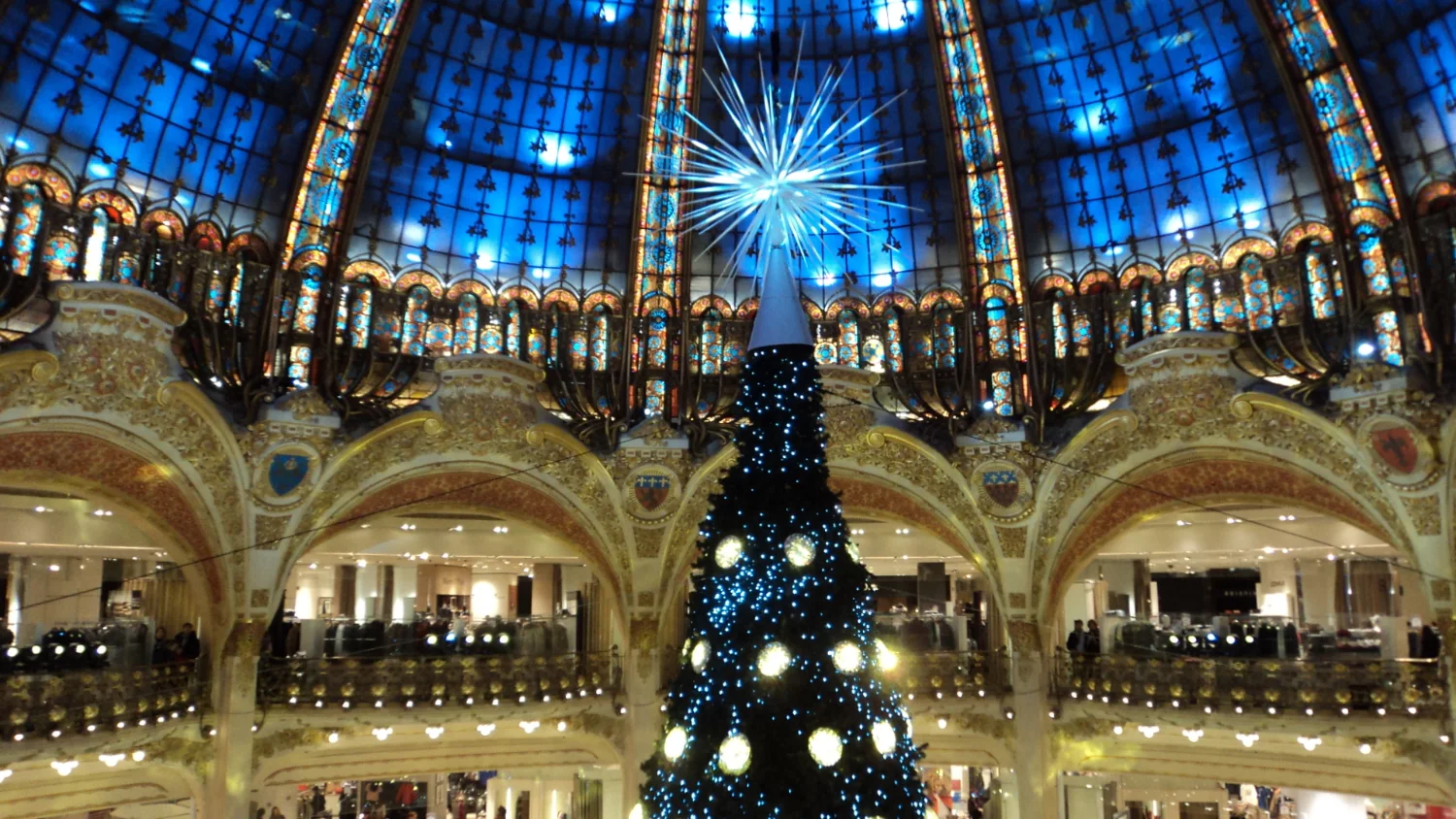
In Paris the scene moves indoors. Beneath the Art Nouveau glass and iron dome of the Galeries Lafayette Haussmann, opened in 1912, a monumental tree is installed every year with a new theme and set design, rising through the void of the atrium and visible from every gallery. It is a rare case of a tree conceived as an interior design project: daylight from the dome by day, artificial light by night. Lovers of historic department stores can read more in our guide to the most iconic department stores.
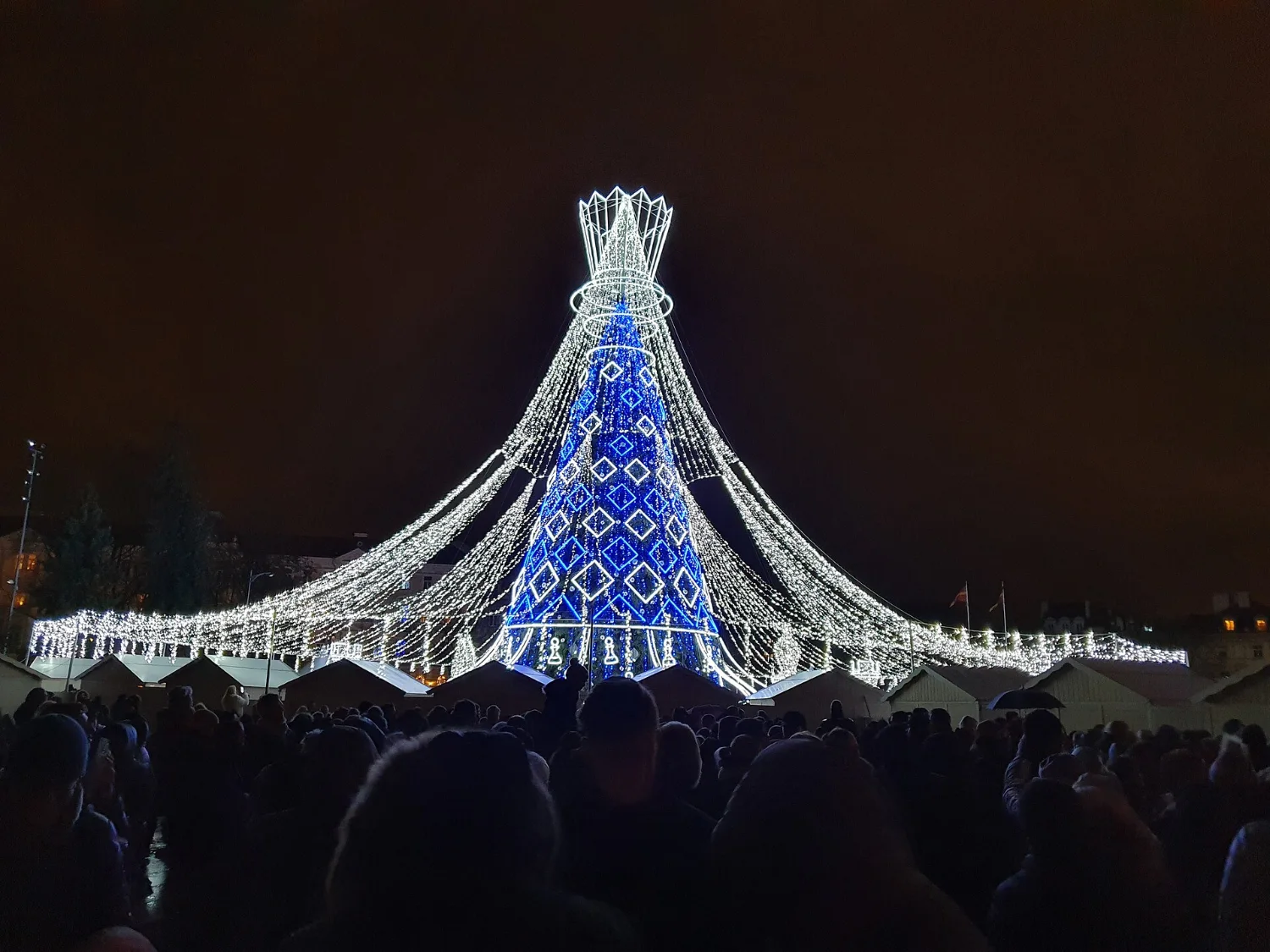
In Vilnius, the tree in Cathedral Square has become, in just a few years, a reference for anyone who sees Christmas through a designer’s eyes. Each edition offers a different interpretation, often built as a legible structure rather than a decorated fir, and the images travel the world. It proves that a public tree can be a contemporary design without losing the warmth of tradition, against the neoclassical backdrop of the cathedral and its bell tower.
Where was the public Christmas tree born?
The Baltic cities and Alsace vie for the honour. Chronicles credit the Brotherhood of Blackheads in Tallinn and Riga with setting up a tree in their guild houses between 1441 and 1510; in Tallinn the tree was then carried into Town Hall Square, where the brothers danced around it. Strasbourg has one of the earliest documented records of a tree in the German-speaking world: sources recall a tree in the cathedral in 1539 and a city chronicle of 1604.
Today Strasbourg, which calls itself the capital of Christmas, renews that story with the great fir on Place Kléber, the heart of the Strasbourg and Colmar Christmas markets. For December travellers, Tallinn’s Town Hall Square and Place Kléber offer two opposite ideas of the tree: the first gathered among medieval façades, the second the protagonist of a grand urban square.
Which are the most beautiful Christmas trees in Italy?
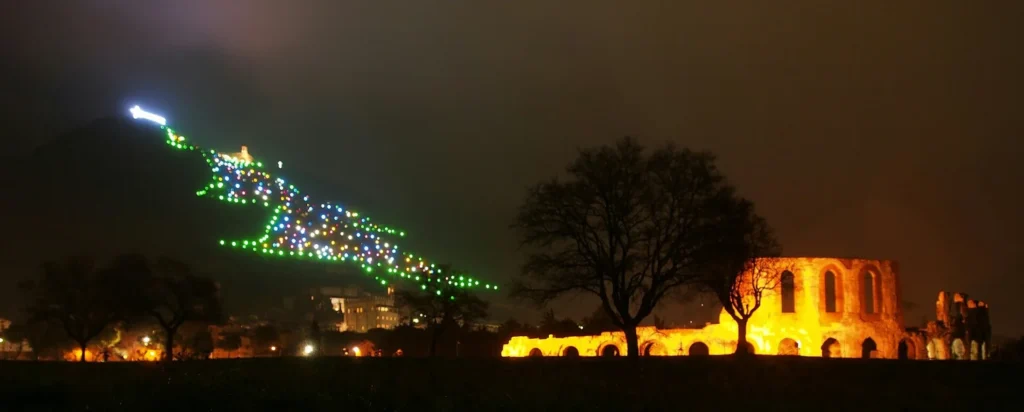
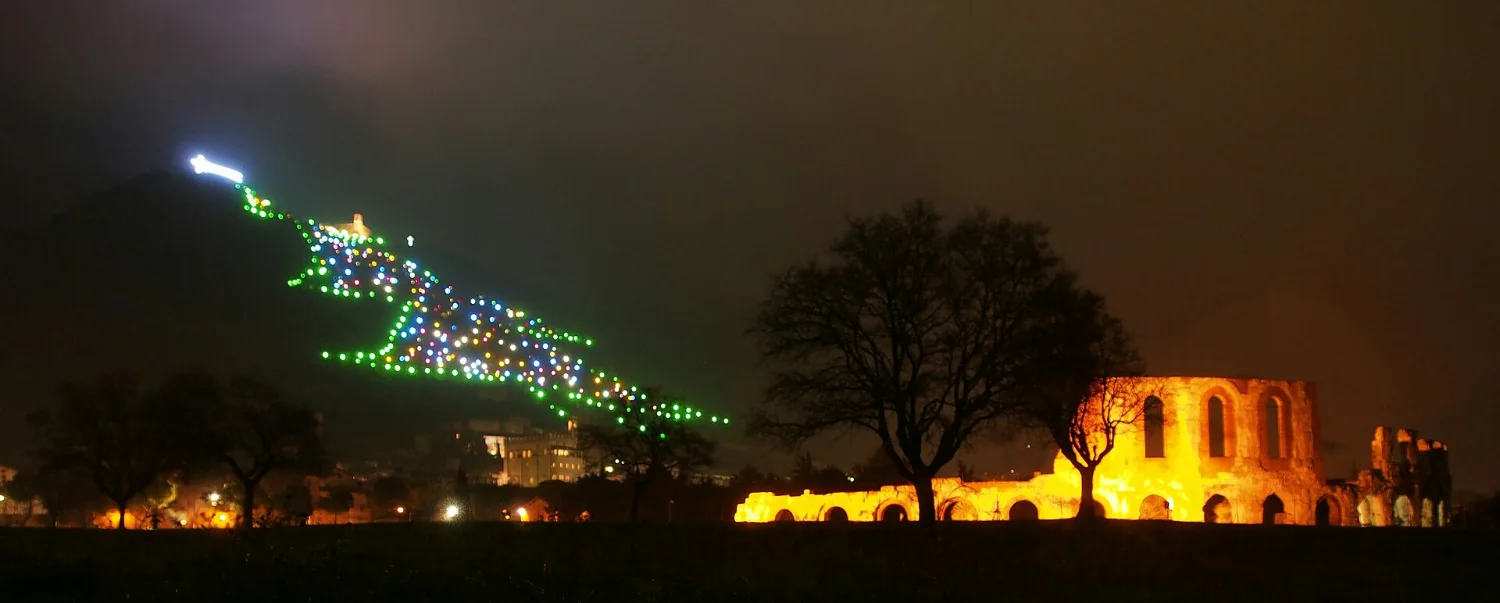
Italy’s record belongs to Gubbio, where since 1981 the slopes of Monte Ingino have lit up with a tree drawn in hundreds of lights. It was first switched on on 24 December 1981 and in 1991 entered the Guinness World Records as the largest Christmas tree in the world: it starts at the medieval walls and climbs more than 750 metres to the Basilica of Sant’Ubaldo, with over eight hundred points of light and a comet star of around a thousand square metres at the top. By tradition it is lit on 7 December, the eve of the Immaculate Conception, and it is run by a committee of volunteers. It is land art before it is decoration: a sign of light that turns the landscape into a stage set.
In Rome, the tree in St Peter’s Square is a tradition begun by John Paul II in 1982, and each year it arrives as a gift from a different region or community, alongside the nativity scene set up in front of the basilica. Its design strength lies entirely in the contrast with Bernini’s colonnade: a natural, vertical and temporary element within the most perfect Baroque architecture in Europe.
In Milan, the tree in Piazza del Duomo changes its staging every year and is the starting point for a tour of the Milan Christmas markets. Standing up to the Gothic façade is demanding, which makes it a good test: when the light is measured, the tree flatters the Candoglia marble instead of competing with it. For more examples of authored light, follow our route through the Christmas light installations in Italy.
What can great public trees teach us about decorating at home?
Three lessons, all of which work in a living room. The first is proportion: a tree should be sized to the space, not to expectations, and leave the walls room to breathe. The second is consistency of light: Trafalgar Square shows that a single colour temperature, warm white, is worth more than a hundred effects. The third is narrative: every successful tree has an idea, whether it is Oslo’s gratitude, the theme at the Galeries Lafayette or the landscape of Gubbio.
Our advice is to choose a few honest materials, wood, glass, paper, metal, and one dominant colour, and let the light do the rest. To turn these ideas into objects, we have selected the best Christmas decoration brands for the 2026 tree.
Frequently asked questions about the most beautiful Christmas tree in the world
What is the largest Christmas tree in the world?
According to Guinness World Records, since 1991 it has been the tree of lights in Gubbio on Monte Ingino, which climbs more than 750 metres from the town walls to the Basilica of Sant’Ubaldo.
When is the Rockefeller Center tree lit?
Traditionally on the Wednesday after Thanksgiving, between late November and early December. The date is announced each year by Rockefeller Center on its website.
Why does the Trafalgar Square tree come from Norway?
Since 1947 Oslo has given it to London as thanks for British support of Norway during the Second World War. It is usually switched on on the first Thursday of December.
When is the Gubbio tree lit?
By tradition on 7 December, the eve of the Immaculate Conception, and it stays lit throughout the Christmas season into January.
Since when has there been a tree in St Peter’s Square?
Since 1982, at the wish of John Paul II. Each year it is donated by a different region or community and stands beside the nativity scene in the square.